Decoding Hyundai Mobis 2025: The Structural Pivot from Hardware Assembler to SDV Mobility Platform
Date : 2026-03-14
Reading : 334
In 2025, Hyundai Mobis delivered a robust financial performance with consolidated revenues reaching $43.0 billion (a 6.8% year-over-year increase) and operating profits climbing to $2.36 billion. However, a superficial reading of these top-line metrics masks a profound paradigm shift. HDIN Research’s comprehensive analysis reveals a company aggressively restructuring its global footprint and reallocating capital to transition from a traditional hardware assembler into a technology-driven, Software-Defined Vehicle (SDV) mobility platform.
The underlying strategic implication is clear: Hyundai Mobis is leveraging its high-margin aftermarket cash-cow to bankroll a massive, high-stakes supply chain reconfiguration aimed at dominating the European and North American electrification markets.
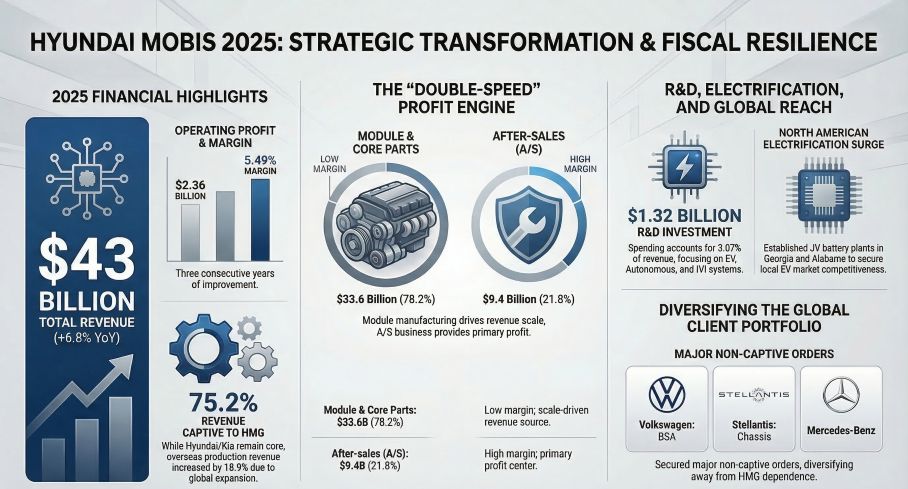
Figure HYUNDAI MOBIS 2025: STRATEGIC TRANSFORMATION & FISCAL RESILIENCE
 Sector Positioning & Structural Profitability
A deep dive into the company’s revenue streams reveals a distinct "dual-speed" profit dynamic. The Module and Core Parts manufacturing division accounted for 78.2% of total revenue ($33.63 billion) but contributed negligibly to the bottom line, reflecting the constrained pricing power typical of a "captive supplier" heavily dependent on its parent group (Hyundai/Kia account for approximately 75.2% of total revenue).
Conversely, the After-Sales (A/S) division, generating 21.8% of revenue ($9.37 billion), functions as the absolute profit engine. Supported by a growing global vehicle fleet and optimized logistics, the A/S segment provides the critical financial ballast required to absorb the heavy R&D and depreciation costs associated with the transition to electrification. While the overall operating margin improved to 5.49%, it remains mid-tier compared to global benchmarks, underscoring the necessity of expanding its non-captive client base to improve gross margins.
Strategic Moats & Supply Chain Reconfiguration
2025 marked a year of decisive geographic recalibration for Hyundai Mobis, characterized by divestments in high-risk regions and aggressive expansion in core strategic markets. Overseas revenue now accounts for 56.2% of the total, driven by a deliberate pivot.
* Strategic Divestment in China: The complete offloading of its Cangzhou subsidiary highlights a strategic retreat from asset-heavy manufacturing in China. This move effectively mitigates exposure to intense local supply chain competition and aligns with a broader de-risking strategy.
* North American & European Expansion: North America emerged as the primary growth engine, fueled by the ramp-up of new facilities like the Alabama chassis module plant supplying Mercedes-Benz. Simultaneously, Hyundai Mobis deepened its European strategic moats by injecting $50.2 million into a Spanish electrified powertrain facility and securing critical Battery System Assembly (BSA) orders from Volkswagen.
This geographic restructuring allows Hyundai Mobis to position itself as a critical, localized Tier-1 integrator for Western OEMs navigating their own EV transitions.
Capital Allocation Efficiency & Technological Investments
Hyundai Mobis continues to exhibit exceptionally prudent capital management, boasting a highly conservative debt-to-asset ratio of just 30.09% and generating $3.14 billion in operating cash flow. This operational efficiency provides a self-funding mechanism for its ambitious R&D and expansion plans, yielding a formidable CFO-to-CAPEX ratio of 3.32x.
Looking ahead, the company has earmarked approximately $1.54 billion for 2026 capital expenditures, heavily weighted toward overseas EV infrastructure. Beyond physical assets, 2025 R&D expenditures reached $1.32 billion (3.07% of revenue). This capital is being deployed to build formidable technical moats in autonomous driving (via its Motional joint venture), ASIL-D certified automotive semiconductors, and its proprietary generative AI service, "MoAI."
Furthermore, the company has aggressively pursued a shareholder "Value-up" program, committing to a Total Shareholder Return (TSR) exceeding 30%, supported by over $437 million in strategic share cancellations in 2025.
Cyclical Headwinds & Market Risks
Despite a robust balance sheet, the company faces notable cyclical headwinds. Capacity utilization in overseas plants currently sits at a low 61.2%, primarily due to the ongoing ramp-up phase of new North American and European EV facilities. Furthermore, a temporary deceleration in global EV demand and persistent inflationary pressures on raw materials (such as aluminum and copper) pose short-to-medium-term threats to profitability.
Additionally, the transition from traditional hardware to an SDV ecosystem requires sustained, heavy capital capitalization. Any further slowdown in the electrification adoption curve could expose the company to asset impairment risks across its newly minted overseas facilities.
HDIN Viewpoint
From the perspective of HDIN Research, Hyundai Mobis is actively rewriting its valuation logic. The market must cease viewing the company merely as a low-growth, high-dividend proxy for the Hyundai Motor Group, and begin evaluating it as an emerging integration leader in semiconductors, robotics, and software platforms.
The successful execution of this pivot hinges entirely on its ability to elevate capacity utilization rates in its newly established Western EV plants and continuously capture non-captive OEM orders. While the short-term margin profile may be pressured by heavy R&D and depreciation, the company's modular integration capabilities and unmatched aftermarket cash flow provide a highly resilient foundation for long-term sector outperformance.
Presentation Download:
Click the PDF download link under “Related Topics” to access the presentation of this report.
Video Analysis:
Click this link to watch the YouTube video.
About HDIN Research:
HDIN Research focuses on providing market consulting services. As an independent third-party consulting firm, it is committed to providing in-depth market research and analysis reports.
Website: www.hdinresearch.com
E-mail: sales@hdinresearch.com
The underlying strategic implication is clear: Hyundai Mobis is leveraging its high-margin aftermarket cash-cow to bankroll a massive, high-stakes supply chain reconfiguration aimed at dominating the European and North American electrification markets.
Figure HYUNDAI MOBIS 2025: STRATEGIC TRANSFORMATION & FISCAL RESILIENCE
Sector Positioning & Structural ProfitabilityA deep dive into the company’s revenue streams reveals a distinct "dual-speed" profit dynamic. The Module and Core Parts manufacturing division accounted for 78.2% of total revenue ($33.63 billion) but contributed negligibly to the bottom line, reflecting the constrained pricing power typical of a "captive supplier" heavily dependent on its parent group (Hyundai/Kia account for approximately 75.2% of total revenue).
Conversely, the After-Sales (A/S) division, generating 21.8% of revenue ($9.37 billion), functions as the absolute profit engine. Supported by a growing global vehicle fleet and optimized logistics, the A/S segment provides the critical financial ballast required to absorb the heavy R&D and depreciation costs associated with the transition to electrification. While the overall operating margin improved to 5.49%, it remains mid-tier compared to global benchmarks, underscoring the necessity of expanding its non-captive client base to improve gross margins.
Strategic Moats & Supply Chain Reconfiguration
2025 marked a year of decisive geographic recalibration for Hyundai Mobis, characterized by divestments in high-risk regions and aggressive expansion in core strategic markets. Overseas revenue now accounts for 56.2% of the total, driven by a deliberate pivot.
* Strategic Divestment in China: The complete offloading of its Cangzhou subsidiary highlights a strategic retreat from asset-heavy manufacturing in China. This move effectively mitigates exposure to intense local supply chain competition and aligns with a broader de-risking strategy.
* North American & European Expansion: North America emerged as the primary growth engine, fueled by the ramp-up of new facilities like the Alabama chassis module plant supplying Mercedes-Benz. Simultaneously, Hyundai Mobis deepened its European strategic moats by injecting $50.2 million into a Spanish electrified powertrain facility and securing critical Battery System Assembly (BSA) orders from Volkswagen.
This geographic restructuring allows Hyundai Mobis to position itself as a critical, localized Tier-1 integrator for Western OEMs navigating their own EV transitions.
Capital Allocation Efficiency & Technological Investments
Hyundai Mobis continues to exhibit exceptionally prudent capital management, boasting a highly conservative debt-to-asset ratio of just 30.09% and generating $3.14 billion in operating cash flow. This operational efficiency provides a self-funding mechanism for its ambitious R&D and expansion plans, yielding a formidable CFO-to-CAPEX ratio of 3.32x.
Looking ahead, the company has earmarked approximately $1.54 billion for 2026 capital expenditures, heavily weighted toward overseas EV infrastructure. Beyond physical assets, 2025 R&D expenditures reached $1.32 billion (3.07% of revenue). This capital is being deployed to build formidable technical moats in autonomous driving (via its Motional joint venture), ASIL-D certified automotive semiconductors, and its proprietary generative AI service, "MoAI."
Furthermore, the company has aggressively pursued a shareholder "Value-up" program, committing to a Total Shareholder Return (TSR) exceeding 30%, supported by over $437 million in strategic share cancellations in 2025.
Cyclical Headwinds & Market Risks
Despite a robust balance sheet, the company faces notable cyclical headwinds. Capacity utilization in overseas plants currently sits at a low 61.2%, primarily due to the ongoing ramp-up phase of new North American and European EV facilities. Furthermore, a temporary deceleration in global EV demand and persistent inflationary pressures on raw materials (such as aluminum and copper) pose short-to-medium-term threats to profitability.
Additionally, the transition from traditional hardware to an SDV ecosystem requires sustained, heavy capital capitalization. Any further slowdown in the electrification adoption curve could expose the company to asset impairment risks across its newly minted overseas facilities.
HDIN Viewpoint
From the perspective of HDIN Research, Hyundai Mobis is actively rewriting its valuation logic. The market must cease viewing the company merely as a low-growth, high-dividend proxy for the Hyundai Motor Group, and begin evaluating it as an emerging integration leader in semiconductors, robotics, and software platforms.
The successful execution of this pivot hinges entirely on its ability to elevate capacity utilization rates in its newly established Western EV plants and continuously capture non-captive OEM orders. While the short-term margin profile may be pressured by heavy R&D and depreciation, the company's modular integration capabilities and unmatched aftermarket cash flow provide a highly resilient foundation for long-term sector outperformance.
Presentation Download:
Click the PDF download link under “Related Topics” to access the presentation of this report.
Video Analysis:
Click this link to watch the YouTube video.
About HDIN Research:
HDIN Research focuses on providing market consulting services. As an independent third-party consulting firm, it is committed to providing in-depth market research and analysis reports.
Website: www.hdinresearch.com
E-mail: sales@hdinresearch.com