Mercedes-Benz 2025 Annual Report Analysis: Navigating Cyclical Headwinds and the SDV Transition
Date : 2026-03-12
Reading : 1115
In 2025, Mercedes-Benz Group navigated a severe stress test characterized by extreme macroeconomic volatility, punitive geopolitical tariff risks, and brutal pricing wars in the Chinese market. While headline figures reflect a contraction—with global revenue declining 9% to $149.48 billion and EBIT dropping 57% to $6.58 billion—these numbers mask a deliberate tactical reset. Rather than engaging in margin-diluting volume battles, Mercedes-Benz leveraged its "Top-End Luxury" strategic moat to defend brand equity, aggressively absorbed $1.83 billion in restructuring costs, and fundamentally shifted its capital allocation efficiency to prepare for the Software-Defined Vehicle (SDV) era.
Figure Mercedes-Benz Group 2025: Resilience in Transition
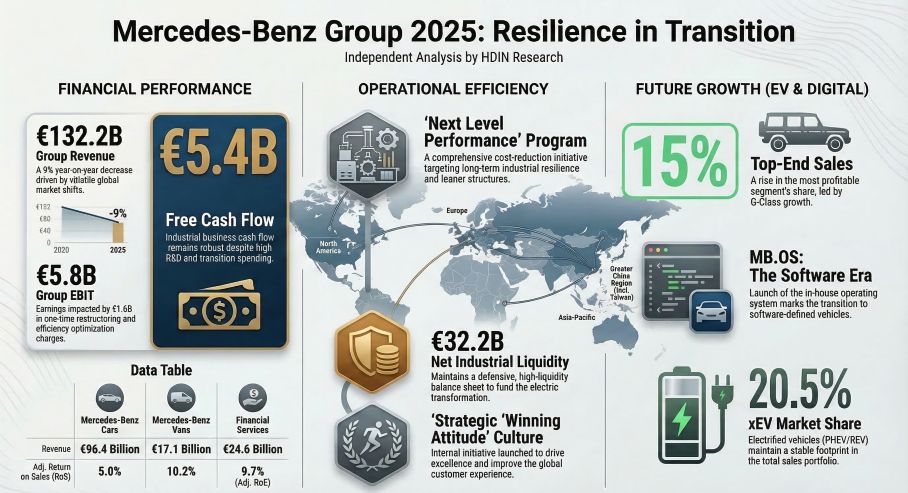 HDIN Research presents a systematic deconstruction of Mercedes-Benz’s 2025 operational and financial architecture, highlighting the strategic implications behind the data.
Sector Positioning: The "Top-End" Strategic Moat
Despite a 9% dip in total passenger car volume (1.8 million units), Mercedes-Benz’s strategic pivot toward high-margin products provided a critical defensive buffer. The Top-End Luxury segment increased its share of total sales to 15%, driven by a formidable 14% volume surge in the iconic G-Class.
The "So What" Factor: In a high-inflation environment where mass-market purchasing power erodes, Mercedes-Benz's Top-End segment acts as an inflation-agnostic profit engine. This deliberate volume-to-value transition is essential for maintaining the group's target Return on Sales (RoS) architecture, shielding the core business from the aggressive margin dilution currently ravaging the broader EV sector.
Financial Health & Capital Allocation Efficiency
A superficial reading of the 57% EBIT plunge suggests operational distress; however, a deep dive into the company’s accounting policies reveals a highly disciplined capital allocation strategy.
In 2025, management executed a "kitchen-sinking" maneuver to clear historical costs at the bottom of the cycle. Notably, the capitalization rate of R&D expenditures was slashed from 43% in 2024 to an ultra-conservative 37%. By directly expensing a larger portion of its $10.94 billion R&D outlay, Mercedes-Benz artificially depressed its 2025 operating profit but significantly enhanced the "quality of earnings" by reducing future amortization burdens.
Coupled with a robust Industrial Free Cash Flow of $6.12 billion and a formidable interest coverage ratio of 36.6x, the group’s balance sheet retains bulletproof liquidity. The financial structure proves that the 2025 earnings contraction is a calculated investment phase rather than a structural failure.
Strategic Pivots: Transitioning to the SDV Era
The most critical inflection point in 2025 was Mercedes-Benz’s formal commercialization of its proprietary MB.OS operating system, debuting on the new MMA architecture (CLA class).
Facing a 29% revenue contraction in the Greater China market (falling to $18.67 billion) due to rapid penetration by domestic EV insurgents, Mercedes-Benz is moving away from traditional hardware premiums. The strategic answer is "Digital Trust" and ecosystem monetization. By integrating customized LLMs (via ByteDance) and localized autonomous driving (via Momenta) in China, and partnering with Nvidia and Google globally, Mercedes-Benz is establishing tech sovereignty.
The "So What" Factor: The brand is transitioning from a cyclical hardware manufacturer to a recurring revenue model. In 2025, "Other Revenue"—which encompasses digital subscriptions and "Digital Extras"—accounted for 13% of total group revenue ($19.42 billion). Winning the SDV race is now the primary lever for reclaiming the premium narrative against tech-centric disruptors.
Industry Outlook & Supply Chain Resilience
Looking ahead to the 2026 guidance, Mercedes-Benz anticipates flat top-line revenue but explicitly lowered its Cars division RoS expectation to the 3%–5% range. This indicates a pragmatic acknowledgment of cyclical headwinds: the company is preparing to absorb the massive upfront R&D costs of its dual-platform strategy (MMA and MB.EA) while fighting for market share in the EV transition.
To mitigate geopolitical fragmentation and tariff vulnerabilities, the group is aggressively deploying a "Local-for-Local" manufacturing footprint. This includes balancing capacities between Europe and North America and embedding human rights and decarbonization audits (like the IRMA standard for battery supply chains) deep into procurement contracts, transforming ESG compliance into a tangible competitive advantage.
HDIN Viewpoint
From the perspective of HDIN Research, Mercedes-Benz’s 2025 performance is a masterclass in cycle management. While the market may penalize the short-term EBIT contraction, institutional observers should recognize this as a period of "tactical retraction." Management is actively bleeding out inefficiencies through the *Next Level Performance* restructuring program and conservative accounting, establishing a leaner baseline for 2026.
The ultimate litmus test for Mercedes-Benz over the next 18 months will not just be EV sales volumes, but the subscription conversion rates of MB.OS and its ability to defend pricing power in China through localized, software-driven premium experiences. Those who execute on capital allocation efficiency during the painful transition phase are the ones who will dictate the luxury architecture of the next decade.
Presentation Download & Media Access
Click the PDF download link under “Related Topics” to access the presentation of this report.
Click this link to watch the YouTube video.
About HDIN Research
HDIN Research focuses on providing market consulting services. As an independent third-party consulting firm, it is committed to providing in-depth market research and analysis reports.
Website: www.hdinresearch.com
E-mail: sales@hdinresearch.com
Figure Mercedes-Benz Group 2025: Resilience in Transition
HDIN Research presents a systematic deconstruction of Mercedes-Benz’s 2025 operational and financial architecture, highlighting the strategic implications behind the data.Sector Positioning: The "Top-End" Strategic Moat
Despite a 9% dip in total passenger car volume (1.8 million units), Mercedes-Benz’s strategic pivot toward high-margin products provided a critical defensive buffer. The Top-End Luxury segment increased its share of total sales to 15%, driven by a formidable 14% volume surge in the iconic G-Class.
The "So What" Factor: In a high-inflation environment where mass-market purchasing power erodes, Mercedes-Benz's Top-End segment acts as an inflation-agnostic profit engine. This deliberate volume-to-value transition is essential for maintaining the group's target Return on Sales (RoS) architecture, shielding the core business from the aggressive margin dilution currently ravaging the broader EV sector.
Financial Health & Capital Allocation Efficiency
A superficial reading of the 57% EBIT plunge suggests operational distress; however, a deep dive into the company’s accounting policies reveals a highly disciplined capital allocation strategy.
In 2025, management executed a "kitchen-sinking" maneuver to clear historical costs at the bottom of the cycle. Notably, the capitalization rate of R&D expenditures was slashed from 43% in 2024 to an ultra-conservative 37%. By directly expensing a larger portion of its $10.94 billion R&D outlay, Mercedes-Benz artificially depressed its 2025 operating profit but significantly enhanced the "quality of earnings" by reducing future amortization burdens.
Coupled with a robust Industrial Free Cash Flow of $6.12 billion and a formidable interest coverage ratio of 36.6x, the group’s balance sheet retains bulletproof liquidity. The financial structure proves that the 2025 earnings contraction is a calculated investment phase rather than a structural failure.
Strategic Pivots: Transitioning to the SDV Era
The most critical inflection point in 2025 was Mercedes-Benz’s formal commercialization of its proprietary MB.OS operating system, debuting on the new MMA architecture (CLA class).
Facing a 29% revenue contraction in the Greater China market (falling to $18.67 billion) due to rapid penetration by domestic EV insurgents, Mercedes-Benz is moving away from traditional hardware premiums. The strategic answer is "Digital Trust" and ecosystem monetization. By integrating customized LLMs (via ByteDance) and localized autonomous driving (via Momenta) in China, and partnering with Nvidia and Google globally, Mercedes-Benz is establishing tech sovereignty.
The "So What" Factor: The brand is transitioning from a cyclical hardware manufacturer to a recurring revenue model. In 2025, "Other Revenue"—which encompasses digital subscriptions and "Digital Extras"—accounted for 13% of total group revenue ($19.42 billion). Winning the SDV race is now the primary lever for reclaiming the premium narrative against tech-centric disruptors.
Industry Outlook & Supply Chain Resilience
Looking ahead to the 2026 guidance, Mercedes-Benz anticipates flat top-line revenue but explicitly lowered its Cars division RoS expectation to the 3%–5% range. This indicates a pragmatic acknowledgment of cyclical headwinds: the company is preparing to absorb the massive upfront R&D costs of its dual-platform strategy (MMA and MB.EA) while fighting for market share in the EV transition.
To mitigate geopolitical fragmentation and tariff vulnerabilities, the group is aggressively deploying a "Local-for-Local" manufacturing footprint. This includes balancing capacities between Europe and North America and embedding human rights and decarbonization audits (like the IRMA standard for battery supply chains) deep into procurement contracts, transforming ESG compliance into a tangible competitive advantage.
HDIN Viewpoint
From the perspective of HDIN Research, Mercedes-Benz’s 2025 performance is a masterclass in cycle management. While the market may penalize the short-term EBIT contraction, institutional observers should recognize this as a period of "tactical retraction." Management is actively bleeding out inefficiencies through the *Next Level Performance* restructuring program and conservative accounting, establishing a leaner baseline for 2026.
The ultimate litmus test for Mercedes-Benz over the next 18 months will not just be EV sales volumes, but the subscription conversion rates of MB.OS and its ability to defend pricing power in China through localized, software-driven premium experiences. Those who execute on capital allocation efficiency during the painful transition phase are the ones who will dictate the luxury architecture of the next decade.
Presentation Download & Media Access
Click the PDF download link under “Related Topics” to access the presentation of this report.
Click this link to watch the YouTube video.
About HDIN Research
HDIN Research focuses on providing market consulting services. As an independent third-party consulting firm, it is committed to providing in-depth market research and analysis reports.
Website: www.hdinresearch.com
E-mail: sales@hdinresearch.com