Kyowa Kirin 2025 Annual Analysis: Forging Strategic Moats in Global Specialty Care Amid Pipeline Reallocations
Date : 2026-03-14
Reading : 91
Kyowa Kirin has officially entered the deep waters of its transformation from a regional Japanese drugmaker into a “Japan-based Global Specialty Pharmaceutical” (J-GSP) enterprise. According to the latest 2025 financial year evaluation by HDIN Research, the company's aggressive geographic restructuring and hyper-focus on high-value biologics have successfully insulated its top line from domestic pricing pressures. However, the abrupt termination of its core immunology asset in early 2026 signals a critical juncture that will test the management’s capital allocation efficiency and M&A agility.
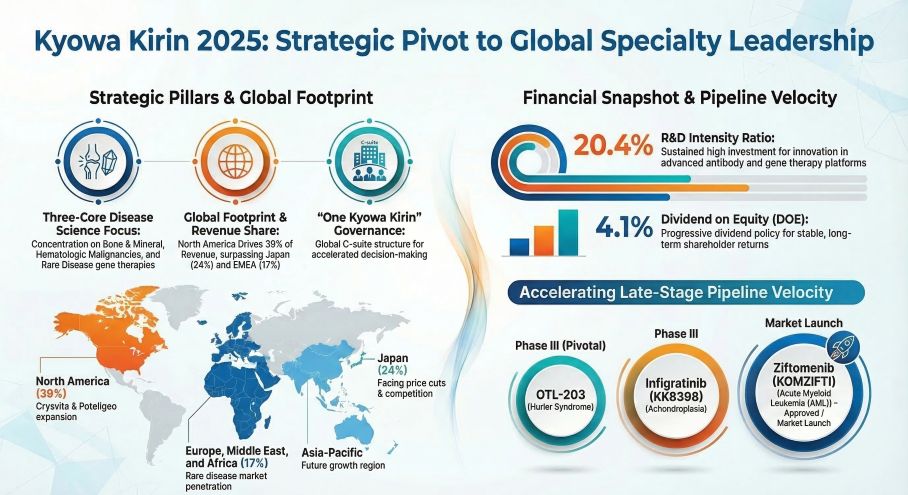
Figure Kyowa Kirin 2025: Strategic Pivot to Global Specialty Leadership
 Financial Health and Capital Allocation Efficiency
For FY2025, Kyowa Kirin recorded robust Core Operating Profit (COP) of approximately $689 million, representing an 8.0% year-over-year increase, despite flat revenue growth at $3.32 billion. The strategic implication here is profound: top-line stagnation was masterfully offset by high-margin technical income—such as royalties from AstraZeneca and licensing milestones from Boehringer Ingelheim—and disciplined SG&A optimization following the Orchard Therapeutics integration.
This margin expansion to 20.7% highlights a resilient underlying business model. Furthermore, the management's transition to a progressive dividend policy, anchored by a rigid Dividend on Equity (DOE) target of over 4%, sends a strong signal to institutional investors: the company intends to protect shareholder returns even amid R&D volatility. Backed by a pristine balance sheet featuring an 80.6% equity ratio and a net D/E ratio consistently below 0.5x, the firm commands substantial dry powder for strategic deployments.
Strategic Moats and Sector Positioning
Kyowa Kirin has successfully constructed an impregnable strategic moat in the rare bone and mineral disease sector. Its flagship asset, Crysvita, generated $1.44 billion in FY2025 (comprising 43.5% of total revenue) and achieved a 100% penetration rate across eight core global markets. Rather than resting on its laurels, the company preemptively extended the product’s lifecycle and patient compliance through the launch of a new subcutaneous syringe formulation.
Simultaneously, the firm is establishing a formidable beachhead in hematologic oncology. The November 2025 FDA approval of Ziftomenib (KOMZIFTI) as a first-in-class oral Menin inhibitor for NPM1-mutant acute myeloid leukemia (AML) provides a highly anticipated growth engine, successfully pivoting the company away from highly commoditized traditional therapies.
Global Supply Chain and JAPAC Strategic Pivots
To support its biologics-heavy pipeline, Kyowa Kirin is undertaking a massive geographical reallocation of capital. The divestiture of its Chinese non-core subsidiary to WinHealth Pharma for approximately $68.3 million exemplifies a McKinsey-style "trimming the fat" approach. By shifting the JAPAC region from a direct-sales model to a high-margin out-licensing structure, the company has freed up operational bandwidth.
This capital has been swiftly redirected toward structural resilience. The company is actively building a “Japan-US” dual-hub manufacturing system, headlined by a $530 million self-funded Capex injection into the Sanford Plant in North Carolina, alongside the newly completed HB7 biologics facility in Takasaki, Japan. This shields the company's supply chain from cyclical geopolitical headwinds while localizing production near its highest-growth North American market.
Cyclical Headwinds and Pipeline Risks
Despite strong operational execution, the firm faces significant cyclical headwinds in its immunology portfolio. The decision in early 2026 to fully terminate all clinical trials for Rocatinlimab represents a severe strategic setback. Running at a high R&D-to-revenue intensity of 20.4%, this single-point failure exposes the inherent risks of a concentrated specialty pipeline and introduces the likelihood of substantial impairment losses in the upcoming fiscal year.
HDIN Viewpoint
From an institutional perspective, HDIN Research views Kyowa Kirin as a fundamentally sound enterprise currently navigating a "repair and reallocate" phase. The J-GSP transformation has successfully uncoupled the company from the drag of Japanese National Health Insurance (NHI) price cuts.
However, realizing the ambitious Vision 2030 target of a 30% operating margin will require aggressive inorganic growth to plug the pipeline vacuum left by Rocatinlimab. Given their substantial cash reserves ($1.46 billion) and highly leveraged multi-modality platforms—including early-stage ADCs and Orchard’s hematopoietic stem cell gene therapy (HSC-GT)—we anticipate that the next 12 to 18 months will be defined by targeted M&A and strategic in-licensing. Investors should closely monitor the commercial ramp-up of Ziftomenib in the US, as it will be the primary litmus test for the firm's near-term earnings resilience.
Presentation Download:
Click the PDF download link under “Related Topics” to access the presentation of this report.
Click this link to watch the YouTube video.
About HDIN Research
Profile: HDIN Research focuses on providing market consulting services. As an independent third-party consulting firm, it is committed to providing in-depth market research and analysis reports.
Website: www.hdinresearch.com
E-mail: sales@hdinresearch.com
Figure Kyowa Kirin 2025: Strategic Pivot to Global Specialty Leadership
Financial Health and Capital Allocation EfficiencyFor FY2025, Kyowa Kirin recorded robust Core Operating Profit (COP) of approximately $689 million, representing an 8.0% year-over-year increase, despite flat revenue growth at $3.32 billion. The strategic implication here is profound: top-line stagnation was masterfully offset by high-margin technical income—such as royalties from AstraZeneca and licensing milestones from Boehringer Ingelheim—and disciplined SG&A optimization following the Orchard Therapeutics integration.
This margin expansion to 20.7% highlights a resilient underlying business model. Furthermore, the management's transition to a progressive dividend policy, anchored by a rigid Dividend on Equity (DOE) target of over 4%, sends a strong signal to institutional investors: the company intends to protect shareholder returns even amid R&D volatility. Backed by a pristine balance sheet featuring an 80.6% equity ratio and a net D/E ratio consistently below 0.5x, the firm commands substantial dry powder for strategic deployments.
Strategic Moats and Sector Positioning
Kyowa Kirin has successfully constructed an impregnable strategic moat in the rare bone and mineral disease sector. Its flagship asset, Crysvita, generated $1.44 billion in FY2025 (comprising 43.5% of total revenue) and achieved a 100% penetration rate across eight core global markets. Rather than resting on its laurels, the company preemptively extended the product’s lifecycle and patient compliance through the launch of a new subcutaneous syringe formulation.
Simultaneously, the firm is establishing a formidable beachhead in hematologic oncology. The November 2025 FDA approval of Ziftomenib (KOMZIFTI) as a first-in-class oral Menin inhibitor for NPM1-mutant acute myeloid leukemia (AML) provides a highly anticipated growth engine, successfully pivoting the company away from highly commoditized traditional therapies.
Global Supply Chain and JAPAC Strategic Pivots
To support its biologics-heavy pipeline, Kyowa Kirin is undertaking a massive geographical reallocation of capital. The divestiture of its Chinese non-core subsidiary to WinHealth Pharma for approximately $68.3 million exemplifies a McKinsey-style "trimming the fat" approach. By shifting the JAPAC region from a direct-sales model to a high-margin out-licensing structure, the company has freed up operational bandwidth.
This capital has been swiftly redirected toward structural resilience. The company is actively building a “Japan-US” dual-hub manufacturing system, headlined by a $530 million self-funded Capex injection into the Sanford Plant in North Carolina, alongside the newly completed HB7 biologics facility in Takasaki, Japan. This shields the company's supply chain from cyclical geopolitical headwinds while localizing production near its highest-growth North American market.
Cyclical Headwinds and Pipeline Risks
Despite strong operational execution, the firm faces significant cyclical headwinds in its immunology portfolio. The decision in early 2026 to fully terminate all clinical trials for Rocatinlimab represents a severe strategic setback. Running at a high R&D-to-revenue intensity of 20.4%, this single-point failure exposes the inherent risks of a concentrated specialty pipeline and introduces the likelihood of substantial impairment losses in the upcoming fiscal year.
HDIN Viewpoint
From an institutional perspective, HDIN Research views Kyowa Kirin as a fundamentally sound enterprise currently navigating a "repair and reallocate" phase. The J-GSP transformation has successfully uncoupled the company from the drag of Japanese National Health Insurance (NHI) price cuts.
However, realizing the ambitious Vision 2030 target of a 30% operating margin will require aggressive inorganic growth to plug the pipeline vacuum left by Rocatinlimab. Given their substantial cash reserves ($1.46 billion) and highly leveraged multi-modality platforms—including early-stage ADCs and Orchard’s hematopoietic stem cell gene therapy (HSC-GT)—we anticipate that the next 12 to 18 months will be defined by targeted M&A and strategic in-licensing. Investors should closely monitor the commercial ramp-up of Ziftomenib in the US, as it will be the primary litmus test for the firm's near-term earnings resilience.
Presentation Download:
Click the PDF download link under “Related Topics” to access the presentation of this report.
Click this link to watch the YouTube video.
About HDIN Research
Profile: HDIN Research focuses on providing market consulting services. As an independent third-party consulting firm, it is committed to providing in-depth market research and analysis reports.
Website: www.hdinresearch.com
E-mail: sales@hdinresearch.com