Beyond Color: How Japan’s Ink Giants Are Pivoting Toward Electronic Materials and Green Packaging in 2025
Date : 2026-03-26
Reading : 177
In the post-pandemic, high-inflation macroeconomic environment, the global ink industry has officially crossed a structural inflection point. Based on a penetrative financial analysis of the FY2025 annual reports from DIC Corporation, Sakata Inx, and artience (formerly Toyo Ink), HDIN Research has identified a definitive paradigm shift: a strategic departure from traditional chemical manufacturing toward high-value electronic and green functional materials. While cyclical headwinds such as the digitization of media and geopolitical friction continue to compress legacy margins, strategic capital allocation and supply chain localization are driving substantial operational resilience among sector leaders.
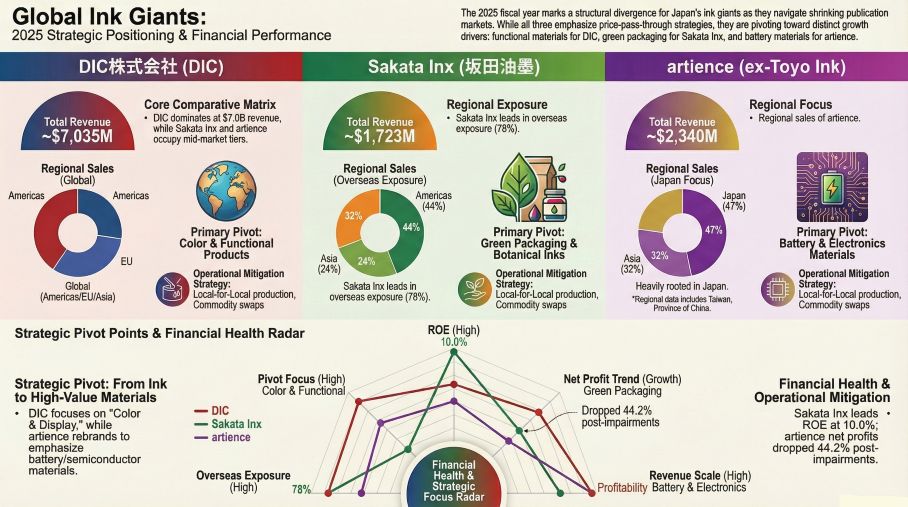
Figure Global Ink Giants 2025: Strategic Positioning & Financial Performance
 Sector Positioning: Building Strategic Moats Through Functionalization
The narrative that "ink is merely color" is entirely obsolete. As structural demand for publication and commercial printing irreversibly declines, the three Japanese giants are leveraging their core dispersion and polymer technologies to build formidable strategic moats in adjacent, high-margin sectors.
Rather than engaging in a race to the bottom in commoditized markets, these players are utilizing legacy packaging inks as "cash cows" to fund aggressive R&D in advanced materials. DIC’s Functional Products division has emerged as its primary profit pool, capitalizing on the AI-driven semiconductor boom via high-performance epoxy resins. Similarly, artience has successfully cross-pollinated its automotive battery CNT (carbon nanotube) conductive paste technologies with its Polymers & Coatings division to create smart, anti-static packaging solutions. Sakata Inx has solidified its defensive positioning by dominating the botanical and green packaging ink space, capturing robust growth in the Americas and emerging Asian markets.
The "So What" Factor: By pivoting R&D from pigment aesthetics to functional performance (e.g., semiconductor photoresists and EV battery materials), these corporations are successfully decoupling their growth trajectories from the structurally declining commercial printing cycle, thereby raising barriers to entry against low-cost regional competitors.
Capital Allocation Efficiency: Scale vs. Agility
A comparative analysis of FY2025 departmental performance reveals diverging approaches to capital efficiency and scale.
* DIC (Absolute Scale & Digital Transformation): With its Packaging & Graphic division generating approximately $3.67 billion in revenue, DIC maintains an absolute scale advantage. Its superior per-capita revenue generation ($351,600) is a direct result of aggressive multinational M&A and a deep penetration into the high-value industrial inkjet (Jet Ink) segment.
* artience (High Cash-to-Profit Matching): Despite flat revenue growth ($1.16 billion in ink-related sectors), artience demonstrated the highest earnings quality, boasting an exceptional operating cash flow to net income match ratio of 2.67x. This indicates highly efficient cash generation, completely devoid of "paper profits."
* Sakata Inx (Overseas Resilience): Sakata Inx exhibited remarkable agility by generating 78.1% of its revenue outside of Japan. By accelerating capital expenditure (CAPEX) in the US and India, the company has effectively fortified its market share in regions with high consumer staples demand.
Navigating Cyclical Headwinds: The "Local-for-Local" Imperative
The macroeconomic operating environment in 2025 presented severe cyclical headwinds, including US tariff uncertainties, Red Sea logistics bottlenecks, and raw material price volatility.
To hedge against these disruptions, HDIN Research notes a collective strategic move toward a "Local-for-Local" supply chain model. By localizing procurement, manufacturing, and R&D within core consumption zones (the Americas, India, and Southeast Asia), companies like Sakata Inx have naturally hedged against currency fluctuations (specifically the weak Yen) and mitigated the impact of soaring ocean freight costs. Furthermore, the strategic deployment of commodity swaps and forward exchange contracts has allowed these firms to lock in material costs, successfully passing inflationary pressures downstream through disciplined pricing strategies.
HDIN Viewpoint: The "Red Flags" in Heavy-Asset Transitions
While the overarching transition to advanced materials is strategically sound, HDIN Research urges institutional investors to carefully monitor the inherent financial risks tied to rapid, heavy-asset diversification.
The transition is not without its casualties. In FY2025, artience recognized a massive $48.59 million impairment loss on its US and Hungarian facilities. This "Big Bath" accounting move highlights the severe friction caused by the sudden deceleration of the global EV market, exposing the risks of premature capacity scaling in battery materials.
Conversely, DIC’s primary red flag lies in delayed impairment recognition. While DIC’s revenues faced downward pressure, its inventory levels surged by 11.6%. Coupled with persistent operating losses in its semiconductor materials (IDC) and Chinese resin subsidiaries, there is a heightened risk of future goodwill impairment if optimistic AI and semiconductor recovery forecasts fail to materialize.
Ultimately, the winner of this decade's ink industry consolidation will not be the company that sells the most volume, but the one that most efficiently reallocates cash flows from legacy printing toward the sustainable, high-margin electronic materials of tomorrow—without overstretching its balance sheet.
Presentation Download & Media Access
* Click the PDF download link under “Related Topics” to access the presentation of this report.
* Click this link to watch the YouTube video.
About HDIN Research
HDIN Research focuses on providing market consulting services. As an independent third-party consulting firm, it is committed to providing in-depth market research and analysis reports.
Website: www.hdinresearch.com
E-mail: sales@hdinresearch.com
Figure Global Ink Giants 2025: Strategic Positioning & Financial Performance
Sector Positioning: Building Strategic Moats Through FunctionalizationThe narrative that "ink is merely color" is entirely obsolete. As structural demand for publication and commercial printing irreversibly declines, the three Japanese giants are leveraging their core dispersion and polymer technologies to build formidable strategic moats in adjacent, high-margin sectors.
Rather than engaging in a race to the bottom in commoditized markets, these players are utilizing legacy packaging inks as "cash cows" to fund aggressive R&D in advanced materials. DIC’s Functional Products division has emerged as its primary profit pool, capitalizing on the AI-driven semiconductor boom via high-performance epoxy resins. Similarly, artience has successfully cross-pollinated its automotive battery CNT (carbon nanotube) conductive paste technologies with its Polymers & Coatings division to create smart, anti-static packaging solutions. Sakata Inx has solidified its defensive positioning by dominating the botanical and green packaging ink space, capturing robust growth in the Americas and emerging Asian markets.
The "So What" Factor: By pivoting R&D from pigment aesthetics to functional performance (e.g., semiconductor photoresists and EV battery materials), these corporations are successfully decoupling their growth trajectories from the structurally declining commercial printing cycle, thereby raising barriers to entry against low-cost regional competitors.
Capital Allocation Efficiency: Scale vs. Agility
A comparative analysis of FY2025 departmental performance reveals diverging approaches to capital efficiency and scale.
* DIC (Absolute Scale & Digital Transformation): With its Packaging & Graphic division generating approximately $3.67 billion in revenue, DIC maintains an absolute scale advantage. Its superior per-capita revenue generation ($351,600) is a direct result of aggressive multinational M&A and a deep penetration into the high-value industrial inkjet (Jet Ink) segment.
* artience (High Cash-to-Profit Matching): Despite flat revenue growth ($1.16 billion in ink-related sectors), artience demonstrated the highest earnings quality, boasting an exceptional operating cash flow to net income match ratio of 2.67x. This indicates highly efficient cash generation, completely devoid of "paper profits."
* Sakata Inx (Overseas Resilience): Sakata Inx exhibited remarkable agility by generating 78.1% of its revenue outside of Japan. By accelerating capital expenditure (CAPEX) in the US and India, the company has effectively fortified its market share in regions with high consumer staples demand.
Navigating Cyclical Headwinds: The "Local-for-Local" Imperative
The macroeconomic operating environment in 2025 presented severe cyclical headwinds, including US tariff uncertainties, Red Sea logistics bottlenecks, and raw material price volatility.
To hedge against these disruptions, HDIN Research notes a collective strategic move toward a "Local-for-Local" supply chain model. By localizing procurement, manufacturing, and R&D within core consumption zones (the Americas, India, and Southeast Asia), companies like Sakata Inx have naturally hedged against currency fluctuations (specifically the weak Yen) and mitigated the impact of soaring ocean freight costs. Furthermore, the strategic deployment of commodity swaps and forward exchange contracts has allowed these firms to lock in material costs, successfully passing inflationary pressures downstream through disciplined pricing strategies.
HDIN Viewpoint: The "Red Flags" in Heavy-Asset Transitions
While the overarching transition to advanced materials is strategically sound, HDIN Research urges institutional investors to carefully monitor the inherent financial risks tied to rapid, heavy-asset diversification.
The transition is not without its casualties. In FY2025, artience recognized a massive $48.59 million impairment loss on its US and Hungarian facilities. This "Big Bath" accounting move highlights the severe friction caused by the sudden deceleration of the global EV market, exposing the risks of premature capacity scaling in battery materials.
Conversely, DIC’s primary red flag lies in delayed impairment recognition. While DIC’s revenues faced downward pressure, its inventory levels surged by 11.6%. Coupled with persistent operating losses in its semiconductor materials (IDC) and Chinese resin subsidiaries, there is a heightened risk of future goodwill impairment if optimistic AI and semiconductor recovery forecasts fail to materialize.
Ultimately, the winner of this decade's ink industry consolidation will not be the company that sells the most volume, but the one that most efficiently reallocates cash flows from legacy printing toward the sustainable, high-margin electronic materials of tomorrow—without overstretching its balance sheet.
Presentation Download & Media Access
* Click the PDF download link under “Related Topics” to access the presentation of this report.
* Click this link to watch the YouTube video.
About HDIN Research
HDIN Research focuses on providing market consulting services. As an independent third-party consulting firm, it is committed to providing in-depth market research and analysis reports.
Website: www.hdinresearch.com
E-mail: sales@hdinresearch.com