Lightwave Logic 2025: Assessing the Strategic Moats and Commercialization Risks of AI Photonics
Date : 2026-03-29
Reading : 92
As the artificial intelligence sector drives unprecedented demand for 800G and 1.6T optical network architectures, Lightwave Logic, Inc. (LWLG) is attempting a critical leap from laboratory research to commercial scale. According to the latest analysis by HDIN Research, the company’s 2025 fiscal year marks a definitive transition toward a "fabless material and IP" business model. Bolstered by a $69 million cash reserve that secures its operational runway through December 2027, the company must now prove that its proprietary Perkinamine® electro-optic (EO) polymers can overcome entrenched manufacturing bottlenecks to capture high-volume foundry orders.
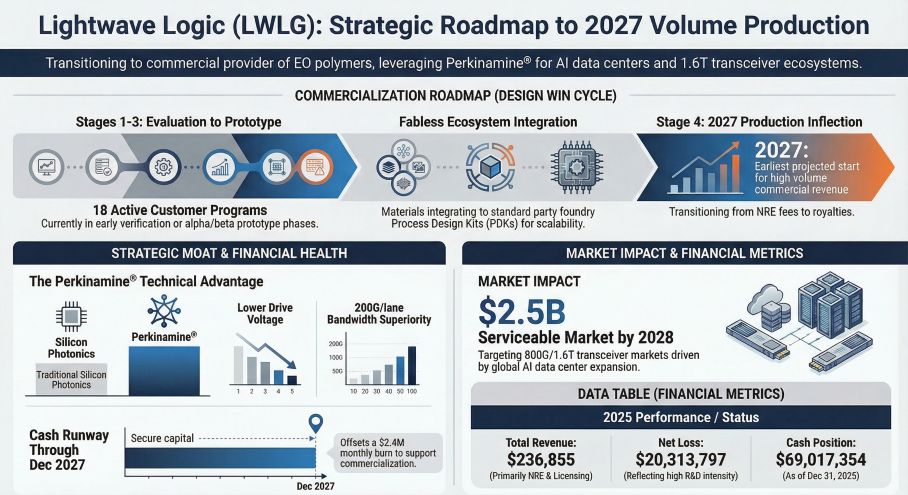
Figure Lightwave Logic (LWLG): Strategic Roadmap to 2027 Volume Production
 Sector Positioning and Strategic Moats
Lightwave Logic’s core competitive advantage lies in the quantified performance metrics of its polymer technology, which is engineered to disrupt traditional Silicon Photonics, Thin-Film Lithium Niobate (TFLN), and Indium Phosphide (InP) platforms. By enabling 200 Gbps-per-lane modulation, the Perkinamine® material directly addresses the power efficiency and latency bottlenecks inherent in hyperscale AI training clusters.
Strategically, the company is building a deep intellectual property moat, boasting 67 granted patents globally—including 45 in the U.S., 12 in the EU, and 5 in China. More importantly, the technology’s compatibility with standard CMOS Back-End-Of-Line (BEOL) processes allows Lightwave Logic to embed its Process Design Kits (PDKs) directly into existing commercial foundry ecosystems. This fabless approach eliminates the need for capital-intensive dedicated production lines, theoretically paving the way for substantial operating leverage once mass commercialization is achieved.
Capital Allocation Efficiency and Financial Health
A structural analysis of Lightwave Logic’s 2025 financials reveals a company navigating the high-cost transition of the "Design Win Cycle." While top-line revenue remains nominal at approximately $236,000 against a net loss of $20.3 million, the composition of this revenue is strategically significant. The recording of $130,000 in Non-Recurring Engineering (NRE) fees and $106,000 in licensing revenue indicates a pivot from pure material sampling to deep client-level architectural integration.
Capital allocation is heavily skewed toward commercial enablement. Management projects monthly cash burn to double to roughly $2.4 million as the company aggressively scales its engineering and foundry integration efforts. However, successful equity offerings in 2025 have fortified the balance sheet. The resulting $69 million in cash and cash equivalents provides a vital, non-dilutive bridge to December 2027—the exact timeline management has targeted for high-volume production revenues.
Cyclical Headwinds and Operational Risks
Despite a compelling technological narrative, the journey from "Phase 3 prototyping" to "Phase 4 mass production" is fraught with operational headwinds. The company currently has 3 projects in the critical Stage 3 validation phase and roughly 15 in earlier assessment stages. The conversion rate of these pipeline projects remains the ultimate test of the company's viability.
Furthermore, HDIN Research has identified several governance and internal control indicators that warrant prudent monitoring. In 2025, the company issued a restatement of historical financials (2021-2024) to correct the accounting of non-cash stock options. Concurrently, board-level adjustments to executive compensation—specifically the conversion of the CEO's Performance Stock Units (PSUs) to standard Restricted Stock Units (RSUs) by removing commercial milestone requirements—signal a defensive governance posture amidst an unpredictable commercialization timeline. Additionally, the company's 100% reliance on ex-U.S. revenue exposes it to geopolitical and export control variables.
The HDIN Viewpoint
Lightwave Logic currently operates in the "valley of death" between technological validation and commercial scale. As an independent third-party consulting firm, HDIN Research views the company's 2027 commercial roadmap as a high-stakes, high-reward proposition. The fundamental bottleneck is not theoretical performance, but mass-production yield. If third-party foundries fail to integrate the polymer material at a sub-$1/Gbps cost threshold, LWLG risks being marginalized by rapidly maturing TFLN and InP alternatives. Investors and supply chain stakeholders must look beyond the macro AI narrative and strictly monitor the translation of the current three Stage-3 prototypes into binding, high-volume production contracts by late 2026.
Presentation Download
Click the PDF download link under “Related Topics” to access the presentation of this report.
Click this link to watch the YouTube video.
About HDIN Research Profile:
HDIN Research focuses on providing market consulting services. As an independent third-party consulting firm, it is committed to providing in-depth market research and analysis reports.
Website: www.hdinresearch.com
E-mail: sales@hdinresearch.com
Figure Lightwave Logic (LWLG): Strategic Roadmap to 2027 Volume Production
Sector Positioning and Strategic MoatsLightwave Logic’s core competitive advantage lies in the quantified performance metrics of its polymer technology, which is engineered to disrupt traditional Silicon Photonics, Thin-Film Lithium Niobate (TFLN), and Indium Phosphide (InP) platforms. By enabling 200 Gbps-per-lane modulation, the Perkinamine® material directly addresses the power efficiency and latency bottlenecks inherent in hyperscale AI training clusters.
Strategically, the company is building a deep intellectual property moat, boasting 67 granted patents globally—including 45 in the U.S., 12 in the EU, and 5 in China. More importantly, the technology’s compatibility with standard CMOS Back-End-Of-Line (BEOL) processes allows Lightwave Logic to embed its Process Design Kits (PDKs) directly into existing commercial foundry ecosystems. This fabless approach eliminates the need for capital-intensive dedicated production lines, theoretically paving the way for substantial operating leverage once mass commercialization is achieved.
Capital Allocation Efficiency and Financial Health
A structural analysis of Lightwave Logic’s 2025 financials reveals a company navigating the high-cost transition of the "Design Win Cycle." While top-line revenue remains nominal at approximately $236,000 against a net loss of $20.3 million, the composition of this revenue is strategically significant. The recording of $130,000 in Non-Recurring Engineering (NRE) fees and $106,000 in licensing revenue indicates a pivot from pure material sampling to deep client-level architectural integration.
Capital allocation is heavily skewed toward commercial enablement. Management projects monthly cash burn to double to roughly $2.4 million as the company aggressively scales its engineering and foundry integration efforts. However, successful equity offerings in 2025 have fortified the balance sheet. The resulting $69 million in cash and cash equivalents provides a vital, non-dilutive bridge to December 2027—the exact timeline management has targeted for high-volume production revenues.
Cyclical Headwinds and Operational Risks
Despite a compelling technological narrative, the journey from "Phase 3 prototyping" to "Phase 4 mass production" is fraught with operational headwinds. The company currently has 3 projects in the critical Stage 3 validation phase and roughly 15 in earlier assessment stages. The conversion rate of these pipeline projects remains the ultimate test of the company's viability.
Furthermore, HDIN Research has identified several governance and internal control indicators that warrant prudent monitoring. In 2025, the company issued a restatement of historical financials (2021-2024) to correct the accounting of non-cash stock options. Concurrently, board-level adjustments to executive compensation—specifically the conversion of the CEO's Performance Stock Units (PSUs) to standard Restricted Stock Units (RSUs) by removing commercial milestone requirements—signal a defensive governance posture amidst an unpredictable commercialization timeline. Additionally, the company's 100% reliance on ex-U.S. revenue exposes it to geopolitical and export control variables.
The HDIN Viewpoint
Lightwave Logic currently operates in the "valley of death" between technological validation and commercial scale. As an independent third-party consulting firm, HDIN Research views the company's 2027 commercial roadmap as a high-stakes, high-reward proposition. The fundamental bottleneck is not theoretical performance, but mass-production yield. If third-party foundries fail to integrate the polymer material at a sub-$1/Gbps cost threshold, LWLG risks being marginalized by rapidly maturing TFLN and InP alternatives. Investors and supply chain stakeholders must look beyond the macro AI narrative and strictly monitor the translation of the current three Stage-3 prototypes into binding, high-volume production contracts by late 2026.
Presentation Download
Click the PDF download link under “Related Topics” to access the presentation of this report.
Click this link to watch the YouTube video.
About HDIN Research Profile:
HDIN Research focuses on providing market consulting services. As an independent third-party consulting firm, it is committed to providing in-depth market research and analysis reports.
Website: www.hdinresearch.com
E-mail: sales@hdinresearch.com