2025 Global Vaccine Sector Outlook: Strategic Moats, Tech Singularities, and Capital Allocation Shifts
Date : 2026-03-31
Reading : 237
The global vaccine industry in 2025 has decisively transitioned from post-pandemic volume expansion into a hyper-competitive era of technological Darwinism. While the "Big Four" (GSK, Merck, Pfizer, Sanofi) continue to command roughly 80% of the global market share, the underlying architecture of their Strategic Moats is facing unprecedented disruption. HDIN Research's latest financial penetration analysis reveals that the rapid compression of R&D cycles, driven by mRNA platforms, combined with severe Cyclical Headwinds from global pricing policies, is forcing a radical reassessment of Sector Positioning and Capital Allocation Efficiency across the board.
Rather than competing purely on scale, the industry's leaders and emerging Asian challengers are now battling over generational technology leaps and agile supply chain resilience.
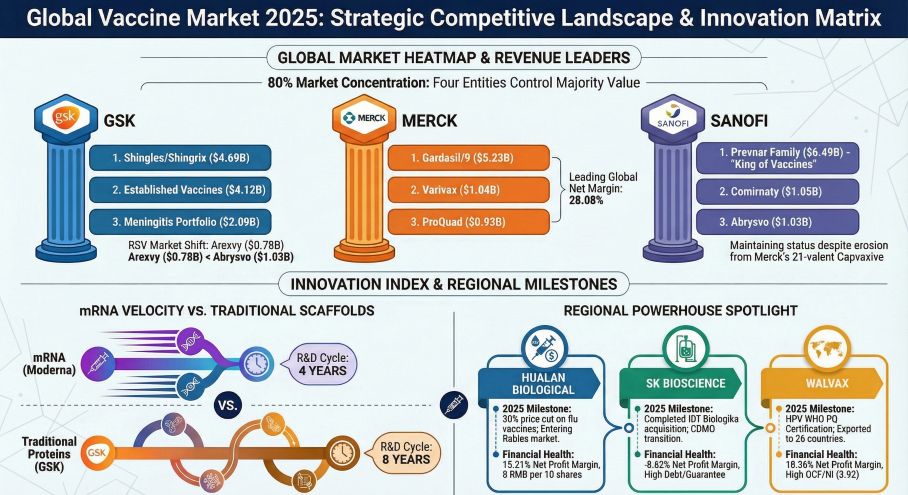
Figure Global Vaccine Market 2025: Strategic Competitive Landscape & Innovation Matrix
 The Technology Singularity: Redrawing Strategic Moats
In 2025, the spillover effect of mRNA technology has triggered a "technology singularity" in the vaccine space, fundamentally altering the traditional R&D timeline. While legacy protein-based platforms historically required up to eight years for product development, companies leveraging mRNA platforms are now commercializing novel vaccines in half that time. This compressed innovation cycle is actively eroding the defensive perimeters of incumbent market leaders.
Furthermore, the race toward high-valent and combination vaccines is separating the market into distinct tiers of competitiveness. In the pneumococcal sector, Merck’s launch of its 21-valent vaccine (Capvaxive) represents a generational leap. By specifically targeting adult indications, Merck generated a massive $759 million revenue surge from this single asset in 2025, actively cannibalizing Pfizer’s legacy Prevnar franchise. Similarly, the respiratory syncytial virus (RSV) market is witnessing rapid commercial maneuvering; Pfizer’s Abrysvo capitalized on a dual-indication strategy (adults and maternal) to overtake GSK's first-to-market Arexvy in absolute annual revenue, demonstrating that superior lifecycle management can outmaneuver initial launch advantages.
Cyclical Headwinds and Geographic Value Destruction
Global biopharma players are currently navigating the most restrictive pricing environment in modern history. In mature markets, the United States' Inflation Reduction Act (IRA) and Most Favored Nation (MFN) policies are enforcing unprecedented pricing transparency, directly capping the margin potential of blockbuster assets and severely limiting commercial flexibility.
Simultaneously, the Chinese market is experiencing severe value destruction driven by Group Purchasing Organizations (GPO) and intense domestic price wars. Merck’s Gardasil franchise—long considered an impenetrable monopoly—suffered a staggering 39% global revenue contraction in 2025. This was primarily triggered by commercial inventory adjustments in China and aggressive domestic substitution from local players like Walvax Biotechnology. Domestic players are not immune to these Cyclical Headwinds, either. Overreliance on single products in a commoditized market has proven dangerous; Hualan Vaccine, heavily dependent on the domestic flu vaccine market, was forced to slash prices by 30%, triggering margin erosion and highlighting the severe risks of concentrated product portfolios.
Capital Allocation Efficiency: The Shift to Smart Capacity and M&A
As organic growth slows, Capital Allocation Efficiency has emerged as the ultimate differentiator between industry leaders and laggards. In 2025, Capital Expenditure (CapEx) has decidedly pivoted away from sheer bioreactor volume expansion toward "smart capacity"—AI-driven manufacturing and flexible mRNA infrastructure. GSK and Pfizer have committed billions to digital enablement and automated supply networks to structurally lower operating expenses.
On the Mergers and Acquisitions (M&A) front, the prevailing strategy is targeted pipeline augmentation over capacity acquisition. Sanofi’s $8.5 billion acquisition of Blueprint Medicines underscores a calculated urgency to acquire external innovation to defend future revenues. Conversely, aggressive inorganic expansion into Contract Development and Manufacturing (CDMO) carries severe margin risks. SK Bioscience's acquisition-heavy pivot into global CDMO operations yielded a superficial 143.5% top-line growth, but the integration costs and idle capacity burdens caused its gross margins to plummet to an unsustainable 11.66%, exposing the fragility of scaling without immediate demand.
HDIN Viewpoint: Institutional Perspective on Financial Resilience
From an institutional advisory perspective, HDIN Research assesses that Sector Positioning in 2025 requires a delicate balance between R&D aggression and balance sheet preservation. GSK and Merck have successfully widened their strategic moats—GSK through a structural pivot toward specialty medicines (now 41.2% of revenue) and Merck through rigorous manufacturing optimization that extends the commercial lifespan of its key assets.
However, investors must exercise extreme caution regarding financial manipulation points among mid-tier and emerging players. Our cross-auditing highlights significant red flags: Walvax Biotechnology’s aggressive R&D capitalization rate (23.42%) mathematically obscures deep profitability pressures, masking the true impact of domestic price wars. Meanwhile, Hualan Vaccine’s ballooning accounts receivable—accounting for nearly 20% of its total assets and exceeding its annual revenue—suggests severe channel stuffing or deteriorating collection capabilities. Moving forward, the true winners will be those who successfully export their technological platforms to emerging markets (such as GAVI/UNICEF tenders) to offset domestic margin compression, executing global expansion without compromising their baseline financial health.
Presentation Download & Media Access
Click the PDF download link under “Related Topics” to access the presentation of this report.
Click this link to watch the YouTube video discussing our strategic findings.
About HDIN Research
About HDIN Research Profile: HDIN Research focuses on providing market consulting services. As an independent third-party consulting firm, it is committed to providing in-depth market research and analysis reports.
Website: www.hdinresearch.com
E-mail: sales@hdinresearch.com
Rather than competing purely on scale, the industry's leaders and emerging Asian challengers are now battling over generational technology leaps and agile supply chain resilience.
Figure Global Vaccine Market 2025: Strategic Competitive Landscape & Innovation Matrix
The Technology Singularity: Redrawing Strategic MoatsIn 2025, the spillover effect of mRNA technology has triggered a "technology singularity" in the vaccine space, fundamentally altering the traditional R&D timeline. While legacy protein-based platforms historically required up to eight years for product development, companies leveraging mRNA platforms are now commercializing novel vaccines in half that time. This compressed innovation cycle is actively eroding the defensive perimeters of incumbent market leaders.
Furthermore, the race toward high-valent and combination vaccines is separating the market into distinct tiers of competitiveness. In the pneumococcal sector, Merck’s launch of its 21-valent vaccine (Capvaxive) represents a generational leap. By specifically targeting adult indications, Merck generated a massive $759 million revenue surge from this single asset in 2025, actively cannibalizing Pfizer’s legacy Prevnar franchise. Similarly, the respiratory syncytial virus (RSV) market is witnessing rapid commercial maneuvering; Pfizer’s Abrysvo capitalized on a dual-indication strategy (adults and maternal) to overtake GSK's first-to-market Arexvy in absolute annual revenue, demonstrating that superior lifecycle management can outmaneuver initial launch advantages.
Cyclical Headwinds and Geographic Value Destruction
Global biopharma players are currently navigating the most restrictive pricing environment in modern history. In mature markets, the United States' Inflation Reduction Act (IRA) and Most Favored Nation (MFN) policies are enforcing unprecedented pricing transparency, directly capping the margin potential of blockbuster assets and severely limiting commercial flexibility.
Simultaneously, the Chinese market is experiencing severe value destruction driven by Group Purchasing Organizations (GPO) and intense domestic price wars. Merck’s Gardasil franchise—long considered an impenetrable monopoly—suffered a staggering 39% global revenue contraction in 2025. This was primarily triggered by commercial inventory adjustments in China and aggressive domestic substitution from local players like Walvax Biotechnology. Domestic players are not immune to these Cyclical Headwinds, either. Overreliance on single products in a commoditized market has proven dangerous; Hualan Vaccine, heavily dependent on the domestic flu vaccine market, was forced to slash prices by 30%, triggering margin erosion and highlighting the severe risks of concentrated product portfolios.
Capital Allocation Efficiency: The Shift to Smart Capacity and M&A
As organic growth slows, Capital Allocation Efficiency has emerged as the ultimate differentiator between industry leaders and laggards. In 2025, Capital Expenditure (CapEx) has decidedly pivoted away from sheer bioreactor volume expansion toward "smart capacity"—AI-driven manufacturing and flexible mRNA infrastructure. GSK and Pfizer have committed billions to digital enablement and automated supply networks to structurally lower operating expenses.
On the Mergers and Acquisitions (M&A) front, the prevailing strategy is targeted pipeline augmentation over capacity acquisition. Sanofi’s $8.5 billion acquisition of Blueprint Medicines underscores a calculated urgency to acquire external innovation to defend future revenues. Conversely, aggressive inorganic expansion into Contract Development and Manufacturing (CDMO) carries severe margin risks. SK Bioscience's acquisition-heavy pivot into global CDMO operations yielded a superficial 143.5% top-line growth, but the integration costs and idle capacity burdens caused its gross margins to plummet to an unsustainable 11.66%, exposing the fragility of scaling without immediate demand.
HDIN Viewpoint: Institutional Perspective on Financial Resilience
From an institutional advisory perspective, HDIN Research assesses that Sector Positioning in 2025 requires a delicate balance between R&D aggression and balance sheet preservation. GSK and Merck have successfully widened their strategic moats—GSK through a structural pivot toward specialty medicines (now 41.2% of revenue) and Merck through rigorous manufacturing optimization that extends the commercial lifespan of its key assets.
However, investors must exercise extreme caution regarding financial manipulation points among mid-tier and emerging players. Our cross-auditing highlights significant red flags: Walvax Biotechnology’s aggressive R&D capitalization rate (23.42%) mathematically obscures deep profitability pressures, masking the true impact of domestic price wars. Meanwhile, Hualan Vaccine’s ballooning accounts receivable—accounting for nearly 20% of its total assets and exceeding its annual revenue—suggests severe channel stuffing or deteriorating collection capabilities. Moving forward, the true winners will be those who successfully export their technological platforms to emerging markets (such as GAVI/UNICEF tenders) to offset domestic margin compression, executing global expansion without compromising their baseline financial health.
Presentation Download & Media Access
Click the PDF download link under “Related Topics” to access the presentation of this report.
Click this link to watch the YouTube video discussing our strategic findings.
About HDIN Research
About HDIN Research Profile: HDIN Research focuses on providing market consulting services. As an independent third-party consulting firm, it is committed to providing in-depth market research and analysis reports.
Website: www.hdinresearch.com
E-mail: sales@hdinresearch.com