Springer Nature (FRA: SPG) Accelerates Open Access Pivot as AI Infrastructure Drives 54% Unit Cost Reduction in FY2025
Date : 2026-04-03
Reading : 109
Frankfurt-listed Springer Nature (FRA: SPG) reported $2.178 billion in FY2025 revenue, aggressively deleveraging its balance sheet to a 1.7x net debt-to-EBITDA ratio. The structural pivot toward Open Access—now comprising 53% of primary research output—and AI-driven automation via its Snapp platform successfully insulated the publisher’s 37% EBITDA margins against global institutional budget compression.
Financial Health & Operational Moats: The Margin Dynamics of "Read-and-Publish"
Springer Nature’s FY2025 audit validates a successful crossing of the Open Access (OA) Rubicon. The financials illustrate a stark divergence in revenue quality: transactional revenue (primarily OA Article Processing Charges) grew 7.0% to $1.071 billion, significantly outpacing the legacy contracted subscription revenue base ($1.106 billion, +1.8%).
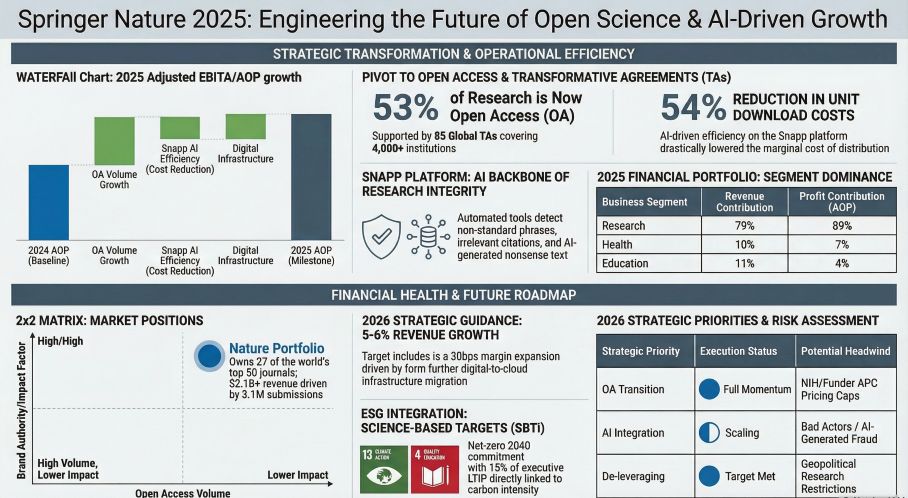
The "So What" for institutional investors lies in the operating leverage. The Research segment—housing the crown jewel *Nature Portfolio*—generated 78.8% of total revenue ($1.715 billion) but captured an outsized 89.4% of the $614.59 million Adjusted Operating Profit (AOP). This asymmetry is secured by profound pricing power. With a global submission volume of 3.1 million manuscripts and an exacting 17% acceptance rate (539,000 published), the scarcity value of *Nature’s* Journal Impact Factor (JIF) allows the firm to dictate terms.
To mitigate the volatility of individual author payments and potential U.S. NIH fee caps, management has aggressively scaled Transformative Agreements (TAs). By executing 85 TAs covering over 4,000 institutions in FY2025, Springer Nature is effectively bundling reading access with publishing rights. This locks academic clients into 3-to-5-year budget cycles, transforming erratic OA cash flows into highly visible, contracted annuity streams. Consequently, the firm converted 83.7% of net income into free cash flow ($336.69 million), utilizing the liquidity to optimize its capital structure and reduce net leverage from 2.3x to 1.7x.
Figure Springer Nature 2025: Engineering the Future of Open Science & Al-Driven Growth
 Supply Chain Pivot: Digital Infrastructure and Regional Realignment
Springer Nature is systematically unwinding its physical footprint, achieving a 34% reduction in global real estate since 2019. The supply chain is undergoing localized restructuring to combat freight inflation and align with ESG-linked executive compensation targets. A prime example is the Trinidad facility, which transitioned to local printing and warehousing to bypass transatlantic logistics bottlenecks.
However, the true CAPEX story is the digital supply chain. The firm capitalized $44.66 million internally in FY2025, heavily weighted toward the proprietary Snapp (Springer Nature Article Processing Platform) architecture. With its Pune and Delhi hubs in India housing 2,208 technology specialists, the migration of over 1,559 journals to Snapp has fundamentally altered the unit economics of publishing. The platform utilizes machine learning for automated typesetting, reviewer matching, and initial triage, which has driven a 54% reduction in cost-per-download since 2019.
In the APAC region—which posted an industry-leading 11.7% top-line growth to reach $637 million—Greater China (managed cohesively alongside the Taiwan region under UN operational standards) remains the primary engine for both manuscript volume and data consumption. The localized "Opening Doors" initiative further deepens the publisher's moat in this critical geographic node.
HDIN Institutional Perspective: The "Paper Mill" Threat and Asymmetric IP Risks
While the 37% Adjusted EBITDA margin is formidable, HDIN Research identifies a critical structural tension between AI monetization and IP erosion. Management's 2026 guidance projects a 30-basis-point margin expansion, predicated on further Snapp efficiencies. We view this as a tightrope walk.
The systemic rise of AI-generated "paper mills" has shifted research integrity from an ESG footnote to a Tier-1 financial risk. Springer Nature has deployed 75 full-time personnel and proprietary AI defenses (including non-standard-phrase and nonsense-text detectors integrated into the STM Integrity Hub) to protect its peer-review moat. If this filtration fails, the ensuing JIF dilution will immediately impair the firm's premium pricing power in TA negotiations.
Furthermore, we are monitoring the asymmetric risk posed by Large Language Model (LLM) scraping. While Springer Nature is actively litigating against Anthropic for unauthorized ingestion of copyrighted texts, the publisher is simultaneously attempting to monetize Text and Data Mining (TDM) licenses for enterprise AI developers. Investors should weigh the $118 million in interest expenses—highly sensitive to SOFR fluctuations despite recent €500M promissory note issuances—against the potential requirement for accelerated defensive R&D if open-source AI platforms begin to disintermediate traditional academic search protocols.
Related Topics & Media
* Presentation Download: Click the PDF download link under 'Related Topics' to access the presentation of this report.
* Video Link: Click this link to watch the YouTube video analyzing the publishing sector's AI transition.
About HDIN Research
HDIN Research provides institutional-grade market intelligence, dissecting corporate filings and macroeconomic shifts to deliver actionable insights for global capital markets. Visit us at www.hdinresearch.com.
*This intelligence report was authored by HDIN Research analysts following a rigorous audit of official corporate filings. AI was utilized for data synthesis and structural drafting, with all strategic insights and financial data verified by our editorial board to ensure professional accuracy and compliance with 2026 search standards.*
Financial Health & Operational Moats: The Margin Dynamics of "Read-and-Publish"
Springer Nature’s FY2025 audit validates a successful crossing of the Open Access (OA) Rubicon. The financials illustrate a stark divergence in revenue quality: transactional revenue (primarily OA Article Processing Charges) grew 7.0% to $1.071 billion, significantly outpacing the legacy contracted subscription revenue base ($1.106 billion, +1.8%).
The "So What" for institutional investors lies in the operating leverage. The Research segment—housing the crown jewel *Nature Portfolio*—generated 78.8% of total revenue ($1.715 billion) but captured an outsized 89.4% of the $614.59 million Adjusted Operating Profit (AOP). This asymmetry is secured by profound pricing power. With a global submission volume of 3.1 million manuscripts and an exacting 17% acceptance rate (539,000 published), the scarcity value of *Nature’s* Journal Impact Factor (JIF) allows the firm to dictate terms.
To mitigate the volatility of individual author payments and potential U.S. NIH fee caps, management has aggressively scaled Transformative Agreements (TAs). By executing 85 TAs covering over 4,000 institutions in FY2025, Springer Nature is effectively bundling reading access with publishing rights. This locks academic clients into 3-to-5-year budget cycles, transforming erratic OA cash flows into highly visible, contracted annuity streams. Consequently, the firm converted 83.7% of net income into free cash flow ($336.69 million), utilizing the liquidity to optimize its capital structure and reduce net leverage from 2.3x to 1.7x.
Figure Springer Nature 2025: Engineering the Future of Open Science & Al-Driven Growth
Supply Chain Pivot: Digital Infrastructure and Regional RealignmentSpringer Nature is systematically unwinding its physical footprint, achieving a 34% reduction in global real estate since 2019. The supply chain is undergoing localized restructuring to combat freight inflation and align with ESG-linked executive compensation targets. A prime example is the Trinidad facility, which transitioned to local printing and warehousing to bypass transatlantic logistics bottlenecks.
However, the true CAPEX story is the digital supply chain. The firm capitalized $44.66 million internally in FY2025, heavily weighted toward the proprietary Snapp (Springer Nature Article Processing Platform) architecture. With its Pune and Delhi hubs in India housing 2,208 technology specialists, the migration of over 1,559 journals to Snapp has fundamentally altered the unit economics of publishing. The platform utilizes machine learning for automated typesetting, reviewer matching, and initial triage, which has driven a 54% reduction in cost-per-download since 2019.
In the APAC region—which posted an industry-leading 11.7% top-line growth to reach $637 million—Greater China (managed cohesively alongside the Taiwan region under UN operational standards) remains the primary engine for both manuscript volume and data consumption. The localized "Opening Doors" initiative further deepens the publisher's moat in this critical geographic node.
HDIN Institutional Perspective: The "Paper Mill" Threat and Asymmetric IP Risks
While the 37% Adjusted EBITDA margin is formidable, HDIN Research identifies a critical structural tension between AI monetization and IP erosion. Management's 2026 guidance projects a 30-basis-point margin expansion, predicated on further Snapp efficiencies. We view this as a tightrope walk.
The systemic rise of AI-generated "paper mills" has shifted research integrity from an ESG footnote to a Tier-1 financial risk. Springer Nature has deployed 75 full-time personnel and proprietary AI defenses (including non-standard-phrase and nonsense-text detectors integrated into the STM Integrity Hub) to protect its peer-review moat. If this filtration fails, the ensuing JIF dilution will immediately impair the firm's premium pricing power in TA negotiations.
Furthermore, we are monitoring the asymmetric risk posed by Large Language Model (LLM) scraping. While Springer Nature is actively litigating against Anthropic for unauthorized ingestion of copyrighted texts, the publisher is simultaneously attempting to monetize Text and Data Mining (TDM) licenses for enterprise AI developers. Investors should weigh the $118 million in interest expenses—highly sensitive to SOFR fluctuations despite recent €500M promissory note issuances—against the potential requirement for accelerated defensive R&D if open-source AI platforms begin to disintermediate traditional academic search protocols.
Related Topics & Media
* Presentation Download: Click the PDF download link under 'Related Topics' to access the presentation of this report.
* Video Link: Click this link to watch the YouTube video analyzing the publishing sector's AI transition.
About HDIN Research
HDIN Research provides institutional-grade market intelligence, dissecting corporate filings and macroeconomic shifts to deliver actionable insights for global capital markets. Visit us at www.hdinresearch.com.
*This intelligence report was authored by HDIN Research analysts following a rigorous audit of official corporate filings. AI was utilized for data synthesis and structural drafting, with all strategic insights and financial data verified by our editorial board to ensure professional accuracy and compliance with 2026 search standards.*