Humanoid Robotics 2025: Unitree and UBTECH Cross Mass-Production Threshold as Embodied AI Drives Structural R&D Dilution
Date : 2026-04-17
Reading : 335
The global robotics sector reached a definitive structural inflection point in 2025, pivoting from deterministic mechanical execution to AI-driven embodied intelligence. Analysis of FY2025 operational data for industry leaders—Unitree, UBTECH, and Dobot—reveals a fracturing of the "Time-to-Market" (TTM) paradigm. While industrial incumbents maintain absolute revenue dominance, humanoid "challengers" have successfully transitioned from lab prototypes to volume-based commercialization, driven by Vision-Language-Action (VLA) models and aggressive vertical integration. This shift is algorithmically diluting R&D-to-revenue ratios, signaling the end of the pre-commercialization "hardware over-engineering" phase.
I. Financial Divergence: "Quality" Growth vs. "Empty" Scaling
The 2025 fiscal landscape demonstrates a sharp polarization between agile, product-driven models and heavy, solution-oriented frameworks.
Figure 2026 Global Humanoid Robotics Strategic Landscape
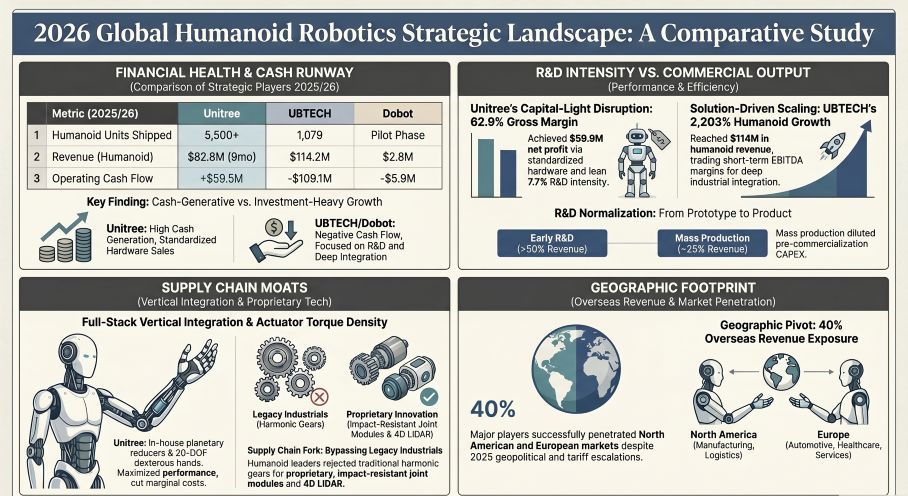
Unitree (The Scale Disruptor): Achieved global leadership in humanoid shipments, delivering over 5,500 units in 2025. Its "smartphone-velocity" iteration cycle (6–9 months) and verticalized supply chain produced an exceptional 62.91% gross margin on humanoids.
UBTECH (The Enterprise Heavyweight): Revenue grew 53.3%, powered by a 2,203.7% surge in humanoid sales to automotive giants like Zeekr and Audi. However, its model faces "empty growth" risks; negative OCF indicates a reliance on external capital despite top-line scaling.
II. The "Supply Chain Fork": Rejecting Legacy Components
A critical finding in the 2025 audit is the humanoid sector's rejection of traditional industrial supply chains. Humanoids require high-dynamic locomotion (impact resistance) rather than the fixed-base rigidity of traditional KUKA or Dobot arms.
Proprietary Actuation: Unitree independently developed planetary reducers with optimized tooth profiles to withstand ground-impact forces that would shatter standard harmonic gears.
Vertical Integration as a Moat: By manufacturing motors, 4D LiDAR, and 20-DOF dexterous hands in-house, Unitree reduced the base price of its R1 humanoid to an unprecedented $4,160 (RMB 29,900).
The "One Brain, Multiple Bodies" Strategy: Dobot is bridging the gap by applying its 0.1N-level high-precision force control IP across cobots, wheeled humanoids (ATOM-W), and quadrupeds (Rover X1).
III. Strategic Analysis: Navigating the "Ceilings" of 2026
Despite technical breakthroughs, the industry faces three structural constraints (the "External, Internal, and Cost Ceilings"):
Geopolitical Vulnerability: Overseas revenue accounts for 39.2% of Unitree's main business. Potential US tariff escalations or restricted procurement lists remain primary macroeconomic risks.
The Safety Certification Gap: While cobots operate under mature ISO/TS 15066 standards, humanoids currently operate in a regulatory vacuum. UBTECH has proactively led the drafting of China’s first national standards for humanoid navigation and task operation to lower this barrier to entry.
Data Scarcity vs. Generalization: The transition from "lab prototypes" to "factory workers" requires massive high-quality industrial data. UBTECH is leveraging Sim2Real simulation and multi-modal data centers to gather tens of millions of industry data points annually.
HDIN Institutional Perspective
The humanoid robotics sector has successfully decoupled the "Brain" (Cognitive Reasoning) from the "Body" (Motion Control). While legacy manufacturers like KUKA are slowly integrating AI software, Unitree has essentially commoditized the hardware layer. UBTECH’s strategy of embedding humanoids into automotive production workflows represents the first viable path to Industrial ROI, but its financial sustainability depends on converting "solution-heavy" contracts into high-margin recurring revenue. Investors should monitor inventory obsolescence risks; the 12–18 month iteration cycle renders older hardware generations obsolete at a rate comparable to consumer electronics.
Presentation Download: Click the PDF download link under "Related Topics" to access the full presentation of this report.
Video Link: Click this link to watch the YouTube video.
About HDIN Research:
HDIN Research provides independent, data-driven analysis of emerging technology sectors and global manufacturing cycles.
This intelligence report was authored by HDIN Research analysts following a rigorous audit of official corporate filings from KUKA, Unitree, UBTECH, and Dobot. AI was utilized for data synthesis and structural drafting, with all strategic insights and financial data verified by our editorial board to ensure professional accuracy and compliance with 2026 search standards.
I. Financial Divergence: "Quality" Growth vs. "Empty" Scaling
The 2025 fiscal landscape demonstrates a sharp polarization between agile, product-driven models and heavy, solution-oriented frameworks.
Figure 2026 Global Humanoid Robotics Strategic Landscape
Unitree (The Scale Disruptor): Achieved global leadership in humanoid shipments, delivering over 5,500 units in 2025. Its "smartphone-velocity" iteration cycle (6–9 months) and verticalized supply chain produced an exceptional 62.91% gross margin on humanoids.
UBTECH (The Enterprise Heavyweight): Revenue grew 53.3%, powered by a 2,203.7% surge in humanoid sales to automotive giants like Zeekr and Audi. However, its model faces "empty growth" risks; negative OCF indicates a reliance on external capital despite top-line scaling.
II. The "Supply Chain Fork": Rejecting Legacy Components
A critical finding in the 2025 audit is the humanoid sector's rejection of traditional industrial supply chains. Humanoids require high-dynamic locomotion (impact resistance) rather than the fixed-base rigidity of traditional KUKA or Dobot arms.
Proprietary Actuation: Unitree independently developed planetary reducers with optimized tooth profiles to withstand ground-impact forces that would shatter standard harmonic gears.
Vertical Integration as a Moat: By manufacturing motors, 4D LiDAR, and 20-DOF dexterous hands in-house, Unitree reduced the base price of its R1 humanoid to an unprecedented $4,160 (RMB 29,900).
The "One Brain, Multiple Bodies" Strategy: Dobot is bridging the gap by applying its 0.1N-level high-precision force control IP across cobots, wheeled humanoids (ATOM-W), and quadrupeds (Rover X1).
III. Strategic Analysis: Navigating the "Ceilings" of 2026
Despite technical breakthroughs, the industry faces three structural constraints (the "External, Internal, and Cost Ceilings"):
Geopolitical Vulnerability: Overseas revenue accounts for 39.2% of Unitree's main business. Potential US tariff escalations or restricted procurement lists remain primary macroeconomic risks.
The Safety Certification Gap: While cobots operate under mature ISO/TS 15066 standards, humanoids currently operate in a regulatory vacuum. UBTECH has proactively led the drafting of China’s first national standards for humanoid navigation and task operation to lower this barrier to entry.
Data Scarcity vs. Generalization: The transition from "lab prototypes" to "factory workers" requires massive high-quality industrial data. UBTECH is leveraging Sim2Real simulation and multi-modal data centers to gather tens of millions of industry data points annually.
HDIN Institutional Perspective
The humanoid robotics sector has successfully decoupled the "Brain" (Cognitive Reasoning) from the "Body" (Motion Control). While legacy manufacturers like KUKA are slowly integrating AI software, Unitree has essentially commoditized the hardware layer. UBTECH’s strategy of embedding humanoids into automotive production workflows represents the first viable path to Industrial ROI, but its financial sustainability depends on converting "solution-heavy" contracts into high-margin recurring revenue. Investors should monitor inventory obsolescence risks; the 12–18 month iteration cycle renders older hardware generations obsolete at a rate comparable to consumer electronics.
Presentation Download: Click the PDF download link under "Related Topics" to access the full presentation of this report.
Video Link: Click this link to watch the YouTube video.
About HDIN Research:
HDIN Research provides independent, data-driven analysis of emerging technology sectors and global manufacturing cycles.
This intelligence report was authored by HDIN Research analysts following a rigorous audit of official corporate filings from KUKA, Unitree, UBTECH, and Dobot. AI was utilized for data synthesis and structural drafting, with all strategic insights and financial data verified by our editorial board to ensure professional accuracy and compliance with 2026 search standards.