Horizon Quantum (NASDAQ: HQ) Executes $35M Vertical Integration Pivot Following $120M SPAC Liquidity Injection
Date : 2026-04-20
Reading : 58
In March 2026, Singapore-based Horizon Quantum Holdings Ltd. (NASDAQ: HQ) structurally rectified a severe 2025 "going concern" liquidity crisis by closing a $120 million SPAC merger with dMY Squared Technology Group. The transaction equips the pre-commercial software developer with immediate solvency to execute a radical infrastructure shift. Rather than relying solely on third-party cloud endpoints, Horizon is funneling its newly acquired capital into a $35 million dedicated hardware procurement from IonQ, transitioning its operations from bespoke algorithm consulting into a scalable, vertically integrated Quantum-as-a-Service (QaaS) ecosystem.
Financial Health & Operational Moats: The "Gross Margin" Fallacy
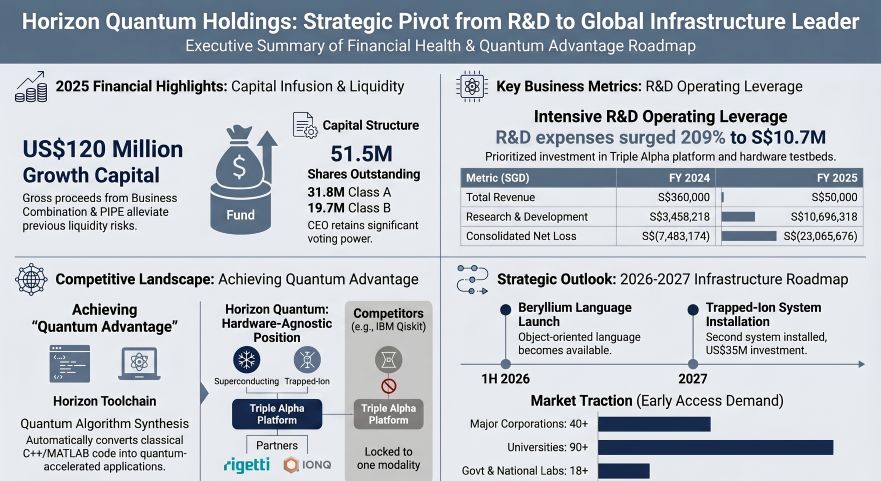
A superficial audit of Horizon’s FY2025 income statement reveals an 86% top-line contraction to a nominal USD 38,883, alongside an EBITDA deficit widening to USD (16.33 million). However, treating this as operational degradation fundamentally misreads the Company's strategic pivot.
Horizon is currently shedding unscalable, ad-hoc milestone R&D consulting to establish a foundation for pure-play software licensing. Consequently, traditional margin analysis is structurally inapplicable. The FY2025 financial narrative is dictated entirely by a 209% surge in R&D operating expenses (USD 8.32 million), largely driven by aggressive equity-based talent acquisition and the physical capitalization of its Phase 1 hardware testbed at its Alice@Mediapolis headquarters.
Furthermore, the alarming 196.5% Asset-Liability Ratio reported at year-end was a temporary U.S. GAAP accounting artifact. Pre-merger Simple Agreements for Future Equity (SAFEs) were marked-to-market as derivative liabilities, synthetically bloating current debt. The March 2026 SPAC capitalization fully converted these SAFEs into Class A Ordinary Shares, instantly deleveraging the balance sheet. This $120 million capital buffer allows Horizon to absorb expected spikes in depreciation expenses over the next 24 months without immediate threat of insolvency, fortifying its "Triple Alpha" software moat—an abstraction layer designed to synthesize C/C++ into quantum-executable code via its proprietary Beryllium, Helium, and Hydrogen languages.
Figure Horizon Quantum Holdings: Strategic Pivot from R&D to Global Infrastructure Leader
 Supply Chain Pivot: Modular Hedging Against "Walled Gardens"
Unlike classical semiconductor and hardware firms currently battling cyclical inventory de-stocking and hardware margin compression, Horizon's supply chain risks are overwhelmingly concentrated in a fragmented oligopoly of upstream cryogenic and processor vendors. The primary existential threat to Horizon is the "walled garden" software ecosystems being rapidly erected by major public cloud providers.
To circumvent this infrastructural chokehold, Horizon is aggressively pursuing vertical integration. The Company's Phase 1 quantum testbed in Singapore deliberately utilizes a multi-vendor modular architecture—pairing Rigetti Novera Quantum Processing Units (QPUs) with Quantum Machines OPX1000 control systems and Maybell Big Fridge dilution refrigerators.
More critically, Horizon has executed a $35 million Quantum Systems Agreement to procure a dedicated trapped-ion supercomputer from IonQ. Slated for deployment in either Singapore or its secondary European hub at 24 Fitzwilliam Place, Dublin, this asset effectively acts as a physical hedge. By owning the hardware, Horizon guarantees direct computational capacity for its enterprise clients, bypassing the latency and platform-lock risks inherent to third-party public clouds.
HDIN Institutional Perspective
From an institutional vantage point, Horizon Quantum's 2025-2026 lifecycle demonstrates the brutal realities of the current deep-tech funding environment. To survive, quantum software pure-plays must morph into infrastructure owners. The massive $35 million CAPEX outlay signals that software agility alone is insufficient; controlling the hardware execution layer is mandatory to eventually establish cost-pass-through mechanisms via usage-based cloud models.
Looking ahead to 2027-2028, we anticipate Horizon will face significant short-to-mid-term EPS deterioration as the straight-line depreciation of the IonQ system hits the P&L—estimated at $5.0M to $11.6M in annual non-cash D&A. However, this is a necessary structural trade-off. As the sector consolidates, Horizon's robust cash runway and hardware-agnostic platform position it favorably. To capture dominant market share ahead of a theoretical 2028 "quantum advantage" inflection point, management may ultimately determine that accretive acquisitions of smaller, niche algorithm compilers are required to fully flesh out its Triple Alpha ecosystem.
Presentation Download & Video Access
Click the PDF download link under 'Related Topics' to access the presentation of this report.
Click this link to watch the YouTube video.
About HDIN Research
HDIN Research is a premier provider of institutional-grade market intelligence, specializing in raw corporate filing analysis, supply chain forensics, and geopolitical macro-strategy. Discover more structural insights at www.hdinresearch.com.
This intelligence report was authored by HDIN Research analysts following a rigorous audit of official corporate filings. AI was utilized for data synthesis and structural drafting, with all strategic insights and financial data verified by our editorial board to ensure professional accuracy and compliance with 2026 search standards.
Financial Health & Operational Moats: The "Gross Margin" Fallacy
A superficial audit of Horizon’s FY2025 income statement reveals an 86% top-line contraction to a nominal USD 38,883, alongside an EBITDA deficit widening to USD (16.33 million). However, treating this as operational degradation fundamentally misreads the Company's strategic pivot.
Horizon is currently shedding unscalable, ad-hoc milestone R&D consulting to establish a foundation for pure-play software licensing. Consequently, traditional margin analysis is structurally inapplicable. The FY2025 financial narrative is dictated entirely by a 209% surge in R&D operating expenses (USD 8.32 million), largely driven by aggressive equity-based talent acquisition and the physical capitalization of its Phase 1 hardware testbed at its Alice@Mediapolis headquarters.
Furthermore, the alarming 196.5% Asset-Liability Ratio reported at year-end was a temporary U.S. GAAP accounting artifact. Pre-merger Simple Agreements for Future Equity (SAFEs) were marked-to-market as derivative liabilities, synthetically bloating current debt. The March 2026 SPAC capitalization fully converted these SAFEs into Class A Ordinary Shares, instantly deleveraging the balance sheet. This $120 million capital buffer allows Horizon to absorb expected spikes in depreciation expenses over the next 24 months without immediate threat of insolvency, fortifying its "Triple Alpha" software moat—an abstraction layer designed to synthesize C/C++ into quantum-executable code via its proprietary Beryllium, Helium, and Hydrogen languages.
Figure Horizon Quantum Holdings: Strategic Pivot from R&D to Global Infrastructure Leader
Supply Chain Pivot: Modular Hedging Against "Walled Gardens"Unlike classical semiconductor and hardware firms currently battling cyclical inventory de-stocking and hardware margin compression, Horizon's supply chain risks are overwhelmingly concentrated in a fragmented oligopoly of upstream cryogenic and processor vendors. The primary existential threat to Horizon is the "walled garden" software ecosystems being rapidly erected by major public cloud providers.
To circumvent this infrastructural chokehold, Horizon is aggressively pursuing vertical integration. The Company's Phase 1 quantum testbed in Singapore deliberately utilizes a multi-vendor modular architecture—pairing Rigetti Novera Quantum Processing Units (QPUs) with Quantum Machines OPX1000 control systems and Maybell Big Fridge dilution refrigerators.
More critically, Horizon has executed a $35 million Quantum Systems Agreement to procure a dedicated trapped-ion supercomputer from IonQ. Slated for deployment in either Singapore or its secondary European hub at 24 Fitzwilliam Place, Dublin, this asset effectively acts as a physical hedge. By owning the hardware, Horizon guarantees direct computational capacity for its enterprise clients, bypassing the latency and platform-lock risks inherent to third-party public clouds.
HDIN Institutional Perspective
From an institutional vantage point, Horizon Quantum's 2025-2026 lifecycle demonstrates the brutal realities of the current deep-tech funding environment. To survive, quantum software pure-plays must morph into infrastructure owners. The massive $35 million CAPEX outlay signals that software agility alone is insufficient; controlling the hardware execution layer is mandatory to eventually establish cost-pass-through mechanisms via usage-based cloud models.
Looking ahead to 2027-2028, we anticipate Horizon will face significant short-to-mid-term EPS deterioration as the straight-line depreciation of the IonQ system hits the P&L—estimated at $5.0M to $11.6M in annual non-cash D&A. However, this is a necessary structural trade-off. As the sector consolidates, Horizon's robust cash runway and hardware-agnostic platform position it favorably. To capture dominant market share ahead of a theoretical 2028 "quantum advantage" inflection point, management may ultimately determine that accretive acquisitions of smaller, niche algorithm compilers are required to fully flesh out its Triple Alpha ecosystem.
Presentation Download & Video Access
Click the PDF download link under 'Related Topics' to access the presentation of this report.
Click this link to watch the YouTube video.
About HDIN Research
HDIN Research is a premier provider of institutional-grade market intelligence, specializing in raw corporate filing analysis, supply chain forensics, and geopolitical macro-strategy. Discover more structural insights at www.hdinresearch.com.
This intelligence report was authored by HDIN Research analysts following a rigorous audit of official corporate filings. AI was utilized for data synthesis and structural drafting, with all strategic insights and financial data verified by our editorial board to ensure professional accuracy and compliance with 2026 search standards.