Electric Commercial Vehicle Cycle Hits Trough: Cenntro Inc. Signals Severe Liquidity Crisis as FY2025 Gross Margins Invert to -12.8%
Date : 2026-04-22
Reading : 92
In FY2025, Cenntro Inc. reported a 42.2% year-over-year top-line collapse to $18.08 million, driven by systemic channel partner friction and plummeting vehicle average selling prices across its core European and U.S. operations. Compounded by a catastrophic 2.6% capacity utilization rate at its primary Changxing facility and punitive new U.S. tariffs on Chinese imports, the commercial EV manufacturer’s gross margins inverted to negative 12.8%. Operating with a razor-thin unrestricted cash buffer of $4.48 million and a monthly operating cash burn of $1.05 million, Cenntro faces an immediate going-concern threat requiring emergency capital restructuring to survive the 2026 fiscal cycle.
Financial Health & Operational Moats: The Collapse of Unit Economics
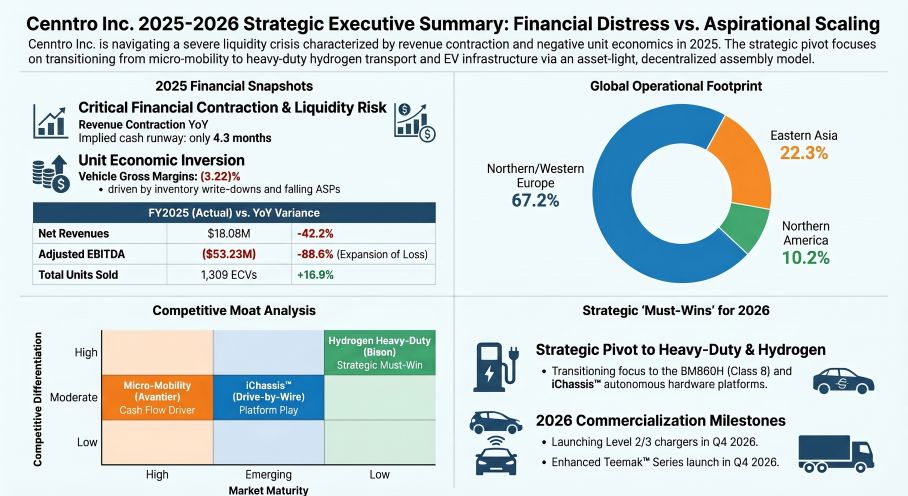
Cenntro’s 2025 audit exposes a structural breakdown in its core unit economics, characterized by severe margin compression. While management previously guided toward margin expansion through direct "EV Centers," the reality is a fragmented product mix overly reliant on low-margin micro-mobility form factors. Of the 1,309 vehicles delivered in 2025, 46.7% were entry-level Avantier units, driving the blended Average Selling Price (ASP) down to a highly dilutive $12,284 per vehicle.
This collapse in ASP, coupled with the absence of viable cost-pass-through mechanisms to absorb macroeconomic shocks, directly forced vehicle sales gross margins into negative territory (-3.22%). The balance sheet reveals deeper systemic distress: a $4.56 million provision for credit losses signals acute insolvency among regional distributors, neutralizing Cenntro's ability to monetize its $7.31 million gross receivables ledger.
Furthermore, the operational moat for future commercialization is actively degrading. R&D expenditure was slashed by 45% to a skeletal $2.81 million to conserve capital. This fundamentally contradicts management’s aspirational 2026 targets of launching the Class 8 BM860H hydrogen fuel cell semi-tractor and commercial-scale Level 3 DC chargers. Without the capital bandwidth for accretive acquisitions or internal engineering scale, Cenntro’s intellectual property pipeline—including its proprietary iChassis autonomous platform—risks stagnation before achieving commercial critical mass.
Figure Cenntro Inc 2025-2026 Strategic Executive Summary Financial Distress vs Aspirational Scaling
 Supply Chain Pivot: The "Asset-Light" Paradox
Unlike legacy auto OEMs relying on capital-intensive vertical integration, Cenntro’s supply chain architecture is built entirely on a decentralized, "merge-in-transit" model. The company sources semi-knocked down (SKD) kits primarily from its 474,000-square-foot facility in Changxing, China, exporting them for localized micro-assembly at facilities in Freehold, New Jersey; Barstow, California; and Bochum, Germany.
Theoretically, this asset-light pivot insulates the company from massive CAPEX requirements. In practice, the FY2025 data proves this framework is highly vulnerable to geopolitical fragmentation. The March 2025 implementation of a 20% U.S. tariff on Chinese imports abruptly destroyed the cost arbitrage of the SKD strategy. Simultaneously, an inability to accurately match production with end-market demand choked the logistics network. Cenntro’s inventory turnover ratio plummeted to an abysmal 0.89x, forcing the company into defensive inventory de-stocking protocols and resulting in massive non-operating impairment charges, including $4.48 million in direct inventory write-downs and write-offs.
HDIN Institutional Perspective: A Canary in the Micro-EV Coal Mine
Cenntro’s 2025 financial disclosures provide a critical, non-linear indicator for the broader Electric Commercial Vehicle (ECV) sector: outsourced, cross-border supply chains are no longer viable under current trade realignments. Management’s inability to scale beyond a 2.6% utilization rate in China exposes the fatal flaw of relying on a fragmented dealer network without the brand equity required to command premium pricing.
The immediate institutional risk is not operational, but existential. Cenntro’s implied cash runway of approximately 4.3 months is actively colliding with an aggressive new Nasdaq regulatory framework. The proposed Nasdaq rule taking effect on January 13, 2026, requires a strict $5 million minimum market value for continued listing—a threshold that uniquely threatens an immediate suspension without a standard compliance cure period. The company is completely cornered; it cannot trade Zero-Emission Vehicle (ZEV) credits to synthesize revenue, and its pivot to heavier commercial platforms requires a capital injection that the current debt and equity markets are unlikely to provide on favorable terms.
Presentation Download & Video Access
Presentation Download: Click the PDF download link under 'Related Topics' to access the presentation of this report.
Video Link: Click this link to watch the YouTube video.
About HDIN Research:
HDIN Research (www.hdinresearch.com) provides institutional-grade market intelligence, delivering rigorous, data-driven insights into global supply chain dynamics, capital markets, and corporate strategy.
This intelligence report was authored by HDIN Research analysts following a rigorous audit of official corporate filings. AI was utilized for data synthesis and structural drafting, with all strategic insights and financial data verified by our editorial board to ensure professional accuracy and compliance with 2026 search standards.
Financial Health & Operational Moats: The Collapse of Unit Economics
Cenntro’s 2025 audit exposes a structural breakdown in its core unit economics, characterized by severe margin compression. While management previously guided toward margin expansion through direct "EV Centers," the reality is a fragmented product mix overly reliant on low-margin micro-mobility form factors. Of the 1,309 vehicles delivered in 2025, 46.7% were entry-level Avantier units, driving the blended Average Selling Price (ASP) down to a highly dilutive $12,284 per vehicle.
This collapse in ASP, coupled with the absence of viable cost-pass-through mechanisms to absorb macroeconomic shocks, directly forced vehicle sales gross margins into negative territory (-3.22%). The balance sheet reveals deeper systemic distress: a $4.56 million provision for credit losses signals acute insolvency among regional distributors, neutralizing Cenntro's ability to monetize its $7.31 million gross receivables ledger.
Furthermore, the operational moat for future commercialization is actively degrading. R&D expenditure was slashed by 45% to a skeletal $2.81 million to conserve capital. This fundamentally contradicts management’s aspirational 2026 targets of launching the Class 8 BM860H hydrogen fuel cell semi-tractor and commercial-scale Level 3 DC chargers. Without the capital bandwidth for accretive acquisitions or internal engineering scale, Cenntro’s intellectual property pipeline—including its proprietary iChassis autonomous platform—risks stagnation before achieving commercial critical mass.
Figure Cenntro Inc 2025-2026 Strategic Executive Summary Financial Distress vs Aspirational Scaling
Supply Chain Pivot: The "Asset-Light" ParadoxUnlike legacy auto OEMs relying on capital-intensive vertical integration, Cenntro’s supply chain architecture is built entirely on a decentralized, "merge-in-transit" model. The company sources semi-knocked down (SKD) kits primarily from its 474,000-square-foot facility in Changxing, China, exporting them for localized micro-assembly at facilities in Freehold, New Jersey; Barstow, California; and Bochum, Germany.
Theoretically, this asset-light pivot insulates the company from massive CAPEX requirements. In practice, the FY2025 data proves this framework is highly vulnerable to geopolitical fragmentation. The March 2025 implementation of a 20% U.S. tariff on Chinese imports abruptly destroyed the cost arbitrage of the SKD strategy. Simultaneously, an inability to accurately match production with end-market demand choked the logistics network. Cenntro’s inventory turnover ratio plummeted to an abysmal 0.89x, forcing the company into defensive inventory de-stocking protocols and resulting in massive non-operating impairment charges, including $4.48 million in direct inventory write-downs and write-offs.
HDIN Institutional Perspective: A Canary in the Micro-EV Coal Mine
Cenntro’s 2025 financial disclosures provide a critical, non-linear indicator for the broader Electric Commercial Vehicle (ECV) sector: outsourced, cross-border supply chains are no longer viable under current trade realignments. Management’s inability to scale beyond a 2.6% utilization rate in China exposes the fatal flaw of relying on a fragmented dealer network without the brand equity required to command premium pricing.
The immediate institutional risk is not operational, but existential. Cenntro’s implied cash runway of approximately 4.3 months is actively colliding with an aggressive new Nasdaq regulatory framework. The proposed Nasdaq rule taking effect on January 13, 2026, requires a strict $5 million minimum market value for continued listing—a threshold that uniquely threatens an immediate suspension without a standard compliance cure period. The company is completely cornered; it cannot trade Zero-Emission Vehicle (ZEV) credits to synthesize revenue, and its pivot to heavier commercial platforms requires a capital injection that the current debt and equity markets are unlikely to provide on favorable terms.
Presentation Download & Video Access
Presentation Download: Click the PDF download link under 'Related Topics' to access the presentation of this report.
Video Link: Click this link to watch the YouTube video.
About HDIN Research:
HDIN Research (www.hdinresearch.com) provides institutional-grade market intelligence, delivering rigorous, data-driven insights into global supply chain dynamics, capital markets, and corporate strategy.
This intelligence report was authored by HDIN Research analysts following a rigorous audit of official corporate filings. AI was utilized for data synthesis and structural drafting, with all strategic insights and financial data verified by our editorial board to ensure professional accuracy and compliance with 2026 search standards.