Asian PCB Leaders Pivot to AI Substrates and 'China+N' Mitigation as Top Tier Posts 124% Revenue Surge
Date : 2026-04-20
Reading : 2900
A K-shaped structural super-cycle is tearing through the global Printed Circuit Board (PCB) sector heading into FY2026. Driven by the AI hyperscaler boom, top-tier Chinese and South Korean manufacturers—including ISU Petasys (KRX: 007660) and WUS Printed Circuit (SZSE: 002463)—are aggressively diverting capital away from commoditized hardware to monopolize the $8,000–$10,000 per unit AI server board market. Simultaneously, stringent U.S. tariffs and "Double Carbon" environmental ceilings are forcing an unprecedented, synchronized CAPEX migration to Southeast Asia, radically permanently altering the electronics supply chain.
Financial Health & Operational Moats: The K-Shaped Margin Divergence
The FY2025 audits reveal an industry defined by absolute structural polarization. The top-tier segment has entered an AI-driven structural super-cycle characterized by supply shortages and exponential value expansion, while traditional consumer board manufacturers face brutal inventory de-stocking and irreversible margin compression.
A rigorous analysis of operational cash flow (CFO) versus net income across the sector demonstrates elite earnings quality for the market leaders. Because advanced PCB manufacturing requires immense, sustained capital expenditure, massive non-cash depreciation systematically suppresses bottom-line net income while bolstering operating liquidity. Avary Holding (SZSE: 002938) reported a net income of $520 million against a massive CFO of $1.01 billion, executing a highly sustainable 64% dividend payout ratio.
However, capital deployment strategies are severely bifurcated. ISU Petasys (KRX: 007660), capturing a staggering 124.6% YoY revenue growth via its monopoly-like hold on global Big Tech AI accelerators, slashed its standalone dividend payout to just 10.7%. This is not distress; it is a calculated capital hoarding maneuver to fully fund the aggressive construction of its "Plant 5" dedicated AI facility.
The operational moat here is defined by technological scarcity. Advancing from legacy 14-layer server boards to 18+ layer High-Layer Count (HLC) AI architectures—utilizing M8/M9 ultra-low loss materials and High Very Low Profile (HVLP) copper foils—has effectively locked out lower-tier competitors. WUS Printed Circuit’s pivot toward these high-margin, 18+ layer architectures pushed its revenue-per-employee to an industry-leading $165,599, proving that organic cash flow generation is now entirely reliant on technological niche rather than raw manufacturing scale.
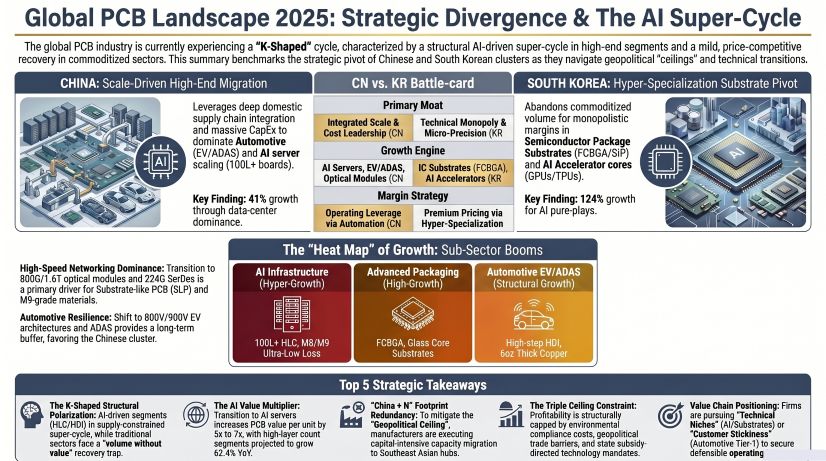
Figure Global PCB Landscape: 2025 Strategic Divergence & The Al Super-Cycle
 Supply Chain Pivot: The "China+N" Geographic Hedging
Unconstrained, volume-driven PCB expansion in domestic Asian hubs has hit a geopolitical and environmental ceiling. Anticipating "Trump Tariffs 2.0" and navigating global supply chain friction, the Chinese cohort is executing a highly capital-intensive "China+N" strategy, moving high-volume production out of the crosshairs of bilateral trade wars.
Thailand has emerged as the absolute epicenter of this geographic hedge. Industry titans including Avary Holding, Wanyuantong, and Dynamic Electronics are rapidly transitioning their Thai bases from the construction phase to the yield ramp-up phase. WUS Printed Circuit explicitly noted in its filings that it intentionally suppresses its direct U.S. exports below 5% of total revenue to blunt the impact of tariff mechanisms on raw materials and finished goods, utilizing its new offshore footprint to service Western hyperscalers.
Simultaneously, the industry is rejecting heavy vertical integration. Rather than acquiring chemical plants, leaders are establishing "virtual integration." By conducting joint R&D on electrical properties with upstream material suppliers, firms like Shennan Circuits (SZSE: 002916) bypass basic commodity constraints, locking in priority allocations for scarce FC-BGA substrate resins and high-speed optics materials (800G/1.6T) through strategic cost-pass-through mechanisms.
HDIN Institutional Perspective: A Structural Oligopoly in the Making
The FY2025 benchmarking data validates a thesis HDIN Research has tracked since the onset of the AI infrastructure boom: the PCB sector is transitioning into a technological oligopoly. A permanent divergence now separates the South Korean and Chinese strategic playbooks.
South Korean heavyweights like Simmtech (KOSDAQ: 222800) and Daeduck Electronics are executing a "Deep Tech Packaging" pivot. Recognizing they cannot beat Chinese manufacturers on cost-leadership, they have abandoned traditional multi-layer boards to focus CapEx entirely on Semiconductor Package Substrates (FC-BGA, FC-CSP) and frontier R&D in Glass Core Substrates, effectively operating as outsourced extensions of the memory semiconductor giants.
Conversely, Chinese firms are dominating macro-level system infrastructure. Manufacturers like Victory Giant Technology have breached the 100-layer barrier for AI Data Center Universal Baseboards (UBBs), while Avary Holding leverages Substrate-like PCB (SLP) technology to dominate the 800G and 1.6T optical module markets. Furthermore, Chinese firms carry substantial structural resilience against a smartphone downcycle due to aggressive value-chain upgrading into automotive electronics—evidenced by Kinwong Electronic’s (SHSE: 603228) dominance in multi-year, sticky 800V EV and ADAS Tier-1 contracts.
Investors must navigate clear idiosyncratic risks amidst this boom. Balance sheets laden with goodwill from accretive acquisitions—such as Shenghong Technology’s $166 million M&A exposure—require strict monitoring for impairment triggers, while high-leverage players face acute vulnerability to macroeconomic shocks. Ultimately, the 2026 cycle dictates a stark reality: adapt to high-layer AI and auto substrates, or face permanent obsolescence in the commoditized volume trap.
Presentation Download & Video Access
Presentation Download: Click the PDF download link under 'Related Topics' to access the presentation of this report.
Video Link: Click this link to watch the YouTube video
About HDIN Research:
Visit www.hdinresearch.com for institutional-grade market intelligence and primary corporate filing analytics.
This intelligence report was authored by HDIN Research analysts following a rigorous audit of official corporate filings. AI was utilized for data synthesis and structural drafting, with all strategic insights and financial data verified by our editorial board to ensure professional accuracy and compliance with 2026 search standards.
Financial Health & Operational Moats: The K-Shaped Margin Divergence
The FY2025 audits reveal an industry defined by absolute structural polarization. The top-tier segment has entered an AI-driven structural super-cycle characterized by supply shortages and exponential value expansion, while traditional consumer board manufacturers face brutal inventory de-stocking and irreversible margin compression.
A rigorous analysis of operational cash flow (CFO) versus net income across the sector demonstrates elite earnings quality for the market leaders. Because advanced PCB manufacturing requires immense, sustained capital expenditure, massive non-cash depreciation systematically suppresses bottom-line net income while bolstering operating liquidity. Avary Holding (SZSE: 002938) reported a net income of $520 million against a massive CFO of $1.01 billion, executing a highly sustainable 64% dividend payout ratio.
However, capital deployment strategies are severely bifurcated. ISU Petasys (KRX: 007660), capturing a staggering 124.6% YoY revenue growth via its monopoly-like hold on global Big Tech AI accelerators, slashed its standalone dividend payout to just 10.7%. This is not distress; it is a calculated capital hoarding maneuver to fully fund the aggressive construction of its "Plant 5" dedicated AI facility.
The operational moat here is defined by technological scarcity. Advancing from legacy 14-layer server boards to 18+ layer High-Layer Count (HLC) AI architectures—utilizing M8/M9 ultra-low loss materials and High Very Low Profile (HVLP) copper foils—has effectively locked out lower-tier competitors. WUS Printed Circuit’s pivot toward these high-margin, 18+ layer architectures pushed its revenue-per-employee to an industry-leading $165,599, proving that organic cash flow generation is now entirely reliant on technological niche rather than raw manufacturing scale.
Figure Global PCB Landscape: 2025 Strategic Divergence & The Al Super-Cycle
Supply Chain Pivot: The "China+N" Geographic HedgingUnconstrained, volume-driven PCB expansion in domestic Asian hubs has hit a geopolitical and environmental ceiling. Anticipating "Trump Tariffs 2.0" and navigating global supply chain friction, the Chinese cohort is executing a highly capital-intensive "China+N" strategy, moving high-volume production out of the crosshairs of bilateral trade wars.
Thailand has emerged as the absolute epicenter of this geographic hedge. Industry titans including Avary Holding, Wanyuantong, and Dynamic Electronics are rapidly transitioning their Thai bases from the construction phase to the yield ramp-up phase. WUS Printed Circuit explicitly noted in its filings that it intentionally suppresses its direct U.S. exports below 5% of total revenue to blunt the impact of tariff mechanisms on raw materials and finished goods, utilizing its new offshore footprint to service Western hyperscalers.
Simultaneously, the industry is rejecting heavy vertical integration. Rather than acquiring chemical plants, leaders are establishing "virtual integration." By conducting joint R&D on electrical properties with upstream material suppliers, firms like Shennan Circuits (SZSE: 002916) bypass basic commodity constraints, locking in priority allocations for scarce FC-BGA substrate resins and high-speed optics materials (800G/1.6T) through strategic cost-pass-through mechanisms.
HDIN Institutional Perspective: A Structural Oligopoly in the Making
The FY2025 benchmarking data validates a thesis HDIN Research has tracked since the onset of the AI infrastructure boom: the PCB sector is transitioning into a technological oligopoly. A permanent divergence now separates the South Korean and Chinese strategic playbooks.
South Korean heavyweights like Simmtech (KOSDAQ: 222800) and Daeduck Electronics are executing a "Deep Tech Packaging" pivot. Recognizing they cannot beat Chinese manufacturers on cost-leadership, they have abandoned traditional multi-layer boards to focus CapEx entirely on Semiconductor Package Substrates (FC-BGA, FC-CSP) and frontier R&D in Glass Core Substrates, effectively operating as outsourced extensions of the memory semiconductor giants.
Conversely, Chinese firms are dominating macro-level system infrastructure. Manufacturers like Victory Giant Technology have breached the 100-layer barrier for AI Data Center Universal Baseboards (UBBs), while Avary Holding leverages Substrate-like PCB (SLP) technology to dominate the 800G and 1.6T optical module markets. Furthermore, Chinese firms carry substantial structural resilience against a smartphone downcycle due to aggressive value-chain upgrading into automotive electronics—evidenced by Kinwong Electronic’s (SHSE: 603228) dominance in multi-year, sticky 800V EV and ADAS Tier-1 contracts.
Investors must navigate clear idiosyncratic risks amidst this boom. Balance sheets laden with goodwill from accretive acquisitions—such as Shenghong Technology’s $166 million M&A exposure—require strict monitoring for impairment triggers, while high-leverage players face acute vulnerability to macroeconomic shocks. Ultimately, the 2026 cycle dictates a stark reality: adapt to high-layer AI and auto substrates, or face permanent obsolescence in the commoditized volume trap.
Presentation Download & Video Access
Presentation Download: Click the PDF download link under 'Related Topics' to access the presentation of this report.
Video Link: Click this link to watch the YouTube video
About HDIN Research:
Visit www.hdinresearch.com for institutional-grade market intelligence and primary corporate filing analytics.
This intelligence report was authored by HDIN Research analysts following a rigorous audit of official corporate filings. AI was utilized for data synthesis and structural drafting, with all strategic insights and financial data verified by our editorial board to ensure professional accuracy and compliance with 2026 search standards.