Flexible Solutions (NYSE: FSI) Accelerates Latin American Production Pivot as R&D Monetization Offsets 5.8% Core Volume Contraction
Date : 2026-04-23
Reading : 96
Flexible Solutions International (NYSE: FSI) concluded its FY2025 audit with stagnant consolidated revenues of $38.52 million, masking a 5.8% physical product contraction driven by acute client inventory de-stocking. The specialty chemical manufacturer narrowly stabilized its top line by injecting $2.5 million in newly recognized R&D service revenues. Pressured by a 210-basis-point margin compression, management is rapidly restructuring its global footprint. By divesting its Mendota, Illinois asset and launching operations in Panama for January 2026, FSI is proactively insulating its balance sheet from geopolitical supply chain friction and extreme customer concentration in the agricultural and energy sectors.
Financial Health & Operational Moats: Cash Conversion Trumps Earnings Contraction
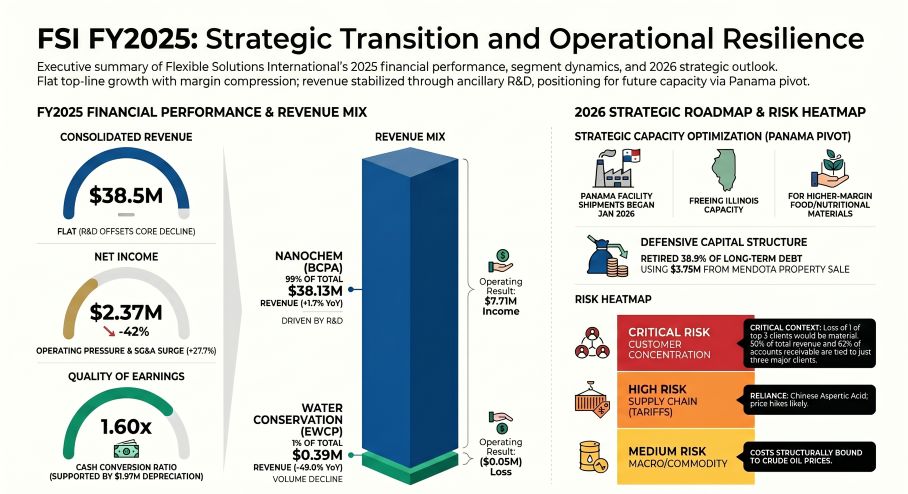
A superficial reading of FSI’s 2025 income statement suggests profound fundamental deterioration: Net income plummeted 42% year-over-year to $2.36 million, while operating margins compressed from 14.4% to 11.9%. However, this top-line stagnation obscures a highly defensive, cash-rich deleveraging narrative.
The 210-basis-point gross margin compression (dropping to 32.5%) was explicitly driven by the friction of scaling new products, exposing FSI’s limited short-term pricing power. Yet, the "Quality of Earnings"—measured by operating cash flow conversion—materially strengthened to a 1.60x ratio, backed by $1.96 million in non-cash depreciation and stringent working capital management. Management actively prioritized balance sheet fortification over accretive acquisitions, utilizing a $1.21 million gain from the sale of a 14,000 sq. ft. Mendota property to aggressively retire $4.31 million in long-term debt.
Strategically, FSI’s technological moat remains anchored in legacy IP acquired from Donlar Corporation and a critical cross-licensing agreement with chemical giant Lanxess AG. By neutralizing process patent barriers against Lanxess, FSI shifts the competitive arena entirely to commercial execution—leveraging its smaller size to engineer customized thermal polyaspartate (TPA) formulations for specific oil well profiles and agricultural soil conditions that multinational conglomerates cannot profitably address.
Figure FSl FY2025 Strategic Transition and Operational Resilience
 Supply Chain Pivot: Geopolitical Exposure and the Panama Expansion
FSI’s deliberate lack of vertical integration serves as a double-edged sword. By operating purely on spot-market procurement without long-term supply contracts, the company avoids locking into elevated commodity peaks but fully absorbs structural volatility.
The firm’s primary TPA engine is highly vulnerable to raw material pricing derived from crude oil and imported aspartic acid from China. Management has bluntly signaled that any escalation in Chinese tariffs will immediately test their cost-pass-through mechanisms; if agricultural and oilfield end-users reject inevitable price hikes, operating margins face further erosion.
To structurally hedge these vulnerabilities, FSI is rapidly decentralizing its manufacturing footprint. The strategic launch of Pana Chem Solutions Inc. in Panama—with official shipments commencing in January 2026—serves a dual purpose. First, it localizes the production of NanoChem Legacy products for the growing Latin American market. Second, and more critically, it unburdens the primary 56,780 sq. ft. Peru, Illinois hub, freeing up premium domestic capacity to scale higher-margin, highly confidential custom food and nutritional materials.
HDIN Institutional Perspective: Cyclical Troughs and the EWCP Mirage
From an institutional viewpoint, FSI’s FY2025 disclosures emit strong cyclical trough signals for its niche verticals. The baseline revenue fragility is severe: just three primary clients dictate 50% of total sales ($18.06 million) and 62% of Accounts Receivable. The $2.72 million year-over-year combined revenue drop from "Company B" and "Company C" directly quantifies the impact of downstream inventory de-stocking and capital expenditure pullbacks in the macro agricultural and energy markets.
Furthermore, any retail investment thesis framing FSI as an environmental "water scarcity" play remains fundamentally flawed. The Energy and Water Conservation Products (EWCP) segment, anchored by WATERSAVR® and HEATSAVR®, generated a microscopic $388,713 in 2025—roughly 1% of total sales—and operated at a net loss. Despite heavy global ESG tailwinds, the segment lacks commercial scalability. Until the cost-benefit friction of deploying chemical retardants mathematically exceeds the highly subsidized global price of municipal water, EWCP will remain a regulatory-bottlenecked ESG narrative rather than a capitalized operational reality.
Presentation Download & Video Access
Presentation Download: Click the PDF download link under 'Related Topics' to access the presentation of this report.
Video Link: Click this link to watch the YouTube video.
About HDIN Research:
HDIN Research (www.hdinresearch.com) is a premier provider of institutional-grade equity intelligence and strategic market analysis, delivering uncompromising clarity on complex corporate filings, global supply chain pivots, and macroeconomic trends.
*This intelligence report was authored by HDIN Research analysts following a rigorous audit of official corporate filings. AI was utilized for data synthesis and structural drafting, with all strategic insights and financial data verified by our editorial board to ensure professional accuracy and compliance with 2026 search standards.*
Financial Health & Operational Moats: Cash Conversion Trumps Earnings Contraction
A superficial reading of FSI’s 2025 income statement suggests profound fundamental deterioration: Net income plummeted 42% year-over-year to $2.36 million, while operating margins compressed from 14.4% to 11.9%. However, this top-line stagnation obscures a highly defensive, cash-rich deleveraging narrative.
The 210-basis-point gross margin compression (dropping to 32.5%) was explicitly driven by the friction of scaling new products, exposing FSI’s limited short-term pricing power. Yet, the "Quality of Earnings"—measured by operating cash flow conversion—materially strengthened to a 1.60x ratio, backed by $1.96 million in non-cash depreciation and stringent working capital management. Management actively prioritized balance sheet fortification over accretive acquisitions, utilizing a $1.21 million gain from the sale of a 14,000 sq. ft. Mendota property to aggressively retire $4.31 million in long-term debt.
Strategically, FSI’s technological moat remains anchored in legacy IP acquired from Donlar Corporation and a critical cross-licensing agreement with chemical giant Lanxess AG. By neutralizing process patent barriers against Lanxess, FSI shifts the competitive arena entirely to commercial execution—leveraging its smaller size to engineer customized thermal polyaspartate (TPA) formulations for specific oil well profiles and agricultural soil conditions that multinational conglomerates cannot profitably address.
Figure FSl FY2025 Strategic Transition and Operational Resilience
Supply Chain Pivot: Geopolitical Exposure and the Panama ExpansionFSI’s deliberate lack of vertical integration serves as a double-edged sword. By operating purely on spot-market procurement without long-term supply contracts, the company avoids locking into elevated commodity peaks but fully absorbs structural volatility.
The firm’s primary TPA engine is highly vulnerable to raw material pricing derived from crude oil and imported aspartic acid from China. Management has bluntly signaled that any escalation in Chinese tariffs will immediately test their cost-pass-through mechanisms; if agricultural and oilfield end-users reject inevitable price hikes, operating margins face further erosion.
To structurally hedge these vulnerabilities, FSI is rapidly decentralizing its manufacturing footprint. The strategic launch of Pana Chem Solutions Inc. in Panama—with official shipments commencing in January 2026—serves a dual purpose. First, it localizes the production of NanoChem Legacy products for the growing Latin American market. Second, and more critically, it unburdens the primary 56,780 sq. ft. Peru, Illinois hub, freeing up premium domestic capacity to scale higher-margin, highly confidential custom food and nutritional materials.
HDIN Institutional Perspective: Cyclical Troughs and the EWCP Mirage
From an institutional viewpoint, FSI’s FY2025 disclosures emit strong cyclical trough signals for its niche verticals. The baseline revenue fragility is severe: just three primary clients dictate 50% of total sales ($18.06 million) and 62% of Accounts Receivable. The $2.72 million year-over-year combined revenue drop from "Company B" and "Company C" directly quantifies the impact of downstream inventory de-stocking and capital expenditure pullbacks in the macro agricultural and energy markets.
Furthermore, any retail investment thesis framing FSI as an environmental "water scarcity" play remains fundamentally flawed. The Energy and Water Conservation Products (EWCP) segment, anchored by WATERSAVR® and HEATSAVR®, generated a microscopic $388,713 in 2025—roughly 1% of total sales—and operated at a net loss. Despite heavy global ESG tailwinds, the segment lacks commercial scalability. Until the cost-benefit friction of deploying chemical retardants mathematically exceeds the highly subsidized global price of municipal water, EWCP will remain a regulatory-bottlenecked ESG narrative rather than a capitalized operational reality.
Presentation Download & Video Access
Presentation Download: Click the PDF download link under 'Related Topics' to access the presentation of this report.
Video Link: Click this link to watch the YouTube video.
About HDIN Research:
HDIN Research (www.hdinresearch.com) is a premier provider of institutional-grade equity intelligence and strategic market analysis, delivering uncompromising clarity on complex corporate filings, global supply chain pivots, and macroeconomic trends.
*This intelligence report was authored by HDIN Research analysts following a rigorous audit of official corporate filings. AI was utilized for data synthesis and structural drafting, with all strategic insights and financial data verified by our editorial board to ensure professional accuracy and compliance with 2026 search standards.*