Cirrus Aircraft Executes High-Margin Services Pivot as Vision Jet ASP Expansion Signals Insulated Pricing Power
Date : 2026-05-01
Reading : 71
Cirrus Aircraft is fundamentally restructuring the general aviation profit pool by transitioning from a hardware OEM to a recurring-revenue lifecycle provider. While the geopolitical firewall separating operations from its 80.18% stakeholder, Aviation Industry Corporation of China (AVIC), ensures FAA compliance under 14 CFR Part 21, the immediate margin catalyst is the firm's aftermarket ecosystem. Anchored by the Knoxville Vision Center, a 17.0% YoY surge in services revenue validates a structural Total Addressable Market (TAM) expansion, successfully monetizing a highly lucrative cohort of non-pilot ultra-high-net-worth individuals.
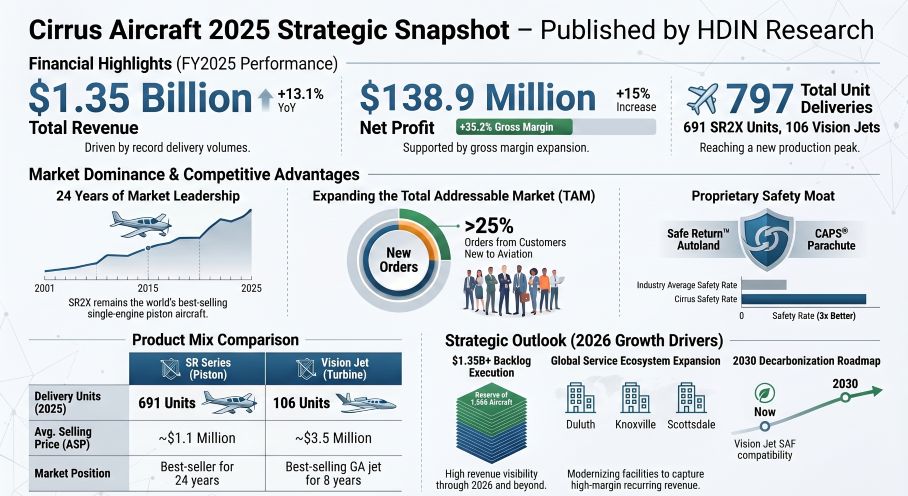
图表Cirrus Aircraft 2025 Strategic Snapshot
ASP Leverage and Services Margin Accretion
Beyond the top-line delivery of 797 units and $1.35 billion in FY2025 revenue, the underlying margin narrative is driven by an aggressively optimized price-mix variance. The Vision Jet demonstrated exceptional pricing power; despite macroeconomic headwinds, Average Selling Price (ASP) expanded from $3.4 million to $3.5 million on 106 delivered units. This unit economic strength translated into a 15.4% jump in aggregate gross profit to $477 million, yielding a 35.2% gross margin (+70 bps YoY) that effectively neutralizes supply chain cost inflation.
More critically, the 'Cirrus Services & Others' segment generated $203 million, growing at 17.0% YoY and structurally outpacing the 12.5% growth in core hardware sales. This represents a textbook R&D-to-Moat translation. By integrating the proprietary Cirrus IQ™ digital tether with standardized Cirrus Approach® training, the company is shifting its cash-conversion cycle toward high-margin aftermarket streams, structurally decoupling long-term profitability from the historical cyclicality of industrial aerospace deliveries.
CAPEX Footprint and Sanctions Firewalls
To absorb the projected 2026 aftermarket demand, capital allocation is heavily weighted toward brownfield and greenfield expansions across Duluth, Grand Forks, Scottsdale, Knoxville, McKinney, and Orlando. This physical footprint deepens the switching-cost moat by centralizing the ownership experience. Simultaneously, hardware innovation—specifically the FAA-approved Safe Return™ emergency autoland system and CAPS® airframe parachute—has acted as a direct TAM multiplier, with over 25% of 2025 orders originating from customers entirely new to aviation.
On the supply chain and governance front, operations are tightly ring-fenced to mitigate geopolitical exposure. To isolate U.S. engineering and international certification from AVIC (and its subsidiary CAIGA), management enforces a strict export compliance firewall, algorithmically screening counterparties against OFAC and BIS Military End-User lists. While corporate connected transactions—such as engine procurement from Continental—continue, they operate strictly at arm's-length. Meanwhile, the decarbonization strategy highlights a tension between volume growth and sustainability: while absolute operational emissions spiked 32.19% (20,236.43 tCO2e) due to manufacturing velocity, the company exceeded its 2030 intensity targets. Scope 1 intensity compressed 14.6% to 7.03 tCO2e per $1M revenue, supported by the Vision Jet's integration of ASTM D1655-compliant Sustainable Aviation Fuel (SAF) and the PAFI-aligned transition away from 100LL leaded fuels.
HDIN Institutional Perspective
While management highlights the 25% new-entrant order influx as a validation of the Safe Return™ technology, the structural reliance on intensive physical infrastructure expansion exposes a potential lag in operating leverage. The transition to a premium "lifestyle brand" necessitates a capital-heavy 2026 expansion of the services footprint. We assess that while the software-and-services pivot successfully insulates the firm against hardware order-book volatility, the concurrent reliance on AVIC-affiliated suppliers and the looming industry-wide mandate to eliminate 100LL aviation fuel introduce unpriced supply-side friction. If the physical service network fails to scale perfectly in tandem with the swelling installed base, the projected 2026 margin expansion could compress under the weight of heightened SG&A overhead.
Presentation Download & Video Access:
Click the PDF download link under 'Related Topics' to access the presentation of this report.
Click this link to watch the YouTube video.
HDIN Research is a premier global market intelligence and strategic advisory firm specializing in institutional-grade financial analysis, supply chain audits, and macroeconomic forecasting. Our dedicated sector analysts deliver actionable, data-driven insights tailored for private equity, hedge funds, and corporate strategy teams. Visit us at www.hdinresearch.com.
*This intelligence report was authored by HDIN Research analysts following a rigorous audit of official corporate filings. AI was utilized for data synthesis and structural drafting, with all strategic insights and financial data verified by our editorial board to ensure professional accuracy and compliance with 2026 search standards.*
图表Cirrus Aircraft 2025 Strategic Snapshot
ASP Leverage and Services Margin Accretion
Beyond the top-line delivery of 797 units and $1.35 billion in FY2025 revenue, the underlying margin narrative is driven by an aggressively optimized price-mix variance. The Vision Jet demonstrated exceptional pricing power; despite macroeconomic headwinds, Average Selling Price (ASP) expanded from $3.4 million to $3.5 million on 106 delivered units. This unit economic strength translated into a 15.4% jump in aggregate gross profit to $477 million, yielding a 35.2% gross margin (+70 bps YoY) that effectively neutralizes supply chain cost inflation.
More critically, the 'Cirrus Services & Others' segment generated $203 million, growing at 17.0% YoY and structurally outpacing the 12.5% growth in core hardware sales. This represents a textbook R&D-to-Moat translation. By integrating the proprietary Cirrus IQ™ digital tether with standardized Cirrus Approach® training, the company is shifting its cash-conversion cycle toward high-margin aftermarket streams, structurally decoupling long-term profitability from the historical cyclicality of industrial aerospace deliveries.
CAPEX Footprint and Sanctions Firewalls
To absorb the projected 2026 aftermarket demand, capital allocation is heavily weighted toward brownfield and greenfield expansions across Duluth, Grand Forks, Scottsdale, Knoxville, McKinney, and Orlando. This physical footprint deepens the switching-cost moat by centralizing the ownership experience. Simultaneously, hardware innovation—specifically the FAA-approved Safe Return™ emergency autoland system and CAPS® airframe parachute—has acted as a direct TAM multiplier, with over 25% of 2025 orders originating from customers entirely new to aviation.
On the supply chain and governance front, operations are tightly ring-fenced to mitigate geopolitical exposure. To isolate U.S. engineering and international certification from AVIC (and its subsidiary CAIGA), management enforces a strict export compliance firewall, algorithmically screening counterparties against OFAC and BIS Military End-User lists. While corporate connected transactions—such as engine procurement from Continental—continue, they operate strictly at arm's-length. Meanwhile, the decarbonization strategy highlights a tension between volume growth and sustainability: while absolute operational emissions spiked 32.19% (20,236.43 tCO2e) due to manufacturing velocity, the company exceeded its 2030 intensity targets. Scope 1 intensity compressed 14.6% to 7.03 tCO2e per $1M revenue, supported by the Vision Jet's integration of ASTM D1655-compliant Sustainable Aviation Fuel (SAF) and the PAFI-aligned transition away from 100LL leaded fuels.
HDIN Institutional Perspective
While management highlights the 25% new-entrant order influx as a validation of the Safe Return™ technology, the structural reliance on intensive physical infrastructure expansion exposes a potential lag in operating leverage. The transition to a premium "lifestyle brand" necessitates a capital-heavy 2026 expansion of the services footprint. We assess that while the software-and-services pivot successfully insulates the firm against hardware order-book volatility, the concurrent reliance on AVIC-affiliated suppliers and the looming industry-wide mandate to eliminate 100LL aviation fuel introduce unpriced supply-side friction. If the physical service network fails to scale perfectly in tandem with the swelling installed base, the projected 2026 margin expansion could compress under the weight of heightened SG&A overhead.
Presentation Download & Video Access:
Click the PDF download link under 'Related Topics' to access the presentation of this report.
Click this link to watch the YouTube video.
HDIN Research is a premier global market intelligence and strategic advisory firm specializing in institutional-grade financial analysis, supply chain audits, and macroeconomic forecasting. Our dedicated sector analysts deliver actionable, data-driven insights tailored for private equity, hedge funds, and corporate strategy teams. Visit us at www.hdinresearch.com.
*This intelligence report was authored by HDIN Research analysts following a rigorous audit of official corporate filings. AI was utilized for data synthesis and structural drafting, with all strategic insights and financial data verified by our editorial board to ensure professional accuracy and compliance with 2026 search standards.*