Global MRO Restructuring Phase: Grainger, GPC, and ZKH Diverge on Capex Realignment as $1.13B Tech Expenditures Define 2026 Outlook
Date : 2026-05-01
Reading : 170
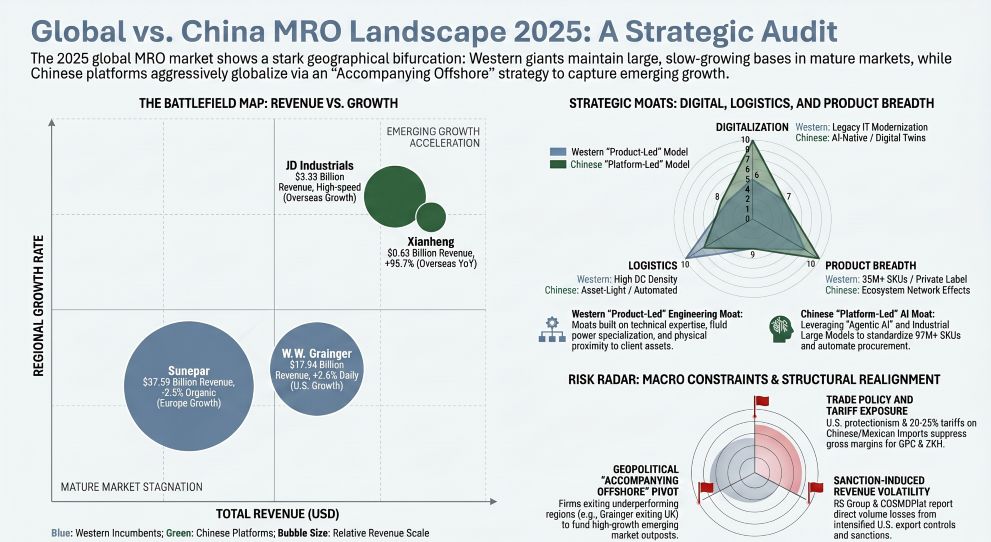
Aggressive U.S. tariff regimes targeting China and Mexico are triggering a structural margin squeeze across the MRO distribution sector. As NYSE: GPC absorbs a severe $1.5B credit shock and tariff-driven pricing volatility, Western incumbents like NYSE: GWW are capitulating on European operations—exiting the UK with a $196M loss. Conversely, Chinese challengers like NYSE: ZKH are executing an "Accompanying Offshore" strategy, establishing asset-light localized nodes like NorthSky Supply in Texas to bypass trade barriers. Capital allocation is radically bifurcating toward automation to offset supply chain friction and wage inflation.
Figure Global vs China MRO Landscape 2025
 Deconstructing Growth CapEx and Red Flag Anomalies
The 2025 financial disclosures reveal a severe divergence in capital productivity. Leading platforms are migrating away from traditional "Maintenance CapEx" (facility leases, standard IT) toward high-margin "Growth CapEx" anchored in Agentic AI and SaaS ecosystems. NYSE: GWW deployed $684M in 2025 CapEx, holding a massive $821M gross carrying amount in capitalized software. Similarly, Sonepar is actively executing its €1 billion ($1.13B) commitment to its proprietary Spark digital platform.
However, aggressive tech capitalization is simultaneously exposing deep internal control flaws and off-balance sheet liabilities across the peer group:
* Credit & Inventory Governance Failures: NYSE: GPC witnessed a catastrophic 92.7% net profit plunge, driven by a highly irregular $1.505B expected credit loss stemming from the bankruptcy of core supplier First Brands Group, compounded by a $742M pension liquidation. Concurrently, LSE: RS1 was forced into a retroactive $7.39M inventory provision restatement due to systematic classification errors in its U.S. operations.
* Shadow Banking & Sunk Costs: Secondary players face severe asset impairments. Chinese distributor Xianheng recorded a $15.94M mark-to-market loss on mid-risk trust wealth management products, effectively vaporizing 90% of the principal in an off-balance sheet shadow banking exposure. Meanwhile, NYSE: GWW’s complete exit from the UK via the divestiture of Cromwell and closure of Zoro UK crystallized a $196M SG&A loss with zero tax-deductible shielding, highlighting severe capital misallocation in prior European expansions.
Comparative Resilience and Labor Substitution
A geographical and demographic bifurcation dictates 2026 margin resilience. Western platforms are structurally over-indexed to sluggish mature markets (Europe and North America), while facing acute tariff exposure. NYSE: GPC's supply chain economics were severely disrupted by the 20% tariff on Chinese imports and 25% on Mexican/Canadian goods, forcing immediate nearshoring maneuvers.
To bypass these friction points, Chinese MROs are scaling localization strategies. NYSE: ZKH mitigates cross-border tariff risks by scaling its NorthSky Supply platform, leveraging seven localized distribution centers across Texas, California, and Illinois to guarantee 48-hour domestic fulfillment.
Technological labor substitution has become the primary driver of Operating Leverage (OpLev):
* Digital Twins & Anchor Concentration: Pre-IPO entity Kaos (COSMOPlat) outspends peers in predictive maintenance, funneling $41M in 9M2025 R&D to scale its COSMO-iMOM digital twin technology. This is deployed across 17 global Lighthouse Factories. However, its moat is highly fragile due to extreme ecosystem concentration; 58.9% ($362M) of its revenue is tethered to its parent, Haier Group.
* Human Capital Deflation: Headcount and revenue growth have fundamentally decoupled. NYSE: ZKH represents the absolute benchmark for labor substitution, shrinking its human workforce by 10.1% while deploying an AI Smart Workbench and ~5,000 RPA bots. This digital workforce execution resulted in an 8.8% reduction in Sales & Marketing OPEX while increasing customer procurement productivity by 50%.
* End-Market Pivot: Legacy manufacturing revenue is being aggressively swapped for datacenter and EV infrastructure. Sonepar generated $1.69B from datacenter infrastructure, while NYSE: AIT pivots its engineered fluid-power solutions away from heavy industrials toward North American semiconductor reshoring projects.
HDIN Institutional Perspective
The sector is entering a 'trough-discovery' phase. While NYSE: ZKH and JD Industrials (via its JoyIndustrial LLM) signal operational leverage through aggressive labor substitution (RPA deployment outpacing human headcount), Western incumbents are struggling with working capital governance and geopolitical whiplash. Management teams blaming 'macro headwinds' are actively masking delayed footprint rationalization. NYSE: GPC’s colossal $1.5B credit loss and LSE: RS1's inventory restatement suggest that the broader peer group's supply chain due diligence is severely lacking. Furthermore, NYSE: GWW’s un-tax-shielded $196M UK exit confirms that legacy distributors waited far too long to amputate bleeding overseas assets. Expect a compression in ROIC spreads through 1H2026 for distributors that fail to rotate CapEx out of physical warehousing and into proprietary industrial data layers.
Presentation Download & Video Access:
Click the PDF download link under 'Related Topics' to access the presentation of this report.
Click this link to watch the YouTube video.
HDIN Research is a premier global market intelligence and strategic advisory firm specializing in institutional-grade financial analysis, supply chain audits, and macroeconomic forecasting. Our dedicated sector analysts deliver actionable, data-driven insights tailored for private equity, hedge funds, and corporate strategy teams. Visit us at www.hdinresearch.com.
*This intelligence report was authored by HDIN Research analysts following a rigorous audit of official corporate filings. AI was utilized for data synthesis and structural drafting, with all strategic insights and financial data verified by our editorial board to ensure professional accuracy and compliance with 2026 search standards.*
Figure Global vs China MRO Landscape 2025
Deconstructing Growth CapEx and Red Flag AnomaliesThe 2025 financial disclosures reveal a severe divergence in capital productivity. Leading platforms are migrating away from traditional "Maintenance CapEx" (facility leases, standard IT) toward high-margin "Growth CapEx" anchored in Agentic AI and SaaS ecosystems. NYSE: GWW deployed $684M in 2025 CapEx, holding a massive $821M gross carrying amount in capitalized software. Similarly, Sonepar is actively executing its €1 billion ($1.13B) commitment to its proprietary Spark digital platform.
However, aggressive tech capitalization is simultaneously exposing deep internal control flaws and off-balance sheet liabilities across the peer group:
* Credit & Inventory Governance Failures: NYSE: GPC witnessed a catastrophic 92.7% net profit plunge, driven by a highly irregular $1.505B expected credit loss stemming from the bankruptcy of core supplier First Brands Group, compounded by a $742M pension liquidation. Concurrently, LSE: RS1 was forced into a retroactive $7.39M inventory provision restatement due to systematic classification errors in its U.S. operations.
* Shadow Banking & Sunk Costs: Secondary players face severe asset impairments. Chinese distributor Xianheng recorded a $15.94M mark-to-market loss on mid-risk trust wealth management products, effectively vaporizing 90% of the principal in an off-balance sheet shadow banking exposure. Meanwhile, NYSE: GWW’s complete exit from the UK via the divestiture of Cromwell and closure of Zoro UK crystallized a $196M SG&A loss with zero tax-deductible shielding, highlighting severe capital misallocation in prior European expansions.
Comparative Resilience and Labor Substitution
A geographical and demographic bifurcation dictates 2026 margin resilience. Western platforms are structurally over-indexed to sluggish mature markets (Europe and North America), while facing acute tariff exposure. NYSE: GPC's supply chain economics were severely disrupted by the 20% tariff on Chinese imports and 25% on Mexican/Canadian goods, forcing immediate nearshoring maneuvers.
To bypass these friction points, Chinese MROs are scaling localization strategies. NYSE: ZKH mitigates cross-border tariff risks by scaling its NorthSky Supply platform, leveraging seven localized distribution centers across Texas, California, and Illinois to guarantee 48-hour domestic fulfillment.
Technological labor substitution has become the primary driver of Operating Leverage (OpLev):
* Digital Twins & Anchor Concentration: Pre-IPO entity Kaos (COSMOPlat) outspends peers in predictive maintenance, funneling $41M in 9M2025 R&D to scale its COSMO-iMOM digital twin technology. This is deployed across 17 global Lighthouse Factories. However, its moat is highly fragile due to extreme ecosystem concentration; 58.9% ($362M) of its revenue is tethered to its parent, Haier Group.
* Human Capital Deflation: Headcount and revenue growth have fundamentally decoupled. NYSE: ZKH represents the absolute benchmark for labor substitution, shrinking its human workforce by 10.1% while deploying an AI Smart Workbench and ~5,000 RPA bots. This digital workforce execution resulted in an 8.8% reduction in Sales & Marketing OPEX while increasing customer procurement productivity by 50%.
* End-Market Pivot: Legacy manufacturing revenue is being aggressively swapped for datacenter and EV infrastructure. Sonepar generated $1.69B from datacenter infrastructure, while NYSE: AIT pivots its engineered fluid-power solutions away from heavy industrials toward North American semiconductor reshoring projects.
HDIN Institutional Perspective
The sector is entering a 'trough-discovery' phase. While NYSE: ZKH and JD Industrials (via its JoyIndustrial LLM) signal operational leverage through aggressive labor substitution (RPA deployment outpacing human headcount), Western incumbents are struggling with working capital governance and geopolitical whiplash. Management teams blaming 'macro headwinds' are actively masking delayed footprint rationalization. NYSE: GPC’s colossal $1.5B credit loss and LSE: RS1's inventory restatement suggest that the broader peer group's supply chain due diligence is severely lacking. Furthermore, NYSE: GWW’s un-tax-shielded $196M UK exit confirms that legacy distributors waited far too long to amputate bleeding overseas assets. Expect a compression in ROIC spreads through 1H2026 for distributors that fail to rotate CapEx out of physical warehousing and into proprietary industrial data layers.
Presentation Download & Video Access:
Click the PDF download link under 'Related Topics' to access the presentation of this report.
Click this link to watch the YouTube video.
HDIN Research is a premier global market intelligence and strategic advisory firm specializing in institutional-grade financial analysis, supply chain audits, and macroeconomic forecasting. Our dedicated sector analysts deliver actionable, data-driven insights tailored for private equity, hedge funds, and corporate strategy teams. Visit us at www.hdinresearch.com.
*This intelligence report was authored by HDIN Research analysts following a rigorous audit of official corporate filings. AI was utilized for data synthesis and structural drafting, with all strategic insights and financial data verified by our editorial board to ensure professional accuracy and compliance with 2026 search standards.*