SenseTime Group Inc. Executes "1+X" GenAI Pivot as Accelerated Receivables Recovery Signals Structural Turnaround in Mainland Core Operations
Date : 2026-05-07
Reading : 271
SenseTime Group Inc.’s 2025 financial disclosures reveal a decisive pivot away from heavily impaired legacy public-sector contracts toward high-velocity Generative AI monetization. Driven by a 51% surge in GenAI revenue, the firm slashed net losses by 58.6% and achieved positive H2 operating cash flow. By exporting its SenseCore domestic compute infrastructure to Saudi Arabia and spinning off its intelligent driving unit, management is proactively hedging against geopolitical semiconductor embargoes while forcefully restructuring the balance sheet to finance the hyper-scaling of its native multi-modal NEO architecture.
Margin Re-rating and Capital Allocation Shifts
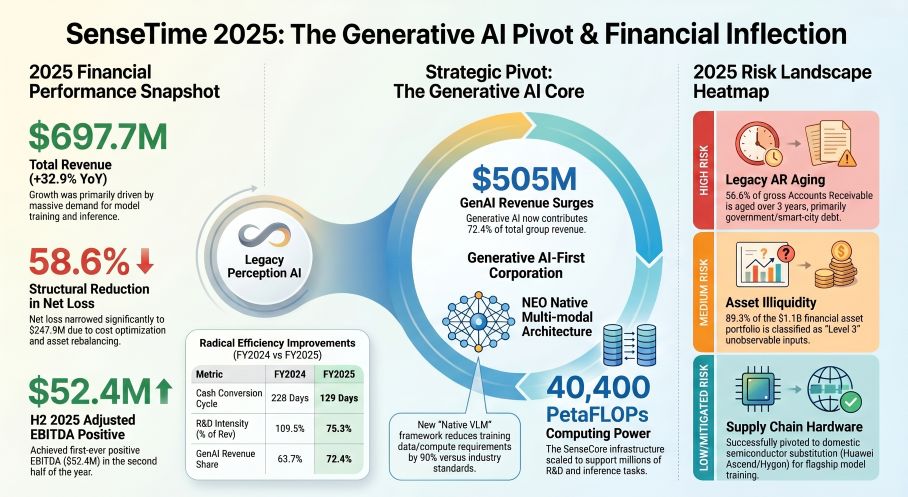
SenseTime (HKG: 0020) has fundamentally altered its unit economics. The strategic shift to an Artificial Intelligence Data Center (AIDC) model catalyzed a 32.9% top-line expansion to $697.69 million, while deliberately accepting a slight gross margin compression from 42.9% to 41.0%. This dilution is mathematically sound, reflecting the inherent hardware intensity of GenAI operations relative to pure software integration. More critically, the company achieved aggressive operating leverage: despite launching massive foundational models, R&D expenses contracted by 8.6% to $525.27 million, signaling an inflection point from capital-heavy algorithm exploration to commercial scale.
However, a forensic audit of the balance sheet reveals a severely bifurcated accounts receivable (AR) "barbell." Legacy government receivables over three years old constitute a staggering 56.6% of the gross AR base, forcing a $470.94 million Expected Credit Loss (ECL) provision. This structural illiquidity is aggressively counterbalanced by the $263.82 million influx of sub-6-month AR—a 119.6% year-over-year surge linked to GenAI traction. The rapid influx of higher-quality private sector revenue effectively collapsed the firm's overall Cash Conversion Cycle (CCC) from 228 days to a highly efficient 129 days. To insulate the core balance sheet from massive GenAI compute CapEx, management executed optimally timed equity placements, raising $1.08 billion globally across 2024 and 2025.
Figure SenseTime 2025: The Generative Al Pivot & Financial Inflection
 Native Architectures and Geopolitical Hedging
SenseTime’s operational moat now hinges on an extreme software-hardware co-optimization strategy designed to neutralize global hardware trade restrictions. The firm has scaled its SenseCore Advanced AI Data Center to 40,400 PetaFLOPS, systematically substituting constrained overseas GPUs with domestic silicon ecosystems, notably adapting to the Huawei Ascend 384 super node.
On the model frontier, the deployment of the proprietary NEO Native VLM architecture fundamentally bypasses the industry-standard "spliced" LLM structure. By achieving Native Embedding and Native Multi-head Attention at the kernel level, the NEO architecture requires just 1/10th of the training data and computing power of competitor equivalents. The LightX2V inference system validated this approach, achieving real-time physical world simulation exclusively on domestic manufacturing-constrained hardware. To de-risk mainland concentration, SenseTime has successfully exported this hardware-agnostic software stack, deploying China’s first exported domestic compute cluster in Saudi Arabia and establishing critical R&D joint ventures in Abu Dhabi and Singapore.
HDIN Institutional Perspective
While management heavily promotes the 119.6% year-over-year surge in short-term receivables as validation of GenAI commercial velocity, the balance sheet remains burdened by the toxic overhang of legacy smart-city underwriting. An ECL schedule necessitating the write-off of 56.47% of accounts receivable after just 24 months underscores structurally flawed historical capital allocation. Furthermore, the firm's $1.12 billion portfolio of Level 3 Fair Value Through Profit or Loss (FVPL) assets mechanically boosts net income via $89.88 million in mark-to-market gains. We challenge the quality of this bottom-line recovery: these highly illiquid, unobservable assets obscure the true operational cash-burn of SenseTime’s early-stage ecosystem joint ventures. The company's future ROE expansion relies entirely on whether the $504.97 million GenAI revenue engine can sustain its 51% growth trajectory without requiring proportional surges in working capital.
Presentation Download & Video Access:
Click the PDF download link under 'Related Topics' to access the presentation of this report.
Click this link to watch the YouTube video.
HDIN Research is a premier global market intelligence and strategic advisory firm specializing in institutional-grade financial analysis, supply chain audits, and macroeconomic forecasting. Our dedicated sector analysts deliver actionable, data-driven insights tailored for private equity, hedge funds, and corporate strategy teams. Visit us at www.hdinresearch.com.
*This intelligence report was authored by HDIN Research analysts following a rigorous audit of official corporate filings. AI was utilized for data synthesis and structural drafting, with all strategic insights and financial data verified by our editorial board to ensure professional accuracy and compliance with 2026 search standards.*
Margin Re-rating and Capital Allocation Shifts
SenseTime (HKG: 0020) has fundamentally altered its unit economics. The strategic shift to an Artificial Intelligence Data Center (AIDC) model catalyzed a 32.9% top-line expansion to $697.69 million, while deliberately accepting a slight gross margin compression from 42.9% to 41.0%. This dilution is mathematically sound, reflecting the inherent hardware intensity of GenAI operations relative to pure software integration. More critically, the company achieved aggressive operating leverage: despite launching massive foundational models, R&D expenses contracted by 8.6% to $525.27 million, signaling an inflection point from capital-heavy algorithm exploration to commercial scale.
However, a forensic audit of the balance sheet reveals a severely bifurcated accounts receivable (AR) "barbell." Legacy government receivables over three years old constitute a staggering 56.6% of the gross AR base, forcing a $470.94 million Expected Credit Loss (ECL) provision. This structural illiquidity is aggressively counterbalanced by the $263.82 million influx of sub-6-month AR—a 119.6% year-over-year surge linked to GenAI traction. The rapid influx of higher-quality private sector revenue effectively collapsed the firm's overall Cash Conversion Cycle (CCC) from 228 days to a highly efficient 129 days. To insulate the core balance sheet from massive GenAI compute CapEx, management executed optimally timed equity placements, raising $1.08 billion globally across 2024 and 2025.
Figure SenseTime 2025: The Generative Al Pivot & Financial Inflection
Native Architectures and Geopolitical HedgingSenseTime’s operational moat now hinges on an extreme software-hardware co-optimization strategy designed to neutralize global hardware trade restrictions. The firm has scaled its SenseCore Advanced AI Data Center to 40,400 PetaFLOPS, systematically substituting constrained overseas GPUs with domestic silicon ecosystems, notably adapting to the Huawei Ascend 384 super node.
On the model frontier, the deployment of the proprietary NEO Native VLM architecture fundamentally bypasses the industry-standard "spliced" LLM structure. By achieving Native Embedding and Native Multi-head Attention at the kernel level, the NEO architecture requires just 1/10th of the training data and computing power of competitor equivalents. The LightX2V inference system validated this approach, achieving real-time physical world simulation exclusively on domestic manufacturing-constrained hardware. To de-risk mainland concentration, SenseTime has successfully exported this hardware-agnostic software stack, deploying China’s first exported domestic compute cluster in Saudi Arabia and establishing critical R&D joint ventures in Abu Dhabi and Singapore.
HDIN Institutional Perspective
While management heavily promotes the 119.6% year-over-year surge in short-term receivables as validation of GenAI commercial velocity, the balance sheet remains burdened by the toxic overhang of legacy smart-city underwriting. An ECL schedule necessitating the write-off of 56.47% of accounts receivable after just 24 months underscores structurally flawed historical capital allocation. Furthermore, the firm's $1.12 billion portfolio of Level 3 Fair Value Through Profit or Loss (FVPL) assets mechanically boosts net income via $89.88 million in mark-to-market gains. We challenge the quality of this bottom-line recovery: these highly illiquid, unobservable assets obscure the true operational cash-burn of SenseTime’s early-stage ecosystem joint ventures. The company's future ROE expansion relies entirely on whether the $504.97 million GenAI revenue engine can sustain its 51% growth trajectory without requiring proportional surges in working capital.
Presentation Download & Video Access:
Click the PDF download link under 'Related Topics' to access the presentation of this report.
Click this link to watch the YouTube video.
HDIN Research is a premier global market intelligence and strategic advisory firm specializing in institutional-grade financial analysis, supply chain audits, and macroeconomic forecasting. Our dedicated sector analysts deliver actionable, data-driven insights tailored for private equity, hedge funds, and corporate strategy teams. Visit us at www.hdinresearch.com.
*This intelligence report was authored by HDIN Research analysts following a rigorous audit of official corporate filings. AI was utilized for data synthesis and structural drafting, with all strategic insights and financial data verified by our editorial board to ensure professional accuracy and compliance with 2026 search standards.*