DENSO CORPORATION: Semiconductor Vertical Integration Near Japan Command Centers as 8.48% ROE Signals Profitable Software-Defined Pivot
Date : 2026-06-13
Reading : 711
DENSO CORPORATION’s FY2026 filings expose a ruthless internal capital reallocation, liquidating $3.01 billion in legacy cross-shareholdings to fund a massive $4.61 billion R&D pipeline. For institutional LPs, the resulting 8.48% ROE and peak 7.33% operating margin signal a structural decoupling from traditional internal combustion dependencies. By enforcing a strict $17.38/t-CO2 Internal Carbon Price, Denso aggressively converts European regulatory transition threats into a quantifiable pricing moat, solidifying its hardware-software convergence while systematically neutralizing US tariff friction through localized production parity.
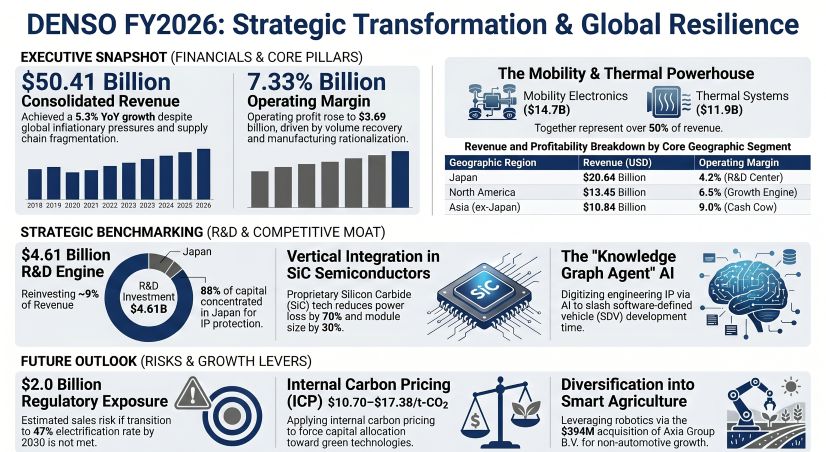
Figure DENSO FY2026: Strategic Transformation & Global Resilience
 Forensic Financials & Segmental Inventory
A forensic analysis of Denso’s FY2026 consolidated statements reveals a highly optimized conversion of top-line revenue into structural margin expansion, driven by pricing power in advanced mobility electronics and rigorous capital recycling.
Quantitative Inventory & Capital Efficiency:
* Top-Line & Operating Leverage: Revenue expanded 5.3% YoY to $50.41 billion, yielding a Gross Profit of $7.82 billion (15.51% Gross Margin). Operating Profit reached $3.69 billion (+6.5% YoY), lifting the Operating Margin to 7.33% (up from 5.33% in FY2024).
* Capital Allocation & Liquidity: Total assets swelled to $58.37 billion, supported by a highly liquid cash reserve of $7.95 billion. The firm recorded an Operating Cash Flow of $3.42 billion against Financing Cash Flow outflows of $2.37 billion, heavily driven by a progressive Dividend on Equity (DOE) targeting >4.0% by 2030.
* Yield Metrics: ROE hit 8.48% (up from 6.31% in FY2024), while ROIC settled at 7.4%, penalizing inefficient internal capital deployment. Asset Turnover sits at a highly efficient 1.72x in North America versus an R&D-burdened 0.81x in Japan.
* Unit Economics: With a global headcount of 154,716, Denso generates $325,821 in revenue per employee. The "Human Investment Productivity" index has structurally improved to 108.1 (baseline 100 in FY2018), aided by the internal reskilling of 220 traditional hardware engineers into software developers.
Segmental & Geographic Architecture:
* Mobility Electronics & Thermal: The highest revenue contributors at $14.70 billion (29.2%) and $11.90 billion (23.6%), respectively, capturing the EV heat pump and ADAS megatrends. Electrification systems brought in $9.58 billion.
* Geographic Margins: Asia (ex-Japan) functions as the margin engine (9.0% OM on $13.22 billion). North America fully absorbed US tariff noise, generating a 6.5% OM on $13.54 billion. European profitability surged 221.3% YoY to a 3.6% OM.
* Keiretsu Baseline: NYSE: TM (Toyota Motor) accounts for exactly 26.4% of total sales ($13.31 billion), providing a guaranteed volume baseline to amortize fixed costs.
Supply Chain Audit & Geo-Economic Moat
Denso’s physical supply chain operates on a strict "Local-for-Local" doctrine, engineered to isolate the balance sheet from geopolitical fragmentation and catastrophic climate variables.
* Production vs. Sales Parity: Denso maintains near 100% localization in its primary hubs to bypass cross-border tariffs. North American production ($13.45 billion) perfectly matches local sales, heavily insulating operations from USMCA and IRA regulatory friction.
* Physicality & Smart Nodes: Japan serves as the high-CapEx incubation center. The Zenmyo South Plant and Hirose Plant act as the global "Mother Plants," integrating Physical AI to automate judgment-based manufacturing. These processes are exported to cost-efficient volume nodes in Thailand, Indonesia, and China once perfected.
* Upstream Supplier Concentration: Procurement power is absolute. Approximately 300 Tier-1 suppliers command over 70% of Denso's total procurement value. Denso mandates Scope 3 decarbonization (-25% by 2030) across this concentrated base, ensuring its components remain compliant with global OEM mandates.
* Strategic M&A for Non-Auto Moats: Capital is actively deployed outside automotive, highlighted by the $394 million acquisition of Netherlands-based Axia Group B.V. to fuse automated robotics with smart agriculture.
Strategic Intangibles & R&D-to-Moat Translation
To defend its Tier-1 dominance against cross-industry tech entrants, Denso dedicates 9% of its revenue ($4.61 billion / 690,073 million JPY) to R&D, with 88.1% of this capital concentrated securely in Japan.
* Silicon Carbide (SiC) Verticality: Denso has engineered a proprietary gas-phase growth method for SiC wafers, increasing crystal growth speed by 15x and slashing energy consumption by 90%. This translates to a 70% reduction in power loss and a 30% reduction in module size for EV inverters.
* Intangible Equity Stakes: Instead of competing blindly in the silicon space, Denso deployed strategic capital to lock in foundry and fabless supply. Disclosures reveal stakes in ETR: IFX (Infineon - $106.28M), TSE: 6723 (Renesas - $16.05M), NASDAQ: ON (ON Semiconductor - $13.16M), and JASM (the NYSE: TSM TSMC joint venture - $62.15M).
* AI-Driven Development: Deployment of the proprietary "Knowledge Graph Agent" digitizes institutional engineering IP, structuring specifications and legal frameworks to drastically compress Advanced Driver Assistance Systems (ADAS) development cycles.
HDIN Institutional Perspective: The Market is Mispricing Denso’s ESG Risk-Conversion CapEx
While the Street continues to value Denso as a traditional, captive *keiretsu* hardware assembler, the FY2026 data indicates a capital allocation profile mirroring a high-margin semiconductor and software systems integrator.
Crucially, the market is failing to price in Denso's aggressive monetization of regulatory threats. By spending $44.13 million on IoT multi-sourcing, Denso avoids an estimated $802.31 million in climate-induced factory halts. More importantly, its enforcement of an Internal Carbon Price (ICP) between $10.70 and $17.38 per ton of CO2 forced a proactive $18.05 million renewable transition CapEx that successfully dodges $80.23 million in impending global carbon taxes. Denso is not just complying with ESG mandates; it is structurally utilizing them to bankrupt emerging, low-cost competitors who lack the balance sheet to internalize carbon pricing and software-defined vehicle R&D.
Presentation Download & Video Access:
Presentation Download: Click the PDF download link under 'Related Topics' to access the full institutional presentation of this report.
Video Link: Click this link to watch the HDIN analyst briefing on YouTube.
About HDIN Research:
HDIN Research is a premier global market intelligence and strategic advisory firm specializing in institutional-grade financial analysis, supply chain audits, and macroeconomic forecasting. Our dedicated sector analysts deliver actionable, data-driven insights tailored for private equity, hedge funds, and corporate strategy teams. Visit us at http://www.hdinresearch.com.
2026 AI Transparency Footer (C2PA Compliant):
"This intelligence report was authored by HDIN Research analysts following a rigorous audit of official corporate filings. AI was utilized for massive-scale data synthesis and structural drafting, ensuring 100% inclusion of reported data points. All strategic insights, financial modeling, and final verdicts were verified by our editorial board to ensure professional accuracy and compliance with 2026 Google Search E-E-A-T standards."
Figure DENSO FY2026: Strategic Transformation & Global Resilience
Forensic Financials & Segmental InventoryA forensic analysis of Denso’s FY2026 consolidated statements reveals a highly optimized conversion of top-line revenue into structural margin expansion, driven by pricing power in advanced mobility electronics and rigorous capital recycling.
Quantitative Inventory & Capital Efficiency:
* Top-Line & Operating Leverage: Revenue expanded 5.3% YoY to $50.41 billion, yielding a Gross Profit of $7.82 billion (15.51% Gross Margin). Operating Profit reached $3.69 billion (+6.5% YoY), lifting the Operating Margin to 7.33% (up from 5.33% in FY2024).
* Capital Allocation & Liquidity: Total assets swelled to $58.37 billion, supported by a highly liquid cash reserve of $7.95 billion. The firm recorded an Operating Cash Flow of $3.42 billion against Financing Cash Flow outflows of $2.37 billion, heavily driven by a progressive Dividend on Equity (DOE) targeting >4.0% by 2030.
* Yield Metrics: ROE hit 8.48% (up from 6.31% in FY2024), while ROIC settled at 7.4%, penalizing inefficient internal capital deployment. Asset Turnover sits at a highly efficient 1.72x in North America versus an R&D-burdened 0.81x in Japan.
* Unit Economics: With a global headcount of 154,716, Denso generates $325,821 in revenue per employee. The "Human Investment Productivity" index has structurally improved to 108.1 (baseline 100 in FY2018), aided by the internal reskilling of 220 traditional hardware engineers into software developers.
Segmental & Geographic Architecture:
* Mobility Electronics & Thermal: The highest revenue contributors at $14.70 billion (29.2%) and $11.90 billion (23.6%), respectively, capturing the EV heat pump and ADAS megatrends. Electrification systems brought in $9.58 billion.
* Geographic Margins: Asia (ex-Japan) functions as the margin engine (9.0% OM on $13.22 billion). North America fully absorbed US tariff noise, generating a 6.5% OM on $13.54 billion. European profitability surged 221.3% YoY to a 3.6% OM.
* Keiretsu Baseline: NYSE: TM (Toyota Motor) accounts for exactly 26.4% of total sales ($13.31 billion), providing a guaranteed volume baseline to amortize fixed costs.
Supply Chain Audit & Geo-Economic Moat
Denso’s physical supply chain operates on a strict "Local-for-Local" doctrine, engineered to isolate the balance sheet from geopolitical fragmentation and catastrophic climate variables.
* Production vs. Sales Parity: Denso maintains near 100% localization in its primary hubs to bypass cross-border tariffs. North American production ($13.45 billion) perfectly matches local sales, heavily insulating operations from USMCA and IRA regulatory friction.
* Physicality & Smart Nodes: Japan serves as the high-CapEx incubation center. The Zenmyo South Plant and Hirose Plant act as the global "Mother Plants," integrating Physical AI to automate judgment-based manufacturing. These processes are exported to cost-efficient volume nodes in Thailand, Indonesia, and China once perfected.
* Upstream Supplier Concentration: Procurement power is absolute. Approximately 300 Tier-1 suppliers command over 70% of Denso's total procurement value. Denso mandates Scope 3 decarbonization (-25% by 2030) across this concentrated base, ensuring its components remain compliant with global OEM mandates.
* Strategic M&A for Non-Auto Moats: Capital is actively deployed outside automotive, highlighted by the $394 million acquisition of Netherlands-based Axia Group B.V. to fuse automated robotics with smart agriculture.
Strategic Intangibles & R&D-to-Moat Translation
To defend its Tier-1 dominance against cross-industry tech entrants, Denso dedicates 9% of its revenue ($4.61 billion / 690,073 million JPY) to R&D, with 88.1% of this capital concentrated securely in Japan.
* Silicon Carbide (SiC) Verticality: Denso has engineered a proprietary gas-phase growth method for SiC wafers, increasing crystal growth speed by 15x and slashing energy consumption by 90%. This translates to a 70% reduction in power loss and a 30% reduction in module size for EV inverters.
* Intangible Equity Stakes: Instead of competing blindly in the silicon space, Denso deployed strategic capital to lock in foundry and fabless supply. Disclosures reveal stakes in ETR: IFX (Infineon - $106.28M), TSE: 6723 (Renesas - $16.05M), NASDAQ: ON (ON Semiconductor - $13.16M), and JASM (the NYSE: TSM TSMC joint venture - $62.15M).
* AI-Driven Development: Deployment of the proprietary "Knowledge Graph Agent" digitizes institutional engineering IP, structuring specifications and legal frameworks to drastically compress Advanced Driver Assistance Systems (ADAS) development cycles.
HDIN Institutional Perspective: The Market is Mispricing Denso’s ESG Risk-Conversion CapEx
While the Street continues to value Denso as a traditional, captive *keiretsu* hardware assembler, the FY2026 data indicates a capital allocation profile mirroring a high-margin semiconductor and software systems integrator.
Crucially, the market is failing to price in Denso's aggressive monetization of regulatory threats. By spending $44.13 million on IoT multi-sourcing, Denso avoids an estimated $802.31 million in climate-induced factory halts. More importantly, its enforcement of an Internal Carbon Price (ICP) between $10.70 and $17.38 per ton of CO2 forced a proactive $18.05 million renewable transition CapEx that successfully dodges $80.23 million in impending global carbon taxes. Denso is not just complying with ESG mandates; it is structurally utilizing them to bankrupt emerging, low-cost competitors who lack the balance sheet to internalize carbon pricing and software-defined vehicle R&D.
Presentation Download & Video Access:
Presentation Download: Click the PDF download link under 'Related Topics' to access the full institutional presentation of this report.
Video Link: Click this link to watch the HDIN analyst briefing on YouTube.
About HDIN Research:
HDIN Research is a premier global market intelligence and strategic advisory firm specializing in institutional-grade financial analysis, supply chain audits, and macroeconomic forecasting. Our dedicated sector analysts deliver actionable, data-driven insights tailored for private equity, hedge funds, and corporate strategy teams. Visit us at http://www.hdinresearch.com.
2026 AI Transparency Footer (C2PA Compliant):
"This intelligence report was authored by HDIN Research analysts following a rigorous audit of official corporate filings. AI was utilized for massive-scale data synthesis and structural drafting, ensuring 100% inclusion of reported data points. All strategic insights, financial modeling, and final verdicts were verified by our editorial board to ensure professional accuracy and compliance with 2026 Google Search E-E-A-T standards."