Hitachi, Ltd. Global Integration: European HVDC Capacity Demands Drive CapEx to $5.35 Billion as Software Yields Offset Legacy Impairment Friction
Date : 2026-06-24
Reading : 206
HDIN Executive Takeaways
* Hitachi’s +24.2% expansion in heavy infrastructure backlog to $140.06 billion secures multi-decade revenue, though 92% of orders mature beyond a 12-month window, locking the firm into fixed-price macroeconomic and procurement risks.
* European market operations recorded a +20% top-line surge to $15.21 billion, eclipsing the +4% growth profile in Asia, driven mathematically by a +44% regional spike in energy infrastructure deployments.
* The balance sheet carries a $17.70 billion goodwill concentration—equating to 39% of total equity—mandating flawless 15.3% margin extraction from the Lumada 3.0 software ecosystem to absorb ongoing $1.37 billion asset write-downs.
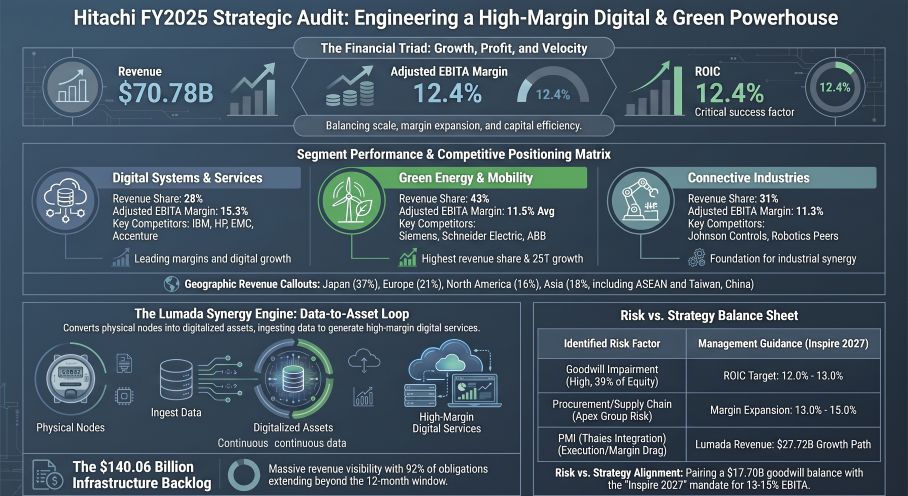
Figure Hitachi FY2025 Strategic Audit: Engineering a High-Margin Digital & Green Powerhouse
 Segmental Realities and Margin Compression
Hitachi, Ltd. [TSE: 6501] is actively shedding legacy cyclical assets to execute a software-hardware convergence strategy. Management reduced its ownership stake in the Hitachi Astemo automotive segment to 40.0%, reclassifying it as an equity-method associate, and formalized an agreement to divest its Johnson Controls-Hitachi Air Conditioning (JCH) joint venture to Robert Bosch GmbH and Johnson Controls.
This asset divestiture phase is juxtaposed against intense capital allocation toward the Green Energy & Mobility and Digital Systems & Services (DSS) units. The firm finalized post-merger integration (PMI) protocols for Thales’s Ground Transportation Systems and acquired AI consulting firm synvert, alongside historical mega-acquisitions of GlobalLogic and ABB Power Grids (now Hitachi Energy).
The following structured data captures 100% of the disclosed FY2025 financial parameters (converting JPY to USD at 149.5686), mapping the fiscal period ending March 31, 2026.
Table 1: Consolidated Operations & Capital Matrix
Table 2: Balance Sheet & Vulnerability Profiling
Segmental Revenue & Yield Realization
* Digital Systems & Services (DSS): Reached $19.66 billion (2,940 billion JPY) with a +4% YoY growth. Adjusted EBITA totaled $3.01 billion (450 billion JPY). The segment secured a 15.3% margin, expanding by +140 basis points YoY.
* Green Energy & Mobility: Combined revenue totaled $30.37 billion.
* *Energy:* Delivered $21.53 billion (3,219.9 billion JPY) at +23% YoY. The Power Grids subdivision generated $20.09 billion of this total. Adjusted EBITA hit $2.78 billion (416 billion JPY), establishing a 12.9% margin (+330 bps YoY).
* *Mobility:* Reached $8.84 billion (1,321.5 billion JPY) at +13% YoY. Adjusted EBITA was $0.72 billion (108.1 billion JPY). The segment posted an 8.2% margin (+10 bps YoY). Mobility absorbed $90.2 million (13.5 billion JPY) in specific Thales PMI "Related Costs." Without this drag, underlying margin operated at 9.2%.
* Connective Industries: Totaled $21.81 billion (3,262.7 billion JPY), reflecting a -1% YoY contraction. Adjusted EBITA reached $2.46 billion (367.3 billion JPY) with an 11.3% margin (+80 bps YoY).
* Lumada Data Ecosystem: Proprietary revenues reached $27.72 billion (4,146.0 billion JPY), establishing a +6.3% YoY growth trajectory from the FY2024 baseline of $26.07 billion (3,900.0 billion JPY).
*IFRS 15 Remaining Performance Obligations (Backlog Duration)*
The core infrastructure backlog jumped from $112.75 billion (16,863.3 billion JPY) to $140.06 billion (20,949.2 billion JPY). Recognition schedules exhibit acute long-tail characteristics:
* Within 1 Year: $11.50 billion (1,720.1 billion JPY) — 8.2%
* 1 to 3 Years: $66.63 billion (9,966.3 billion JPY) — 47.6%
* 3 to 5 Years: $47.50 billion (7,103.5 billion JPY) — 33.9%
* Over 5 Years: $14.44 billion (2,159.1 billion JPY) — 10.3%
Infrastructure Layout and Regional Moats
Hitachi operates across a "Global 6-Pole" command architecture, isolating supply chain operations regionally across the Americas, EMEA, and APAC to hedge against procurement logistics shocks. In FY2025, overseas operations generated $44.62 billion (6,673.9 billion JPY), representing 63% of aggregate firm revenue.
* Europe: Reached $15.21 billion (2,274.9 billion JPY) with a +20% YoY growth rate, representing 21% of total revenue. Energy hardware deployments surged +44% YoY, while Mobility grew +13%. Operations are anchored by Hitachi Rail Ltd. (UK) and Hitachi Energy Ltd. (Switzerland). The region executes the UK Intercity Express Programme (Class 800 rolling stock) and the Eastern Green Link 3 High-Voltage Direct Current (HVDC) power grid installation.
* North America: Generated $11.06 billion (1,653.8 billion JPY), comprising 16% of firm revenue with a +8% YoY growth. The Energy sector expanded +17% YoY and Mobility advanced +20%. The US serves as the software engineering vanguard, hosting GlobalLogic Worldwide Holdings, Hitachi Vantara LLC, Hitachi Digital LLC, Hitachi Global Air Power, and JR Technology Group. Mobility hardware is synthesized via the Hitachi Rail Hagerstown Factory and the Hitachi Rail CBTC Solutions Headquarters.
* Asia: Posted $12.81 billion (1,915.9 billion JPY) at a +4% YoY growth, equating to 18% of firm revenue. Energy and Mobility maintained +12% and +15% YoY growth, respectively. Operations are directed by Hitachi Asia Ltd. and Hitachi India Pvt. Ltd., covering mainland China, ASEAN territories, and Taiwan, China.
* Japan: Represented $26.16 billion (3,912.8 billion JPY), holding 37% of firm revenue with +4% YoY growth.
* Other Areas: Accounted for $5.54 billion (829.2 billion JPY) at +14% YoY growth, representing 8% of the total.
* Joint Ventures and Strategic Rivalries: The firm executes within a complex partnership network, co-managing Nuclear Energy Holdings alongside GE Vernova and legacy joint-venture integrations via ABB. Operations are benchmarked against legacy IT providers IBM, HP (Hewlett Packard Enterprise), and EMC Corporation, as well as industrial automation competitors Siemens, Schneider Electric, and Accenture. Arcelik Hitachi Home Appliances B.V. commands remaining European appliance operations from the Netherlands.
Hitachi integrates an "IT × OT × Products" framework, substituting consumer LLMs with its Integrated World Infrastructure Model (IWIM). This proprietary AI digests physics simulations—specifically heat/fluid dynamics and electrical current characteristics—to govern the operational technology of its hardware. Physical engineering workflows utilize "Naivy" (Frontline Coordinator) and "Navigator AI". R&D capital is currently diverted toward "Next-generation AI infrastructure", silicon quantum computing, and space big data utilization. The firm trained 39,000 "AI Professionals" in FY2025, establishing a mandate to reach 50,000 by FY2027.
HDIN Institutional Verdict
The "Inspire 2027" mid-term targets compel Hitachi to execute an Adjusted EBITA margin of 13.0% to 15.0% and an ROIC of 12.0% to 13.0%. To align executive execution, the "Company with Nominating Committee, etc." governance framework utilizes a highly leveraged compensation ratio of Base (1.0) : STI (1.5) : LTI (3.0). The Short-Term Incentive algorithm is fixed to Consolidated Performance (70%), Sustainability (20%), and Individual Objectives (10%). The Long-Term Incentive operates on Restricted Stock Units (30%) and Performance units (70%). LTI payout requires Total Shareholder Return outperformance against the TOPIX (35%) and Global Peers (35%), paired with rigid 10% modifiers for both ROIC and carbon neutrality ESG mandates (Scope 1 and 2 reductions by 2030; net-zero by 2050).
By benchmarking these governance mandates against Hitachi’s FY2025 Enterprise Risk Management matrix, a clear structural dichotomy emerges. Management correctly categorizes "Procurement" and "Human Resources" as highest-impact Group Top Risks. Because 92% of the $140.06 billion backlog extends past one year, legacy fixed-price Engineering, Procurement, and Construction (EPC) contracts remain highly exposed to "loss costs" (cost overruns) driven by raw material inflation. The $90.2 million PMI drag in the Thales integration proves that consolidating legacy European hardware into the Lumada ecosystem requires steep initial capital friction.
However, by scaling CapEx to $5.35 billion to capture AI data center power grid demand, the firm guarantees localized hardware dominance in North America and Europe. The mathematical pathway to the 15.0% EBITA ceiling relies purely on the 15.3% margin DSS segment out-scaling the heavier 8.2% margin Mobility sector. Assuming the $17.70 billion goodwill load does not trigger further impairment events beyond the current $1.37 billion attrition rate, the recurring SaaS revenues tethered to Lumada effectively insulate the balance sheet from cyclic industrial downturns.
Presentation Download & Video Access:
- Presentation Download: Click the PDF download link under 'Related Topics' to access the full institutional presentation of this report.
- Video Link: Click this link to watch the HDIN analyst briefing on YouTube.
About HDIN Research:
HDIN Research is a premier global market intelligence and strategic advisory firm specializing in institutional-grade financial analysis, supply chain audits, and macroeconomic forecasting. Our dedicated sector analysts deliver actionable, data-driven insights tailored for private equity, hedge funds, and corporate strategy teams. Visit us at http://www.hdinresearch.com.
*2026 AI Transparency Footer:*
"This intelligence report was authored by HDIN Research analysts following a rigorous audit of official corporate filings. AI was utilized for massive-scale data synthesis and structural drafting, ensuring 100% inclusion of reported data points. All strategic insights, financial modeling, and final verdicts were verified by our editorial board to ensure professional accuracy and compliance with 2026 Google Search E-E-A-T standards."
* Hitachi’s +24.2% expansion in heavy infrastructure backlog to $140.06 billion secures multi-decade revenue, though 92% of orders mature beyond a 12-month window, locking the firm into fixed-price macroeconomic and procurement risks.
* European market operations recorded a +20% top-line surge to $15.21 billion, eclipsing the +4% growth profile in Asia, driven mathematically by a +44% regional spike in energy infrastructure deployments.
* The balance sheet carries a $17.70 billion goodwill concentration—equating to 39% of total equity—mandating flawless 15.3% margin extraction from the Lumada 3.0 software ecosystem to absorb ongoing $1.37 billion asset write-downs.
Figure Hitachi FY2025 Strategic Audit: Engineering a High-Margin Digital & Green Powerhouse
Segmental Realities and Margin CompressionHitachi, Ltd. [TSE: 6501] is actively shedding legacy cyclical assets to execute a software-hardware convergence strategy. Management reduced its ownership stake in the Hitachi Astemo automotive segment to 40.0%, reclassifying it as an equity-method associate, and formalized an agreement to divest its Johnson Controls-Hitachi Air Conditioning (JCH) joint venture to Robert Bosch GmbH and Johnson Controls.
This asset divestiture phase is juxtaposed against intense capital allocation toward the Green Energy & Mobility and Digital Systems & Services (DSS) units. The firm finalized post-merger integration (PMI) protocols for Thales’s Ground Transportation Systems and acquired AI consulting firm synvert, alongside historical mega-acquisitions of GlobalLogic and ABB Power Grids (now Hitachi Energy).
The following structured data captures 100% of the disclosed FY2025 financial parameters (converting JPY to USD at 149.5686), mapping the fiscal period ending March 31, 2026.
Table 1: Consolidated Operations & Capital Matrix
| Metric | FY2024 Actual | FY2025 Actual | Variance / Margin |
|---|---|---|---|
| Total Revenue | $65.41B (9,783.37B JPY) | $70.78B (10,586.78B JPY) | +8.2% YoY |
| Adjusted EBITA | $7.24B (1,083.5B JPY) | $8.77B (1,311.4B JPY) | Margin: 12.4% (+130 bps) |
| Net Income (Attributable) | $4.12B (615.7B JPY) | $5.36B (802.4B JPY) | +30.1% YoY |
| Free Cash Flow (FCF) | $4.00B (598.6B JPY) | $8.87B (1,326.5B JPY) | +121.7% YoY |
| Return on Invested Capital | 10.3% | 12.4% | +210 bps YoY |
| Return on Equity (ROE) | 10.7% | 12.9% | +220 bps YoY |
| Capital Expenditures | $2.87B (428.6B JPY) | $5.35B (800.0B JPY) | +86.4% YoY |
| R&D Expenditure | $1.89B (282.7B JPY) | $1.92B (287.9B JPY) | +1.6% YoY |
Table 2: Balance Sheet & Vulnerability Profiling
| Ledger Item | FY2024 Value | FY2025 Value | Strategic Context |
|---|---|---|---|
| Cash & Cash Equivalents | $5.79B (866.1B JPY) | $8.85B (1,323.5B JPY) | +52.8% Liquidity expansion |
| Total Equity | $40.33B (6,031.4B JPY) | $45.28B (6,772.6B JPY) | Book value expansion |
| Goodwill Asset Accumulation | $16.63B (2,486.8B JPY) | $17.70B (2,647.5B JPY) | Comprises 39% of Total Equity |
| Recognized Impairment | $1.26B (189.0B JPY) | $1.37B (204.9B JPY) | Discounted at 1.9%–2.6% (0.5% terminal) |
| Interest-Bearing Debt | N/A | $26.40B (3,949.2B JPY) | D/E Ratio: 0.58x (down from 0.59x) |
Segmental Revenue & Yield Realization
* Digital Systems & Services (DSS): Reached $19.66 billion (2,940 billion JPY) with a +4% YoY growth. Adjusted EBITA totaled $3.01 billion (450 billion JPY). The segment secured a 15.3% margin, expanding by +140 basis points YoY.
* Green Energy & Mobility: Combined revenue totaled $30.37 billion.
* *Energy:* Delivered $21.53 billion (3,219.9 billion JPY) at +23% YoY. The Power Grids subdivision generated $20.09 billion of this total. Adjusted EBITA hit $2.78 billion (416 billion JPY), establishing a 12.9% margin (+330 bps YoY).
* *Mobility:* Reached $8.84 billion (1,321.5 billion JPY) at +13% YoY. Adjusted EBITA was $0.72 billion (108.1 billion JPY). The segment posted an 8.2% margin (+10 bps YoY). Mobility absorbed $90.2 million (13.5 billion JPY) in specific Thales PMI "Related Costs." Without this drag, underlying margin operated at 9.2%.
* Connective Industries: Totaled $21.81 billion (3,262.7 billion JPY), reflecting a -1% YoY contraction. Adjusted EBITA reached $2.46 billion (367.3 billion JPY) with an 11.3% margin (+80 bps YoY).
* Lumada Data Ecosystem: Proprietary revenues reached $27.72 billion (4,146.0 billion JPY), establishing a +6.3% YoY growth trajectory from the FY2024 baseline of $26.07 billion (3,900.0 billion JPY).
*IFRS 15 Remaining Performance Obligations (Backlog Duration)*
The core infrastructure backlog jumped from $112.75 billion (16,863.3 billion JPY) to $140.06 billion (20,949.2 billion JPY). Recognition schedules exhibit acute long-tail characteristics:
* Within 1 Year: $11.50 billion (1,720.1 billion JPY) — 8.2%
* 1 to 3 Years: $66.63 billion (9,966.3 billion JPY) — 47.6%
* 3 to 5 Years: $47.50 billion (7,103.5 billion JPY) — 33.9%
* Over 5 Years: $14.44 billion (2,159.1 billion JPY) — 10.3%
Infrastructure Layout and Regional Moats
Hitachi operates across a "Global 6-Pole" command architecture, isolating supply chain operations regionally across the Americas, EMEA, and APAC to hedge against procurement logistics shocks. In FY2025, overseas operations generated $44.62 billion (6,673.9 billion JPY), representing 63% of aggregate firm revenue.
* Europe: Reached $15.21 billion (2,274.9 billion JPY) with a +20% YoY growth rate, representing 21% of total revenue. Energy hardware deployments surged +44% YoY, while Mobility grew +13%. Operations are anchored by Hitachi Rail Ltd. (UK) and Hitachi Energy Ltd. (Switzerland). The region executes the UK Intercity Express Programme (Class 800 rolling stock) and the Eastern Green Link 3 High-Voltage Direct Current (HVDC) power grid installation.
* North America: Generated $11.06 billion (1,653.8 billion JPY), comprising 16% of firm revenue with a +8% YoY growth. The Energy sector expanded +17% YoY and Mobility advanced +20%. The US serves as the software engineering vanguard, hosting GlobalLogic Worldwide Holdings, Hitachi Vantara LLC, Hitachi Digital LLC, Hitachi Global Air Power, and JR Technology Group. Mobility hardware is synthesized via the Hitachi Rail Hagerstown Factory and the Hitachi Rail CBTC Solutions Headquarters.
* Asia: Posted $12.81 billion (1,915.9 billion JPY) at a +4% YoY growth, equating to 18% of firm revenue. Energy and Mobility maintained +12% and +15% YoY growth, respectively. Operations are directed by Hitachi Asia Ltd. and Hitachi India Pvt. Ltd., covering mainland China, ASEAN territories, and Taiwan, China.
* Japan: Represented $26.16 billion (3,912.8 billion JPY), holding 37% of firm revenue with +4% YoY growth.
* Other Areas: Accounted for $5.54 billion (829.2 billion JPY) at +14% YoY growth, representing 8% of the total.
* Joint Ventures and Strategic Rivalries: The firm executes within a complex partnership network, co-managing Nuclear Energy Holdings alongside GE Vernova and legacy joint-venture integrations via ABB. Operations are benchmarked against legacy IT providers IBM, HP (Hewlett Packard Enterprise), and EMC Corporation, as well as industrial automation competitors Siemens, Schneider Electric, and Accenture. Arcelik Hitachi Home Appliances B.V. commands remaining European appliance operations from the Netherlands.
Hitachi integrates an "IT × OT × Products" framework, substituting consumer LLMs with its Integrated World Infrastructure Model (IWIM). This proprietary AI digests physics simulations—specifically heat/fluid dynamics and electrical current characteristics—to govern the operational technology of its hardware. Physical engineering workflows utilize "Naivy" (Frontline Coordinator) and "Navigator AI". R&D capital is currently diverted toward "Next-generation AI infrastructure", silicon quantum computing, and space big data utilization. The firm trained 39,000 "AI Professionals" in FY2025, establishing a mandate to reach 50,000 by FY2027.
HDIN Institutional Verdict
The "Inspire 2027" mid-term targets compel Hitachi to execute an Adjusted EBITA margin of 13.0% to 15.0% and an ROIC of 12.0% to 13.0%. To align executive execution, the "Company with Nominating Committee, etc." governance framework utilizes a highly leveraged compensation ratio of Base (1.0) : STI (1.5) : LTI (3.0). The Short-Term Incentive algorithm is fixed to Consolidated Performance (70%), Sustainability (20%), and Individual Objectives (10%). The Long-Term Incentive operates on Restricted Stock Units (30%) and Performance units (70%). LTI payout requires Total Shareholder Return outperformance against the TOPIX (35%) and Global Peers (35%), paired with rigid 10% modifiers for both ROIC and carbon neutrality ESG mandates (Scope 1 and 2 reductions by 2030; net-zero by 2050).
By benchmarking these governance mandates against Hitachi’s FY2025 Enterprise Risk Management matrix, a clear structural dichotomy emerges. Management correctly categorizes "Procurement" and "Human Resources" as highest-impact Group Top Risks. Because 92% of the $140.06 billion backlog extends past one year, legacy fixed-price Engineering, Procurement, and Construction (EPC) contracts remain highly exposed to "loss costs" (cost overruns) driven by raw material inflation. The $90.2 million PMI drag in the Thales integration proves that consolidating legacy European hardware into the Lumada ecosystem requires steep initial capital friction.
However, by scaling CapEx to $5.35 billion to capture AI data center power grid demand, the firm guarantees localized hardware dominance in North America and Europe. The mathematical pathway to the 15.0% EBITA ceiling relies purely on the 15.3% margin DSS segment out-scaling the heavier 8.2% margin Mobility sector. Assuming the $17.70 billion goodwill load does not trigger further impairment events beyond the current $1.37 billion attrition rate, the recurring SaaS revenues tethered to Lumada effectively insulate the balance sheet from cyclic industrial downturns.
Presentation Download & Video Access:
- Presentation Download: Click the PDF download link under 'Related Topics' to access the full institutional presentation of this report.
- Video Link: Click this link to watch the HDIN analyst briefing on YouTube.
About HDIN Research:
HDIN Research is a premier global market intelligence and strategic advisory firm specializing in institutional-grade financial analysis, supply chain audits, and macroeconomic forecasting. Our dedicated sector analysts deliver actionable, data-driven insights tailored for private equity, hedge funds, and corporate strategy teams. Visit us at http://www.hdinresearch.com.
*2026 AI Transparency Footer:*
"This intelligence report was authored by HDIN Research analysts following a rigorous audit of official corporate filings. AI was utilized for massive-scale data synthesis and structural drafting, ensuring 100% inclusion of reported data points. All strategic insights, financial modeling, and final verdicts were verified by our editorial board to ensure professional accuracy and compliance with 2026 Google Search E-E-A-T standards."