Global Piano Industry FY2025 Performance: Why Samick and Chinese Manufacturers Diverge on Supply Chain Arbitrage Amid Domestic Demand Paralysis
Date : 2026-07-15
Reading : 302
HDIN Market Intelligence Brief
1. Multi-entity inventory gluts exceeding 500 days of sales force drastic production halts, with Pearl River Piano Group [SHE: 002678] cutting acoustic output by 59.9% as entry-level demand fails.
2. Samick Musical Instruments [KRX: 004960] sustains marginal profitability via Southeast Asian labor arbitrage, shielding it from fixed-cost failures pushing Pearl River and Hailun Piano [SHE: 300329] into deep losses.
3. Industry capital flow diverts from physical factories into digital creator systems and non-musical conglomerates, signaling structural erosion of traditional acoustic moats.
Figure 2025 Global Piano industry Benchmarking: From Acoustic Craftsmanship to Structural Consolidation
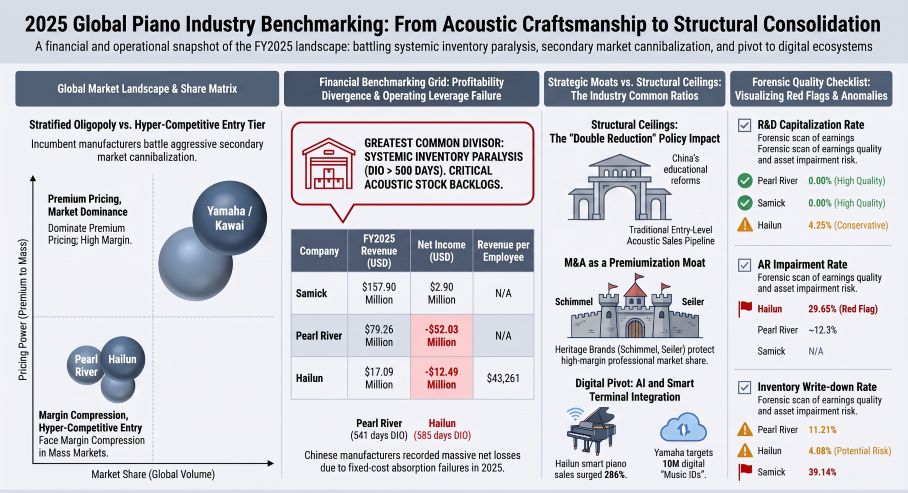
Segmental Realities and Margin Compression
The premium musical instrument market in fiscal year 2025 exhibits severe margin pressure and structural overcapacity. Chinese domestic manufacturers are experiencing severe fixed-cost absorption failures due to negative operating leverage, while consolidated enterprises with diversified revenue models or geographically optimized operations maintain thin profit buffers.
To isolate core operational performance, the table below provides a granular segmentation of total revenues, comparing core musical instrument manufacturing against expanding non-core business segments (converted at the standard rates of 1 USD = 7.1875 CNY = 1,421.40 KRW):
Domestic demand in East Asia has reached a definitive volume ceiling, forcing manufacturers to rely on overseas exports or non-core business units. Geographically, Samick Musical Instruments has achieved a highly globalized layout, whereas Pearl River Piano Group and Hailun Piano remain structurally dependent on a stagnating Chinese domestic market:
* Samick Musical Instruments: Rest of Asia accounts for $10.01 million plus domestic South Korean sales of $86.28 million. North and South America represent its largest export region at $58.44 million, with Europe contributing $3.03 million and other regions accounting for $0.14 million.
* Pearl River Piano Group: Mainland China (including Taiwan, China) accounts for $61.74 million (77.9% of total revenue), leaving only $17.52 million (22.1%) for all foreign operations combined.
* Hailun Piano: Domestic revenue in Mainland China (including Taiwan, China) fell 35.07% year-over-year to $10.76 million (63.0% of total revenue). In contrast, foreign sales rose 13.46% year-over-year to $6.33 million (37.0% of total revenue), signaling stronger resilience in overseas B2B channels.
Product substitution is actively undercutting the acoustic segment. Hailun Piano’s upright acoustic piano sales volume dropped 34.69% year-over-year, while its Smart Digital Piano sales volume surged 239.82% year-over-year from 2,152 units to 7,313 units, driving a 286.66% increase in digital segment revenue. Pearl River Piano Group reported a 38.60% drop in acoustic piano sales, forcing it to deploy hybrid crossover units such as its C101B and DQ100 lines.
Working capital indicators point to acute channel blockages:
* Days Sales Outstanding (DSO): Samick Musical Instruments recorded an efficient cash conversion cycle of ~36.7 days (Accounts Receivable of 22.57 billion KRW against total revenue of 224.44 billion KRW). Pearl River Piano Group registered a moderate DSO of ~124.0 days (Accounts Receivable of 193.57 million CNY against total revenue of 569.66 million CNY). Hailun Piano's DSO reached a highly distressed ~417.6 days (Accounts Receivable of 140.54 million CNY against total revenue of 122.82 million CNY), reflecting severe liquidity bottlenecks in its distribution channels.
* Days Inventory Outstanding (DIO): Using physical units as a proxy reveals a systemic inventory freeze. Pearl River Piano Group holds 34,344 pianos in completed stock against 23,174 units sold in FY2025, representing a physical DIO of ~541 days. Hailun Piano holds 11,089 acoustic pianos (10,562 upright and 527 grand) against 6,922 units sold (6,173 upright and 749 grand), representing a physical DIO of ~585 days. To stop inventory build-up, Pearl River Piano Group cut production by 59.9% year-over-year, and Hailun Piano cut upright production by 47.7% year-over-year.
Infrastructure Layout and Regional Moats
Traditional competitive advantages built on asset-heavy acoustic craftsmanship are being replaced by regional cost arbitrage, material substitution, and legacy European brand acquisitions.
* Geographic Labor Arbitrage & Supply Chain Footprint: Samick Musical Instruments ceased all domestic acoustic manufacturing in South Korea in 2016 due to high labor costs, shifting 100% of its physical acoustic production to its subsidiary PT. Samick Indonesia in Bogor. This plant secures direct access to local raw timber (Lauan, Pine, and Plywood), allowing the company to hedge against rising import wood prices. In contrast, Pearl River Piano Group maintains an asset-heavy domestic structure at its Zengcheng industrial park. Due to a 59.9% drop in acoustic output, the company closed and relocated its 33,000-square-meter Dali factory and emptied Building 5 of its Zengcheng facility, leasing out approximately 200,000 square meters of idle factory space to external tenants. To variabilize fixed overhead, Pearl River Piano Group utilized 541,632 hours of outsourced labor in FY2025 at a cost of $4.95 million (35.60 million CNY). Hailun Piano operates with a leaner footprint of 395 employees, but paid $171,988 (1.24 million CNY) in employee termination benefits in FY2025 as it adjusted capacity, and sold its Xiangshan land plot and engineering assets for $4.71 million (33.89 million CNY) to curb depreciation.
* Material Innovation and Ecological Sourcing: Yamaha Corporation has implemented a Taskforce on Nature-related Financial Disclosures (TNFD) LEAP approach, modeling potential habitat shifts for critical broadleaf and coniferous trees (including Akaezomatsu/Red Spruce, Indian Rosewood, and African Blackwood) up to 2090 under 2°C and 4°C global warming scenarios. Hailun Piano has actively substituted scarce wood materials by engineering cast aluminum alloy action rails, polymer/composite action components, and synthetic ebony, reducing raw timber dependence.
* Channel Credit Backstops & Defaults: Distribution networks are experiencing extreme stress. Samick Musical Instruments maintains a continuous dealer floorplan financing agreement with Wells Fargo Commercial Distribution Finance LLC, acting as a credit backstop. While active recovery is currently limited to $29,256, the structure exposes the parent company to downstream dealer defaults. Channel distress is highly visible in Hailun Piano’s 100% bad debt write-offs for regional distributors, including Shenyang Qinyouduzhong Musical Instruments Co., Ltd. ($284,463 / 2.04 million CNY), Chaoyang Shuangta District Jiayi Musical Instrument Store ($5,368 / 38,584 CNY), and Linfen Dingjian Piano Store Co., Ltd. ($4,174 / 30,000 CNY).
* Human Capital Risk & Apprenticeship Systems: To prevent a craftsmanship gap (工匠断层) in its R&D team (where only 27 out of 239 personnel are under 30), Pearl River Piano Group utilizes a "master leading apprentices" model, testing 120 individuals and certifying 45% as senior workers in FY2025. Hailun Piano, with only 4 of its 55 R&D staff under 30, maintains a pipeline through Ningbo Vocational and Technical College, recruiting local workers and offering free training programs.
* M&A Brand Portfolios: To bypass the volume ceiling and access higher-margin professional segments, Asian producers continue to leverage acquired legacy Western brands. Pearl River Piano Group operates Germany’s Schimmel (acquired in 2016) alongside its premium domestic Kayserburg line. Samick Musical Instruments markets through its acquired 160-year-old German brand Seiler and the Pramberger trademark.
HDIN Institutional Verdict
The divergent financial results of the FY2025 cohort confirm that purely acoustic, asset-heavy manufacturing models are structurally unviable under current macroeconomic conditions.
An analysis of the cash flow conversion ratios reveals significant disparities between accounting losses and actual cash burn, reflecting heavy asset write-downs and depreciation:
* Pearl River Piano Group: Reported a Net Loss of -$52.03 million (-373.97 million CNY) against an Operating Cash Flow of -$18.77 million (-134.91 million CNY). This positive 36.0% conversion variance confirms that a large portion of the loss represents non-cash depreciation of idle fixed assets and inventory write-downs.
* Hailun Piano: Posted a Net Loss of -$12.49 million (-89.78 million CNY) against an Operating Cash Flow of -$6.20 million (-44.58 million CNY).
2. Receivables Deterioration: Hailun Piano’s Accounts Receivable book balance of $19.55 million (140.54 million CNY) carries a staggering bad debt provision of $5.55 million (39.92 million CNY), or 28.41% (parent level: $17.94 million book balance with $5.32 million provision, or 29.65%). This high rate indicates that past revenues were likely recognized aggressively through dealer channel stuffing and are now uncollectible.
3. Capital Structure and Solvency Risk: Both Hailun Piano and Samick Musical Instruments operate with moderate debt-to-equity ratios (~60.0% and 58.2% respectively). However, Hailun’s interest expenses reached $1.20 million (8.68 million CNY) in FY2025 against deeply negative EBIT, meaning it must draw down its $2.84 million (20.45 million CNY) cash reserves to service debt. Samick Musical Instruments, by contrast, is supported by a stable utility-like cash flow buffer from its non-core Suwan Energy division (power generation and district heating).
4. Capitalization Quality: R&D accounting across the cohort remains conservative. Pearl River expensed 100% of its $4.79 million R&D budget (0% capitalization). Hailun capitalized only 4.25% ($59,828 / 430,019 CNY) of its $1.41 million R&D, and Samick capitalized zero, confirming high earnings quality and minimal balance-sheet masking.
Rather than reinvesting in core acoustic capacity, surviving players are using capital for non-core diversification. Pearl River Piano Group deployed $16.70 million (120 million CNY) to acquire stage lighting subsidiary Hongyang Mingdao, and $27.83 million (200 million CNY) to launch cultural tourism subsidiary Wen Zhi Lv (acquiring the Baishui Waterfall scenic area operating rights). Yamaha Corporation is bypassing traditional wholesale networks by investing in its Direct-to-Consumer "Music Connect" digital subscription platform (Yamaha Creator Pass), targeting 10 million unified user IDs and setting a 10-year revenue target of over $66.86 million (10 billion JPY) from digital subscriptions.
The structural ceiling on acoustic piano sales is now permanent. The manufacturers most likely to navigate this transition are those decoupling their cash flows from physical acoustic units and pivoting toward high-margin digital audio software, alternative industrial sectors, or legacy brand monetization.
Presentation Download & Video Access:
Presentation Download: Click the PDF download link under 'Related Topics' to access the full institutional presentation of this report.
Video Link: Click this link to watch the HDIN analyst briefing on YouTube.
About HDIN Research:
HDIN Research is a premier global market intelligence and strategic advisory firm specializing in institutional-grade financial analysis, supply chain audits, and macroeconomic forecasting. Our dedicated sector analysts deliver actionable, data-driven insights tailored for private equity, hedge funds, and corporate strategy teams. Visit us at [http://www.hdinresearch.com](http://www.hdinresearch.com).
2026 AI Transparency Footer:
"This intelligence report was authored by HDIN Research analysts following a rigorous audit of official corporate filings. AI was utilized for massive-scale data synthesis and structural drafting, ensuring 100% inclusion of reported data points. All strategic insights, financial modeling, and final verdicts were verified by our editorial board to ensure professional accuracy and compliance with 2026 Google Search E-E-A-T standards."
1. Multi-entity inventory gluts exceeding 500 days of sales force drastic production halts, with Pearl River Piano Group [SHE: 002678] cutting acoustic output by 59.9% as entry-level demand fails.
2. Samick Musical Instruments [KRX: 004960] sustains marginal profitability via Southeast Asian labor arbitrage, shielding it from fixed-cost failures pushing Pearl River and Hailun Piano [SHE: 300329] into deep losses.
3. Industry capital flow diverts from physical factories into digital creator systems and non-musical conglomerates, signaling structural erosion of traditional acoustic moats.
Figure 2025 Global Piano industry Benchmarking: From Acoustic Craftsmanship to Structural Consolidation
Segmental Realities and Margin Compression
The premium musical instrument market in fiscal year 2025 exhibits severe margin pressure and structural overcapacity. Chinese domestic manufacturers are experiencing severe fixed-cost absorption failures due to negative operating leverage, while consolidated enterprises with diversified revenue models or geographically optimized operations maintain thin profit buffers.
To isolate core operational performance, the table below provides a granular segmentation of total revenues, comparing core musical instrument manufacturing against expanding non-core business segments (converted at the standard rates of 1 USD = 7.1875 CNY = 1,421.40 KRW):
Table FY2025 Revenue Structure by Company
| Company | Total FY2025 Revenue (USD) | Musical Instruments Segment (USD & % of Total Revenue) | Non-Core Segments (USD & % of Total Revenue) |
|---|---|---|---|
| Samick Musical Instruments | $157.90M (KRW 224.44B) | $76.26M (48.3%)(Acoustic/Digital Pianos, Guitars) | $81.64M (51.7%)(Energy/District Heating: 38.7% via Suwan Energy; Real Estate & Other: 13.0%) |
| Pearl River Piano Group | $79.26M (CNY 569.66M) | $56.91M (71.8%)(Acoustic/Digital Piano Sales & After-sales Services) | $22.35M (28.2%)(Stage Lighting: 8.6%; Cultural Services: 16.8%; Other: 2.8%) |
| Hailun Piano | $17.09M (CNY 122.82M) | $16.85M (98.6%)(Upright Pianos, Grand Pianos, Digital Pianos & Parts) | $0.24M (1.4%)(Art Training & Education) |
| Yamaha Corporation [TYO: 7951] | ~$3.11B (JPY 465.33B) | 33.0% of Total Revenue(Musical Instruments Segment) | 67.0% of Total Revenue(Audio/AV: 42.0%; New Business: 19.0%; Staff & Other: 6.0%) |
Domestic demand in East Asia has reached a definitive volume ceiling, forcing manufacturers to rely on overseas exports or non-core business units. Geographically, Samick Musical Instruments has achieved a highly globalized layout, whereas Pearl River Piano Group and Hailun Piano remain structurally dependent on a stagnating Chinese domestic market:
* Samick Musical Instruments: Rest of Asia accounts for $10.01 million plus domestic South Korean sales of $86.28 million. North and South America represent its largest export region at $58.44 million, with Europe contributing $3.03 million and other regions accounting for $0.14 million.
* Pearl River Piano Group: Mainland China (including Taiwan, China) accounts for $61.74 million (77.9% of total revenue), leaving only $17.52 million (22.1%) for all foreign operations combined.
* Hailun Piano: Domestic revenue in Mainland China (including Taiwan, China) fell 35.07% year-over-year to $10.76 million (63.0% of total revenue). In contrast, foreign sales rose 13.46% year-over-year to $6.33 million (37.0% of total revenue), signaling stronger resilience in overseas B2B channels.
Product substitution is actively undercutting the acoustic segment. Hailun Piano’s upright acoustic piano sales volume dropped 34.69% year-over-year, while its Smart Digital Piano sales volume surged 239.82% year-over-year from 2,152 units to 7,313 units, driving a 286.66% increase in digital segment revenue. Pearl River Piano Group reported a 38.60% drop in acoustic piano sales, forcing it to deploy hybrid crossover units such as its C101B and DQ100 lines.
Working capital indicators point to acute channel blockages:
* Days Sales Outstanding (DSO): Samick Musical Instruments recorded an efficient cash conversion cycle of ~36.7 days (Accounts Receivable of 22.57 billion KRW against total revenue of 224.44 billion KRW). Pearl River Piano Group registered a moderate DSO of ~124.0 days (Accounts Receivable of 193.57 million CNY against total revenue of 569.66 million CNY). Hailun Piano's DSO reached a highly distressed ~417.6 days (Accounts Receivable of 140.54 million CNY against total revenue of 122.82 million CNY), reflecting severe liquidity bottlenecks in its distribution channels.
* Days Inventory Outstanding (DIO): Using physical units as a proxy reveals a systemic inventory freeze. Pearl River Piano Group holds 34,344 pianos in completed stock against 23,174 units sold in FY2025, representing a physical DIO of ~541 days. Hailun Piano holds 11,089 acoustic pianos (10,562 upright and 527 grand) against 6,922 units sold (6,173 upright and 749 grand), representing a physical DIO of ~585 days. To stop inventory build-up, Pearl River Piano Group cut production by 59.9% year-over-year, and Hailun Piano cut upright production by 47.7% year-over-year.
Infrastructure Layout and Regional Moats
Traditional competitive advantages built on asset-heavy acoustic craftsmanship are being replaced by regional cost arbitrage, material substitution, and legacy European brand acquisitions.
* Geographic Labor Arbitrage & Supply Chain Footprint: Samick Musical Instruments ceased all domestic acoustic manufacturing in South Korea in 2016 due to high labor costs, shifting 100% of its physical acoustic production to its subsidiary PT. Samick Indonesia in Bogor. This plant secures direct access to local raw timber (Lauan, Pine, and Plywood), allowing the company to hedge against rising import wood prices. In contrast, Pearl River Piano Group maintains an asset-heavy domestic structure at its Zengcheng industrial park. Due to a 59.9% drop in acoustic output, the company closed and relocated its 33,000-square-meter Dali factory and emptied Building 5 of its Zengcheng facility, leasing out approximately 200,000 square meters of idle factory space to external tenants. To variabilize fixed overhead, Pearl River Piano Group utilized 541,632 hours of outsourced labor in FY2025 at a cost of $4.95 million (35.60 million CNY). Hailun Piano operates with a leaner footprint of 395 employees, but paid $171,988 (1.24 million CNY) in employee termination benefits in FY2025 as it adjusted capacity, and sold its Xiangshan land plot and engineering assets for $4.71 million (33.89 million CNY) to curb depreciation.
* Material Innovation and Ecological Sourcing: Yamaha Corporation has implemented a Taskforce on Nature-related Financial Disclosures (TNFD) LEAP approach, modeling potential habitat shifts for critical broadleaf and coniferous trees (including Akaezomatsu/Red Spruce, Indian Rosewood, and African Blackwood) up to 2090 under 2°C and 4°C global warming scenarios. Hailun Piano has actively substituted scarce wood materials by engineering cast aluminum alloy action rails, polymer/composite action components, and synthetic ebony, reducing raw timber dependence.
* Channel Credit Backstops & Defaults: Distribution networks are experiencing extreme stress. Samick Musical Instruments maintains a continuous dealer floorplan financing agreement with Wells Fargo Commercial Distribution Finance LLC, acting as a credit backstop. While active recovery is currently limited to $29,256, the structure exposes the parent company to downstream dealer defaults. Channel distress is highly visible in Hailun Piano’s 100% bad debt write-offs for regional distributors, including Shenyang Qinyouduzhong Musical Instruments Co., Ltd. ($284,463 / 2.04 million CNY), Chaoyang Shuangta District Jiayi Musical Instrument Store ($5,368 / 38,584 CNY), and Linfen Dingjian Piano Store Co., Ltd. ($4,174 / 30,000 CNY).
* Human Capital Risk & Apprenticeship Systems: To prevent a craftsmanship gap (工匠断层) in its R&D team (where only 27 out of 239 personnel are under 30), Pearl River Piano Group utilizes a "master leading apprentices" model, testing 120 individuals and certifying 45% as senior workers in FY2025. Hailun Piano, with only 4 of its 55 R&D staff under 30, maintains a pipeline through Ningbo Vocational and Technical College, recruiting local workers and offering free training programs.
* M&A Brand Portfolios: To bypass the volume ceiling and access higher-margin professional segments, Asian producers continue to leverage acquired legacy Western brands. Pearl River Piano Group operates Germany’s Schimmel (acquired in 2016) alongside its premium domestic Kayserburg line. Samick Musical Instruments markets through its acquired 160-year-old German brand Seiler and the Pramberger trademark.
HDIN Institutional Verdict
The divergent financial results of the FY2025 cohort confirm that purely acoustic, asset-heavy manufacturing models are structurally unviable under current macroeconomic conditions.
An analysis of the cash flow conversion ratios reveals significant disparities between accounting losses and actual cash burn, reflecting heavy asset write-downs and depreciation:
* Pearl River Piano Group: Reported a Net Loss of -$52.03 million (-373.97 million CNY) against an Operating Cash Flow of -$18.77 million (-134.91 million CNY). This positive 36.0% conversion variance confirms that a large portion of the loss represents non-cash depreciation of idle fixed assets and inventory write-downs.
* Hailun Piano: Posted a Net Loss of -$12.49 million (-89.78 million CNY) against an Operating Cash Flow of -$6.20 million (-44.58 million CNY).
Table Forensic Inventory Analysis (FY2025)
| Company | Gross Inventory (USD M) | Inventory Impairment Provision | Impairment Coverage Indicator | Forensic Assessment |
|---|---|---|---|---|
| Samick Musical Instruments | $38.86M | 39.14% | ████████████████████ | High impairment coverage, indicating significant inventory aging, valuation pressure, or conservative provisioning practices |
| Pearl River Piano Group | $157.18M | 11.21% | ██████ | Moderate impairment coverage; large inventory base warrants scrutiny regarding inventory turnover, demand visibility, and potential channel accumulation |
| Hailun Piano | $49.96M | 4.08% | ██ | Low impairment coverage relative to inventory scale, potentially indicating lower perceived inventory risk but requiring validation through turnover and sales realization trends |
1. Inventory Provision Divergence: Samick Musical Instruments maintains an aggressive and highly realistic provisioning policy. Against $38.86 million (55.23 billion KRW) in gross inventory, it holds a 39.14% impairment reserve (21.62 billion KRW), with raw materials written down by 58.06% and merchandise by 60.30%. Pearl River Piano Group holds a total inventory impairment reserve of $17.63 million (126.70 million CNY), reflecting an 11.21% overall provision, with a 13.67% write-down rate on finished goods. Conversely, Hailun Piano holds an inventory provision of only $2.04 million (14.64 million CNY), representing a 4.08% overall impairment rate and a minimal 5.07% write-down on finished goods. Given Hailun's 585-day DIO backlog, this conservative provisioning suggests a high risk of future inventory write-downs.
2. Receivables Deterioration: Hailun Piano’s Accounts Receivable book balance of $19.55 million (140.54 million CNY) carries a staggering bad debt provision of $5.55 million (39.92 million CNY), or 28.41% (parent level: $17.94 million book balance with $5.32 million provision, or 29.65%). This high rate indicates that past revenues were likely recognized aggressively through dealer channel stuffing and are now uncollectible.3. Capital Structure and Solvency Risk: Both Hailun Piano and Samick Musical Instruments operate with moderate debt-to-equity ratios (~60.0% and 58.2% respectively). However, Hailun’s interest expenses reached $1.20 million (8.68 million CNY) in FY2025 against deeply negative EBIT, meaning it must draw down its $2.84 million (20.45 million CNY) cash reserves to service debt. Samick Musical Instruments, by contrast, is supported by a stable utility-like cash flow buffer from its non-core Suwan Energy division (power generation and district heating).
4. Capitalization Quality: R&D accounting across the cohort remains conservative. Pearl River expensed 100% of its $4.79 million R&D budget (0% capitalization). Hailun capitalized only 4.25% ($59,828 / 430,019 CNY) of its $1.41 million R&D, and Samick capitalized zero, confirming high earnings quality and minimal balance-sheet masking.
Rather than reinvesting in core acoustic capacity, surviving players are using capital for non-core diversification. Pearl River Piano Group deployed $16.70 million (120 million CNY) to acquire stage lighting subsidiary Hongyang Mingdao, and $27.83 million (200 million CNY) to launch cultural tourism subsidiary Wen Zhi Lv (acquiring the Baishui Waterfall scenic area operating rights). Yamaha Corporation is bypassing traditional wholesale networks by investing in its Direct-to-Consumer "Music Connect" digital subscription platform (Yamaha Creator Pass), targeting 10 million unified user IDs and setting a 10-year revenue target of over $66.86 million (10 billion JPY) from digital subscriptions.
The structural ceiling on acoustic piano sales is now permanent. The manufacturers most likely to navigate this transition are those decoupling their cash flows from physical acoustic units and pivoting toward high-margin digital audio software, alternative industrial sectors, or legacy brand monetization.
Presentation Download & Video Access:
Presentation Download: Click the PDF download link under 'Related Topics' to access the full institutional presentation of this report.
Video Link: Click this link to watch the HDIN analyst briefing on YouTube.
About HDIN Research:
HDIN Research is a premier global market intelligence and strategic advisory firm specializing in institutional-grade financial analysis, supply chain audits, and macroeconomic forecasting. Our dedicated sector analysts deliver actionable, data-driven insights tailored for private equity, hedge funds, and corporate strategy teams. Visit us at [http://www.hdinresearch.com](http://www.hdinresearch.com).
2026 AI Transparency Footer:
"This intelligence report was authored by HDIN Research analysts following a rigorous audit of official corporate filings. AI was utilized for massive-scale data synthesis and structural drafting, ensuring 100% inclusion of reported data points. All strategic insights, financial modeling, and final verdicts were verified by our editorial board to ensure professional accuracy and compliance with 2026 Google Search E-E-A-T standards."