Kestra Medical Technologies, Ltd.: Fleet Monetization Scale-Up Across 20 U.S. Logistical Hubs as 59% Top-Line Growth Signals Entrenched Duopoly Displacement
Date : 2026-07-22
Reading : 115
HDIN Executive Takeaways
1. Kestra Medical Technologies, Ltd. [NASDAQ: KEST] achieved a 59% year-over-year revenue increase to $95.1 million in FY2026, leveraging established HCPCS K0606 billing to scale its monthly equipment leasing model directly to third-party payors, thereby bypassing hospital capital budget limitations.
2. Fleet-driven capital intensity remains a core constraint, with FY2026 capital expenditures of $34.9 million representing 36.7% of total revenue, leaving the company's single-segment supply chain exposed to spot-market semiconductor and electronic component price fluctuations.
3. A subsequent July 2026 debt refinancing of $200.0 million pushes maturity out to July 2031 but introduces a variable cash-interest burden and minimum $20.0 million liquidity covenant, which will converge with escalating lease commitments starting in FY2028.
Segmental Realities, Accounting Shifts, and Capital Burn
Kestra Medical Technologies, Ltd. operates as a single reporting segment focused on wearable, outpatient cardiac recovery solutions. The company’s monetization model operates as Medical Device as a Service (MDaaS), utilizing a month-to-month lease architecture to deploy its proprietary ASSURE Wearable Cardioverter Defibrillator (WCD) fleet to patients during typical 40- to 90-day prescription windows.
Revenue is primarily dictated by established Durable Medical Equipment (DME) reimbursement codes under HCPCS code K0606. The Medicare fee schedule allows a reimbursement rate of approximately $3,589 per month for the first three months of a prescription, before declining 25% to $2,692 per month for months four through thirteen. The maximum allowable Medicare revenue generated over the lifetime of a single patient lease is capped at approximately $37,683.
The company's top-line hyper-growth has been driven by active patient volume expansion, with gross margins benefiting from depreciation adjustments on the rental pool. The following table details Kestra Medical Technologies' core financial metrics for FY2025 and FY2026:
Table: Financial Performance, Operating Efficiency, and Capital Position Analysis (FY2025–FY2026)
Accounting Adjustments and Capital Structure Realignment
During FY2026, Kestra Medical Technologies executed a prospective accounting estimate change, extending the estimated useful life of its rental fleet hardware (specifically the battery chargers and WCD monitors) from a range of 2–8 years to 2–15 years (specifically, monitors were extended from 7 to 15 years, and chargers from 5 to 15 years). This modification reduced FY2026 depreciation expense by $1.41 million, directly inflating reported gross profit and gross margins by an equivalent amount. Non-operating income was also impacted by a $2.67 million non-cash fair value gain on the remeasurement of warrant liabilities.
As of April 30, 2026, long-term debt consisted of $45.0 million in principal outstanding under a 2024 Term Loan maturing in September 2028. Subsequent to the fiscal year-end, on July 10, 2026, the company executed a strategic debt refinancing via a new $200.0 million senior secured term loan facility. Kestra Medical Technologies immediately drew down a $75.0 million Tranche A loan to retire the $45.0 million 2024 Term Loan, providing approximately $20.0 million in net new working capital and pushing the debt maturity wall to July 10, 2031.
The new facility carries a floating rate of 5.50% plus 3-month SOFR (subject to a 3.25% SOFR floor), yielding an estimated current cash interest drag of approximately $6.5 million to $7.5 million annually. The debt structure permits 48 months of interest-only payments, delaying principal amortization until the second fiscal quarter of 2030, while enforcing a continuous minimum liquidity covenant of $20.0 million.
Supply Chain Architecture, Regulatory Hurdles, and Intellectual Property
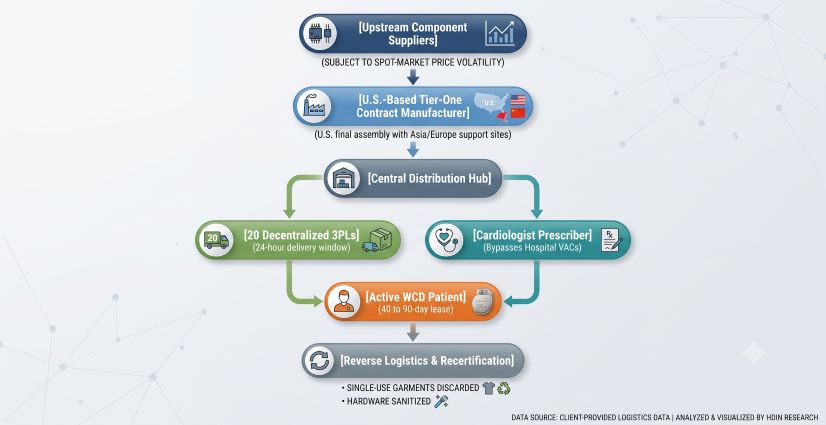
Kestra Medical Technologies operates an asset-light, fabless manufacturing and supply chain architecture designed to minimize internal capital requirements. The company does not own or operate any production facilities, relying entirely on a restricted roster of tier-one third-party contract manufacturers and suppliers to build the ASSURE WCD and its components, including SensorFit garments, chargers, monitors, batteries, and cables.
Figure Kestra Medical Supply Chain Architecture
Geographic and Operational Footprint
* Revenues & Long-Lived Assets: 100% geographically concentrated in the United States. No international regulatory approvals have been obtained.
* Global Headquarters: Kirkland, Washington, U.S. (Two leased facilities encompassing 35,200 sq. ft. for R&D, clinical, and administrative functions).
* Regional Support: Southlake, Texas, U.S. (350 sq. ft. administrative office).
* International Tax Domicile: Incorporated in Bermuda, maintaining tax residency and a 300 sq. ft. administrative office in Dublin, Ireland. Operating subsidiaries span the Cayman Islands, Ireland, and the United States.
* Decentralized Logistics: Supported by one central hub and 20 strategically positioned third-party logistics (3PL) warehouses across the United States. Delivery, fitting, and training are executed via a network of over 500 contracted Assure Patient Specialists (APS), up from 300 in the prior year.
Sourcing Squeeze and Reverse Logistics
The company’s raw materials sourcing is highly vulnerable due to a lack of long-term supply agreements for critical electronic and structural components. Although the primary assembly of the WCD is executed at U.S.-based facilities of its contract partners, the underlying supply chain is exposed to international tariff frictions and component shortages. Kestra Medical Technologies has deployed $1.76 million in long-term supplier deposits to secure production lines.
Furthermore, the leasing model makes cash flow highly sensitive to the reverse-logistics cycle. At the end of a patient’s 40- to 90-day wear period, the device must be shipped back via third-party carriers to a contract partner's facility. Single-use SensorFit garments are discarded, while monitors and chargers are inspected, sanitized, and recertified. Shipping delays, damaged returns, or patient non-compliance directly limit fleet utilization and deplete active inventory.
Clinical Moat and Intellectual Property Defensibility
The ASSURE WCD is classified as an FDA Class III medical device, requiring PreMarket Approval (PMA), which was secured on July 27, 2021. To maintain a rapid software deployment cycle, Kestra Medical Technologies has structurally separated its digital health platform—comprising the ASSURE patient application, the Kestra CareStation physician portal, and Heart Alert Services—as a Class I, 510(k)-exempt architecture. This allows continuous algorithm adjustments without triggering lengthy Class III PMA reviews.
In January 2026, Kestra Medical Technologies signed an exclusive licensing, investment, and co-development agreement with Biobeat Technologies to integrate an FDA-cleared, cuffless ambulatory blood pressure monitoring (ABPM) patch into its platform. Clinical validation is anchored by the ACE-PAS post-approval registry, tracking approximately 40,000 patients (with published results on a cohort of 21,612 patients demonstrating a 100% successful conversion rate for ventricular tachycardia/fibrillation, a median daily wear time exceeding 23 hours, and a false alarm rate of 6% compared to 46% for ZOLL Medical's competitive LifeVest). In April 2026, the company introduced its Enhanced ASSURE Detection Algorithm, lowering the projected false alarm rate to 3%.
As of April 30, 2026, the company’s global patent shield comprises 264 issued patents (229 in the U.S., 17 in the EU, 8 in Japan, 5 in Australia, and 5 in China) alongside 125 pending applications. The earliest expiration date for Kestra Medical Technologies' issued patents is February 2031, providing a five-year window of foundational exclusivity against generic 510(k) competitors.
HDIN Institutional Verdict
Kestra Medical Technologies, Ltd. has demonstrated substantial commercial execution, growing its revenue by 59% in FY2026 and contracting with payors covering over 290 million lives in the United States. However, forensic analysis of the company's financial disclosures reveals structural headwinds that challenge management’s long-term margin and cash flow assumptions.
First, the reported gross margin expansion to 51.4% is heavily flattered by the prospective extension of the rental equipment's useful life to 15 years. This accounting adjustment artificially lowered FY2026 depreciation by $1.41 million. Without this change, adjusted gross margins would have settled at 49.9%. Given the rapid evolution of digital health sensors and battery degradation, projecting a 15-year operational lifespan for highly utilized, patient-worn hardware represents an aggressive accounting assumption that may lead to accelerated future write-downs.
Second, the MDaaS model presents an inherently unfavorable cash conversion cycle during a rapid scale-up phase. Kestra Medical Technologies must spend capital upfront to manufacture the physical devices ($34.9 million in FY2026 CapEx) and deploy direct sales representatives (increasing territories from 80 to 130) and over 500 APS contractors. This upfront investment is recovered slowly through highly regulated monthly reimbursement claims.
While bypassing hospital purchasing committees accelerates clinical adoption, it shifts credit and collection risk entirely onto the company. This structural challenge is reflected in the 80% spike in net accounts receivable to $14.54 million and a corresponding surge in the allowance for bad debt to $5.79 million.
Additionally, direct billing of government payors exposes Kestra Medical Technologies to retrospective Medicare audits and recoupment actions, while ongoing consolidation within the commercial insurance sector limits long-term pricing leverage for HCPCS code K0606.
Finally, the company's capital runway of 2.2 years, supported by $262.2 million in total liquidity, is highly dependent on navigating a looming structural cash drain. Although the subsequent July 2026 debt refinancing pushes maturities to 2031, the 48-month interest-only period will expire in Q2 2030. At that point, heavy principal amortization will begin.
This amortization cliff will directly coincide with a tripling of the company’s undiscounted lease obligations (which rise from $43,000 in FY2027 to an average of $1.49 million annually over the FY2029–FY2031 period) and ongoing material weaknesses in internal controls over financial reporting.
If Kestra Medical Technologies does not achieve self-sustaining operational cash flow or secure CE Mark approval for its Western European expansion (targeting Germany and France within three years) by late 2029, the combination of variable cash-interest payments, lease escalations, and the onset of debt amortization will likely force highly dilutive equity raises.
Presentation Download & Video Access
Presentation Download: Click the PDF download link under 'Related Topics' to access the full institutional presentation of this report.
Video Link: Click this link to watch the HDIN analyst briefing on YouTube.
About HDIN Research
HDIN Research is a premier global market intelligence and strategic advisory firm specializing in institutional-grade financial analysis, supply chain audits, and macroeconomic forecasting. Our dedicated sector analysts deliver actionable, data-driven insights tailored for private equity, hedge funds, and corporate strategy teams. Visit us at http://www.hdinresearch.com.
2026 AI Transparency Footer
"This intelligence report was authored by HDIN Research analysts following a rigorous audit of official corporate filings. AI was utilized for massive-scale data synthesis and structural drafting, ensuring 100% inclusion of reported data points. All strategic insights, financial modeling, and final verdicts were verified by our editorial board to ensure professional accuracy and compliance with 2026 Google Search E-E-A-T standards."
1. Kestra Medical Technologies, Ltd. [NASDAQ: KEST] achieved a 59% year-over-year revenue increase to $95.1 million in FY2026, leveraging established HCPCS K0606 billing to scale its monthly equipment leasing model directly to third-party payors, thereby bypassing hospital capital budget limitations.
2. Fleet-driven capital intensity remains a core constraint, with FY2026 capital expenditures of $34.9 million representing 36.7% of total revenue, leaving the company's single-segment supply chain exposed to spot-market semiconductor and electronic component price fluctuations.
3. A subsequent July 2026 debt refinancing of $200.0 million pushes maturity out to July 2031 but introduces a variable cash-interest burden and minimum $20.0 million liquidity covenant, which will converge with escalating lease commitments starting in FY2028.
Segmental Realities, Accounting Shifts, and Capital Burn
Kestra Medical Technologies, Ltd. operates as a single reporting segment focused on wearable, outpatient cardiac recovery solutions. The company’s monetization model operates as Medical Device as a Service (MDaaS), utilizing a month-to-month lease architecture to deploy its proprietary ASSURE Wearable Cardioverter Defibrillator (WCD) fleet to patients during typical 40- to 90-day prescription windows.
Revenue is primarily dictated by established Durable Medical Equipment (DME) reimbursement codes under HCPCS code K0606. The Medicare fee schedule allows a reimbursement rate of approximately $3,589 per month for the first three months of a prescription, before declining 25% to $2,692 per month for months four through thirteen. The maximum allowable Medicare revenue generated over the lifetime of a single patient lease is capped at approximately $37,683.
The company's top-line hyper-growth has been driven by active patient volume expansion, with gross margins benefiting from depreciation adjustments on the rental pool. The following table details Kestra Medical Technologies' core financial metrics for FY2025 and FY2026:
Table: Financial Performance, Operating Efficiency, and Capital Position Analysis (FY2025–FY2026)
| Financial Metric | FY2025 | FY2026 | Year-over-Year (YoY) Change / Footnote Details |
|---|---|---|---|
| Total Revenue | $59.8 million | $95.1 million | +59.0%; driven by a 58.0% increase in active patient volume |
| Gross Profit | $24.2 million | $48.9 million | +102.1%; partially impacted by a $1.41 million accounting classification shift |
| Gross Margin | 40.5% | 51.4% | Expanded by 1,090 basis points |
| Operating Loss | $(106.4) million | $(134.7) million | Loss widened by 26.6% in absolute terms |
| Operating Margin | -177.8% | -141.6% | Improved by 3,620 basis points, reflecting relative operating leverage improvement |
| Selling, General & Administrative (SG&A) Expense | $114.8 million | $164.1 million | +43.0%; represented 172.5% of revenue, with personnel costs increasing by $33.2 million |
| Research & Development (R&D) Expense | $15.7 million | $19.5 million | +24.2%; driven by personnel/share-based compensation (+$2.4M) and contractor expenses (+$1.4M) |
| R&D Intensity | 26.2% | 20.5% | Declined by 570 basis points |
| Net Loss | $(113.8) million | $(131.6) million | Net margin improved to -138.4% from -190.3% in FY2025 |
| Capital Expenditures (CapEx) | $22.9 million | $34.9 million | CapEx intensity increased to 36.7% of total revenue |
| Operating Cash Flow | N/A | $(81.7) million | Reflects upfront investment in physical rental inventory |
| Unlevered Free Cash Flow Burn | N/A | $(116.6) million | Defined as operating cash flow less capital expenditures |
| Total Liquidity | N/A | $262.2 million | Includes cash, cash equivalents, and short-/long-term investments |
| Net Accounts Receivable | $8.08 million | $14.54 million | +80.0%; reflects extended medical billing collection cycles |
| Bad Debt Allowance | $3.19 million | $5.79 million | Increase of $2.60 million provision for potentially uncollectible accounts |
| Accumulated Deficit | N/A | $651.9 million | Represents cumulative capital deficit since company inception |
Accounting Adjustments and Capital Structure Realignment
During FY2026, Kestra Medical Technologies executed a prospective accounting estimate change, extending the estimated useful life of its rental fleet hardware (specifically the battery chargers and WCD monitors) from a range of 2–8 years to 2–15 years (specifically, monitors were extended from 7 to 15 years, and chargers from 5 to 15 years). This modification reduced FY2026 depreciation expense by $1.41 million, directly inflating reported gross profit and gross margins by an equivalent amount. Non-operating income was also impacted by a $2.67 million non-cash fair value gain on the remeasurement of warrant liabilities.
As of April 30, 2026, long-term debt consisted of $45.0 million in principal outstanding under a 2024 Term Loan maturing in September 2028. Subsequent to the fiscal year-end, on July 10, 2026, the company executed a strategic debt refinancing via a new $200.0 million senior secured term loan facility. Kestra Medical Technologies immediately drew down a $75.0 million Tranche A loan to retire the $45.0 million 2024 Term Loan, providing approximately $20.0 million in net new working capital and pushing the debt maturity wall to July 10, 2031.
The new facility carries a floating rate of 5.50% plus 3-month SOFR (subject to a 3.25% SOFR floor), yielding an estimated current cash interest drag of approximately $6.5 million to $7.5 million annually. The debt structure permits 48 months of interest-only payments, delaying principal amortization until the second fiscal quarter of 2030, while enforcing a continuous minimum liquidity covenant of $20.0 million.
Supply Chain Architecture, Regulatory Hurdles, and Intellectual Property
Kestra Medical Technologies operates an asset-light, fabless manufacturing and supply chain architecture designed to minimize internal capital requirements. The company does not own or operate any production facilities, relying entirely on a restricted roster of tier-one third-party contract manufacturers and suppliers to build the ASSURE WCD and its components, including SensorFit garments, chargers, monitors, batteries, and cables.
Figure Kestra Medical Supply Chain Architecture
Geographic and Operational Footprint
* Revenues & Long-Lived Assets: 100% geographically concentrated in the United States. No international regulatory approvals have been obtained.
* Global Headquarters: Kirkland, Washington, U.S. (Two leased facilities encompassing 35,200 sq. ft. for R&D, clinical, and administrative functions).
* Regional Support: Southlake, Texas, U.S. (350 sq. ft. administrative office).
* International Tax Domicile: Incorporated in Bermuda, maintaining tax residency and a 300 sq. ft. administrative office in Dublin, Ireland. Operating subsidiaries span the Cayman Islands, Ireland, and the United States.
* Decentralized Logistics: Supported by one central hub and 20 strategically positioned third-party logistics (3PL) warehouses across the United States. Delivery, fitting, and training are executed via a network of over 500 contracted Assure Patient Specialists (APS), up from 300 in the prior year.
Sourcing Squeeze and Reverse Logistics
The company’s raw materials sourcing is highly vulnerable due to a lack of long-term supply agreements for critical electronic and structural components. Although the primary assembly of the WCD is executed at U.S.-based facilities of its contract partners, the underlying supply chain is exposed to international tariff frictions and component shortages. Kestra Medical Technologies has deployed $1.76 million in long-term supplier deposits to secure production lines.
Furthermore, the leasing model makes cash flow highly sensitive to the reverse-logistics cycle. At the end of a patient’s 40- to 90-day wear period, the device must be shipped back via third-party carriers to a contract partner's facility. Single-use SensorFit garments are discarded, while monitors and chargers are inspected, sanitized, and recertified. Shipping delays, damaged returns, or patient non-compliance directly limit fleet utilization and deplete active inventory.
Clinical Moat and Intellectual Property Defensibility
The ASSURE WCD is classified as an FDA Class III medical device, requiring PreMarket Approval (PMA), which was secured on July 27, 2021. To maintain a rapid software deployment cycle, Kestra Medical Technologies has structurally separated its digital health platform—comprising the ASSURE patient application, the Kestra CareStation physician portal, and Heart Alert Services—as a Class I, 510(k)-exempt architecture. This allows continuous algorithm adjustments without triggering lengthy Class III PMA reviews.
In January 2026, Kestra Medical Technologies signed an exclusive licensing, investment, and co-development agreement with Biobeat Technologies to integrate an FDA-cleared, cuffless ambulatory blood pressure monitoring (ABPM) patch into its platform. Clinical validation is anchored by the ACE-PAS post-approval registry, tracking approximately 40,000 patients (with published results on a cohort of 21,612 patients demonstrating a 100% successful conversion rate for ventricular tachycardia/fibrillation, a median daily wear time exceeding 23 hours, and a false alarm rate of 6% compared to 46% for ZOLL Medical's competitive LifeVest). In April 2026, the company introduced its Enhanced ASSURE Detection Algorithm, lowering the projected false alarm rate to 3%.
As of April 30, 2026, the company’s global patent shield comprises 264 issued patents (229 in the U.S., 17 in the EU, 8 in Japan, 5 in Australia, and 5 in China) alongside 125 pending applications. The earliest expiration date for Kestra Medical Technologies' issued patents is February 2031, providing a five-year window of foundational exclusivity against generic 510(k) competitors.
HDIN Institutional Verdict
Kestra Medical Technologies, Ltd. has demonstrated substantial commercial execution, growing its revenue by 59% in FY2026 and contracting with payors covering over 290 million lives in the United States. However, forensic analysis of the company's financial disclosures reveals structural headwinds that challenge management’s long-term margin and cash flow assumptions.
First, the reported gross margin expansion to 51.4% is heavily flattered by the prospective extension of the rental equipment's useful life to 15 years. This accounting adjustment artificially lowered FY2026 depreciation by $1.41 million. Without this change, adjusted gross margins would have settled at 49.9%. Given the rapid evolution of digital health sensors and battery degradation, projecting a 15-year operational lifespan for highly utilized, patient-worn hardware represents an aggressive accounting assumption that may lead to accelerated future write-downs.
Second, the MDaaS model presents an inherently unfavorable cash conversion cycle during a rapid scale-up phase. Kestra Medical Technologies must spend capital upfront to manufacture the physical devices ($34.9 million in FY2026 CapEx) and deploy direct sales representatives (increasing territories from 80 to 130) and over 500 APS contractors. This upfront investment is recovered slowly through highly regulated monthly reimbursement claims.
While bypassing hospital purchasing committees accelerates clinical adoption, it shifts credit and collection risk entirely onto the company. This structural challenge is reflected in the 80% spike in net accounts receivable to $14.54 million and a corresponding surge in the allowance for bad debt to $5.79 million.
Additionally, direct billing of government payors exposes Kestra Medical Technologies to retrospective Medicare audits and recoupment actions, while ongoing consolidation within the commercial insurance sector limits long-term pricing leverage for HCPCS code K0606.
Finally, the company's capital runway of 2.2 years, supported by $262.2 million in total liquidity, is highly dependent on navigating a looming structural cash drain. Although the subsequent July 2026 debt refinancing pushes maturities to 2031, the 48-month interest-only period will expire in Q2 2030. At that point, heavy principal amortization will begin.
This amortization cliff will directly coincide with a tripling of the company’s undiscounted lease obligations (which rise from $43,000 in FY2027 to an average of $1.49 million annually over the FY2029–FY2031 period) and ongoing material weaknesses in internal controls over financial reporting.
If Kestra Medical Technologies does not achieve self-sustaining operational cash flow or secure CE Mark approval for its Western European expansion (targeting Germany and France within three years) by late 2029, the combination of variable cash-interest payments, lease escalations, and the onset of debt amortization will likely force highly dilutive equity raises.
Presentation Download & Video Access
Presentation Download: Click the PDF download link under 'Related Topics' to access the full institutional presentation of this report.
Video Link: Click this link to watch the HDIN analyst briefing on YouTube.
About HDIN Research
HDIN Research is a premier global market intelligence and strategic advisory firm specializing in institutional-grade financial analysis, supply chain audits, and macroeconomic forecasting. Our dedicated sector analysts deliver actionable, data-driven insights tailored for private equity, hedge funds, and corporate strategy teams. Visit us at http://www.hdinresearch.com.
2026 AI Transparency Footer
"This intelligence report was authored by HDIN Research analysts following a rigorous audit of official corporate filings. AI was utilized for massive-scale data synthesis and structural drafting, ensuring 100% inclusion of reported data points. All strategic insights, financial modeling, and final verdicts were verified by our editorial board to ensure professional accuracy and compliance with 2026 Google Search E-E-A-T standards."