Giunti Psychometrics Holding S.p.A.: Shift to Cloud-Based Digital Assessment Platforms in Florence and Sao Paulo as 10.1% YoY Consolidated Pro-Forma Revenue Growth to $42.58 Million Signals Structural Margin Expansion
Date : 2026-07-23
Reading : 179
HDIN Executive Takeaways
1. Platform Pivot: Giunti Psychometrics Holding S.p.A.'s shift to the "Giunti Testing" SaaS platform expanded active clients to ~122,000 and test administrations to >2,000,000 in FY25, driving structural margin expansion.
2. M&A-Led Scale: The 92.5% step-up acquisition of Brazil's Vetor Editora and the 2026–2033 exclusive Pearson agreement hedge geopolitical risks via geographic diversification, targeting $45.22 million in Latin America.
3. Governance Rigidities: Post-IPO dual-class shares grant Psychometrics Holding S.r.l. 70.50% voting rights on a 29.81% public capital float, shielding the entity from hostile takeovers but limiting minority influence.
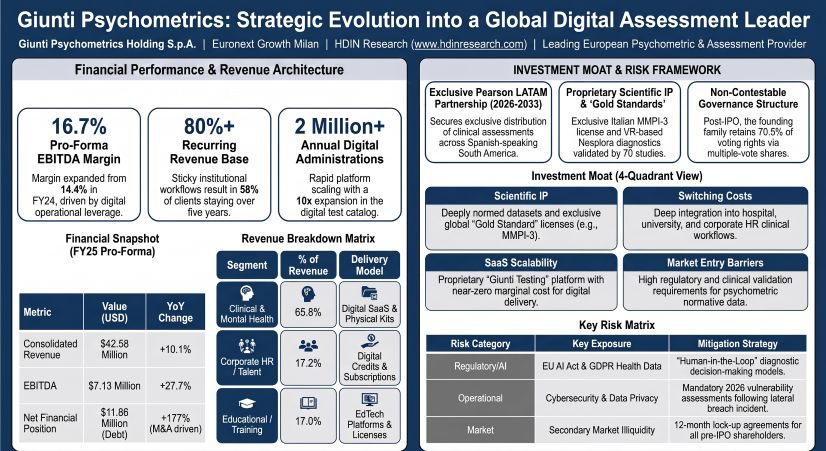
Figure Giunti Psychometrics: Strategic Evolution into a Global Digital Assessment Leader
 Segmental Realities and Margin Compression
Giunti Psychometrics Holding S.p.A. [EGM: GP] is executing a structural business model transformation, transitioning from physical, paper-based assessment kit publishing to a cloud-based digital Platform-as-a-Service (PaaS) and Software-as-a-Service (SaaS) model.
In FY25, consolidated pro-forma revenues rose 10.1% year-on-year (YoY) to $42.58 million, up from $38.69 million in FY24. Growth was driven primarily by the Clinical Assessment division, which expanded 14.6% YoY to $28.03 million (or $28.02 million as stated in clinical division reports), representing 65.8% of the consolidated top line. This performance offset a minor 0.2% contraction in the Corporate HR / Talent segment, caused by temporary deferrals of specific enterprise contracts.
Table 1: Consolidated Pro Forma Revenue Breakdown by Business Segment (FY2024–FY2025)
Table 2: Geographic Revenue Distribution and Market Contribution (FY2025)
Consolidated pro-forma EBITDA reached $7.13 million in FY25, a 27.7% YoY increase over the implied $5.58 million in FY24, expanding the EBITDA margin by 230 basis points to 16.7%. Adjusted EBITDA (excluding $0.44 million in severance incentives) stood at $7.56 million, equivalent to a 17.8% margin.
Conversely, the EBIT margin contracted slightly by 40 basis points to 9.2% (EBIT of $3.91 million). This compression is entirely attributable to a 52.8% surge in Depreciation & Amortization (D&A) to $2.83 million, stemming from the amortization of newly capitalized R&D software and the goodwill generated by the acquisition of Vetor Editora Psico Pedagógica in Brazil. Net profit was recorded at $2.54 million, representing a net margin of 6.0%.
Table 3: Profitability, Leverage, and Operating Efficiency Analysis (FY2024–FY2025)
The transition from physical kits (such as paper manuals and response sheets) to the centralized "Giunti Testing" digital ecosystem has transformed the Group's volume economics:
* Active Client Base: Scaled from a beta phase of 50 clients in FY20 to approximately 122,000 (and reported as 120,000 in alternative internal trackers) in FY25.
* Test Catalog Breadth: Expanded 10-fold from 74 tests in FY20 to 750 tests in FY25.
* Annual Test Volumes: Surged from ~90,000 administrations in FY20 to over 2,000,000 administrations in FY25.
* Revenue Quality and Retention: High switching costs are embedded within institutional workflows (automated scoring, clinical reporting, and electronic health record integration). Over 80% of FY25 revenue was generated from clients with a tenure exceeding 1 year (lowering new client revenue dependency to under 20%), while ~58% of revenues were generated from clients with a tenure exceeding 5 years. The top 10 clients account for approximately 11% of total revenue, representing low counterparty risk.
This digital platform transition utilizes a prepaid credit-based pricing model. Customers purchase digital "credits" in advance to access platform tests. Under the Group’s revenue recognition policy, these credit sales are deferred as liabilities (Risconti passivi) and only recognized in the P&L upon actual test consumption by the user or upon expiration after 12 months. This pricing model provides the Group with interest-free working capital.
Infrastructure Layout and Regional Moats
The Group's physical and digital architecture is segmented into centralized strategic management, international R&D hubs, and culturally localized commercial subsidiaries across 15 countries:
* Global Headquarters: Florence, Italy. The headquarters centrally controls intellectual property (IP), copyright licensing, and M&A integration.
* R&D Hubs & Expenditures: The Group operates specialized R&D hubs across Florence (Italy), Lisbon (Portugal), and Madrid (Spain). R&D CapEx stood at $1.81 million in FY25 (down slightly from $1.92 million in FY24), with 55% ($1.02 million) allocated to Clinical, 26% ($0.45 million) to Educational, and 19% ($0.34 million) to Corporate HR. Expensed research in the P&L rose 31.4% to $0.44 million in FY25 (up from $0.34 million in FY24), while capitalized development costs remained stable at $0.90 million in FY25 ($0.88 million in FY24). Intangibles in progress reached $0.74 million at the end of FY25.
* Product Pipeline: The Group released 33 new products/updates in 2024 and approximately 40 in 2025. It has a scheduled pipeline of 112 new products or updates between 2026 and 2028: 81 products are allocated to South America (including 35 specifically for Brazil), 16 for the Italian market, and 15 for other European jurisdictions.
* Exclusive IP Agreements:
* *NCS Pearson Inc. LATAM License:* A major clinical growth driver is a 2026–2033 exclusive agreement to adapt, clinically validate, and distribute Pearson's clinical evaluation instruments across Spanish-speaking Latin America. The contract is projected to generate approximately $45.22 million (EUR 40 million) in total revenue.
* *University of Minnesota Press License:* Long-term exclusive license for the MMPI-3 (Minnesota Multiphasic Personality Inventory) in Italy and globally for the Italian language.
* *Nesplora VR:* A 100%-owned subsidiary utilizing Virtual Reality for neuropsychological evaluations. The tool is backed by 70 scientific studies and standardized on a normative sample of 70,000 subjects.
* Supply Chain & Real Estate Footprint: Physical logistics (manuals and paper kits) remain relevant in Brazil, where local distributors handle roughly 50% of revenue. Key leases include the Florence headquarters from related-party Immobiliare Sarpi 7 S.r.l. for $131,150 (EUR 116,000) annually, alongside operating facilities in Spain and Brazil. Operating lease expenses for the group totaled $535.9k in FY25, down from $568.7k in FY24.
HDIN Institutional Verdict
The Euronext Growth Milan (EGM) listing of Giunti Psychometrics Holding S.p.A. is structured as a primary capital increase of up to $45.22 million (EUR 40.0 million) through 3.5 million new Ordinary Shares ($38.76 million reserved for institutional investors, $6.46 million for retail). There is no secondary offering, except for a Greenshoe option of up to 525,000 existing shares provided by minority shareholder Giunti Editore S.p.A. for market stabilization.
Proceeds are earmarked for growth: completing the staged buyout of Vetor Editora in Brazil ($7.12 million in deferred consideration), executing the potential call option by September 2026 to acquire the remaining stake of Chile's Adipa Holding S.p.A. for a pre-agreed Enterprise Value of $9.04 million, and funding the Pearson LATAM rollouts.
While management’s digital scalability narrative is supported by high capital efficiency (17.8% ROIC and 26.6% ROE), institutional investors must evaluate several structural and financial risks:
* Dual-Class Voting Concentration: Post-IPO, the controlling entity, Psychometrics Holding S.r.l., will retain 60.00% of the share capital but command 70.50% of the voting rights via 1,500,000 Multiple Voting Shares (which carry 10 votes per share). The public free float represents 29.81% of capital but only 14.91% of voting rights, rendering the company strictly non-contestable.
* Balance Sheet Leverage & Covenants: Net Debt expanded to $11.86 million in FY25 (up from $4.28 million in FY24), raising Net Debt/EBITDA from 0.77x to 1.66x. Though below the BNL covenant ceiling of 2.5x (and Banco BPM’s 3.0x ceiling), the current debt-to-equity ratio of 1.24x leaves limited headroom against BNL’s Net Debt/Equity limit of 1.5x (which scales down to 1.0x).
* Guarantees and Intercompany Exposure: The $5.65 million facilities from Banco BPM and BNL are backed by a 70% guarantee from SACE S.p.A. and joint corporate guarantees from Giunti Psychometrics Italia S.r.l. Furthermore, the Group holds a $1.32 million non-interest-bearing cash-pooling credit with recently deconsolidated Giunti eTherapy S.r.l., which the Issuer is contractually committed to convert into equity if a third-party investor enters the entity within 24 months of the IPO.
* Regulatory and Cybersecurity Risk: The Group processes sensitive "special category" health data (Article 9 GDPR) and biometric-adjacent data via remote examination proctoring. A security incident occurred in December 2025, where a privileged account compromise led to lateral network movements; although no data was exfiltrated, the delay in detection until May 2026 represents a compliance risk. Potential regulatory penalties under GDPR can reach up to $22.61 million or 4% of global turnover.
* Public Mandate Reliance: Approximately 14.75% of consolidated revenues are tied to legislative mandates, including mandatory psychometric testing for driver's licenses in Brazil (7.25% of revenue) and standardized testing in Chilean public schools (7.5% of revenue). Legislative amendments in these jurisdictions represent a direct top-line risk.
* Supplier Concentration & Royalties: The Group paid $4.19 million in royalties in FY25, representing its largest third-party service cost. Under major contracts like the Pearson agreement, the Group must pay guaranteed minimum royalties, which will compress margins if regional demand underperforms.
Presentation Download & Video Access:
Presentation Download: Click the PDF download link under 'Related Topics' to access the full institutional presentation of this report.
Video Link: Click this link to watch the HDIN analyst briefing on YouTube.
About HDIN Research:
HDIN Research is a premier global market intelligence and strategic advisory firm specializing in institutional-grade financial analysis, supply chain audits, and macroeconomic forecasting. Our dedicated sector analysts deliver actionable, data-driven insights tailored for private equity, hedge funds, and corporate strategy teams. Visit us at http://www.hdinresearch.com.
2026 AI Transparency Footer:
"This intelligence report was authored by HDIN Research analysts following a rigorous audit of official corporate filings. AI was utilized for massive-scale data synthesis and structural drafting, ensuring 100% inclusion of reported data points. All strategic insights, financial modeling, and final verdicts were verified by our editorial board to ensure professional accuracy and compliance with 2026 Google Search E-E-A-T standards."
1. Platform Pivot: Giunti Psychometrics Holding S.p.A.'s shift to the "Giunti Testing" SaaS platform expanded active clients to ~122,000 and test administrations to >2,000,000 in FY25, driving structural margin expansion.
2. M&A-Led Scale: The 92.5% step-up acquisition of Brazil's Vetor Editora and the 2026–2033 exclusive Pearson agreement hedge geopolitical risks via geographic diversification, targeting $45.22 million in Latin America.
3. Governance Rigidities: Post-IPO dual-class shares grant Psychometrics Holding S.r.l. 70.50% voting rights on a 29.81% public capital float, shielding the entity from hostile takeovers but limiting minority influence.
Figure Giunti Psychometrics: Strategic Evolution into a Global Digital Assessment Leader
Segmental Realities and Margin CompressionGiunti Psychometrics Holding S.p.A. [EGM: GP] is executing a structural business model transformation, transitioning from physical, paper-based assessment kit publishing to a cloud-based digital Platform-as-a-Service (PaaS) and Software-as-a-Service (SaaS) model.
In FY25, consolidated pro-forma revenues rose 10.1% year-on-year (YoY) to $42.58 million, up from $38.69 million in FY24. Growth was driven primarily by the Clinical Assessment division, which expanded 14.6% YoY to $28.03 million (or $28.02 million as stated in clinical division reports), representing 65.8% of the consolidated top line. This performance offset a minor 0.2% contraction in the Corporate HR / Talent segment, caused by temporary deferrals of specific enterprise contracts.
Table 1: Consolidated Pro Forma Revenue Breakdown by Business Segment (FY2024–FY2025)
| Business Segment | FY2024 Revenue ($M) | % of Total (FY2024) | FY2025 Revenue ($M) | % of Total (FY2025) | YoY Growth (%) |
|---|---|---|---|---|---|
| Clinical Assessment | 24.46 | 63.2% | 28.03 | 65.8% | +14.6% |
| Corporate HR / Talent Solutions | 7.33 | 18.9% | 7.32 | 17.2% | -0.2% |
| Educational Testing | 3.37 | 8.7% | 3.44 | 8.1% | +2.2% |
| Professional Training | 3.52 | 9.1% | 3.79 | 8.9% | +7.6% |
| Total Revenue | 38.69 | 100.0% | 42.58 | 100.0% | +10.1% |
Table 2: Geographic Revenue Distribution and Market Contribution (FY2025)
| Geographic Region | FY2025 Revenue ($M) | % of Total Revenue | Key Operating Entities / Markets |
|---|---|---|---|
| Italy | 18.43 | 43.8% | Giunti Psychometrics Italia; Giunti Psicologia.io |
| Brazil | 14.70 | 34.6% | Vetor Editora Psico Pedagógica and subsidiaries |
| Rest of EMEA | 5.11 | ~12.0% | Spain, Bulgaria, Hungary, Romania, Ukraine, Turkey |
| Latin America (Ex-Brazil) | 3.83 | ~9.0% | Chile, Colombia, Costa Rica, Mexico |
| Total Revenue | 42.58 | 100.0% | — |
Consolidated pro-forma EBITDA reached $7.13 million in FY25, a 27.7% YoY increase over the implied $5.58 million in FY24, expanding the EBITDA margin by 230 basis points to 16.7%. Adjusted EBITDA (excluding $0.44 million in severance incentives) stood at $7.56 million, equivalent to a 17.8% margin.
Conversely, the EBIT margin contracted slightly by 40 basis points to 9.2% (EBIT of $3.91 million). This compression is entirely attributable to a 52.8% surge in Depreciation & Amortization (D&A) to $2.83 million, stemming from the amortization of newly capitalized R&D software and the goodwill generated by the acquisition of Vetor Editora Psico Pedagógica in Brazil. Net profit was recorded at $2.54 million, representing a net margin of 6.0%.
Table 3: Profitability, Leverage, and Operating Efficiency Analysis (FY2024–FY2025)
| Key Profitability, Leverage, and Efficiency Metrics | FY2024 | FY2025 | YoY Change / Metric Status |
|---|---|---|---|
| EBITDA ($M) | ~5.58 | 7.13 | +27.7% |
| EBITDA Margin | 14.4% | 16.7% | Expanded by 230 bps |
| EBIT ($M) | — | 3.91 | 9.2% operating margin |
| Net Profit ($M) | — | 2.54 | 6.0% net margin |
| Return on Invested Capital (ROIC) | — | 17.8% | EBIT ($3.91M) / Net Invested Capital ($21.98M) |
| Return on Equity (ROE) | — | 26.6% | Net Profit ($2.54M) / Net Equity ($9.57M) |
| Net Financial Position (Net Debt) ($M) | 4.28 | 11.86 | +177.1%; primarily driven by the Vetor Editora acquisition |
| Net Debt / EBITDA | 0.77x | 1.66x | Increased 115.6% |
| Debt-to-Equity Ratio | — | 1.24x | Based on net equity of $9.57M |
| Interest Coverage Ratio (EBITDA / Interest Expense) | — | 12.0x | Based on FY2025 interest expense of $0.59M |
| Days Sales Outstanding (DSO) | 74 days | 61 days | Improved by 13 days |
| Days Payable Outstanding (DPO) | 96 days | 78 days | Reduced by 18 days |
| Commercial Net Working Capital ($M) | — | 6.04 | Equivalent to 14.2% of total revenue |
| Operating Cash Flow (OCF) ($M) | — | 5.26 | Positive operating cash generation |
| Total Capital Expenditures (CapEx) ($M) | — | 7.90 / 7.91 | Primarily allocated to intangible assets ($7.81M) |
| Free Cash Flow to Debt ($M) | — | (4.59) | Negative due to elevated growth-related CapEx and M&A investment |
The transition from physical kits (such as paper manuals and response sheets) to the centralized "Giunti Testing" digital ecosystem has transformed the Group's volume economics:
* Active Client Base: Scaled from a beta phase of 50 clients in FY20 to approximately 122,000 (and reported as 120,000 in alternative internal trackers) in FY25.
* Test Catalog Breadth: Expanded 10-fold from 74 tests in FY20 to 750 tests in FY25.
* Annual Test Volumes: Surged from ~90,000 administrations in FY20 to over 2,000,000 administrations in FY25.
* Revenue Quality and Retention: High switching costs are embedded within institutional workflows (automated scoring, clinical reporting, and electronic health record integration). Over 80% of FY25 revenue was generated from clients with a tenure exceeding 1 year (lowering new client revenue dependency to under 20%), while ~58% of revenues were generated from clients with a tenure exceeding 5 years. The top 10 clients account for approximately 11% of total revenue, representing low counterparty risk.
This digital platform transition utilizes a prepaid credit-based pricing model. Customers purchase digital "credits" in advance to access platform tests. Under the Group’s revenue recognition policy, these credit sales are deferred as liabilities (Risconti passivi) and only recognized in the P&L upon actual test consumption by the user or upon expiration after 12 months. This pricing model provides the Group with interest-free working capital.
Infrastructure Layout and Regional Moats
The Group's physical and digital architecture is segmented into centralized strategic management, international R&D hubs, and culturally localized commercial subsidiaries across 15 countries:
* Global Headquarters: Florence, Italy. The headquarters centrally controls intellectual property (IP), copyright licensing, and M&A integration.
* R&D Hubs & Expenditures: The Group operates specialized R&D hubs across Florence (Italy), Lisbon (Portugal), and Madrid (Spain). R&D CapEx stood at $1.81 million in FY25 (down slightly from $1.92 million in FY24), with 55% ($1.02 million) allocated to Clinical, 26% ($0.45 million) to Educational, and 19% ($0.34 million) to Corporate HR. Expensed research in the P&L rose 31.4% to $0.44 million in FY25 (up from $0.34 million in FY24), while capitalized development costs remained stable at $0.90 million in FY25 ($0.88 million in FY24). Intangibles in progress reached $0.74 million at the end of FY25.
* Product Pipeline: The Group released 33 new products/updates in 2024 and approximately 40 in 2025. It has a scheduled pipeline of 112 new products or updates between 2026 and 2028: 81 products are allocated to South America (including 35 specifically for Brazil), 16 for the Italian market, and 15 for other European jurisdictions.
* Exclusive IP Agreements:
* *NCS Pearson Inc. LATAM License:* A major clinical growth driver is a 2026–2033 exclusive agreement to adapt, clinically validate, and distribute Pearson's clinical evaluation instruments across Spanish-speaking Latin America. The contract is projected to generate approximately $45.22 million (EUR 40 million) in total revenue.
* *University of Minnesota Press License:* Long-term exclusive license for the MMPI-3 (Minnesota Multiphasic Personality Inventory) in Italy and globally for the Italian language.
* *Nesplora VR:* A 100%-owned subsidiary utilizing Virtual Reality for neuropsychological evaluations. The tool is backed by 70 scientific studies and standardized on a normative sample of 70,000 subjects.
* Supply Chain & Real Estate Footprint: Physical logistics (manuals and paper kits) remain relevant in Brazil, where local distributors handle roughly 50% of revenue. Key leases include the Florence headquarters from related-party Immobiliare Sarpi 7 S.r.l. for $131,150 (EUR 116,000) annually, alongside operating facilities in Spain and Brazil. Operating lease expenses for the group totaled $535.9k in FY25, down from $568.7k in FY24.
HDIN Institutional Verdict
The Euronext Growth Milan (EGM) listing of Giunti Psychometrics Holding S.p.A. is structured as a primary capital increase of up to $45.22 million (EUR 40.0 million) through 3.5 million new Ordinary Shares ($38.76 million reserved for institutional investors, $6.46 million for retail). There is no secondary offering, except for a Greenshoe option of up to 525,000 existing shares provided by minority shareholder Giunti Editore S.p.A. for market stabilization.
Proceeds are earmarked for growth: completing the staged buyout of Vetor Editora in Brazil ($7.12 million in deferred consideration), executing the potential call option by September 2026 to acquire the remaining stake of Chile's Adipa Holding S.p.A. for a pre-agreed Enterprise Value of $9.04 million, and funding the Pearson LATAM rollouts.
While management’s digital scalability narrative is supported by high capital efficiency (17.8% ROIC and 26.6% ROE), institutional investors must evaluate several structural and financial risks:
* Dual-Class Voting Concentration: Post-IPO, the controlling entity, Psychometrics Holding S.r.l., will retain 60.00% of the share capital but command 70.50% of the voting rights via 1,500,000 Multiple Voting Shares (which carry 10 votes per share). The public free float represents 29.81% of capital but only 14.91% of voting rights, rendering the company strictly non-contestable.
* Balance Sheet Leverage & Covenants: Net Debt expanded to $11.86 million in FY25 (up from $4.28 million in FY24), raising Net Debt/EBITDA from 0.77x to 1.66x. Though below the BNL covenant ceiling of 2.5x (and Banco BPM’s 3.0x ceiling), the current debt-to-equity ratio of 1.24x leaves limited headroom against BNL’s Net Debt/Equity limit of 1.5x (which scales down to 1.0x).
* Guarantees and Intercompany Exposure: The $5.65 million facilities from Banco BPM and BNL are backed by a 70% guarantee from SACE S.p.A. and joint corporate guarantees from Giunti Psychometrics Italia S.r.l. Furthermore, the Group holds a $1.32 million non-interest-bearing cash-pooling credit with recently deconsolidated Giunti eTherapy S.r.l., which the Issuer is contractually committed to convert into equity if a third-party investor enters the entity within 24 months of the IPO.
* Regulatory and Cybersecurity Risk: The Group processes sensitive "special category" health data (Article 9 GDPR) and biometric-adjacent data via remote examination proctoring. A security incident occurred in December 2025, where a privileged account compromise led to lateral network movements; although no data was exfiltrated, the delay in detection until May 2026 represents a compliance risk. Potential regulatory penalties under GDPR can reach up to $22.61 million or 4% of global turnover.
* Public Mandate Reliance: Approximately 14.75% of consolidated revenues are tied to legislative mandates, including mandatory psychometric testing for driver's licenses in Brazil (7.25% of revenue) and standardized testing in Chilean public schools (7.5% of revenue). Legislative amendments in these jurisdictions represent a direct top-line risk.
* Supplier Concentration & Royalties: The Group paid $4.19 million in royalties in FY25, representing its largest third-party service cost. Under major contracts like the Pearson agreement, the Group must pay guaranteed minimum royalties, which will compress margins if regional demand underperforms.
Presentation Download & Video Access:
Presentation Download: Click the PDF download link under 'Related Topics' to access the full institutional presentation of this report.
Video Link: Click this link to watch the HDIN analyst briefing on YouTube.
About HDIN Research:
HDIN Research is a premier global market intelligence and strategic advisory firm specializing in institutional-grade financial analysis, supply chain audits, and macroeconomic forecasting. Our dedicated sector analysts deliver actionable, data-driven insights tailored for private equity, hedge funds, and corporate strategy teams. Visit us at http://www.hdinresearch.com.
2026 AI Transparency Footer:
"This intelligence report was authored by HDIN Research analysts following a rigorous audit of official corporate filings. AI was utilized for massive-scale data synthesis and structural drafting, ensuring 100% inclusion of reported data points. All strategic insights, financial modeling, and final verdicts were verified by our editorial board to ensure professional accuracy and compliance with 2026 Google Search E-E-A-T standards."