OKYO Pharma: Strategic Pivot to Neuropathic Corneal Pain Near Tufts Medical Center as Phase 3 Funding and Executive Upgrades Signal Impending Registration Drive
Date : 2026-07-23
Reading : 142
HDIN Market Intelligence Brief
1. OKYO Pharma [NASDAQ: OKYO] has pivoted to a pure-play Neuropathic Corneal Pain (NCP) clinical model, backing its lead GPCR agonist urcosimod into global Phase 3 NEPTUNE trials.
2. A major C-suite restructuring secures elite ophthalmic launch expertise to navigate single-source CDMO vulnerabilities and execute impending regulatory pathways.
3. Despite a $20.59 million liquidity pool, imminent $1.5 million Phase 3 milestone obligations and trial expansion will compress the historical $495,000 monthly cash burn.
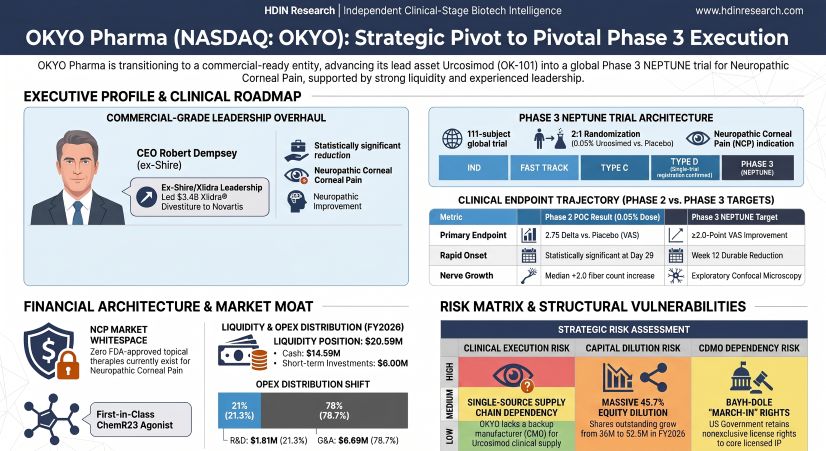
Figure OKYO Pharma: Strategic Pivot to Pivotal Phase 3 Execution
Segmental Cost Structures, Capitalization Profiles, and Clinical Liabilities
OKYO Pharma’s financial architecture is characterized by a pre-revenue profile with capital allocation heavily weighted toward non-clinical corporate expenses, mitigated by a recent equity injection. As of March 31, 2026, the company's total liquidity pool was $20.59 million. Net Working Capital (NWC) stood at a surplus of $12.33 million, with current assets of $20.97 million against current liabilities of $8.64 million.
During the trailing 12-month (TTM) period ended March 31, 2026, net cash used in operating activities totaled $5.94 million, translating to an average monthly cash burn of $495,000. While this historical burn rate mathematically implies a runway of approximately 41.6 months, the clinical transition of its primary asset, urcosimod (formerly OK-101), from an 18-subject Phase 2 trial to the ~111-subject global Phase 3 NEPTUNE trial will compress actual runway duration.
Total operating expenses (OpEx) for FY2026 reached $8.50 million, distributed as follows:
Table: Operating Expense Structure and Cost Allocation Analysis (FY2026)
The $450,000 decrease in direct R&D spending was driven by the settlement of legacy patent invoices and the structural transition from a 240-patient Dry Eye Disease (DED) trial to the highly concentrated 18-patient Phase 2 Proof-of-Concept (PoC) trial for NCP. Conversely, the $1.85 million surge in G&A overhead was driven by non-cash option charges, legal costs related to share issuances, executive onboarding fees for the incoming CEO and CMO, and elevated public relations and media consulting fees.
The capitalization table underwent material dilution in FY2026. Outstanding ordinary shares expanded by 45.7%, climbing from 36,020,815 in FY2025 to 52,479,527 as of March 31, 2026. This expansion was primarily driven by a February 2026 underwritten public offering of 10,815,000 ordinary shares at $1.85 per share (with a 1,622,250 share underwriter option), netting cash proceeds of $25.02 million for the fiscal year (reflecting gross proceeds of $20.0 million, which expanded to approximately $22.0 million following the underwriter's option exercise in March 2026).
Further dilution was driven by the retirement of high-interest debt and stock-based settlements:
* Debt Conversion: On October 29, 2025, fixed-term unsecured loans totaling $950,000 (carrying a 20% interest rate) and $546,236 in accrued interest were converted into 1,887,306 shares. This transaction comprised $950,000 in principal converted at a strike price of $0.70 per share into 1,357,141 shares, and $546,236 in accrued interest converted into 530,163 shares.
* Consultancy Settlements: The company issued 292,018 shares in lieu of cash to settle outstanding advisory fees.
OKYO Pharma’s balance sheet is encumbered by significant contingent liabilities tied to its licensing agreements:
* On Target Therapeutics (Urcosimod): The company faces up to $4.9 million in development milestones: $300,000 (Phase 1), $600,000 (Phase 2), $1.5 million (Phase 3), and $2.5 million upon first commercial sale. The $1.5 million Phase 3 milestone is a near-term contingent liability triggered by the initiation of the NEPTUNE trial. Additionally, the agreement mandates up to $37 million in tiered sales milestones (ranging from $2 million on $50 million in net sales to $15 million on $1 billion in net sales) and low single-digit royalties on net sales.
* Tufts Medical Center (OK-201): Under the license agreement for its secondary asset, OK-201, the company paid an upfront fee of $15,000 (calculated as $14,511 based on the mandated 1.3192 GBP/USD exchange rate for the £11,000 fee). The contract carries an ongoing $10,000 annual maintenance fee until the first commercial sale is achieved.
* Leases & Off-Balance Sheet: The company has no off-balance sheet arrangements. Non-cancellable operating lease obligations for its New York executive office total $13,018 due within one year.
* Related Party Transactions: OKYO Pharma shares office space and resources with Tiziana Life Sciences Ltd, an entity controlled by Chairman Gabriele Cerrone. In FY2026, OKYO incurred $169,552 under this shared-services agreement. As of March 31, 2026, OKYO owed Tiziana $493,832, while Tiziana owed OKYO $638,178. Accrued director fees outstanding as of March 31, 2026, totaled $50,258 to Gabriele Cerrone, $7,148 to John Brancaccio, $3,574 to Bernard Denoyer, and $3,574 to Willy Simon.
Pipeline Architecture, Manufacturing Dependencies, and Academic Clinical Moats
OKYO Pharma is concentrating its resources on urcosimod (formerly OK-101), a first-in-class lipidated chemerin peptide GPCR agonist targeting the ChemR23 receptor. Urcosimod utilizes a dual mechanism of action to suppress immune-mediated inflammation and neuronal/glial cell populations in the dorsal root ganglion, spinal cord, and retina. Management executed a strategic pivot in mid-2024, shifting the drug’s development from DED to NCP, a severe neuropathic condition with zero FDA-approved topical therapies.
The clinical development timeline and regulatory milestones for urcosimod are structured as follows:
* February 9, 2024: FDA cleared the Investigational New Drug (IND) application. Initially proposed as an open-label study, the design was amended to a double-masked, randomized, 12-week placebo-controlled protocol following FDA feedback.
* May 1, 2025: FDA granted Fast Track designation.
* January 2026 (Type C Meeting): The FDA aligned on Phase 2b/3 parameters, confirming that a ≥2-point improvement on the Visual Analogue Scale (VAS) at Week 12 constitutes a clinically meaningful primary endpoint. The agency also accepted the Ocular Pain Assessment Survey (OPAS) as supportive quality-of-life evidence and aligned with OKYO’s Chemistry, Manufacturing, and Controls (CMC) strategy.
* July 2026 (Type D Meeting): The FDA agreed on a single-dose Phase 3 study design and established a potential single-trial registration pathway.
The upcoming Phase 3 NEPTUNE trial will be a global study across the United States and Europe, enrolling approximately 111 subjects randomized 2:1 to receive either 0.05% urcosimod or placebo. The higher 0.1% dose evaluated in earlier stages has been eliminated due to a lack of therapeutic efficacy.
Urcosimod's clinical efficacy signals are derived from two distinct trials:
* Dry Eye Disease Phase 2b Trial (n=240, 14 weeks): Demonstrated statistically significant ocular pain reduction via VAS, with p-values of 0.03 at Day 29, 0.04 at Day 57, and 0.01 at Day 85.
* NCP Phase 2 Proof-of-Concept Trial (n=18, 12 weeks, QID dosing):
* Per-Protocol Population (n=4 per group): 0.05% urcosimod achieved a mean VAS pain score reduction of 5.5 at Week 12 versus 2.75 for placebo (delta of 2.75). Rapid onset was demonstrated at Week 4, with a mean VAS change of 5.25 versus 3.0 for placebo. Within-group baseline-to-end reduction was statistically significant (p=0.025), while the between-group difference narrowly missed significance (p=0.07). Notably, 75% of the 0.05% cohort achieved >80% improvement in pain severity.
* Intent-to-Treat Population (n=6 per group): Mean VAS reduction was 4.2 for the 0.05% group versus 2.5 for placebo (p=0.2). Greater than 50% improvement was observed in 67% of the urcosimod group compared to 33% of the placebo group, yielding a Cohen-d effect size > 1.2.
* Anatomical Disease Modification (Confocal Microscopy): Treatment with 0.05% urcosimod demonstrated median increases in total corneal nerve fiber count (+2.0 n/0.16 mm²) and total nerve fiber length (+2.6 mm/mm², p=0.057 vs. placebo). Placebo patients experienced median decreases of -1.92 n/0.16 mm² (count) and -1.63 mm/mm² (length).
* Quality of Life (0-10 scale): Ophthalmic pain reduction translated to superior mean improvements over placebo in "Enjoying life/relationships" (-4.5 vs. 0), "Mood" (-1.5 vs. -0.5), and "Time spent thinking about eye pain" (-3.0 vs. -1.5).
The company's secondary pipeline asset, OK-201 (a non-opioid, lipidated BAM8-22 analogue targeting neuropathic pain and ocular inflammation), has been deprioritized to an exploratory level. Preclinical in vivo ciliary nerve ligation mouse models demonstrated pain reduction equivalent to oral gabapentin, but resources remain consolidated on urcosimod.
OKYO Pharma operates an asset-light operational model. It holds zero manufacturing infrastructure and relies on a single-source Contract Manufacturing Organization (CMO) for clinical supply and future commercial sales, with no active backup manufacturer. Manufacturing is constrained by the procurement complexity of biologic-derived raw materials and lipid-conjugated peptides. Furthermore, a recent transition of urcosimod to single-use sterile ampoules introduces specialized fill-finish packaging dependencies.
Clinical R&D has been heavily concentrated at Tufts Medical Center in Boston, Massachusetts, which served as the sole clinical site for the Phase 2 NCP trial under a single Principal Investigator, Dr. Pedram Hamrah, MD.
The company's intellectual property estate consists of 8 issued patents and 15 pending applications globally as of June 30, 2025, secured via exclusive licenses from On Target Therapeutics and Tufts Medical Center:
* Urcosimod Composition-of-Matter (US): Expires March 13, 2034, with potential extension to 2039.
* Urcosimod Method-of-Use for Neuropathic Pain (US): Expires March 13, 2034 (plus 187 days of Patent Term Adjustment), extendable to 2039.
* Urcosimod Method-of-Use for Dry Eye Disease (US): Expires January 23, 2037, extendable to 2041.
* OK-201 Composition & Method (US Patent No. 10,899,796): Issued February 23, 2021; expires November 9, 2036 (plus 70 days of PTA), extendable to 2042.
* Geographic Coverage: Patent Cooperation Treaty (PCT) applications are nationalized across the United States, Europe, Japan, Australia, and Canada, with a baseline PCT expiration of 2037.
HDIN Institutional Verdict: High-Yield Alignment and Buyout Arbitrage
OKYO Pharma’s corporate architecture is structured for an M&A transaction rather than long-term independent commercial operations. The company's governance and incentive structures are heavily influenced by Non-Executive Chairman Gabriele Cerrone, who beneficially owns 10,526,416 shares, representing 19.94% of the outstanding equity, through Planwise Group Limited and Panetta Partners Limited. Total executive and director stock ownership stands at 10,676,840 shares (19.94%), meaning the remainder of the C-suite and Board collectively holds less than 1% of the underlying equity.
The corporate strategy shifted in Q1 2026 via a targeted C-suite overhaul. The company appointed Robert J. Dempsey as CEO and Dr. Flavio Mantelli, MD, PhD, as CMO. Dempsey brings commercial exit pedigree, having previously served as Group VP and Head of Global Ophthalmology at Shire, where he launched the dry eye drug Xiidra® and engineered its $3.4 billion upfront (plus $1.9 billion milestone) divestiture to Novartis. Dr. Mantelli previously served as CMO of Dompé, overseeing the clinical development and FDA approval of Oxervate® (cenegermin-bkbj) for neurotrophic keratopathy. Keeren Shah, CFO since August 2020, concurrently serves as CFO for other Cerrone-controlled entities, including Tiziana Life Sciences.
This executive team's incentive alignment is heavily weighted toward equity derivatives:
* Option Pool: As of March 31, 2026, there were 5,327,377 options outstanding with a weighted average exercise price of $2.04 (following a January 2025 repricing of legacy options to $1.60).
* CEO Alignment: Dempsey holds zero underlying shares but was granted 2.1 million options (vesting through 2036), with 500,000 options tied to a strict 1-year performance hurdle.
* CMO Alignment: Mantelli was granted 750,000 options at an exercise price of $1.96.
The primary structural indicator of a near-term buyout strategy is the Panetta Partners Ltd change-of-control agreement, effective January 1, 2026. This contract entitles Chairman Cerrone's beneficially owned entity to tiered cash payments calculated as a percentage of the company's Enterprise Value (EV) upon an asset sale or licensing transaction:
[Enterprise Value Trigger]
├── EV ≥ $275 Million ──> 3.5% EV Cash Payout to Panetta Partners
├── EV ≥ $500 Million ──> 6.5% EV Cash Payout to Panetta Partners
└── EV ≥ $900 Million ──> 9.0% EV Cash Payout to Panetta Partners
This payout structure, combined with the lack of direct stock ownership by the newly appointed executive officers, strongly suggests that management is incentivized to execute the Phase 3 NEPTUNE trial as a de-risking event to trigger an acquisition.
Institutional investors must weigh this clear exit alignment against severe operational and macro risks. OKYO's physical clinical assets are highly concentrated around Tufts Medical Center and Dr. Pedram Hamrah, creating significant single-site risk. Operationally, the single-source CMO model with zero manufacturing redundancy leaves the clinical and commercial supply chain exposed to single-point failures.
Furthermore, because the licensed patents from Tufts Medical Center were developed with US federal funding, they are subject to the Bayh-Dole Act of 1980. This grants the US government march-in rights to mandate third-party licensing or enforce strict domestic manufacturing requirements.
Regulatory challenges are compounded by post-Brexit divergence, requiring separate dual-track marketing authorizations from the UK's MHRA and the European Medicines Agency (EMA), thereby escalating administrative and clinical supply costs.
On a macro level, future commercial margins face compression from the Inflation Reduction Act (IRA) Medicare price negotiations in the US, alongside legislative risks such as proposed ACA premium tax credit restrictions and potential Medicaid funding caps. Finally, because patent applications are kept secret for 18 months, OKYO operates with a continuous freedom-to-operate blind spot, exposing its clinical progress to competitor IP challenges.
For the fiscal year ended March 31, 2026, the company's auditor, PKF Littlejohn LLP, issued a clean audit opinion with zero Critical Audit Matters (KAMs) and did not include a going concern modification. This clean assessment is supported by the capital preservation realized by the February 2026 public offering and the conservative accounting treatment of expensing 100% of R&D costs under IAS 38, leaving zero capitalized R&D assets on the balance sheet.
OKYO Pharma presents an asymmetric, clinical-stage vehicle where the downside is defined by clinical trial execution, single-source manufacturing, and dilutive funding risks, while the upside is tied to an explicit, executive-led M&A exit strategy.
Presentation Download & Video Access
Presentation Download: Click the PDF download link under 'Related Topics' to access the full institutional presentation of this report.
Video Link: Click this link to watch the HDIN analyst briefing on YouTube.
About HDIN Research
HDIN Research is a premier global market intelligence and strategic advisory firm specializing in institutional-grade financial analysis, supply chain audits, and macroeconomic forecasting. Our dedicated sector analysts deliver actionable, data-driven insights tailored for private equity, hedge funds, and corporate strategy teams. Visit us at http://www.hdinresearch.com.
2026 AI Transparency Footer
"This intelligence report was authored by HDIN Research analysts following a rigorous audit of official corporate filings. AI was utilized for massive-scale data synthesis and structural drafting, ensuring 100% inclusion of reported data points. All strategic insights, financial modeling, and final verdicts were verified by our editorial board to ensure professional accuracy and compliance with 2026 Google Search E-E-A-T standards."
1. OKYO Pharma [NASDAQ: OKYO] has pivoted to a pure-play Neuropathic Corneal Pain (NCP) clinical model, backing its lead GPCR agonist urcosimod into global Phase 3 NEPTUNE trials.
2. A major C-suite restructuring secures elite ophthalmic launch expertise to navigate single-source CDMO vulnerabilities and execute impending regulatory pathways.
3. Despite a $20.59 million liquidity pool, imminent $1.5 million Phase 3 milestone obligations and trial expansion will compress the historical $495,000 monthly cash burn.
Figure OKYO Pharma: Strategic Pivot to Pivotal Phase 3 Execution
Segmental Cost Structures, Capitalization Profiles, and Clinical Liabilities
OKYO Pharma’s financial architecture is characterized by a pre-revenue profile with capital allocation heavily weighted toward non-clinical corporate expenses, mitigated by a recent equity injection. As of March 31, 2026, the company's total liquidity pool was $20.59 million. Net Working Capital (NWC) stood at a surplus of $12.33 million, with current assets of $20.97 million against current liabilities of $8.64 million.
During the trailing 12-month (TTM) period ended March 31, 2026, net cash used in operating activities totaled $5.94 million, translating to an average monthly cash burn of $495,000. While this historical burn rate mathematically implies a runway of approximately 41.6 months, the clinical transition of its primary asset, urcosimod (formerly OK-101), from an 18-subject Phase 2 trial to the ~111-subject global Phase 3 NEPTUNE trial will compress actual runway duration.
Total operating expenses (OpEx) for FY2026 reached $8.50 million, distributed as follows:
Table: Operating Expense Structure and Cost Allocation Analysis (FY2026)
| Operating Expense Segment | FY2026 Allocation ($ USD) | Percentage of Total Operating Expenses (%) | Year-over-Year (YoY) Variance |
|---|---|---|---|
| General & Administrative (G&A) | $6,690,000 | 78.7% | Increased by $1,850,000 |
| Research & Development (R&D) | $1,810,000 | 21.3% | Decreased by $450,000 |
| Total Operating Expenses | $8,500,000 | 100.0% | Increased by $1,400,000 |
The $450,000 decrease in direct R&D spending was driven by the settlement of legacy patent invoices and the structural transition from a 240-patient Dry Eye Disease (DED) trial to the highly concentrated 18-patient Phase 2 Proof-of-Concept (PoC) trial for NCP. Conversely, the $1.85 million surge in G&A overhead was driven by non-cash option charges, legal costs related to share issuances, executive onboarding fees for the incoming CEO and CMO, and elevated public relations and media consulting fees.
The capitalization table underwent material dilution in FY2026. Outstanding ordinary shares expanded by 45.7%, climbing from 36,020,815 in FY2025 to 52,479,527 as of March 31, 2026. This expansion was primarily driven by a February 2026 underwritten public offering of 10,815,000 ordinary shares at $1.85 per share (with a 1,622,250 share underwriter option), netting cash proceeds of $25.02 million for the fiscal year (reflecting gross proceeds of $20.0 million, which expanded to approximately $22.0 million following the underwriter's option exercise in March 2026).
Further dilution was driven by the retirement of high-interest debt and stock-based settlements:
* Debt Conversion: On October 29, 2025, fixed-term unsecured loans totaling $950,000 (carrying a 20% interest rate) and $546,236 in accrued interest were converted into 1,887,306 shares. This transaction comprised $950,000 in principal converted at a strike price of $0.70 per share into 1,357,141 shares, and $546,236 in accrued interest converted into 530,163 shares.
* Consultancy Settlements: The company issued 292,018 shares in lieu of cash to settle outstanding advisory fees.
OKYO Pharma’s balance sheet is encumbered by significant contingent liabilities tied to its licensing agreements:
* On Target Therapeutics (Urcosimod): The company faces up to $4.9 million in development milestones: $300,000 (Phase 1), $600,000 (Phase 2), $1.5 million (Phase 3), and $2.5 million upon first commercial sale. The $1.5 million Phase 3 milestone is a near-term contingent liability triggered by the initiation of the NEPTUNE trial. Additionally, the agreement mandates up to $37 million in tiered sales milestones (ranging from $2 million on $50 million in net sales to $15 million on $1 billion in net sales) and low single-digit royalties on net sales.
* Tufts Medical Center (OK-201): Under the license agreement for its secondary asset, OK-201, the company paid an upfront fee of $15,000 (calculated as $14,511 based on the mandated 1.3192 GBP/USD exchange rate for the £11,000 fee). The contract carries an ongoing $10,000 annual maintenance fee until the first commercial sale is achieved.
* Leases & Off-Balance Sheet: The company has no off-balance sheet arrangements. Non-cancellable operating lease obligations for its New York executive office total $13,018 due within one year.
* Related Party Transactions: OKYO Pharma shares office space and resources with Tiziana Life Sciences Ltd, an entity controlled by Chairman Gabriele Cerrone. In FY2026, OKYO incurred $169,552 under this shared-services agreement. As of March 31, 2026, OKYO owed Tiziana $493,832, while Tiziana owed OKYO $638,178. Accrued director fees outstanding as of March 31, 2026, totaled $50,258 to Gabriele Cerrone, $7,148 to John Brancaccio, $3,574 to Bernard Denoyer, and $3,574 to Willy Simon.
Pipeline Architecture, Manufacturing Dependencies, and Academic Clinical Moats
OKYO Pharma is concentrating its resources on urcosimod (formerly OK-101), a first-in-class lipidated chemerin peptide GPCR agonist targeting the ChemR23 receptor. Urcosimod utilizes a dual mechanism of action to suppress immune-mediated inflammation and neuronal/glial cell populations in the dorsal root ganglion, spinal cord, and retina. Management executed a strategic pivot in mid-2024, shifting the drug’s development from DED to NCP, a severe neuropathic condition with zero FDA-approved topical therapies.
The clinical development timeline and regulatory milestones for urcosimod are structured as follows:
* February 9, 2024: FDA cleared the Investigational New Drug (IND) application. Initially proposed as an open-label study, the design was amended to a double-masked, randomized, 12-week placebo-controlled protocol following FDA feedback.
* May 1, 2025: FDA granted Fast Track designation.
* January 2026 (Type C Meeting): The FDA aligned on Phase 2b/3 parameters, confirming that a ≥2-point improvement on the Visual Analogue Scale (VAS) at Week 12 constitutes a clinically meaningful primary endpoint. The agency also accepted the Ocular Pain Assessment Survey (OPAS) as supportive quality-of-life evidence and aligned with OKYO’s Chemistry, Manufacturing, and Controls (CMC) strategy.
* July 2026 (Type D Meeting): The FDA agreed on a single-dose Phase 3 study design and established a potential single-trial registration pathway.
The upcoming Phase 3 NEPTUNE trial will be a global study across the United States and Europe, enrolling approximately 111 subjects randomized 2:1 to receive either 0.05% urcosimod or placebo. The higher 0.1% dose evaluated in earlier stages has been eliminated due to a lack of therapeutic efficacy.
Urcosimod's clinical efficacy signals are derived from two distinct trials:
* Dry Eye Disease Phase 2b Trial (n=240, 14 weeks): Demonstrated statistically significant ocular pain reduction via VAS, with p-values of 0.03 at Day 29, 0.04 at Day 57, and 0.01 at Day 85.
* NCP Phase 2 Proof-of-Concept Trial (n=18, 12 weeks, QID dosing):
* Per-Protocol Population (n=4 per group): 0.05% urcosimod achieved a mean VAS pain score reduction of 5.5 at Week 12 versus 2.75 for placebo (delta of 2.75). Rapid onset was demonstrated at Week 4, with a mean VAS change of 5.25 versus 3.0 for placebo. Within-group baseline-to-end reduction was statistically significant (p=0.025), while the between-group difference narrowly missed significance (p=0.07). Notably, 75% of the 0.05% cohort achieved >80% improvement in pain severity.
* Intent-to-Treat Population (n=6 per group): Mean VAS reduction was 4.2 for the 0.05% group versus 2.5 for placebo (p=0.2). Greater than 50% improvement was observed in 67% of the urcosimod group compared to 33% of the placebo group, yielding a Cohen-d effect size > 1.2.
* Anatomical Disease Modification (Confocal Microscopy): Treatment with 0.05% urcosimod demonstrated median increases in total corneal nerve fiber count (+2.0 n/0.16 mm²) and total nerve fiber length (+2.6 mm/mm², p=0.057 vs. placebo). Placebo patients experienced median decreases of -1.92 n/0.16 mm² (count) and -1.63 mm/mm² (length).
* Quality of Life (0-10 scale): Ophthalmic pain reduction translated to superior mean improvements over placebo in "Enjoying life/relationships" (-4.5 vs. 0), "Mood" (-1.5 vs. -0.5), and "Time spent thinking about eye pain" (-3.0 vs. -1.5).
The company's secondary pipeline asset, OK-201 (a non-opioid, lipidated BAM8-22 analogue targeting neuropathic pain and ocular inflammation), has been deprioritized to an exploratory level. Preclinical in vivo ciliary nerve ligation mouse models demonstrated pain reduction equivalent to oral gabapentin, but resources remain consolidated on urcosimod.
OKYO Pharma operates an asset-light operational model. It holds zero manufacturing infrastructure and relies on a single-source Contract Manufacturing Organization (CMO) for clinical supply and future commercial sales, with no active backup manufacturer. Manufacturing is constrained by the procurement complexity of biologic-derived raw materials and lipid-conjugated peptides. Furthermore, a recent transition of urcosimod to single-use sterile ampoules introduces specialized fill-finish packaging dependencies.
Clinical R&D has been heavily concentrated at Tufts Medical Center in Boston, Massachusetts, which served as the sole clinical site for the Phase 2 NCP trial under a single Principal Investigator, Dr. Pedram Hamrah, MD.
The company's intellectual property estate consists of 8 issued patents and 15 pending applications globally as of June 30, 2025, secured via exclusive licenses from On Target Therapeutics and Tufts Medical Center:
* Urcosimod Composition-of-Matter (US): Expires March 13, 2034, with potential extension to 2039.
* Urcosimod Method-of-Use for Neuropathic Pain (US): Expires March 13, 2034 (plus 187 days of Patent Term Adjustment), extendable to 2039.
* Urcosimod Method-of-Use for Dry Eye Disease (US): Expires January 23, 2037, extendable to 2041.
* OK-201 Composition & Method (US Patent No. 10,899,796): Issued February 23, 2021; expires November 9, 2036 (plus 70 days of PTA), extendable to 2042.
* Geographic Coverage: Patent Cooperation Treaty (PCT) applications are nationalized across the United States, Europe, Japan, Australia, and Canada, with a baseline PCT expiration of 2037.
HDIN Institutional Verdict: High-Yield Alignment and Buyout Arbitrage
OKYO Pharma’s corporate architecture is structured for an M&A transaction rather than long-term independent commercial operations. The company's governance and incentive structures are heavily influenced by Non-Executive Chairman Gabriele Cerrone, who beneficially owns 10,526,416 shares, representing 19.94% of the outstanding equity, through Planwise Group Limited and Panetta Partners Limited. Total executive and director stock ownership stands at 10,676,840 shares (19.94%), meaning the remainder of the C-suite and Board collectively holds less than 1% of the underlying equity.
The corporate strategy shifted in Q1 2026 via a targeted C-suite overhaul. The company appointed Robert J. Dempsey as CEO and Dr. Flavio Mantelli, MD, PhD, as CMO. Dempsey brings commercial exit pedigree, having previously served as Group VP and Head of Global Ophthalmology at Shire, where he launched the dry eye drug Xiidra® and engineered its $3.4 billion upfront (plus $1.9 billion milestone) divestiture to Novartis. Dr. Mantelli previously served as CMO of Dompé, overseeing the clinical development and FDA approval of Oxervate® (cenegermin-bkbj) for neurotrophic keratopathy. Keeren Shah, CFO since August 2020, concurrently serves as CFO for other Cerrone-controlled entities, including Tiziana Life Sciences.
This executive team's incentive alignment is heavily weighted toward equity derivatives:
* Option Pool: As of March 31, 2026, there were 5,327,377 options outstanding with a weighted average exercise price of $2.04 (following a January 2025 repricing of legacy options to $1.60).
* CEO Alignment: Dempsey holds zero underlying shares but was granted 2.1 million options (vesting through 2036), with 500,000 options tied to a strict 1-year performance hurdle.
* CMO Alignment: Mantelli was granted 750,000 options at an exercise price of $1.96.
The primary structural indicator of a near-term buyout strategy is the Panetta Partners Ltd change-of-control agreement, effective January 1, 2026. This contract entitles Chairman Cerrone's beneficially owned entity to tiered cash payments calculated as a percentage of the company's Enterprise Value (EV) upon an asset sale or licensing transaction:
[Enterprise Value Trigger]
├── EV ≥ $275 Million ──> 3.5% EV Cash Payout to Panetta Partners
├── EV ≥ $500 Million ──> 6.5% EV Cash Payout to Panetta Partners
└── EV ≥ $900 Million ──> 9.0% EV Cash Payout to Panetta Partners
This payout structure, combined with the lack of direct stock ownership by the newly appointed executive officers, strongly suggests that management is incentivized to execute the Phase 3 NEPTUNE trial as a de-risking event to trigger an acquisition.
Institutional investors must weigh this clear exit alignment against severe operational and macro risks. OKYO's physical clinical assets are highly concentrated around Tufts Medical Center and Dr. Pedram Hamrah, creating significant single-site risk. Operationally, the single-source CMO model with zero manufacturing redundancy leaves the clinical and commercial supply chain exposed to single-point failures.
Furthermore, because the licensed patents from Tufts Medical Center were developed with US federal funding, they are subject to the Bayh-Dole Act of 1980. This grants the US government march-in rights to mandate third-party licensing or enforce strict domestic manufacturing requirements.
Regulatory challenges are compounded by post-Brexit divergence, requiring separate dual-track marketing authorizations from the UK's MHRA and the European Medicines Agency (EMA), thereby escalating administrative and clinical supply costs.
On a macro level, future commercial margins face compression from the Inflation Reduction Act (IRA) Medicare price negotiations in the US, alongside legislative risks such as proposed ACA premium tax credit restrictions and potential Medicaid funding caps. Finally, because patent applications are kept secret for 18 months, OKYO operates with a continuous freedom-to-operate blind spot, exposing its clinical progress to competitor IP challenges.
For the fiscal year ended March 31, 2026, the company's auditor, PKF Littlejohn LLP, issued a clean audit opinion with zero Critical Audit Matters (KAMs) and did not include a going concern modification. This clean assessment is supported by the capital preservation realized by the February 2026 public offering and the conservative accounting treatment of expensing 100% of R&D costs under IAS 38, leaving zero capitalized R&D assets on the balance sheet.
OKYO Pharma presents an asymmetric, clinical-stage vehicle where the downside is defined by clinical trial execution, single-source manufacturing, and dilutive funding risks, while the upside is tied to an explicit, executive-led M&A exit strategy.
Presentation Download & Video Access
Presentation Download: Click the PDF download link under 'Related Topics' to access the full institutional presentation of this report.
Video Link: Click this link to watch the HDIN analyst briefing on YouTube.
About HDIN Research
HDIN Research is a premier global market intelligence and strategic advisory firm specializing in institutional-grade financial analysis, supply chain audits, and macroeconomic forecasting. Our dedicated sector analysts deliver actionable, data-driven insights tailored for private equity, hedge funds, and corporate strategy teams. Visit us at http://www.hdinresearch.com.
2026 AI Transparency Footer
"This intelligence report was authored by HDIN Research analysts following a rigorous audit of official corporate filings. AI was utilized for massive-scale data synthesis and structural drafting, ensuring 100% inclusion of reported data points. All strategic insights, financial modeling, and final verdicts were verified by our editorial board to ensure professional accuracy and compliance with 2026 Google Search E-E-A-T standards."