HNO International, Inc.: Strategic Pivot to Decentralized Hydrogen Refueling Stalls in Katy, Texas as $2.6 Million Working Capital Deficit and Patent Surrender Threaten Solvency
Date : 2026-07-24
Reading : 171
HDIN Market Intelligence Brief
1. HNO International, Inc. [OTCQB: HNOI] faces extreme customer concentration with 100% of projected recurring revenues tied to a single, non-operational trucking offtake in Katy, Texas.
2. Operational capacity is structurally compromised by the March 2025 surrender of its entire patent portfolio back to CEO Donald Owens, leaving the public entity with zero owned patents.
3. A $2.61 million working capital deficit and under 3 months of cash runway force reliance on a highly dilutive $30 million Lambda Ventures ELOC and toxic convertible notes.
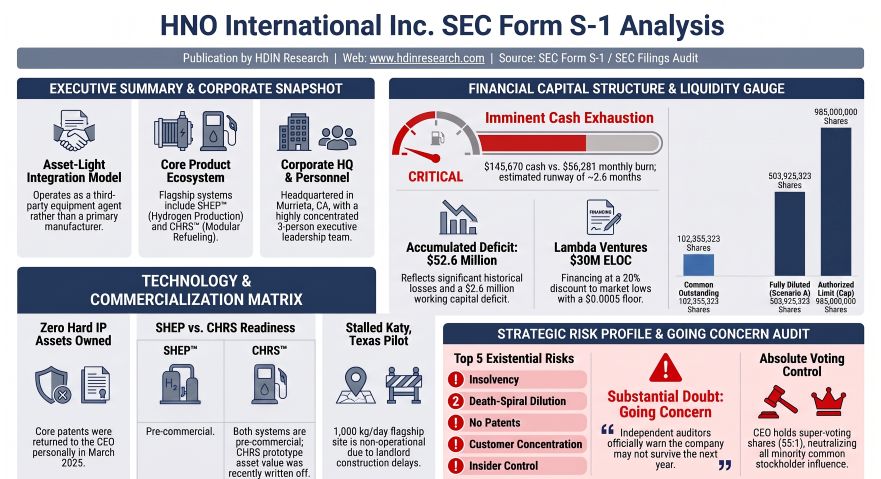
Figure HNO International Inc SEC Form S-1 Analysis
 Segmental Realities, Balance Sheet Insolvency, and Accounting Restatements
An audit of HNO International, Inc.’s regulatory disclosures reveals a severe mismatch between its theoretical green hydrogen business model and its operational financial performance. The company has generated only nominal historical revenues, which are entirely detached from its core modular hydrogen generation projects. Under ASC 606 (Revenue Recognition - Principal vs. Agent), the company’s revenues are recognized strictly on a "net basis" because it acts as an agent rather than a principal, facilitating the drop-shipment of third-party hydrogen equipment directly to end-users without ever taking physical control of the inventory.
During the fiscal years ended October 31, 2024, and October 31, 2025, and the six-month period ended April 30, 2026, the company's financial metrics highlighted acute distress:
Table Balance Sheet & Operating Performance Summary (FY2024–6M FY2026)
To determine the cash runway, the average monthly cash burn rate is calculated based on the $337,687 operating cash outflow for the six months ended April 30, 2026, yielding $56,281 per month. Against cash reserves of $145,670, the company possesses an estimated runway of only 2.59 months. This severe cash constraint triggered a "Going Concern" explanatory paragraph from the former independent auditor, Barton CPA, PLLC, for the fiscal years ended October 31, 2024, and 2025. Subsequently, on April 13, 2026, the company dismissed Barton CPA, PLLC, and engaged Green Growth CPAs, reporting no direct disagreements over accounting treatments.
The integrity of historical financial reporting is further compromised by material weaknesses in Internal Control over Financial Reporting (ICFR). On September 12, 2025, the Board of Directors determined that previously issued financial statements for FY 2024, Q1 2025, and Q2 2025 could no longer be relied upon. The restatement was triggered by incorrect valuations of service stock issuances under ASC 718 (Stock-Based Compensation), resulting in massive expense increases of $1,108,368 for FY 2024 and a cumulative $4,827,055 through the quarter ended January 31, 2025.
Furthermore, the company utilizes ASC 815 (Derivatives and Hedging) to account for convertible debt with embedded variable conversion features. These conversion options fail the "fixed-for-fixed" test under ASC 815-40-15 and are categorized as Level 3 derivative liabilities, measured at fair value using the intrinsic-value method at each reporting period. Under ASC 842 (Leases), the company carries a Right-of-Use (ROU) asset of $35,161 as of April 30, 2026, for its Murrieta, California office space. Notably, the flagship Katy, Texas lease has been excluded from the balance sheet; because landlord construction remains incomplete, the lease has technically not commenced, and no ROU asset or corresponding lease liability has been recognized.
Infrastructure Layout, Supply Chain Single-Sourcing, and Related-Party IP Stripping
The physical layout of the business consists of three main locations:
* Murrieta, California: Operating HQ and research laboratory, spanning a leased 5,000 square foot facility (Suites A and B).
* Katy, Texas: The flagship industrial production site, a leased ~25,000 square foot facility designed to house a 1,000 kg/day Hydrogen Farm. It remains non-operational due to landlord build-out delays.
* Lancaster, California: A contracted site designated for a secondary decentralized production hub; development is currently stalled due to capital constraints.
Operationally, the company represents itself as an integrated technology innovator promoting modular platforms, including the Scalable Hydrogen Energy Platform (SHEP™), the Compact Hydrogen Refueling Station (CHRS™), and the HyGrid™ Intelligent Hydrogen Microgrid. However, its supply chain architecture reveals that the company functions primarily as an equipment integrator. The company exhibits single-source supply chain vulnerabilities, relying entirely on third-party Original Equipment Manufacturers (OEMs) for critical components including:
* Electrolyzers
* High-pressure storage systems
* Compressors
* Membranes
* Dispensing and refueling hardware
These components are sole-sourced or involve proprietary OEM technologies, meaning the company lacks secondary supplier redundancy. Despite strategic claims of utilizing "low-cost, PGM-free electrolysis technology" to eliminate dependency on Platinum Group Metals (like platinum and iridium), the unbuilt status of its planned in-house 1.25 MW electrolyzer manufacturing line forces the company to rely on foreign OEM sub-components. This exposes the firm to regulatory disqualification from federal infrastructure grants under U.S. "Buy America" domestic content provisions.
Additionally, the public entity holds zero owned patents. In March 2025, a related-party transaction effectively stripped the company of its core technological moat. Under a Termination Agreement executed on March 13, 2025, the January 2023 Patent Purchase Agreement with CEO Donald Owens was terminated. The core patents were returned to Owens personally, and the Series A Preferred Stock issued as consideration was canceled. While Owens' private affiliate, HNO Green Fuels, Inc. (HNOGF), owns 19 US and 3 international patents, no licensing or royalty agreements exist that grant the public entity legal usage rights. Consequently, the company relies solely on unpatented trade secrets, leaving its modular SHEP™ and CHRS™ systems exposed to replication, reverse-engineering, and third-party infringement lawsuits. This lack of capitalization is reinforced by a FY 2025 out-of-period adjustment recording a $105,190 loss on the write-off of the CHRS prototype intangible asset, which originally carried a value of $136,725.
HDIN Institutional Verdict and Capital Dilution Stress-Test
This strategic audit reveals a severe divergence between management's commercial projections and the physical and financial realities of the business. The company is locked into a highly centralized governance and capital structure that concentrates power and financial returns with the founder, while passing extreme dilution and execution risk to retail equity holders.
The company is funded by a highly dilutive, variable-rate financing architecture, which can be categorized via a MECE framework into four distinct buckets:
Table Financing Instruments, Capital Structure Risks & Dilution Analysis
To evaluate the impact on public shareholders, we stress-tested the capital structure under two scenarios:
* Scenario A (Registered S-1 & Insider Conversion): Assuming the issuance of the 32,570,000 S-1 registered resale shares (composed of 25,000,000 ELOC Put shares, 500,000 Initial Commitment shares, 5,530,000 Note conversion shares, and 1,540,000 Warrant shares), the issuance of 9,000,000 ELOC Fulfillment Commitment shares, and the conversion of 360,000 Series B Preferred Shares held by insiders (convertible at 1,000:1, representing 360,000,000 common shares).
* Total projected shares outstanding would increase from the current 102,355,323 baseline to 503,925,323 shares, diluting existing retail shareholders by 79.7%.
* Scenario B (Theoretical Maximum Dilution / Death Spiral): If the market price declines to the ELOC absolute floor of $0.0005 per share, drawing the remaining $30 million would require issuing 60 billion common shares. However, the company's Articles of Incorporation limit authorized common shares to 985,000,000.
* Under this boundary condition, the maximum issuable capacity is 882,644,677 shares, representing a maximum theoretical dilution of 89.6% and reducing current shareholders' economic ownership to roughly one-tenth of its current value.
This dilute architecture is coupled with a total absence of standard public-company governance controls. There are zero independent directors on the three-member Board of Directors (Donald Owens, Hossein Haririnia, and William Parker) and zero established oversight committees. Compensation is heavily concentrated, with CFO Hossein Haririnia receiving cash salaries of $189,750 in FY 2024 and $206,250 in FY 2025, while CEO Donald Owens received $0 in cash but retains absolute voting control.
Owens directly owns 100% of the 5,000,000 Series A Preferred Shares, which command 55 votes per share. This structure grants Owens unilateral authority over all stockholder votes. The January 2025 Share Exchange Agreements further enabled insiders to shield equity from public disclosure thresholds; Owens exchanged 245,000,000 common shares for 245,000 Series B Preferred Shares, and HNOGF exchanged 115,000,000 common shares for 115,000 Series B Preferred Shares (all convertible 1,000:1 with a 4.99% blocker).
Ultimately, while the company’s business model targets high-potential markets like Class 8 trucking and hydrogen drones (via a non-binding Cellen MOU) and seeks to leverage federal subsidies like the IRA Section 45V Clean Hydrogen Production Tax Credit ($3.00/kg potential), the underlying entity is highly fragile. Because the company does not own its technology, lacks independent governance, operates with a $2.61 million working capital deficit, and has zero operating cash flow, its commercial survival remains entirely dependent on toxic capital raises that continually dilute minority shareholders.
Table Strategic Risk Matrix
Table Technology Concept vs. Commercial Reality Matrix
Presentation Download & Video Access:
- Presentation Download: Click the PDF download link under 'Related Topics' to access the full institutional presentation of this report.
- Video Link: Click this link to watch the HDIN analyst briefing on YouTube.
About HDIN Research:
HDIN Research is a premier global market intelligence and strategic advisory firm specializing in institutional-grade financial analysis, supply chain audits, and macroeconomic forecasting. Our dedicated sector analysts deliver actionable, data-driven insights tailored for private equity, hedge funds, and corporate strategy teams. Visit us at http://www.hdinresearch.com.
2026 AI Transparency Footer:
"This intelligence report was authored by HDIN Research analysts following a rigorous audit of official corporate filings. AI was utilized for massive-scale data synthesis and structural drafting, ensuring 100% inclusion of reported data points. All strategic insights, financial modeling, and final verdicts were verified by our editorial board to ensure professional accuracy and compliance with 2026 Google Search E-E-A-T standards."
1. HNO International, Inc. [OTCQB: HNOI] faces extreme customer concentration with 100% of projected recurring revenues tied to a single, non-operational trucking offtake in Katy, Texas.
2. Operational capacity is structurally compromised by the March 2025 surrender of its entire patent portfolio back to CEO Donald Owens, leaving the public entity with zero owned patents.
3. A $2.61 million working capital deficit and under 3 months of cash runway force reliance on a highly dilutive $30 million Lambda Ventures ELOC and toxic convertible notes.
Figure HNO International Inc SEC Form S-1 Analysis
Segmental Realities, Balance Sheet Insolvency, and Accounting RestatementsAn audit of HNO International, Inc.’s regulatory disclosures reveals a severe mismatch between its theoretical green hydrogen business model and its operational financial performance. The company has generated only nominal historical revenues, which are entirely detached from its core modular hydrogen generation projects. Under ASC 606 (Revenue Recognition - Principal vs. Agent), the company’s revenues are recognized strictly on a "net basis" because it acts as an agent rather than a principal, facilitating the drop-shipment of third-party hydrogen equipment directly to end-users without ever taking physical control of the inventory.
During the fiscal years ended October 31, 2024, and October 31, 2025, and the six-month period ended April 30, 2026, the company's financial metrics highlighted acute distress:
Table Balance Sheet & Operating Performance Summary (FY2024–6M FY2026)
| Metric (USD) | FY2024 (Audited) | FY2025 (Audited) | 6M Ended April 30, 2026 (Unaudited) |
|---|---|---|---|
| Cash & Cash Equivalents | $20,255 | $9,525 | $145,670 |
| Total Assets | $1.25M | $1.73M | $1.39M |
| Current Liabilities | $1.99M | $2.77M | $2.76M |
| Total Liabilities | $2.65M | $3.36M | $3.35M |
| Working Capital | ($1.97M) | ($2.42M) | ($2.61M) |
| Stockholders' Deficit | ($1.40M) | ($1.63M) | ($1.96M) |
| Revenue | $4,241 | $65,561 | $33,821 |
| Net Loss | ($3.34M) | ($6.62M) | ($582,894) |
| Operating Cash Outflow | ($1.80M) | ($960,488) | ($337,687) |
To determine the cash runway, the average monthly cash burn rate is calculated based on the $337,687 operating cash outflow for the six months ended April 30, 2026, yielding $56,281 per month. Against cash reserves of $145,670, the company possesses an estimated runway of only 2.59 months. This severe cash constraint triggered a "Going Concern" explanatory paragraph from the former independent auditor, Barton CPA, PLLC, for the fiscal years ended October 31, 2024, and 2025. Subsequently, on April 13, 2026, the company dismissed Barton CPA, PLLC, and engaged Green Growth CPAs, reporting no direct disagreements over accounting treatments.
The integrity of historical financial reporting is further compromised by material weaknesses in Internal Control over Financial Reporting (ICFR). On September 12, 2025, the Board of Directors determined that previously issued financial statements for FY 2024, Q1 2025, and Q2 2025 could no longer be relied upon. The restatement was triggered by incorrect valuations of service stock issuances under ASC 718 (Stock-Based Compensation), resulting in massive expense increases of $1,108,368 for FY 2024 and a cumulative $4,827,055 through the quarter ended January 31, 2025.
Furthermore, the company utilizes ASC 815 (Derivatives and Hedging) to account for convertible debt with embedded variable conversion features. These conversion options fail the "fixed-for-fixed" test under ASC 815-40-15 and are categorized as Level 3 derivative liabilities, measured at fair value using the intrinsic-value method at each reporting period. Under ASC 842 (Leases), the company carries a Right-of-Use (ROU) asset of $35,161 as of April 30, 2026, for its Murrieta, California office space. Notably, the flagship Katy, Texas lease has been excluded from the balance sheet; because landlord construction remains incomplete, the lease has technically not commenced, and no ROU asset or corresponding lease liability has been recognized.
Infrastructure Layout, Supply Chain Single-Sourcing, and Related-Party IP Stripping
The physical layout of the business consists of three main locations:
* Murrieta, California: Operating HQ and research laboratory, spanning a leased 5,000 square foot facility (Suites A and B).
* Katy, Texas: The flagship industrial production site, a leased ~25,000 square foot facility designed to house a 1,000 kg/day Hydrogen Farm. It remains non-operational due to landlord build-out delays.
* Lancaster, California: A contracted site designated for a secondary decentralized production hub; development is currently stalled due to capital constraints.
Operationally, the company represents itself as an integrated technology innovator promoting modular platforms, including the Scalable Hydrogen Energy Platform (SHEP™), the Compact Hydrogen Refueling Station (CHRS™), and the HyGrid™ Intelligent Hydrogen Microgrid. However, its supply chain architecture reveals that the company functions primarily as an equipment integrator. The company exhibits single-source supply chain vulnerabilities, relying entirely on third-party Original Equipment Manufacturers (OEMs) for critical components including:
* Electrolyzers
* High-pressure storage systems
* Compressors
* Membranes
* Dispensing and refueling hardware
These components are sole-sourced or involve proprietary OEM technologies, meaning the company lacks secondary supplier redundancy. Despite strategic claims of utilizing "low-cost, PGM-free electrolysis technology" to eliminate dependency on Platinum Group Metals (like platinum and iridium), the unbuilt status of its planned in-house 1.25 MW electrolyzer manufacturing line forces the company to rely on foreign OEM sub-components. This exposes the firm to regulatory disqualification from federal infrastructure grants under U.S. "Buy America" domestic content provisions.
Additionally, the public entity holds zero owned patents. In March 2025, a related-party transaction effectively stripped the company of its core technological moat. Under a Termination Agreement executed on March 13, 2025, the January 2023 Patent Purchase Agreement with CEO Donald Owens was terminated. The core patents were returned to Owens personally, and the Series A Preferred Stock issued as consideration was canceled. While Owens' private affiliate, HNO Green Fuels, Inc. (HNOGF), owns 19 US and 3 international patents, no licensing or royalty agreements exist that grant the public entity legal usage rights. Consequently, the company relies solely on unpatented trade secrets, leaving its modular SHEP™ and CHRS™ systems exposed to replication, reverse-engineering, and third-party infringement lawsuits. This lack of capitalization is reinforced by a FY 2025 out-of-period adjustment recording a $105,190 loss on the write-off of the CHRS prototype intangible asset, which originally carried a value of $136,725.
HDIN Institutional Verdict and Capital Dilution Stress-Test
This strategic audit reveals a severe divergence between management's commercial projections and the physical and financial realities of the business. The company is locked into a highly centralized governance and capital structure that concentrates power and financial returns with the founder, while passing extreme dilution and execution risk to retail equity holders.
The company is funded by a highly dilutive, variable-rate financing architecture, which can be categorized via a MECE framework into four distinct buckets:
Table Financing Instruments, Capital Structure Risks & Dilution Analysis
| Instrument Category | Key Parties | Terms / Pricing Mechanics | Dilution & Acceleration Risks |
|---|---|---|---|
| Equity Line of Credit (ELOC) | Lambda Ventures | Up to $30M total funding commitment over 24 months. Put price determined as the lower of 80% of the lowest traded price on the preceding trading day or 80% of the lowest traded price during a multi-day Valuation Period. | Floor price: $0.0005 per share. Subject to a 4.99% beneficial ownership limitation. Issuance volume capped at the lower of $500,000 or 200% of Average Daily Trading Value. Includes cash “buy-in” default penalties. |
| Convertible Promissory Notes | Jefferson Street Capital, Monroe Capital, Lambda Ventures | Four unsecured convertible notes totaling $327,500 principal ($96,250 × 2 and $67,500 × 2). 8% interest fully earned upon issuance, functioning as an original issue discount (OID). | Convertible at the lower of $0.25 per share or 60% of the lowest traded price during the prior 20 trading days. Default provisions accelerate repayment to 150% of principal plus accrued interest. Default interest rate increases to 18% annually. |
| Detachable Warrants | Jefferson Street Capital, Monroe Capital, Lambda Ventures | Total of 1,540,000 warrant shares across four equal tranches (385,000 shares each). Initial exercise price of $0.25 per share with a 5-year maturity (expiring April/May 2031). | Allows cashless exercise if an effective registration statement is unavailable. Subject to standard anti-dilution protection adjustments, creating additional dilution exposure. |
| Insider Credit Facilities | Donald Owens (CEO), HNO Green Fuels, Inc. (HNOGF) | Outstanding insider financing includes $1.375M promissory notes bearing 2% interest and maturing December 31, 2026. Additional $1.288M unsecured, non-interest-bearing advances payable on demand. | Insider claims create a senior liquidation priority risk. A prior $20,000 promissory note settlement was executed through issuance of 20,000,000 common shares, demonstrating potential equity dilution from insider obligations. |
To evaluate the impact on public shareholders, we stress-tested the capital structure under two scenarios:
* Scenario A (Registered S-1 & Insider Conversion): Assuming the issuance of the 32,570,000 S-1 registered resale shares (composed of 25,000,000 ELOC Put shares, 500,000 Initial Commitment shares, 5,530,000 Note conversion shares, and 1,540,000 Warrant shares), the issuance of 9,000,000 ELOC Fulfillment Commitment shares, and the conversion of 360,000 Series B Preferred Shares held by insiders (convertible at 1,000:1, representing 360,000,000 common shares).
* Total projected shares outstanding would increase from the current 102,355,323 baseline to 503,925,323 shares, diluting existing retail shareholders by 79.7%.
* Scenario B (Theoretical Maximum Dilution / Death Spiral): If the market price declines to the ELOC absolute floor of $0.0005 per share, drawing the remaining $30 million would require issuing 60 billion common shares. However, the company's Articles of Incorporation limit authorized common shares to 985,000,000.
* Under this boundary condition, the maximum issuable capacity is 882,644,677 shares, representing a maximum theoretical dilution of 89.6% and reducing current shareholders' economic ownership to roughly one-tenth of its current value.
This dilute architecture is coupled with a total absence of standard public-company governance controls. There are zero independent directors on the three-member Board of Directors (Donald Owens, Hossein Haririnia, and William Parker) and zero established oversight committees. Compensation is heavily concentrated, with CFO Hossein Haririnia receiving cash salaries of $189,750 in FY 2024 and $206,250 in FY 2025, while CEO Donald Owens received $0 in cash but retains absolute voting control.
Owens directly owns 100% of the 5,000,000 Series A Preferred Shares, which command 55 votes per share. This structure grants Owens unilateral authority over all stockholder votes. The January 2025 Share Exchange Agreements further enabled insiders to shield equity from public disclosure thresholds; Owens exchanged 245,000,000 common shares for 245,000 Series B Preferred Shares, and HNOGF exchanged 115,000,000 common shares for 115,000 Series B Preferred Shares (all convertible 1,000:1 with a 4.99% blocker).
Ultimately, while the company’s business model targets high-potential markets like Class 8 trucking and hydrogen drones (via a non-binding Cellen MOU) and seeks to leverage federal subsidies like the IRA Section 45V Clean Hydrogen Production Tax Credit ($3.00/kg potential), the underlying entity is highly fragile. Because the company does not own its technology, lacks independent governance, operates with a $2.61 million working capital deficit, and has zero operating cash flow, its commercial survival remains entirely dependent on toxic capital raises that continually dilute minority shareholders.
Table Strategic Risk Matrix
| Risk Category | High Likelihood (>75% Probability) | Medium Likelihood (25%–75% Probability) | Low Likelihood (<25% Probability) |
|---|---|---|---|
| Severe Impact (Existential Threat) | • Going Concern / Liquidity Exhaustion• Significant Equity Dilution (Convertible Securities / ELOC Financing)• Lack of Defensible Intellectual Property / Patent Loss | • Loss of Katy, TX Offtake Agreement• Supply Chain Disruption / OEM Component Failure• Debt Default Triggering 150% Acceleration | • SEC / OTCQB Delisting Enforcement• Complete Regulatory Prohibition of Decentralized Hydrogen Storage |
| High Impact (Margin / Revenue Loss) | • Katy Facility Construction Delays• Concentrated Voting Control Limiting Minority Shareholder Influence• Penny Stock Liquidity Trap | • BEV Technology Displacing Hydrogen Fuel Cell Electric Vehicles (FCEVs)• Failure to Qualify for IRA Section 45V "Three Pillars" Requirements | • Total Facility Loss Due to Fire or Explosion Event |
| Moderate Impact (Increased Overhead) | • Continuing Public Company Compliance Costs• Related-Party Transaction (RPT) Inefficiencies | • Third-Party Intellectual Property Infringement Claims• Additional Material Weaknesses in Financial Reporting Controls | • Loss of Non-Binding Memorandum of Understanding (MOU) with Cellen Drones |
Table Technology Concept vs. Commercial Reality Matrix
| Strategic Pillar | Target Technology Vision | Current Commercial Reality (As of April 2026) | Key Gap / Bottleneck |
|---|---|---|---|
| Product Manufacturing | Vertically integrated, in-house manufacturing of HyGrid, SHEP, and CHRS systems based on proprietary PGM-free electrolysis technology. | The CHRS prototype intangible asset value has been fully written off. Current revenue generation depends entirely on acting as a third-party equipment intermediary with limited margins. | The planned 1.25 MW in-house electrolyzer manufacturing line remains unbuilt, resulting in substantial dependence on external OEM suppliers. |
| Hydrogen Production | Deployment of decentralized “Hydrogen Farms” capable of producing 1,000+ kg/day of green hydrogen on-site to overcome traditional grid infrastructure limitations. | Current commercial hydrogen production remains at 0 kg/day. The flagship Katy, Texas facility is not operational due to unresolved landlord construction delays. | The company has not yet taken site possession. Approximately $250K in pre-operational capital has been raised, but deployment remains stalled. |
| Revenue Architecture | Establishment of recurring Infrastructure-as-a-Service (IaaS) revenue streams and long-term hydrogen fuel sales supported by PPAs and offtake agreements. | Trailing six-month revenue totals only $33,821, primarily from limited agency activities. The projected $2.55M Katy facility revenue opportunity remains unrealized. | The company cannot monetize its binding Katy offtake agreement until physical hydrogen production infrastructure is completed and commissioned. |
| Asset Base & Expansion Strategy | Development of a multi-state hydrogen infrastructure footprint across Texas and California, targeting high-density heavy-duty transportation corridors. | Current headquarters consist of a 5,000 sq ft office/laboratory facility in Murrieta. The Lancaster, California project remains unfunded and indefinitely delayed. | Severe liquidity constraints (approximately $145K cash balance) significantly limit the capital expenditure required for facility development and geographic expansion. |
Presentation Download & Video Access:
- Presentation Download: Click the PDF download link under 'Related Topics' to access the full institutional presentation of this report.
- Video Link: Click this link to watch the HDIN analyst briefing on YouTube.
About HDIN Research:
HDIN Research is a premier global market intelligence and strategic advisory firm specializing in institutional-grade financial analysis, supply chain audits, and macroeconomic forecasting. Our dedicated sector analysts deliver actionable, data-driven insights tailored for private equity, hedge funds, and corporate strategy teams. Visit us at http://www.hdinresearch.com.
2026 AI Transparency Footer:
"This intelligence report was authored by HDIN Research analysts following a rigorous audit of official corporate filings. AI was utilized for massive-scale data synthesis and structural drafting, ensuring 100% inclusion of reported data points. All strategic insights, financial modeling, and final verdicts were verified by our editorial board to ensure professional accuracy and compliance with 2026 Google Search E-E-A-T standards."