Alzamend Neuro, Inc.: Strategic Out-Licensing Pivot in the United States Near Key Clinical Sites as $711,000 Cash Balance Signals Imminent Dilution and Solvency Strain
Date : 2026-07-27
Reading : 373
HDIN Executive Takeaways
1. Alzamend Neuro, Inc. [NASDAQ: ALZN] faces critical insolvency risk with only $711,000 in cash against an $8.06 million annual cash burn, representing a 1.06-month operational runway.
2. The pipeline is heavily encumbered by high-stakes milestone and royalty obligations owed to the University of South Florida Research Foundation, Inc., creating severe default vulnerabilities.
3. Rapid capital dilution continues through At-The-Market facilities, expanding the basic share count by 12.58% post-fiscal year-end to secure immediate working capital.
Figure Alzamend Neuro Inc (FY2026): Financial Audit, Pipeline Progress & Strategic Risk Landscape
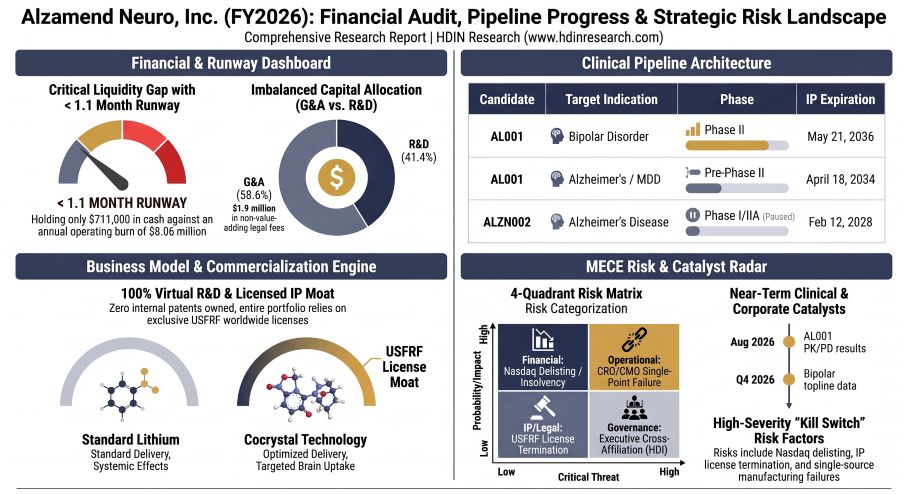 Financial Metrics, Fully Diluted Equity Overhang, and Capital Burn Structure
Alzamend Neuro, Inc. operates with an asymmetric capital structure characterized by extreme equity dilution, zero traditional long-term debt, and severe working capital deficits. As of the fiscal year ended April 30, 2026 (FY2026), the company's cash and cash equivalents collapsed to $711,000 from $3,948,658 in FY2025.
To fund its operations, the company relies on continuous equity financing. During FY2026, Alzamend Neuro, Inc. completed two primary financing events: the issuance of Series C Convertible Preferred Stock, generating $4,035,000 in net proceeds, and the utilization of its At-The-Market (ATM) facility, which yielded $795,000 net. Post-fiscal year-end, between May 1, 2026, and July 22, 2026, the company issued an additional 535,486 shares of common stock through its 2026 ATM facility, bringing in $626,000 in gross proceeds.
Operating expenses for FY2026 totaled $8,766,841, representing a 95.04% increase year-over-year (YoY) compared to $4,496,824 in FY2025. This cost structure is heavily weighted toward general and administrative (G&A) overhead rather than direct clinical development, as outlined in the tables below.
Table Operating Expense Breakdown Analysis (FY2026)
The capital structure as of April 30, 2026, highlights a substantial equity overhang, with options representing more than a quarter of the fully diluted share count.
Table Fully Diluted Equity Structure & Dilution Analysis
The company's outstanding warrants present a notable risk profile because both the Series B and Series C agreements contain down-round anti-dilution ratchet mechanisms. If the company issues common stock below the active exercise prices ($108.00 and $8.29, respectively), these strike prices will automatically reset downward. Given the company's reliance on ATM issuances at depressed market prices to fund its monthly burn, these ratchets threaten to further dilute existing common shareholders.
Furthermore, Alzamend Neuro, Inc. is operating under a Nasdaq compliance grace period expiring September 16, 2026, to remedy its stockholders' equity deficiency, which stood at ~$0.7 million on April 30, 2026, well below the Nasdaq Capital Market's minimum requirement of $2.5 million.
Physical Footprint, Supply Chain Dependencies, and Intellectual Property Expirations
Alzamend Neuro, Inc. maintains a virtual, asset-light physical footprint. Its principal executive office is located in Atlanta, Georgia, under a lease expiring in December 2026 with an annual base rent of approximately $36,000. Administrative and legal offices are completely subsidized by a related public entity, Hyperscale Data, Inc. [NYSE American: GPUS], which provides 200 square feet of office space in Orange County, California, and a legal office in New York, NY, on a rent-free basis.
The company's clinical research is conducted exclusively within the United States. Its key Phase II "Lithium in Brain" trials are executed via a strategic partnership with Massachusetts General Hospital and Harvard Medical School. In compliance with international reporting standards, the company records zero activities or dependencies in Taiwan, Province of China, or other non-US jurisdictions.
Alzamend Neuro, Inc. owns zero internal patents. Its entire therapeutic pipeline is licensed from the University of South Florida Research Foundation, Inc. (USFRF). This master licensing agreement carries heavy milestone and royalty burdens, detailed in the structure below.
* AL001 Licensing Terms (Alzheimer’s Field):
* *Milestone Obligations*: $1,250,000 due upon the first patient treated in a Phase III trial; $10,000,000 due upon FDA New Drug Application (NDA) approval.
* *Royalty Structure*: A 4.5% royalty on net sales, with post-commercialization minimum annual royalties scaling from $40,000 in Year 1, to $80,000 in Year 2, and capping at a permanent $100,000 annual floor from Year 3 onward.
* AL001 Licensing Terms (Neurodegenerative & Psychiatric Fields):
* *Milestone Obligations*: $2,000,000 due upon the first patient treated in a Phase III trial; $16,000,000 due upon the first commercial sale.
* *Royalty Structure*: A 3.0% royalty on net sales, with post-commercialization minimum annual royalties scaling from $40,000 to a permanent $100,000 annual floor by Year 3.
* ALZN002 Licensing Terms (Active Immunotherapy):
* *Milestone Obligations*: $50,000 due upon first dosing of a patient in a Phase I clinical trial; $500,000 due upon completion of the first Phase IIB trial; $1,000,000 due upon the first patient treated in a Phase III trial; $10,000,000 due upon the first commercial sale.
* *Royalty Structure*: A 4.0% royalty on net sales, with post-commercialization minimum annual royalties scaling from $20,000 in Year 1, to $40,000 in Year 2, and capping at a permanent $50,000 annual floor from Year 3 onward.
The underlying patent portfolio exhibits stark differences in protection runways:
The company's supply chain is highly vulnerable due to its virtual model. For AL001, the company relies on a single, unnamed third-party Contract Manufacturing Organization (CMO) to supply its clinical trial material under Good Manufacturing Practices (GMP). For ALZN002, the supply chain is highly complex, requiring specialized autologous manufacturing, including patient leukapheresis, isolation of peripheral blood monocytes, ex-vivo cytokine maturation, peptide pulsing, and a strict cold-chain distribution network.
This supply chain model collapsed in February 2024 when Biorasi, LLC, the company's CRO, terminated its contract. This halted the ALZN002 Phase I/IIA clinical trial. Alzamend Neuro, Inc. has been unable to secure a replacement CRO, pushing the targeted resumption of the trial out to Q1 2027. To support its AL001 trial imaging capabilities, the company maintains a specialized engineering contract with Tesla Dynamic Coils BV. Preclinical GLP toxicology studies are supported by Charles River Laboratories.
The R&D pipeline and clinical timelines are structured as follows:
HDIN Institutional Verdict
Alzamend Neuro, Inc.’s business model is structured as an asset-light, R&D-outsourcing platform, but its financial performance reveals a capital allocation mismatch. Although management positions the company as a streamlined scientific development vehicle, 58.60% ($5,137,056) of its FY2026 operating expenses was consumed by G&A overhead. This administrative drag was dominated by a $1.9 million legal expenditure in its ongoing breach-of-contract lawsuit against former CRO Biorasi, LLC (with the trial scheduled to conclude by the end of August 2026). Direct clinical trial fees represented $2.93 million, while internal investment in scientific materials was minimal at $23,149.
This cost structure is unsustainable given the company's $711,000 cash balance. Because the company’s monthly burn rate stands at approximately $672,318, its cash runway is practically limited to one month. To maintain its going-concern status, the company is highly dependent on continuous equity sales via its ATM facility. This ongoing dilution is compounded by a complex web of related-party transactions and executive cross-affiliations with Hyperscale Data, Inc.:
* Henry C.W. Nisser (EVP & General Counsel): Concurrently serves as President/General Counsel of Hyperscale Data, Inc., RiskOn International, Inc., and Ault & Company, Inc.
* David J. Katzoff (CFO): Concurrently serves as SVP of Finance of Hyperscale Data, Inc.
* William B. Horne (Chairman): Concurrently serves as CEO of Hyperscale Data, Inc. and CFO of Ault & Company, Inc.
* Milton C. Ault III (Founder & Vice Chairman): Concurrently serves as Executive Chairman of Hyperscale Data, Inc., Chairman/CEO of RiskOn International, Inc., and Chairman/CEO of Ault & Company, Inc.
This overlap dilutes executive bandwidth and introduces potential conflicts of interest, particularly regarding financing arrangements. In 2024, Ault Lending (a subsidiary of Hyperscale Data, Inc.) converted $1.15 million in emergency cash advances into Series B Convertible Preferred Stock. In FY2026, Ault Lending converted 2,100 of these preferred shares (representing $2.1 million in historical stated value) into 905,172 shares of common stock.
Governance risk is further elevated by two factors: First, the company is in non-compliance with Nasdaq's majority-independent board requirements following the deaths of independent directors Andrew H. Woo (November 2025) and Dr. Lynne Fahey McGrath (July 2026), leaving only two independent directors (Mark Gustafson and Jeffrey Oram) alongside four non-independent inside directors. Second, a settled August 2023 SEC enforcement action against Milton C. Ault III and Hyperscale Data, Inc. regarding failures to disclose related-person transactions has increased regulatory and reputational risks.
From an asset perspective, Alzamend’s pipeline faces dual operational and scientific hurdles. Although AL001 is designed to broaden the therapeutic index of lithium and bypass extensive safety trials via the FDA's Section 505(b)(2) pathway, its clinical success relies on proving therapeutic superiority and safety over generic lithium carbonate, which is cheap and widely available.
Additionally, the active immunotherapy ALZN002 faces a near-term patent cliff, with its composition-of-matter patent (US Patent No. 8,188,046) set to expire on February 12, 2028. Because the trial has been paused since February 2024 and is not expected to resume until Q1 2027, the commercial exclusivity window is compressed. Even with potential Hatch-Waxman patent term extensions of up to five years, the asset's commercial viability remains highly speculative.
In the absence of a non-dilutive strategic partnership or an outright acquisition by a well-capitalized biopharmaceutical peer, Alzamend's business model will continue to dilute public shareholders to fund its basic operating costs.
Presentation Download & Video Access:
- Presentation Download: Click the PDF download link under 'Related Topics' to access the full institutional presentation of this report.
- Video Link: Click this link to watch the HDIN analyst briefing on YouTube.
About HDIN Research
HDIN Research is a premier global market intelligence and strategic advisory firm specializing in institutional-grade financial analysis, supply chain audits, and macroeconomic forecasting. Our dedicated sector analysts deliver actionable, data-driven insights tailored for private equity, hedge funds, and corporate strategy teams. Visit us at [http://www.hdinresearch.com](http://www.hdinresearch.com).
2026 AI Transparency Footer
"This intelligence report was authored by HDIN Research analysts following a rigorous audit of official corporate filings. AI was utilized for massive-scale data synthesis and structural drafting, ensuring 100% inclusion of reported data points. All strategic insights, financial modeling, and final verdicts were verified by our editorial board to ensure professional accuracy and compliance with 2026 Google Search E-E-A-T standards."
1. Alzamend Neuro, Inc. [NASDAQ: ALZN] faces critical insolvency risk with only $711,000 in cash against an $8.06 million annual cash burn, representing a 1.06-month operational runway.
2. The pipeline is heavily encumbered by high-stakes milestone and royalty obligations owed to the University of South Florida Research Foundation, Inc., creating severe default vulnerabilities.
3. Rapid capital dilution continues through At-The-Market facilities, expanding the basic share count by 12.58% post-fiscal year-end to secure immediate working capital.
Figure Alzamend Neuro Inc (FY2026): Financial Audit, Pipeline Progress & Strategic Risk Landscape
Financial Metrics, Fully Diluted Equity Overhang, and Capital Burn StructureAlzamend Neuro, Inc. operates with an asymmetric capital structure characterized by extreme equity dilution, zero traditional long-term debt, and severe working capital deficits. As of the fiscal year ended April 30, 2026 (FY2026), the company's cash and cash equivalents collapsed to $711,000 from $3,948,658 in FY2025.
To fund its operations, the company relies on continuous equity financing. During FY2026, Alzamend Neuro, Inc. completed two primary financing events: the issuance of Series C Convertible Preferred Stock, generating $4,035,000 in net proceeds, and the utilization of its At-The-Market (ATM) facility, which yielded $795,000 net. Post-fiscal year-end, between May 1, 2026, and July 22, 2026, the company issued an additional 535,486 shares of common stock through its 2026 ATM facility, bringing in $626,000 in gross proceeds.
Operating expenses for FY2026 totaled $8,766,841, representing a 95.04% increase year-over-year (YoY) compared to $4,496,824 in FY2025. This cost structure is heavily weighted toward general and administrative (G&A) overhead rather than direct clinical development, as outlined in the tables below.
Table Operating Expense Breakdown Analysis (FY2026)
| Operating Expense Breakdown | FY2026 Value (USD) | % of Total Operating Expenses | YoY Change (%) | Strategic Operational Context |
|---|---|---|---|---|
| Research & Development (R&D) | $3.63M | 41.40% | +156.54% | Increase primarily driven by a 310.02% surge in clinical trial fees related to the AL001 Phase IIB trial. Internal scientific material expenses remained limited at only $23,149. |
| General & Administrative (G&A) | $5.14M | 58.60% | +66.69% | Growth was mainly attributable to a 252.01% increase in professional service fees, including approximately $1.90M in legal expenses associated with litigation against a former Contract Research Organization (CRO). |
| Total Operating Expenses | $8.77M | 100.00% | +94.95% | Represents a significant operating cash burden, with an estimated monthly burn rate of approximately $672,318 compared with only $711,000 in cash and cash equivalents as of April 30, 2026. |
The capital structure as of April 30, 2026, highlights a substantial equity overhang, with options representing more than a quarter of the fully diluted share count.
Table Fully Diluted Equity Structure & Dilution Analysis
| Equity Component | Share Count | % of Fully Diluted Shares | Pricing & Structural Context |
|---|---|---|---|
| Basic Common Shares Outstanding | 4,256,039 | 71.06% | Increased to 4,791,525 shares by July 22, 2026 due to subsequent ATM (At-the-Market) equity issuances. |
| Outstanding Stock Options | 1,597,000 | 26.67% | Includes 1,593,704 options under approved equity plans and 3,296 options outside approved plans. Weighted average exercise price is $6.32 per share. Includes legacy option tranches linked to milestone exercise prices ranging from $13,500 to $54,000 per share. |
| Outstanding Warrants | 135,972 | 2.27% | Includes 111,111 Series C legacy warrants with an exercise price of $8.29 per share and 23,334 Series B legacy warrants with an exercise price of $108.00 per share. Weighted average exercise price is $72.24 per share. |
| Preferred Stock / RSUs | 0 | 0.00% | Series B and Series C preferred shares were fully converted during FY2026 and subsequently eliminated through formal cancellation certificates in October 2025. |
| Total Fully Diluted Shares | 5,989,011 | 100.00% | Represents the company’s maximum theoretical diluted equity capitalization. |
The company's outstanding warrants present a notable risk profile because both the Series B and Series C agreements contain down-round anti-dilution ratchet mechanisms. If the company issues common stock below the active exercise prices ($108.00 and $8.29, respectively), these strike prices will automatically reset downward. Given the company's reliance on ATM issuances at depressed market prices to fund its monthly burn, these ratchets threaten to further dilute existing common shareholders.
Furthermore, Alzamend Neuro, Inc. is operating under a Nasdaq compliance grace period expiring September 16, 2026, to remedy its stockholders' equity deficiency, which stood at ~$0.7 million on April 30, 2026, well below the Nasdaq Capital Market's minimum requirement of $2.5 million.
Physical Footprint, Supply Chain Dependencies, and Intellectual Property Expirations
Alzamend Neuro, Inc. maintains a virtual, asset-light physical footprint. Its principal executive office is located in Atlanta, Georgia, under a lease expiring in December 2026 with an annual base rent of approximately $36,000. Administrative and legal offices are completely subsidized by a related public entity, Hyperscale Data, Inc. [NYSE American: GPUS], which provides 200 square feet of office space in Orange County, California, and a legal office in New York, NY, on a rent-free basis.
The company's clinical research is conducted exclusively within the United States. Its key Phase II "Lithium in Brain" trials are executed via a strategic partnership with Massachusetts General Hospital and Harvard Medical School. In compliance with international reporting standards, the company records zero activities or dependencies in Taiwan, Province of China, or other non-US jurisdictions.
Alzamend Neuro, Inc. owns zero internal patents. Its entire therapeutic pipeline is licensed from the University of South Florida Research Foundation, Inc. (USFRF). This master licensing agreement carries heavy milestone and royalty burdens, detailed in the structure below.
* AL001 Licensing Terms (Alzheimer’s Field):
* *Milestone Obligations*: $1,250,000 due upon the first patient treated in a Phase III trial; $10,000,000 due upon FDA New Drug Application (NDA) approval.
* *Royalty Structure*: A 4.5% royalty on net sales, with post-commercialization minimum annual royalties scaling from $40,000 in Year 1, to $80,000 in Year 2, and capping at a permanent $100,000 annual floor from Year 3 onward.
* AL001 Licensing Terms (Neurodegenerative & Psychiatric Fields):
* *Milestone Obligations*: $2,000,000 due upon the first patient treated in a Phase III trial; $16,000,000 due upon the first commercial sale.
* *Royalty Structure*: A 3.0% royalty on net sales, with post-commercialization minimum annual royalties scaling from $40,000 to a permanent $100,000 annual floor by Year 3.
* ALZN002 Licensing Terms (Active Immunotherapy):
* *Milestone Obligations*: $50,000 due upon first dosing of a patient in a Phase I clinical trial; $500,000 due upon completion of the first Phase IIB trial; $1,000,000 due upon the first patient treated in a Phase III trial; $10,000,000 due upon the first commercial sale.
* *Royalty Structure*: A 4.0% royalty on net sales, with post-commercialization minimum annual royalties scaling from $20,000 in Year 1, to $40,000 in Year 2, and capping at a permanent $50,000 annual floor from Year 3 onward.
The underlying patent portfolio exhibits stark differences in protection runways:
| Target Drug | Primary Patent Focus | Patent Number & Type | Expiration Date | Operational & Strategic Exclusivity Implications |
|---|---|---|---|---|
| AL001 | Lithium Co-Crystals for Neuropsychiatric Disorders | US 9,603,869 (Method of Use Patent) | May 21, 2036 | Provides a substantial post-approval commercial exclusivity window. Filed on May 21, 2016 and granted on March 28, 2017, supporting long-term market protection based on approved therapeutic indications. |
| AL001 | Organic Anion Lithium Ionic Cocrystals | US 9,840,521 (Composition of Matter Patent) | April 18, 2034 | Represents the strongest layer of intellectual property protection by directly covering the molecular composition and limiting potential generic replication. Filed on April 18, 2014 (or September 24, 2015 according to certain disclosures) and granted on December 12, 2017. |
| ALZN002 | Amyloid Beta Peptides and Methods of Use | US 8,188,046 (Composition of Matter Patent) | February 12, 2028 | Presents a significant strategic challenge due to the limited remaining patent life. Filed on October 12, 2007 (or April 7, 2009 according to certain disclosures) and granted on May 29, 2012. Patent expiry may occur close to or before potential commercial launch. |
The company's supply chain is highly vulnerable due to its virtual model. For AL001, the company relies on a single, unnamed third-party Contract Manufacturing Organization (CMO) to supply its clinical trial material under Good Manufacturing Practices (GMP). For ALZN002, the supply chain is highly complex, requiring specialized autologous manufacturing, including patient leukapheresis, isolation of peripheral blood monocytes, ex-vivo cytokine maturation, peptide pulsing, and a strict cold-chain distribution network.
This supply chain model collapsed in February 2024 when Biorasi, LLC, the company's CRO, terminated its contract. This halted the ALZN002 Phase I/IIA clinical trial. Alzamend Neuro, Inc. has been unable to secure a replacement CRO, pushing the targeted resumption of the trial out to Q1 2027. To support its AL001 trial imaging capabilities, the company maintains a specialized engineering contract with Tesla Dynamic Coils BV. Preclinical GLP toxicology studies are supported by Charles River Laboratories.
The R&D pipeline and clinical timelines are structured as follows:
| Drug Candidate / Indication | Development Timeline | Target Milestone |
|---|---|---|
| AL001 (Healthy Subjects) | =====================> |
August 2026: Pharmacokinetic / Pharmacodynamic (PK/PD) Results |
| AL001 (Bipolar Disorder) | =======================> |
Q4 2026: Phase II Topline Data Readout |
| AL001 (Major Depressive Disorder & PTSD) | =========================> |
Q4 2026: Target Phase II Trial Initiation |
| AL001 (Alzheimer’s Disease) | ===========================> |
Q1 2027: Target Phase II Trial Initiation |
| ALZN002 (Alzheimer’s Disease) | ---------------------------> |
Q1 2027: Target Program Resumption (Paused since February 2024) |
HDIN Institutional Verdict
Alzamend Neuro, Inc.’s business model is structured as an asset-light, R&D-outsourcing platform, but its financial performance reveals a capital allocation mismatch. Although management positions the company as a streamlined scientific development vehicle, 58.60% ($5,137,056) of its FY2026 operating expenses was consumed by G&A overhead. This administrative drag was dominated by a $1.9 million legal expenditure in its ongoing breach-of-contract lawsuit against former CRO Biorasi, LLC (with the trial scheduled to conclude by the end of August 2026). Direct clinical trial fees represented $2.93 million, while internal investment in scientific materials was minimal at $23,149.
This cost structure is unsustainable given the company's $711,000 cash balance. Because the company’s monthly burn rate stands at approximately $672,318, its cash runway is practically limited to one month. To maintain its going-concern status, the company is highly dependent on continuous equity sales via its ATM facility. This ongoing dilution is compounded by a complex web of related-party transactions and executive cross-affiliations with Hyperscale Data, Inc.:
* Henry C.W. Nisser (EVP & General Counsel): Concurrently serves as President/General Counsel of Hyperscale Data, Inc., RiskOn International, Inc., and Ault & Company, Inc.
* David J. Katzoff (CFO): Concurrently serves as SVP of Finance of Hyperscale Data, Inc.
* William B. Horne (Chairman): Concurrently serves as CEO of Hyperscale Data, Inc. and CFO of Ault & Company, Inc.
* Milton C. Ault III (Founder & Vice Chairman): Concurrently serves as Executive Chairman of Hyperscale Data, Inc., Chairman/CEO of RiskOn International, Inc., and Chairman/CEO of Ault & Company, Inc.
This overlap dilutes executive bandwidth and introduces potential conflicts of interest, particularly regarding financing arrangements. In 2024, Ault Lending (a subsidiary of Hyperscale Data, Inc.) converted $1.15 million in emergency cash advances into Series B Convertible Preferred Stock. In FY2026, Ault Lending converted 2,100 of these preferred shares (representing $2.1 million in historical stated value) into 905,172 shares of common stock.
Governance risk is further elevated by two factors: First, the company is in non-compliance with Nasdaq's majority-independent board requirements following the deaths of independent directors Andrew H. Woo (November 2025) and Dr. Lynne Fahey McGrath (July 2026), leaving only two independent directors (Mark Gustafson and Jeffrey Oram) alongside four non-independent inside directors. Second, a settled August 2023 SEC enforcement action against Milton C. Ault III and Hyperscale Data, Inc. regarding failures to disclose related-person transactions has increased regulatory and reputational risks.
From an asset perspective, Alzamend’s pipeline faces dual operational and scientific hurdles. Although AL001 is designed to broaden the therapeutic index of lithium and bypass extensive safety trials via the FDA's Section 505(b)(2) pathway, its clinical success relies on proving therapeutic superiority and safety over generic lithium carbonate, which is cheap and widely available.
Additionally, the active immunotherapy ALZN002 faces a near-term patent cliff, with its composition-of-matter patent (US Patent No. 8,188,046) set to expire on February 12, 2028. Because the trial has been paused since February 2024 and is not expected to resume until Q1 2027, the commercial exclusivity window is compressed. Even with potential Hatch-Waxman patent term extensions of up to five years, the asset's commercial viability remains highly speculative.
In the absence of a non-dilutive strategic partnership or an outright acquisition by a well-capitalized biopharmaceutical peer, Alzamend's business model will continue to dilute public shareholders to fund its basic operating costs.
Presentation Download & Video Access:
- Presentation Download: Click the PDF download link under 'Related Topics' to access the full institutional presentation of this report.
- Video Link: Click this link to watch the HDIN analyst briefing on YouTube.
About HDIN Research
HDIN Research is a premier global market intelligence and strategic advisory firm specializing in institutional-grade financial analysis, supply chain audits, and macroeconomic forecasting. Our dedicated sector analysts deliver actionable, data-driven insights tailored for private equity, hedge funds, and corporate strategy teams. Visit us at [http://www.hdinresearch.com](http://www.hdinresearch.com).
2026 AI Transparency Footer
"This intelligence report was authored by HDIN Research analysts following a rigorous audit of official corporate filings. AI was utilized for massive-scale data synthesis and structural drafting, ensuring 100% inclusion of reported data points. All strategic insights, financial modeling, and final verdicts were verified by our editorial board to ensure professional accuracy and compliance with 2026 Google Search E-E-A-T standards."