Ningbo Deye Technology [SHA: 605117]: Production Base Pivot in Johor, Malaysia as 20.6% Residential Storage Market Leadership Signals Margin Resilience Amid Tariff Volatility
Date : 2026-07-31
Reading : 63
HDIN Market Intelligence Brief
1. Ningbo Deye Technology Co., Ltd. [SHA: 605117] secured the #1 global position in residential energy storage inverters with a 20.6% revenue market share in 2025, shifting sales channels from direct OEM/ODM to 86.8% brand distribution.
2. A dual-base capacity expansion in Johor, Malaysia (3GW inverter capacity) serves as a critical geopolitical hedge against US tariffs reaching 35% on inverters and 50% on solar ACs.
3. Financial efficiency remains elite with Operating Cash Flow consistently exceeding Net Income (1.26x in 2025), offsetting a transition to longer collection cycles where accounts receivable turnover days rose from 30 to 56.
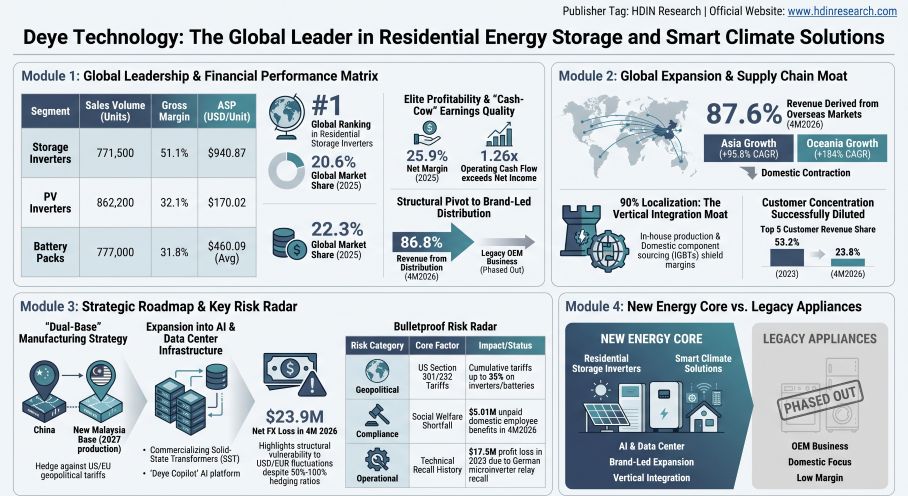
Figure Deye Technology: The Global Leader in Residential Energy Storage and Smart Climate Solutions
 Segmental Realities and Margin Compression
Ningbo Deye Technology [SHA: 605117] has executed a major transition from a traditional home appliance Original Equipment Manufacturer (OEM) to a global Original Brand Manufacturer (OBM) in the solar and energy storage sector. By early 2026, distribution channels accounted for 86.8% ($746.1 million) of total revenue, up from 46.7% ($485.6 million) in FY2023, while direct OEM/ODM sales plummeted from 53.3% to 13.2% over the same period.
The Company’s product line demonstrates diverging unit economics. The core profitability engine, Energy Storage Inverters, maintained gross margins above 51% despite a deliberate 21.0% decline in Average Selling Price (ASP) from 2023 to 2025. This was achieved by lowering unit costs 14.2% through domestic component substitution and scale economies. Conversely, the PV Inverter segment (combining String and Microinverters) faces margin compression due to commoditization, with gross margins dropping to 30.2% in early 2026.
Table: Inverter Unit Economics Breakdown (FY2023–4M2026)
Core Financial Performance Metrics (FY2023–FY2025)
The Company's consolidated balance sheet and income statement reflect top-tier profitability and cash generation capacity, with Operating Cash Flow (OCF) consistently outstripping Net Profit.
Supply Chain & Manufacturing Base Architecture
To defend its margins and bypass rising geopolitical barriers, Ningbo Deye Technology is executing a "China Core + Southeast Asia Hub" dual-base operational model:
* Malaysia (Johor) Production Base (Under Construction): A 133,237 sqm greenfield facility situated in the Singapore-Johor Special Economic Zone. Ground was broken in October 2025, with mass production targeted for January 2027. This base is designed to manufacture 3GW of inverters and 200,000 battery packs annually via 453 inverter and 260 battery pack lines, serving as a primary tariff hedge.
* Ningbo Beilun Base (China): A 120,000 sqm legacy facility focused entirely on inverter manufacturing.
* Ningbo Beilun 246 Base (China): A newly commissioned 100,000 sqm facility operating as an R&D testing center, warehouse, and trade headquarters, maintaining an inverter storage capacity of 1.8GW.
* Ningbo Cixi Base (China): A 171,000 sqm dedicated factory for Commercial & Industrial (C&I) and residential energy storage battery packs, under construction from October 2025 to February 2027.
* Jiaxing Haiyan Base (China): A 258,000 sqm base dedicated strictly to environmental appliances.
R&D Infrastructure and IP Moat
R&D expenses remained highly funded at $78.20 million in FY2025 (4.6% of revenue) and $31.01 million in 4M2026 (3.6% of revenue). Material costs rose from 32.0% of total R&D expenses in 2023 to 49.1% in 4M2026, reflecting intensive hardware prototyping for Third-Generation Silicon Carbide (SiC) semiconductors and Solid-State Transformers (SST). The R&D division expanded to 951 personnel as of April 30, 2026.
Deye holds 632 authorized domestic patents and 166 software copyrights, featuring key technological differentiators:
* Patent No. 202511116538.3: A Resonant DC/AC Converter Based on Dual-Channel MPPT, securing weak-light conversion efficiency for balcony solar setups.
* Patent No. 201811166636.8 & 202411836789.4: Inverter parallel control and anti-backflow systems that solve circulating current bottlenecks. This allows up to 16 single-phase or 10 three-phase inverters to operate in parallel, enabling a 4-millisecond seamless on-grid/off-grid switching capability.
Procurement and Raw Material Dynamics
Raw materials account for 86.5% of the total Cost of Sales as of 4M2026.
* Lithium Iron Phosphate (LFP) Cells: Sourced primarily from Supplier C (accounting for 17.3% or $111.6 million of purchases in 4M2026). Falling cell costs from $0.11/Wh in 2022 to $0.056/Wh in 2024 elevated Deye's Storage Battery Pack gross margin to 41.3% in 2024, before normalizing to 31.1% in 4M2026.
* IGBT & Electronic Components: Deye has localized 90% of its semiconductor procurement within China since 2021, structurally insulating its inverter business from Western supply chain constraints.
* Legacy Heat Exchanger Dual-Distribution: The Company continues to scale down its heat exchanger segment (revenue share fell to 7.7% in 2025). This legacy segment operates under a "Dual Distribution" framework with Customer B (Midea), under which Deye sold $130.4 million in heat exchangers in 2025 while purchasing $105.7 million in copper and aluminum raw materials from Customer B's procurement platform.
Geographic Revenue Trajectory and Market Dynamics
The Company's regional revenue streams are highly tied to localized energy policies and infrastructure crises:
* Europe: Surged to $558.15 million in 2024 due to the Eastern European energy crisis, flattening at $557.04 million in 2025 due to distributor destocking, and exploding to $389.22 million in 4M2026 (45.3% of total revenue) as destocking concluded.
* Asia (ex-China): Reached $481.38 million in 2025, representing a 95.8% CAGR from 2023, driven by energy infrastructure build-outs and weak-grid environments.
* Africa: Highly cyclical; revenue spiked to $200.45 million in 2023 during the South African load-shedding crisis, contracted to $84.31 million in 2024 as panic-buying subsided, and rebounded to $158.40 million in 2025.
* China (Mainland): Contracted at an 11.2% negative CAGR to $344.49 million in 2025, reflecting the deliberate phase-out of the low-margin heat exchanger business.
* North America: Grew to $80.81 million in 2025 (4.7% revenue share) through OEM/ODM partnerships. To bypass US trade barriers, Deye's shipments face a 25% tariff on inverters, 7.5% on storage batteries, and up to 50% Section 232 tariffs on Solar ACs, which are legally borne by US importers.
* Oceania: Grew from $4.78 million in 2023 to $38.50 million in 2025, reaching $28.39 million in 4M2026, driven by Australia's "Cheaper Home Battery Scheme."
HDIN Institutional Verdict
1. Balance Sheet Resilience and Liquidity Backstop
An audit of Deye’s balance sheet reveals exceptional liquidity. As of May 31, 2026, the Company held $1,895.10 million (RMB 13,621.1 million) in untapped, undrawn bank credit lines from Tier-1 financial institutions. Restricted bank deposits of $219.31 million as of April 30, 2026, are fully offset by these facilities. Furthermore, the Company has $0 material pending litigations or off-balance sheet third-party financial guarantees, confirming its capacity to fund its peak CapEx cycle ($112.14 million in contracted capital commitments as of April 30, 2026) through organic cash flows.
2. Product Defect and Compliance Overhangs
Despite strong financial performance, Deye remains exposed to compliance and operational risks:
* German VDE Compliance Black Swan: In July 2023, Deye mass-shipped microinverters to Germany that lacked a required external physical relay. This engineering deviation forced a voluntary recall and relay retrofit program, resulting in a $7.00 million inventory write-down in 2023, alongside net profit erosions of $17.53 million in 2023 and $0.78 million in 2024.
* OFAC Sanctions Exposure: In 2022, Deye generated $230,000 in inverter sales to Syria settled via USD wire transfers, violating US primary sanctions. Minor legacy transactions were also recorded with Iran (2019), North Korea (2023-2024 via a Hong Kong proxy), Russia, and Belarus. Deye filed a Voluntary Self-Disclosure (VSD) with the US OFAC in 2026. Potential civil penalties range from $115,000 to $755,000. IPO proceeds have been strictly ring-fenced under a newly formed Sanctions Oversight Committee to satisfy HKEX compliance.
* Domestic Employee Benefit Shortfalls: Deye has a systemic historical non-compliance record regarding social insurance and housing provident fund contributions in China. The unpaid shortfalls amounted to $5.72 million (2023), $8.19 million (2024), $10.70 million (2025), and $5.01 million (4M2026), affecting up to 8,280 employees. No provisions have been recognized on the balance sheet, though management has committed to a three-year rectification post-IPO.
* Third-Party Payment Risks: Overseas customer billings settled via independent third-party payors surged from $55.0 million in 2023 to $212.9 million (12.5% of revenue) in 2025. While this accommodates foreign exchange restrictions in Africa and Asia, it introduces Anti-Money Laundering (AML) risks. New tripartite protocols implemented in 2026 successfully compressed third-party payment exposure to 6.4% in early 2026.
* Supply Chain Audit Gaps: Deye's prospectus contains no disclosures regarding "Conflict Minerals" (Cobalt, Tantalum, Tungsten, Tin, Gold) tracing for its storage battery packs. This represents a long-term regulatory vulnerability as Western markets enforce the EU Battery Regulation and the US Uyghur Forced Labor Prevention Act.
3. Strategic Transition to AI Data Center Power Infrastructure
To sustain growth beyond residential solar, Deye's R&D pipeline is executing a pivot into the AI power ecosystem. Utilizing its proposed IPO proceeds, the Company is developing Solid-State Transformers (SST) in the 1.25MW to 5MW range, specifically optimized to regulate the highly volatile, high-density power demands of AI Data Centers (AIDC). This strategy, combined with the launch of its "Deye Copilot" AI smart cloud platform for dynamic power trading and virtual power plant (VPP) integration, indicates that management is positioning the company to transition from a hardware component vendor into an integrated energy service provider.
Presentation Download & Video Access:
Presentation Download: Click the PDF download link under 'Related Topics' to access the full institutional presentation of this report.
Video Link: Click this link to watch the HDIN analyst briefing on YouTube.
About HDIN Research:
HDIN Research is a premier global market intelligence and strategic advisory firm specializing in institutional-grade financial analysis, supply chain audits, and macroeconomic forecasting. Our dedicated sector analysts deliver actionable, data-driven insights tailored for private equity, hedge funds, and corporate strategy teams. Visit us at http://www.hdinresearch.com.
2026 AI Transparency Footer:
"This intelligence report was authored by HDIN Research analysts following a rigorous audit of official corporate filings. AI was utilized for massive-scale data synthesis and structural drafting, ensuring 100% inclusion of reported data points. All strategic insights, financial modeling, and final verdicts were verified by our editorial board to ensure professional accuracy and compliance with 2026 Google Search E-E-A-T standards."
1. Ningbo Deye Technology Co., Ltd. [SHA: 605117] secured the #1 global position in residential energy storage inverters with a 20.6% revenue market share in 2025, shifting sales channels from direct OEM/ODM to 86.8% brand distribution.
2. A dual-base capacity expansion in Johor, Malaysia (3GW inverter capacity) serves as a critical geopolitical hedge against US tariffs reaching 35% on inverters and 50% on solar ACs.
3. Financial efficiency remains elite with Operating Cash Flow consistently exceeding Net Income (1.26x in 2025), offsetting a transition to longer collection cycles where accounts receivable turnover days rose from 30 to 56.
Figure Deye Technology: The Global Leader in Residential Energy Storage and Smart Climate Solutions
Segmental Realities and Margin CompressionNingbo Deye Technology [SHA: 605117] has executed a major transition from a traditional home appliance Original Equipment Manufacturer (OEM) to a global Original Brand Manufacturer (OBM) in the solar and energy storage sector. By early 2026, distribution channels accounted for 86.8% ($746.1 million) of total revenue, up from 46.7% ($485.6 million) in FY2023, while direct OEM/ODM sales plummeted from 53.3% to 13.2% over the same period.
The Company’s product line demonstrates diverging unit economics. The core profitability engine, Energy Storage Inverters, maintained gross margins above 51% despite a deliberate 21.0% decline in Average Selling Price (ASP) from 2023 to 2025. This was achieved by lowering unit costs 14.2% through domestic component substitution and scale economies. Conversely, the PV Inverter segment (combining String and Microinverters) faces margin compression due to commoditization, with gross margins dropping to 30.2% in early 2026.
Table: Inverter Unit Economics Breakdown (FY2023–4M2026)
| Segment | Metric | FY2023 | FY2024 | FY2025 | 4M2026 |
| Energy Storage Inverters | ASP (USD/unit) | $1,191.90 | $1,129.14 | $940.87 | $976.04 |
| Gross Margin (%) | 55.0% | 51.8% | 51.1% | 51.1% | |
| Unit Cost (USD/unit) | $536.36 | $544.25 | $460.09 | $477.28 | |
| PV Inverters (String + Micro) | ASP (USD/unit) | $263.10 | $190.14 | $170.02 | $129.28 |
| Gross Margin (%) | 39.0% | 33.5% | 32.1% | 30.2% | |
| Unit Cost (USD/unit) | $160.49 | $126.44 | $115.44 | $90.24 |
Core Financial Performance Metrics (FY2023–FY2025)
The Company's consolidated balance sheet and income statement reflect top-tier profitability and cash generation capacity, with Operating Cash Flow (OCF) consistently outstripping Net Profit.
Table: Historical Financial Performance & Operational Ratios Summary (FY2023–FY2025)
| Metric | FY2023 | FY2024 | FY2025 |
| Total Revenue (USD Million) | $1,040.66 | $1,559.16 | $1,700.70 |
| Gross Profit (USD Million) | $407.51 | $602.26 | $646.79 |
| Net Profit (USD Million) | $249.18 | $411.87 | $440.86 |
| Gross Margin (%) | 39.2% | 38.6% | 38.0% |
| Net Margin (%) | 23.9% | 26.4% | 25.9% |
| Operating Cash Flow (USD Million) | $289.53 | $468.40 | $554.61 |
| OCF / Net Income Ratio | 1.16x | 1.14x | 1.26x |
| Current Ratio | 1.5x | 2.0x | 1.6x |
| Asset-to-Liability Ratio (%) | 51.6% | 37.5% | 48.1% |
| AR Turnover Days | 30 days | 40 days | 56 days |
| Inventory Turnover Days | 68 days | 59 days | 79 days |
Supply Chain & Manufacturing Base Architecture
To defend its margins and bypass rising geopolitical barriers, Ningbo Deye Technology is executing a "China Core + Southeast Asia Hub" dual-base operational model:
* Malaysia (Johor) Production Base (Under Construction): A 133,237 sqm greenfield facility situated in the Singapore-Johor Special Economic Zone. Ground was broken in October 2025, with mass production targeted for January 2027. This base is designed to manufacture 3GW of inverters and 200,000 battery packs annually via 453 inverter and 260 battery pack lines, serving as a primary tariff hedge.
* Ningbo Beilun Base (China): A 120,000 sqm legacy facility focused entirely on inverter manufacturing.
* Ningbo Beilun 246 Base (China): A newly commissioned 100,000 sqm facility operating as an R&D testing center, warehouse, and trade headquarters, maintaining an inverter storage capacity of 1.8GW.
* Ningbo Cixi Base (China): A 171,000 sqm dedicated factory for Commercial & Industrial (C&I) and residential energy storage battery packs, under construction from October 2025 to February 2027.
* Jiaxing Haiyan Base (China): A 258,000 sqm base dedicated strictly to environmental appliances.
R&D Infrastructure and IP Moat
R&D expenses remained highly funded at $78.20 million in FY2025 (4.6% of revenue) and $31.01 million in 4M2026 (3.6% of revenue). Material costs rose from 32.0% of total R&D expenses in 2023 to 49.1% in 4M2026, reflecting intensive hardware prototyping for Third-Generation Silicon Carbide (SiC) semiconductors and Solid-State Transformers (SST). The R&D division expanded to 951 personnel as of April 30, 2026.
Deye holds 632 authorized domestic patents and 166 software copyrights, featuring key technological differentiators:
* Patent No. 202511116538.3: A Resonant DC/AC Converter Based on Dual-Channel MPPT, securing weak-light conversion efficiency for balcony solar setups.
* Patent No. 201811166636.8 & 202411836789.4: Inverter parallel control and anti-backflow systems that solve circulating current bottlenecks. This allows up to 16 single-phase or 10 three-phase inverters to operate in parallel, enabling a 4-millisecond seamless on-grid/off-grid switching capability.
Procurement and Raw Material Dynamics
Raw materials account for 86.5% of the total Cost of Sales as of 4M2026.
* Lithium Iron Phosphate (LFP) Cells: Sourced primarily from Supplier C (accounting for 17.3% or $111.6 million of purchases in 4M2026). Falling cell costs from $0.11/Wh in 2022 to $0.056/Wh in 2024 elevated Deye's Storage Battery Pack gross margin to 41.3% in 2024, before normalizing to 31.1% in 4M2026.
* IGBT & Electronic Components: Deye has localized 90% of its semiconductor procurement within China since 2021, structurally insulating its inverter business from Western supply chain constraints.
* Legacy Heat Exchanger Dual-Distribution: The Company continues to scale down its heat exchanger segment (revenue share fell to 7.7% in 2025). This legacy segment operates under a "Dual Distribution" framework with Customer B (Midea), under which Deye sold $130.4 million in heat exchangers in 2025 while purchasing $105.7 million in copper and aluminum raw materials from Customer B's procurement platform.
Geographic Revenue Trajectory and Market Dynamics
The Company's regional revenue streams are highly tied to localized energy policies and infrastructure crises:
* Europe: Surged to $558.15 million in 2024 due to the Eastern European energy crisis, flattening at $557.04 million in 2025 due to distributor destocking, and exploding to $389.22 million in 4M2026 (45.3% of total revenue) as destocking concluded.
* Asia (ex-China): Reached $481.38 million in 2025, representing a 95.8% CAGR from 2023, driven by energy infrastructure build-outs and weak-grid environments.
* Africa: Highly cyclical; revenue spiked to $200.45 million in 2023 during the South African load-shedding crisis, contracted to $84.31 million in 2024 as panic-buying subsided, and rebounded to $158.40 million in 2025.
* China (Mainland): Contracted at an 11.2% negative CAGR to $344.49 million in 2025, reflecting the deliberate phase-out of the low-margin heat exchanger business.
* North America: Grew to $80.81 million in 2025 (4.7% revenue share) through OEM/ODM partnerships. To bypass US trade barriers, Deye's shipments face a 25% tariff on inverters, 7.5% on storage batteries, and up to 50% Section 232 tariffs on Solar ACs, which are legally borne by US importers.
* Oceania: Grew from $4.78 million in 2023 to $38.50 million in 2025, reaching $28.39 million in 4M2026, driven by Australia's "Cheaper Home Battery Scheme."
HDIN Institutional Verdict
1. Balance Sheet Resilience and Liquidity Backstop
An audit of Deye’s balance sheet reveals exceptional liquidity. As of May 31, 2026, the Company held $1,895.10 million (RMB 13,621.1 million) in untapped, undrawn bank credit lines from Tier-1 financial institutions. Restricted bank deposits of $219.31 million as of April 30, 2026, are fully offset by these facilities. Furthermore, the Company has $0 material pending litigations or off-balance sheet third-party financial guarantees, confirming its capacity to fund its peak CapEx cycle ($112.14 million in contracted capital commitments as of April 30, 2026) through organic cash flows.
2. Product Defect and Compliance Overhangs
Despite strong financial performance, Deye remains exposed to compliance and operational risks:
* German VDE Compliance Black Swan: In July 2023, Deye mass-shipped microinverters to Germany that lacked a required external physical relay. This engineering deviation forced a voluntary recall and relay retrofit program, resulting in a $7.00 million inventory write-down in 2023, alongside net profit erosions of $17.53 million in 2023 and $0.78 million in 2024.
* OFAC Sanctions Exposure: In 2022, Deye generated $230,000 in inverter sales to Syria settled via USD wire transfers, violating US primary sanctions. Minor legacy transactions were also recorded with Iran (2019), North Korea (2023-2024 via a Hong Kong proxy), Russia, and Belarus. Deye filed a Voluntary Self-Disclosure (VSD) with the US OFAC in 2026. Potential civil penalties range from $115,000 to $755,000. IPO proceeds have been strictly ring-fenced under a newly formed Sanctions Oversight Committee to satisfy HKEX compliance.
* Domestic Employee Benefit Shortfalls: Deye has a systemic historical non-compliance record regarding social insurance and housing provident fund contributions in China. The unpaid shortfalls amounted to $5.72 million (2023), $8.19 million (2024), $10.70 million (2025), and $5.01 million (4M2026), affecting up to 8,280 employees. No provisions have been recognized on the balance sheet, though management has committed to a three-year rectification post-IPO.
* Third-Party Payment Risks: Overseas customer billings settled via independent third-party payors surged from $55.0 million in 2023 to $212.9 million (12.5% of revenue) in 2025. While this accommodates foreign exchange restrictions in Africa and Asia, it introduces Anti-Money Laundering (AML) risks. New tripartite protocols implemented in 2026 successfully compressed third-party payment exposure to 6.4% in early 2026.
* Supply Chain Audit Gaps: Deye's prospectus contains no disclosures regarding "Conflict Minerals" (Cobalt, Tantalum, Tungsten, Tin, Gold) tracing for its storage battery packs. This represents a long-term regulatory vulnerability as Western markets enforce the EU Battery Regulation and the US Uyghur Forced Labor Prevention Act.
3. Strategic Transition to AI Data Center Power Infrastructure
To sustain growth beyond residential solar, Deye's R&D pipeline is executing a pivot into the AI power ecosystem. Utilizing its proposed IPO proceeds, the Company is developing Solid-State Transformers (SST) in the 1.25MW to 5MW range, specifically optimized to regulate the highly volatile, high-density power demands of AI Data Centers (AIDC). This strategy, combined with the launch of its "Deye Copilot" AI smart cloud platform for dynamic power trading and virtual power plant (VPP) integration, indicates that management is positioning the company to transition from a hardware component vendor into an integrated energy service provider.
Presentation Download & Video Access:
Presentation Download: Click the PDF download link under 'Related Topics' to access the full institutional presentation of this report.
Video Link: Click this link to watch the HDIN analyst briefing on YouTube.
About HDIN Research:
HDIN Research is a premier global market intelligence and strategic advisory firm specializing in institutional-grade financial analysis, supply chain audits, and macroeconomic forecasting. Our dedicated sector analysts deliver actionable, data-driven insights tailored for private equity, hedge funds, and corporate strategy teams. Visit us at http://www.hdinresearch.com.
2026 AI Transparency Footer:
"This intelligence report was authored by HDIN Research analysts following a rigorous audit of official corporate filings. AI was utilized for massive-scale data synthesis and structural drafting, ensuring 100% inclusion of reported data points. All strategic insights, financial modeling, and final verdicts were verified by our editorial board to ensure professional accuracy and compliance with 2026 Google Search E-E-A-T standards."