Global Pharma & Metabolic Care Benchmark 2026: Why Eli Lilly and Novo Nordisk Diverge on Working Capital and Capex Arbitrage Amid Global Regulatory Compression
Date : 2026-08-14
Reading : 599
HDIN Executive Takeaways
1. Eli Lilly and Company [NYSE: LLY] and Novo Nordisk A/S [CPH: NOVO-B] record divergent cash conversion cycles (+290.63 days vs +250.60 days) driven by LLY's $1.5 billion pre-launch inventory capitalization for oral orforglipron and tirzepatide work-in-process doubling to $8.183 billion.
2. Novo Nordisk A/S recognized a one-time $4.2 billion (DKK 26.8 billion) net revenue true-up in Q1 2026 following favorable 340B administrative rulings, while Sanofi S.A. [EURONEXT: SAN] executed a voluntary Most Favored Nation agreement capping US out-of-pocket insulin costs at $35 per month.
3. Medtronic plc [NYSE: MDT] MiniMed leads diabetes device monetization with an annual average revenue per user (ARPU) of ~$4,847 across >640,000 active pump users, despite incurring a FY2026 GAAP operating loss of $(190) million.
Figure Global Insulin Big Three: Financial Performance, Operational Efficiency, and Strategic Moats (2025-2026 H1)
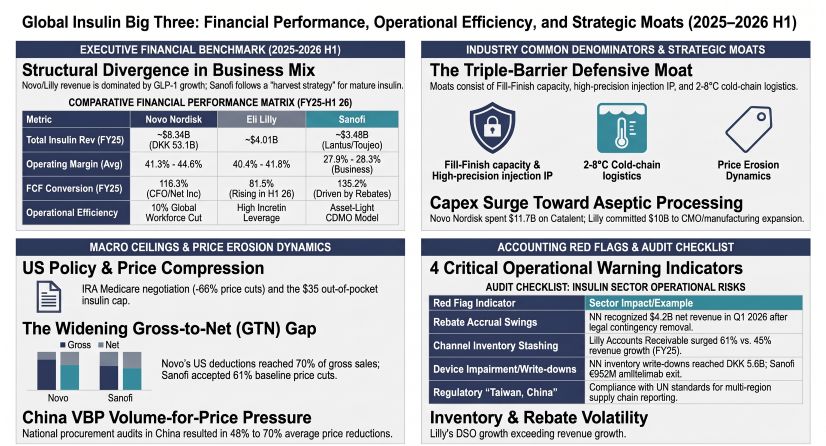 Financial Performance, Segmental Realities, and Balance Sheet Arbitrage
A financial diagnosis of Eli Lilly and Company [NYSE: LLY], Novo Nordisk A/S [CPH: NOVO-B], and Sanofi S.A. [EURONEXT: SAN] based on FY2025 10-K/20-F and H1 2026 reports reveals divergence in earnings quality, working capital efficiency, and free cash flow (FCF) generation. All conversions use normalized benchmark rates: 1 EUR = 1.1306 USD; 1 USD = 6.3729 DKK (1 DKK = 0.156914 USD).
Table Financial Performance, Cash Flow, and Capital Structure Comparison of Eli Lilly, Novo Nordisk, and Sanofi (FY2025–H1 2026)
In FY2025, Eli Lilly recorded a 95% YoY surge in IFRS net income to $20,640 million, yet its CFO-to-net-income conversion ratio registered at 81.46%. This divergence stemmed from a 61.37% jump in accounts receivable from $11,006 million in 2024 to $17,760 million in 2025, creating a -$7,000 million cash drag as Mounjaro and Zepbound expanded across US wholesale networks. By H1 2026, cash collections normalized, raising the conversion ratio to 110.57% on CFO of $16,023 million and net income of $14,491 million. Eli Lilly's DIO reached 352.26 days (453.86 days ending), reflecting $1.5 billion in capitalized pre-launch inventory for oral orforglipron and a doubling of tirzepatide work-in-process inventory from $3,979 million in 2024 to $8,183 million in 2025.
Novo Nordisk maintained an operational CFO-to-net-income ratio of 116.27% in FY2025 on net income of DKK 102,434 million. Accounts receivable declined 1.52% from DKK 71,949 million to DKK 70,856 million despite 6% top-line expansion, supported by non-recourse trade receivable factoring across US and Japanese jurisdictions. Total inventories rose from DKK 40,849 million to DKK 49,623 million, yielding a DIO of 280.82 days due to long API fermentation cycles in Kalundborg and Clayton. In 2025, Novo Nordisk revised its FCF reporting metric: under the new definition (deducting only PP&E CAPEX), FY2025 FCF stood at DKK 58,962 million ($9,252.00 million), compared to DKK 28,295 million ($4,440.12 million) under the former framework, which deducted DKK 29,973 million in intangible purchases and DKK 30.0 billion for the Akero acquisition. H1 2026 FCF under the new metric reached DKK 42,500 million ($6,668.85 million), yielding a 28.61% FCF/Sales conversion rate.
Sanofi generated an FY2025 Continuing CFO-to-net-income ratio of 135.17% on Continuing IFRS Net Income of €7,813 million. Working capital benefited from a €1,330 million cash inflow following a January 2024 US list price reduction on Lantus, which released historical rebate provisions. In H1 2026, Sanofi’s conversion ratio expanded to 237.25% on CFO of €4,643 million and net income of €1,957 million, impacted by a non-cash €952 million impairment on amlitelimab. Sanofi maintained a CCC of +145.64 days, anchored by an ending DPO of 205.92 days.
Metabolic Infrastructure Layout, Product Iterations, and Device Ecosystems
The revenue matrices of the major pharmaceutical entities reflect structural transitions across cardiometabolic and incretin modalities.
Table Cardiometabolic and Diabetes Portfolio Revenue Comparison of Eli Lilly, Novo Nordisk, and Sanofi (FY2025–H1 2026)
Eli Lilly’s cardiometabolic portfolio generated $48,221 million in FY2025 (74.0% of enterprise sales) and $34,113 million in H1 2026. Combined tirzepatide sales (Mounjaro and Zepbound) reached $36,507 million in FY2025 and $27,693 million in H1 2026 (65% of enterprise top-line). In H1 2026, Eli Lilly's total product volume expanded by 62%, offset by a 13% decline in realized net prices driven by US PBM concessions and Chinese NRDL entry. Trulicity contracted 18.6% in FY2025 to $4,276 million due to internal cannibalization by Mounjaro.
Novo Nordisk's metabolic care segment generated DKK 289,456 million ($45,419.83 million) in FY2025, representing 93.7% of total revenues. Ozempic recorded DKK 127,089 million ($19,942.10 million, +10% CER), while Wegovy delivered DKK 79,106 million ($12,412.87 million, +31% CER). In January 2026, Novo Nordisk introduced oral Wegovy (25mg pill), generating over 5 million US prescriptions within 30 weeks. Novo Nordisk maintained a 45.8% value share in global GLP-1 diabetes and a 58% volume share in international markets, though its total global diabetes market share by value declined 3.6% to 30.1%.
Sanofi’s insulin revenues shifted from Lantus (€1,733 million in FY2025, +10.3% CER) to Toujeo (€1,345 million in FY2025, +12.0% CER). Lantus experienced a temporary +32.1% CER sales surge in the US in FY2025 (€808 million) due to competitor supply shortages; as supply normalized, H1 2026 US Lantus sales fell 6.6% CER to €344 million (global Lantus sales down 3.8% CER to €813 million). Tzield generated €63 million ($71.23 million) in FY2025 and €37 million in H1 2026 (+34.5% CER).
In pipeline development, once-weekly basal insulins advanced across clinical and regulatory milestones:
- Novo Nordisk’s once-weekly insulin icodec (Awiqli) completed the ONWARDS 1–6 Phase 3a program. In ONWARDS 1 (T2D), icodec demonstrated superior HbA1c reduction (-1.55% vs -1.35% for glargine U100). In ONWARDS 6 (T1D), icodec met non-inferiority (-0.47% vs -0.51%) but showed an elevated rate of severe or clinically significant hypoglycemia (19.93 vs 10.37 events per patient-year). Following a 2024 FDA Complete Response Letter, Novo Nordisk resubmitted its US BLA in September 2025 restricted strictly to T2D.
- Eli Lilly’s once-weekly insulin efsitora alfa received a positive CHMP opinion in the EU in June 2026 for T2D, with active BLA reviews ongoing in the US, EU, and Japan.
- Novo Nordisk’s once-weekly combination Kyinsu (IcoSema: icodec + semaglutide) secured EMA approval following the COMBINE 1 trial (HbA1c reduction -1.6% vs -0.9% for icodec alone; body weight -3.7 kg vs +1.9 kg) and COMBINE 3 trial (HbA1c -1.5% vs -1.4% for basal-bolus; weight -3.6 kg vs +3.2 kg). Kyinsu is under review in China and Japan.
- In next-generation incretins, Eli Lilly capitalized $1.5 billion in pre-launch inventories for oral orforglipron (Foundayo) following US T2D/obesity filings. Novo Nordisk advanced CagriSema (cagrilintide + semaglutide) in Phase 3 REIMAGINE trials (14.2% to 20%+ weight loss), completed Phase 2 for Amycretin (zenagamtide), and advanced the UBT251 triple agonist into Phase 2. Novo Nordisk also completed Phase 1 trials for glucose-sensitive insulin NN1644 and restructured its T1D stem cell strategy via a partnership with Aspect Biosystems.
- Portfolio rationalizations included Novo Nordisk executing a 10% global workforce reduction (~9,000 positions), discontinuing US Levemir sales (-64.1% to DKK 1,677 million), terminating monlunabant (NN9440) and semaglutide in Alzheimer's (Evoke/Evoke+ Phase 3), and writing down ocedurenone (DKK 5,650 million charge in 2024). Sanofi terminated its Phase 3 amlitelimab atopic dermatitis program in July 2026 (€952 million impairment write-off), its Phase 3 E. coli sepsis vaccine (€239 million write-off), itepekimab in COPD (AERIFY-1/2), and riliprubart in CIDP.
Infrastructure investments focused on global fill-finish capacity and API expansion:
- Novo Nordisk’s parent company completed the $11.7 billion acquisition of three former Catalent fill-finish sites in 2025, expanding Novo Nordisk's sterile fill-finish footprint from 11 to 14 facilities. Primary API expansion includes DKK 59 billion in Kalundborg, Denmark, $5.6 billion in Clayton, North Carolina, and DKK 16 billion in Chartres, France. In FY2025, Novo Nordisk recorded a 15% increase in water withdrawal and an 18% increase in total waste (primarily yeast slurry).
- Eli Lilly expanded manufacturing assets in Indiana, North Carolina, Limerick/Athlone (Ireland), and Alzey (Germany), spent $925 million to acquire the NexPharm Wisconsin facility, and committed up to $10 billion in long-term CMO contracts. Eli Lilly disclosed single-source risks for critical raw materials and potential exposures under the US BIOSECURE Act.
- Sanofi maintained manufacturing hubs in Geel (Belgium), Boston (US), Frankfurt (Germany), and Paris/Lyon (France), alongside its 50/50 BioAtrium AG JV with Lonza Group AG [SIX: LONN] in Visp, Switzerland (€0.8 billion planned investment from 2026 to 2031). Sanofi upgraded facilities in Le Trait (France) and Beijing (China) for localized SoloStar insulin pen production.
The competitive landscape in diabetes devices highlights operational metrics across Abbott Laboratories [NYSE: ABT], DexCom, Inc. [NASDAQ: DXCM], and Medtronic plc [NYSE: MDT]:
Table Continuous Glucose Monitoring (CGM) and Diabetes Device Benchmarking Comparison of Abbott, DexCom, and Medtronic (FY2025–FY2026)
DexCom led labor productivity with $420,000 in revenue per employee in CY2025. Medtronic’s MiniMed generated ~$4,847 in annual ARPU per active pump user in FY2026 ($3,102 million revenue across >640,000 active pump users), supported by a 66% CGM attachment rate (~422,400 sensor users). However, MiniMed recorded a GAAP operating loss of $(190) million in FY2026 (compared to $(146) million in FY2025), impacted by $298 million in corporate shared service allocations and a $157 million Blackstone R&D co-development write-off. Abbott integrated its Instinct 15-day CGM sensor into Medtronic's MiniMed AID pump system under an OEM partnership. Health economics data indicate the MiniMed 780G system achieved an incremental cost-effectiveness ratio (ICER) of $38,842 over a lifetime horizon, while ADAPT trial data showed long-term savings up to $48,616 (€43,000 converted) per QALY.
Forensic Audit, Legal Vulnerabilities, and HDIN Institutional Verdict
Pricing pressure and forensic accounting disclosures illustrate systemic structural headwinds across major healthcare markets.
Under the US Inflation Reduction Act (IRA), Jardiance (co-developed by Eli Lilly) faces a 66% price reduction effective 2026. In January 2026, HHS added Trulicity and Verzenio to the price negotiation list, with mandated price caps taking effect in 2028. IRA statutory rules grant 13 years of protection to BLA biologics compared to 9 years for NDA small molecules. In December 2025, Sanofi executed a voluntary Most Favored Nation (MFN) agreement capping out-of-pocket insulin costs at $35 per month starting January 1, 2026, and cutting baseline prices by 61% on select mature insulins in exchange for a 3-year tariff exemption. In China, the 11th round of Volume-Based Procurement (VBP) generated price reductions between 48% and 70%, with VBP expansion to multi-source insulins slated for 2026. Eli Lilly confirmed that Mounjaro’s inclusion in China's NRDL resulted in realized net price concessions in H1 2026.
Forensic examination of Gross-to-Net (GTN) accounting reveals significant adjustments:
- Novo Nordisk recorded FY2025 global gross sales of DKK 729,423 million ($114.46 billion) and US sales deductions of DKK 394,631 million ($61.92 billion), representing 54.1% of global gross sales and over 70% of gross US revenues. Deductions included DKK 247,003 million in US Managed Care/Medicare rebates, DKK 69,504 million in wholesaler chargebacks, DKK 38,749 million in Medicaid rebates, and DKK 39,375 million in customer discounts/returns, yielding net sales of DKK 309,064 million. As of December 31, 2025, Novo Nordisk held a 340B provision of DKK 26.8 billion ($4.2 billion). Following HRSA’s dismissal of an overcharge petition on December 4, 2025, and finalization on January 20, 2026, Novo Nordisk recognized the entire $4.2 billion (DKK 26.8 billion) as a one-time net revenue true-up in Q1 2026.
- Sanofi maintained total provisions for discounts, rebates, and returns of €8,675 million ($9,807.96 million) as of December 31, 2025, comprising €3,312 million in government programs (Medicaid €1,197 million, Medicare €1,402 million), €1,785 million in managed care/GPO programs, €500 million in chargebacks, and €2,214 million in commercial rebates.
- Eli Lilly recorded total sales rebate and discount accruals of $17,382 million as of December 31, 2025 ($15,122 million in the US). Eli Lilly disclosed that a 5% shift in rebate liability assumptions impacts reported top-line revenue by $897 million. In July 2026, Eli Lilly received ANDA notice letters challenging tirzepatide patents for Mounjaro and Zepbound.
Litigation across US jurisdictions includes:
- US Insulin Pricing Multi-District Litigation (MDL No. 3006): Pending in the US District Court for the District of New Jersey, co-defendants Eli Lilly, Novo Nordisk, and Sanofi face claims alleging list price inflation and PBM rebate collusion. A direct-purchaser trial is scheduled in Massachusetts Federal Court for January 2027. Sanofi received an HHS-OIG subpoena in May 2025 requesting PBM and GPO records from 2020 onward.
- Texas Medicaid Fraud Prevention Act (TMFPA) Litigation: In Harrison County, Texas, Sanofi US is defending a qui tam action alleging illegal nursing vendor kickbacks to promote insulins. In October 2025, relators expanded claims to seven non-insulin products (including Dupixent, Rezurock, Altuviiio, and Tzield). The State of Texas intervened on February 13, 2026. Trial is set for July 19, 2027, with discovery closing January 15, 2027.
- 340B "Mosaic Health" Class Action: In the Western District of New York, 340B covered entities sued Eli Lilly, Sanofi, Novo Nordisk, and AstraZeneca PLC [LSE: AZN] alleging antitrust conspiracy regarding contract pharmacy limitations. Following a Second Circuit reversal of a district court dismissal, defendants filed a cert petition with the US Supreme Court in March 2026. District court fact discovery closes in November 2027.
HDIN Institutional Verdict
HDIN Research concludes that Novo Nordisk maintains superior operational earnings quality, backed by a Net Debt/EBITDA ratio of 0.64x, internal cash conversion, and localized control over API production. The Q1 2026 recognition of $4.2 billion in 340B provisions underscores management's conservative GTN accounting. Conversely, Eli Lilly's 1.24x Net Debt/EBITDA ratio, high DIO (352.26 days), and $54.9 billion in H1 2026 total debt reflect an aggressive capital allocation posture focused on securing incretin volume through $10 billion in long-term CMO guarantees and $1.5 billion in pre-launch inventory capitalization. While this exposes Eli Lilly to short-term working capital friction, it positions the firm to capture incretin market share. Sanofi has de-risked its balance sheet via a low Net Debt/EBITDA ratio (0.82x Business) and extended supplier terms (DPO 205.92 days), utilizing its insulin base as a cash-generating engine to fund specialty immunology assets while avoiding capital-intensive GLP-1 API buildouts.
Presentation Download & Video Access:
- Presentation Download: Click the PDF download link under 'Related Topics' to access the full institutional presentation of this report.
- Video Link: Click this link to watch the HDIN analyst briefing on YouTube.
About HDIN Research:
HDIN Research is a premier global market intelligence and strategic advisory firm specializing in institutional-grade financial analysis, supply chain audits, and macroeconomic forecasting. Our dedicated sector analysts deliver actionable, data-driven insights tailored for private equity, hedge funds, and corporate strategy teams. Visit us at http://www.hdinresearch.com.
2026 AI Transparency Footer:
"This intelligence report was authored by HDIN Research analysts following a rigorous audit of official corporate filings. AI was utilized for massive-scale data synthesis and structural drafting, ensuring 100% inclusion of reported data points. All strategic insights, financial modeling, and final verdicts were verified by our editorial board to ensure professional accuracy and compliance with 2026 Google Search E-E-A-T standards."
1. Eli Lilly and Company [NYSE: LLY] and Novo Nordisk A/S [CPH: NOVO-B] record divergent cash conversion cycles (+290.63 days vs +250.60 days) driven by LLY's $1.5 billion pre-launch inventory capitalization for oral orforglipron and tirzepatide work-in-process doubling to $8.183 billion.
2. Novo Nordisk A/S recognized a one-time $4.2 billion (DKK 26.8 billion) net revenue true-up in Q1 2026 following favorable 340B administrative rulings, while Sanofi S.A. [EURONEXT: SAN] executed a voluntary Most Favored Nation agreement capping US out-of-pocket insulin costs at $35 per month.
3. Medtronic plc [NYSE: MDT] MiniMed leads diabetes device monetization with an annual average revenue per user (ARPU) of ~$4,847 across >640,000 active pump users, despite incurring a FY2026 GAAP operating loss of $(190) million.
Figure Global Insulin Big Three: Financial Performance, Operational Efficiency, and Strategic Moats (2025-2026 H1)
Financial Performance, Segmental Realities, and Balance Sheet ArbitrageA financial diagnosis of Eli Lilly and Company [NYSE: LLY], Novo Nordisk A/S [CPH: NOVO-B], and Sanofi S.A. [EURONEXT: SAN] based on FY2025 10-K/20-F and H1 2026 reports reveals divergence in earnings quality, working capital efficiency, and free cash flow (FCF) generation. All conversions use normalized benchmark rates: 1 EUR = 1.1306 USD; 1 USD = 6.3729 DKK (1 DKK = 0.156914 USD).
Table Financial Performance, Cash Flow, and Capital Structure Comparison of Eli Lilly, Novo Nordisk, and Sanofi (FY2025–H1 2026)
| Financial Metric / Corporate Entity | Eli Lilly and Company [NYSE: LLY] | Novo Nordisk A/S [CPH: NOVO-B] | Sanofi S.A. [EURONEXT: SAN] |
| Gross Margin (%) | |||
| - FY 2025 | 83.04% ($54,127M / $65,179M) | 81.00% (Consolidated) | 77.20% (€33,667M / €43,626M) |
| - H1 2026 | 84.00% ($35,928M / $42,773M) | 79.30% (Adjusted) | 78.70% (IFRS) |
| Operating / EBIT Margin (%) | |||
| - FY 2025 | 40.35% ($26,302M / $65,179M) | 41.30% (Operating Margin) | 14.54% (IFRS €6,344M) / 27.85% (Business €12,149M) |
| - H1 2026 | 41.83% ($17,893M / $42,773M) | 44.60% (Operating Margin) | 14.33% (IFRS €3,168M) / 28.31% (Business €6,258M) |
| Operating Cash Flow (CFO) | |||
| - FY 2025 | $16,813M (IFRS) | DKK 119,102M ($18,688.73M) | €10,561M ($11,940.27M) (Continuing) |
| - H1 2026 | $16,023M (IFRS) | DKK 55,000M+ (CFO basis) | €4,643M ($5,249.38M) (Continuing) |
| CFO / Net Income Conversion (%) | |||
| - FY 2025 | 81.46% (Net: $20,640M) | 116.27% (Net: DKK 102,434M) | 135.17% (Continuing Net: €7,813M) |
| - H1 2026 | 110.57% (Net: $14,491M) | Pending H1 Net Finalization | 237.25% (Continuing Net: €1,957M) |
| Days Sales Outstanding (DSO) | 80.52 days (mean) / 99.44 days (ending) | 84.34 days (mean) / 83.70 days (ending) | 67.31 days (mean) / 70.36 days (ending) |
| Days Inventory Outstanding (DIO) | 352.26 days (mean) / 453.86 days (ending) | 280.82 days (mean) / 308.06 days (ending) | 281.74 days (mean) / 281.20 days (ending) |
| Days Payables Outstanding (DPO) | 142.15 days (mean) / 177.67 days (ending) | 114.56 days (mean) / 122.68 days (ending) | 205.92 days (ending static) |
| Cash Conversion Cycle (CCC) | +290.63 days (mean static) | +250.60 days (mean static) | +145.64 days (ending static) |
| Capital Expenditures (CAPEX) | |||
| - FY 2025 | $7,841M | DKK 60,140M ($9,436.81M) | €1,858M ($2,100.65M) / €1,822M PP&E |
| - H1 2026 | $5,259M | DKK 27,000M (H1 estimate) | €967M ($1,093.29M) / €882M PP&E |
| Free Cash Flow (FCF) & Conversion | |||
| - FY 2025 FCF | $8,972M (CFO - CAPEX) | DKK 58,962M (
4,440.12M) Old |
€8,089M ($9,145.42M) |
| - FY 2025 FCF / Sales (%) | 13.77% | 19.08% (New) / 9.16% (Old) | 18.54% |
| - H1 2026 FCF | $10,764M (CFO - CAPEX) | DKK 42,500M ($6,668.85M) | €3,724M ($4,209.18M) non-IFRS |
| - H1 2026 FCF / Sales (%) | 25.16% | 28.61% | 16.85% |
| Capital Structure & Solvency | |||
| - FY 2025 Debt-to-Asset Ratio | 76.41% ($85.9B / $112.4B) | 64.26% (DKK 348.8B / DKK 542.9B) | 43.45% (IFRS Equity €71.7B) |
| - FY 2025 Net Debt | $35,235M (Total Debt $42.5B) | DKK 95,424M ($14,973M) | €11,008M ($12,445M) |
| - FY 2025 Net Debt / EBITDA | 1.24x (EBITDA $28,299M) | 0.64x (EBITDA DKK 149,640M) | 0.95x IFRS (€11,607M) / 0.82x Business (€13,395M) |
| - Cash & Investments (FY2025) | $7,268M | DKK 26,962M ($4,230M) | €7,657M ($8,657M) |
In FY2025, Eli Lilly recorded a 95% YoY surge in IFRS net income to $20,640 million, yet its CFO-to-net-income conversion ratio registered at 81.46%. This divergence stemmed from a 61.37% jump in accounts receivable from $11,006 million in 2024 to $17,760 million in 2025, creating a -$7,000 million cash drag as Mounjaro and Zepbound expanded across US wholesale networks. By H1 2026, cash collections normalized, raising the conversion ratio to 110.57% on CFO of $16,023 million and net income of $14,491 million. Eli Lilly's DIO reached 352.26 days (453.86 days ending), reflecting $1.5 billion in capitalized pre-launch inventory for oral orforglipron and a doubling of tirzepatide work-in-process inventory from $3,979 million in 2024 to $8,183 million in 2025.
Novo Nordisk maintained an operational CFO-to-net-income ratio of 116.27% in FY2025 on net income of DKK 102,434 million. Accounts receivable declined 1.52% from DKK 71,949 million to DKK 70,856 million despite 6% top-line expansion, supported by non-recourse trade receivable factoring across US and Japanese jurisdictions. Total inventories rose from DKK 40,849 million to DKK 49,623 million, yielding a DIO of 280.82 days due to long API fermentation cycles in Kalundborg and Clayton. In 2025, Novo Nordisk revised its FCF reporting metric: under the new definition (deducting only PP&E CAPEX), FY2025 FCF stood at DKK 58,962 million ($9,252.00 million), compared to DKK 28,295 million ($4,440.12 million) under the former framework, which deducted DKK 29,973 million in intangible purchases and DKK 30.0 billion for the Akero acquisition. H1 2026 FCF under the new metric reached DKK 42,500 million ($6,668.85 million), yielding a 28.61% FCF/Sales conversion rate.
Sanofi generated an FY2025 Continuing CFO-to-net-income ratio of 135.17% on Continuing IFRS Net Income of €7,813 million. Working capital benefited from a €1,330 million cash inflow following a January 2024 US list price reduction on Lantus, which released historical rebate provisions. In H1 2026, Sanofi’s conversion ratio expanded to 237.25% on CFO of €4,643 million and net income of €1,957 million, impacted by a non-cash €952 million impairment on amlitelimab. Sanofi maintained a CCC of +145.64 days, anchored by an ending DPO of 205.92 days.
Metabolic Infrastructure Layout, Product Iterations, and Device Ecosystems
The revenue matrices of the major pharmaceutical entities reflect structural transitions across cardiometabolic and incretin modalities.
Table Cardiometabolic and Diabetes Portfolio Revenue Comparison of Eli Lilly, Novo Nordisk, and Sanofi (FY2025–H1 2026)
| Corporate Entity / Product Line | Brand Identifiers | FY 2025 Revenue (Native) | FY 2025 Revenue (USD Converted) | H1 2026 Revenue (Native / USD) | CER Growth & Lifecycle Metrics |
| Eli Lilly and Company | Total Cardiometabolic | $48,221M | $48,221M | $34,113M | 74.0% of corporate revenue |
| - Traditional Insulins | Humalog, Humulin, Basaglar | $4,006M | $4,006M | $1,936M | -1% YoY FY25; +0.5% YoY H1 2026 |
| - T2D Incretin | Mounjaro (Tirzepatide) | $22,965M | $22,965M | $18,605M | +99% YoY FY25; +106% YoY H1 2026 |
| - Obesity Incretin | Zepbound (Tirzepatide) | $13,542M | $13,542M | $9,088M | +175% YoY FY25; +60% YoY H1 2026 |
| - Legacy / SGLT2 | Trulicity / Jardiance | $4,276M / $3,432M | $4,276M / $3,432M | $2,138M / $2,346M | Trulicity -18.6%; Jardiance H126 +38% |
| Novo Nordisk A/S | Total Metabolic Care | DKK 289,456M | $45,419.83M | N/A | 93.7% of corporate sales |
| - Traditional Insulins | Tresiba, NovoRapid, Ryzodeg | DKK 53,137M | $8,337.96M | Q2 2026: ~DKK 12B | -1% CER FY25 (-4% reported) |
| * Tresiba | Insulin degludec | DKK 12,049M | $1,890.66M | N/A | +21.6% reported FY25 |
| * NovoRapid / Novolog | Insulin aspart | DKK 15,765M | $2,473.75M | N/A | -5.3% reported FY25 |
| * Awiqli | Insulin icodec (Weekly) | DKK 410M | $64.33M | N/A | Commercial rollout phase |
| * Levemir | Insulin detemir | DKK 1,677M | $263.15M | N/A | -64.1% reported (US withdrawal) |
| * Ryzodeg / NovoMix | Degludec/Aspart / Biphasic | DKK 5,382M / DKK 4,933M | $844.51M / $774.06M | N/A | Ryzodeg +9.2%; NovoMix -15.8% |
| - T2D GLP-1 | Ozempic / Rybelsus | DKK 127,089M / DKK 22,093M | $19,942.10M / $3,466.71M | N/A / N/A | Ozempic +10% CER; Rybelsus -2% CER |
| - Obesity GLP-1 | Wegovy (Semaglutide) | DKK 79,106M | $12,412.87M | Q2 2026: DKK 23,152M | +31% CER FY25; Q2 2026 vol +16% CER |
| Sanofi S.A. | Selected Metabolic | N/A | N/A | N/A | Specialty Care Focus |
| - Basal Insulins | Lantus (100U) / Toujeo (300U) | €1,733M / €1,345M | $1,959.33M / $1,520.66M | €813M / €729M | Lantus +10.3% CER FY25; Toujeo +12% CER |
| - Combo / T1D Specialty | Soliqua / Tzield | €282M / €63M | $318.83M / $71.23M | €165M / €37M | Soliqua +28.2% CER; Tzield H126 +34.5% CER |
Eli Lilly’s cardiometabolic portfolio generated $48,221 million in FY2025 (74.0% of enterprise sales) and $34,113 million in H1 2026. Combined tirzepatide sales (Mounjaro and Zepbound) reached $36,507 million in FY2025 and $27,693 million in H1 2026 (65% of enterprise top-line). In H1 2026, Eli Lilly's total product volume expanded by 62%, offset by a 13% decline in realized net prices driven by US PBM concessions and Chinese NRDL entry. Trulicity contracted 18.6% in FY2025 to $4,276 million due to internal cannibalization by Mounjaro.
Novo Nordisk's metabolic care segment generated DKK 289,456 million ($45,419.83 million) in FY2025, representing 93.7% of total revenues. Ozempic recorded DKK 127,089 million ($19,942.10 million, +10% CER), while Wegovy delivered DKK 79,106 million ($12,412.87 million, +31% CER). In January 2026, Novo Nordisk introduced oral Wegovy (25mg pill), generating over 5 million US prescriptions within 30 weeks. Novo Nordisk maintained a 45.8% value share in global GLP-1 diabetes and a 58% volume share in international markets, though its total global diabetes market share by value declined 3.6% to 30.1%.
Sanofi’s insulin revenues shifted from Lantus (€1,733 million in FY2025, +10.3% CER) to Toujeo (€1,345 million in FY2025, +12.0% CER). Lantus experienced a temporary +32.1% CER sales surge in the US in FY2025 (€808 million) due to competitor supply shortages; as supply normalized, H1 2026 US Lantus sales fell 6.6% CER to €344 million (global Lantus sales down 3.8% CER to €813 million). Tzield generated €63 million ($71.23 million) in FY2025 and €37 million in H1 2026 (+34.5% CER).
In pipeline development, once-weekly basal insulins advanced across clinical and regulatory milestones:
- Novo Nordisk’s once-weekly insulin icodec (Awiqli) completed the ONWARDS 1–6 Phase 3a program. In ONWARDS 1 (T2D), icodec demonstrated superior HbA1c reduction (-1.55% vs -1.35% for glargine U100). In ONWARDS 6 (T1D), icodec met non-inferiority (-0.47% vs -0.51%) but showed an elevated rate of severe or clinically significant hypoglycemia (19.93 vs 10.37 events per patient-year). Following a 2024 FDA Complete Response Letter, Novo Nordisk resubmitted its US BLA in September 2025 restricted strictly to T2D.
- Eli Lilly’s once-weekly insulin efsitora alfa received a positive CHMP opinion in the EU in June 2026 for T2D, with active BLA reviews ongoing in the US, EU, and Japan.
- Novo Nordisk’s once-weekly combination Kyinsu (IcoSema: icodec + semaglutide) secured EMA approval following the COMBINE 1 trial (HbA1c reduction -1.6% vs -0.9% for icodec alone; body weight -3.7 kg vs +1.9 kg) and COMBINE 3 trial (HbA1c -1.5% vs -1.4% for basal-bolus; weight -3.6 kg vs +3.2 kg). Kyinsu is under review in China and Japan.
- In next-generation incretins, Eli Lilly capitalized $1.5 billion in pre-launch inventories for oral orforglipron (Foundayo) following US T2D/obesity filings. Novo Nordisk advanced CagriSema (cagrilintide + semaglutide) in Phase 3 REIMAGINE trials (14.2% to 20%+ weight loss), completed Phase 2 for Amycretin (zenagamtide), and advanced the UBT251 triple agonist into Phase 2. Novo Nordisk also completed Phase 1 trials for glucose-sensitive insulin NN1644 and restructured its T1D stem cell strategy via a partnership with Aspect Biosystems.
- Portfolio rationalizations included Novo Nordisk executing a 10% global workforce reduction (~9,000 positions), discontinuing US Levemir sales (-64.1% to DKK 1,677 million), terminating monlunabant (NN9440) and semaglutide in Alzheimer's (Evoke/Evoke+ Phase 3), and writing down ocedurenone (DKK 5,650 million charge in 2024). Sanofi terminated its Phase 3 amlitelimab atopic dermatitis program in July 2026 (€952 million impairment write-off), its Phase 3 E. coli sepsis vaccine (€239 million write-off), itepekimab in COPD (AERIFY-1/2), and riliprubart in CIDP.
Infrastructure investments focused on global fill-finish capacity and API expansion:
- Novo Nordisk’s parent company completed the $11.7 billion acquisition of three former Catalent fill-finish sites in 2025, expanding Novo Nordisk's sterile fill-finish footprint from 11 to 14 facilities. Primary API expansion includes DKK 59 billion in Kalundborg, Denmark, $5.6 billion in Clayton, North Carolina, and DKK 16 billion in Chartres, France. In FY2025, Novo Nordisk recorded a 15% increase in water withdrawal and an 18% increase in total waste (primarily yeast slurry).
- Eli Lilly expanded manufacturing assets in Indiana, North Carolina, Limerick/Athlone (Ireland), and Alzey (Germany), spent $925 million to acquire the NexPharm Wisconsin facility, and committed up to $10 billion in long-term CMO contracts. Eli Lilly disclosed single-source risks for critical raw materials and potential exposures under the US BIOSECURE Act.
- Sanofi maintained manufacturing hubs in Geel (Belgium), Boston (US), Frankfurt (Germany), and Paris/Lyon (France), alongside its 50/50 BioAtrium AG JV with Lonza Group AG [SIX: LONN] in Visp, Switzerland (€0.8 billion planned investment from 2026 to 2031). Sanofi upgraded facilities in Le Trait (France) and Beijing (China) for localized SoloStar insulin pen production.
The competitive landscape in diabetes devices highlights operational metrics across Abbott Laboratories [NYSE: ABT], DexCom, Inc. [NASDAQ: DXCM], and Medtronic plc [NYSE: MDT]:
Table Continuous Glucose Monitoring (CGM) and Diabetes Device Benchmarking Comparison of Abbott, DexCom, and Medtronic (FY2025–FY2026)
| Device Benchmarking Indicator | Abbott Laboratories [NYSE: ABT] (ADC / Libre) | DexCom, Inc. [NASDAQ: DXCM] (Pure-Play CGM) | Medtronic plc [NYSE: MDT] (MiniMed Standalone) |
| Enterprise / Segment Revenue | $44,328M Total / $7,998M Libre Brand (CY25) | $4,662.0M Segment (100% Pure-Play CY25) |
|
| YoY Growth (Reported / Organic) | 17.5% Reported / 16.3% Organic | 16.0% Reported / 16.0% Organic | 14.2% Rep / 8.0% Org FY26 (10.0% Rep / 11.5% Org FY25) |
| Segment Operating Profit / Margin | $7,212M EBIT (33.7% Margin - Medical Devices) | $911.8M Operating Profit (19.6% Margin) | GAAP Loss: $(190)M (-6.1%) / Non-GAAP Adj EBITDA $202M (6.5%) |
| Enterprise Headcount | ~115,000 Employees | ~11,100 Employees | ~8,000 Employees (Diabetes Unit) |
| Revenue Per Employee | ~$385,461 (Enterprise Level) | ~$420,000 | ~387,750FY2026( 387,750FY2026( 339,375 FY2025) |
| Installed User Base & Additions | Undisclosed Active Base | 600k–700k Net Customer Additions CY2025 | >640k Active Pump Users; 145k New Pumps Sold FY26 |
| CGM Attachment & Sensor Life | 10–15 Days Wear Time; Instinct Integration | 10 Days (G6/G7) / 15 Days (G7 15-Day) | 66% CGM Attachment (~422.4k users); Simplera 7d / Instinct 15d |
| Estimated Annual ARPU | Undisclosed | Undisclosed | ~4,847perpumpuser(4,847perpumpuser( 3,102M / 640k active users) |
DexCom led labor productivity with $420,000 in revenue per employee in CY2025. Medtronic’s MiniMed generated ~$4,847 in annual ARPU per active pump user in FY2026 ($3,102 million revenue across >640,000 active pump users), supported by a 66% CGM attachment rate (~422,400 sensor users). However, MiniMed recorded a GAAP operating loss of $(190) million in FY2026 (compared to $(146) million in FY2025), impacted by $298 million in corporate shared service allocations and a $157 million Blackstone R&D co-development write-off. Abbott integrated its Instinct 15-day CGM sensor into Medtronic's MiniMed AID pump system under an OEM partnership. Health economics data indicate the MiniMed 780G system achieved an incremental cost-effectiveness ratio (ICER) of $38,842 over a lifetime horizon, while ADAPT trial data showed long-term savings up to $48,616 (€43,000 converted) per QALY.
Forensic Audit, Legal Vulnerabilities, and HDIN Institutional Verdict
Pricing pressure and forensic accounting disclosures illustrate systemic structural headwinds across major healthcare markets.
Under the US Inflation Reduction Act (IRA), Jardiance (co-developed by Eli Lilly) faces a 66% price reduction effective 2026. In January 2026, HHS added Trulicity and Verzenio to the price negotiation list, with mandated price caps taking effect in 2028. IRA statutory rules grant 13 years of protection to BLA biologics compared to 9 years for NDA small molecules. In December 2025, Sanofi executed a voluntary Most Favored Nation (MFN) agreement capping out-of-pocket insulin costs at $35 per month starting January 1, 2026, and cutting baseline prices by 61% on select mature insulins in exchange for a 3-year tariff exemption. In China, the 11th round of Volume-Based Procurement (VBP) generated price reductions between 48% and 70%, with VBP expansion to multi-source insulins slated for 2026. Eli Lilly confirmed that Mounjaro’s inclusion in China's NRDL resulted in realized net price concessions in H1 2026.
Forensic examination of Gross-to-Net (GTN) accounting reveals significant adjustments:
- Novo Nordisk recorded FY2025 global gross sales of DKK 729,423 million ($114.46 billion) and US sales deductions of DKK 394,631 million ($61.92 billion), representing 54.1% of global gross sales and over 70% of gross US revenues. Deductions included DKK 247,003 million in US Managed Care/Medicare rebates, DKK 69,504 million in wholesaler chargebacks, DKK 38,749 million in Medicaid rebates, and DKK 39,375 million in customer discounts/returns, yielding net sales of DKK 309,064 million. As of December 31, 2025, Novo Nordisk held a 340B provision of DKK 26.8 billion ($4.2 billion). Following HRSA’s dismissal of an overcharge petition on December 4, 2025, and finalization on January 20, 2026, Novo Nordisk recognized the entire $4.2 billion (DKK 26.8 billion) as a one-time net revenue true-up in Q1 2026.
- Sanofi maintained total provisions for discounts, rebates, and returns of €8,675 million ($9,807.96 million) as of December 31, 2025, comprising €3,312 million in government programs (Medicaid €1,197 million, Medicare €1,402 million), €1,785 million in managed care/GPO programs, €500 million in chargebacks, and €2,214 million in commercial rebates.
- Eli Lilly recorded total sales rebate and discount accruals of $17,382 million as of December 31, 2025 ($15,122 million in the US). Eli Lilly disclosed that a 5% shift in rebate liability assumptions impacts reported top-line revenue by $897 million. In July 2026, Eli Lilly received ANDA notice letters challenging tirzepatide patents for Mounjaro and Zepbound.
Litigation across US jurisdictions includes:
- US Insulin Pricing Multi-District Litigation (MDL No. 3006): Pending in the US District Court for the District of New Jersey, co-defendants Eli Lilly, Novo Nordisk, and Sanofi face claims alleging list price inflation and PBM rebate collusion. A direct-purchaser trial is scheduled in Massachusetts Federal Court for January 2027. Sanofi received an HHS-OIG subpoena in May 2025 requesting PBM and GPO records from 2020 onward.
- Texas Medicaid Fraud Prevention Act (TMFPA) Litigation: In Harrison County, Texas, Sanofi US is defending a qui tam action alleging illegal nursing vendor kickbacks to promote insulins. In October 2025, relators expanded claims to seven non-insulin products (including Dupixent, Rezurock, Altuviiio, and Tzield). The State of Texas intervened on February 13, 2026. Trial is set for July 19, 2027, with discovery closing January 15, 2027.
- 340B "Mosaic Health" Class Action: In the Western District of New York, 340B covered entities sued Eli Lilly, Sanofi, Novo Nordisk, and AstraZeneca PLC [LSE: AZN] alleging antitrust conspiracy regarding contract pharmacy limitations. Following a Second Circuit reversal of a district court dismissal, defendants filed a cert petition with the US Supreme Court in March 2026. District court fact discovery closes in November 2027.
HDIN Institutional Verdict
HDIN Research concludes that Novo Nordisk maintains superior operational earnings quality, backed by a Net Debt/EBITDA ratio of 0.64x, internal cash conversion, and localized control over API production. The Q1 2026 recognition of $4.2 billion in 340B provisions underscores management's conservative GTN accounting. Conversely, Eli Lilly's 1.24x Net Debt/EBITDA ratio, high DIO (352.26 days), and $54.9 billion in H1 2026 total debt reflect an aggressive capital allocation posture focused on securing incretin volume through $10 billion in long-term CMO guarantees and $1.5 billion in pre-launch inventory capitalization. While this exposes Eli Lilly to short-term working capital friction, it positions the firm to capture incretin market share. Sanofi has de-risked its balance sheet via a low Net Debt/EBITDA ratio (0.82x Business) and extended supplier terms (DPO 205.92 days), utilizing its insulin base as a cash-generating engine to fund specialty immunology assets while avoiding capital-intensive GLP-1 API buildouts.
Presentation Download & Video Access:
- Presentation Download: Click the PDF download link under 'Related Topics' to access the full institutional presentation of this report.
- Video Link: Click this link to watch the HDIN analyst briefing on YouTube.
About HDIN Research:
HDIN Research is a premier global market intelligence and strategic advisory firm specializing in institutional-grade financial analysis, supply chain audits, and macroeconomic forecasting. Our dedicated sector analysts deliver actionable, data-driven insights tailored for private equity, hedge funds, and corporate strategy teams. Visit us at http://www.hdinresearch.com.
2026 AI Transparency Footer:
"This intelligence report was authored by HDIN Research analysts following a rigorous audit of official corporate filings. AI was utilized for massive-scale data synthesis and structural drafting, ensuring 100% inclusion of reported data points. All strategic insights, financial modeling, and final verdicts were verified by our editorial board to ensure professional accuracy and compliance with 2026 Google Search E-E-A-T standards."