Global Ophthalmic Pharmaceuticals 2026 Outlook: Why Specialty Biopharma and Integrated Eyecare Models Diverge on Commercial SG&A Leverage Amid Tightening US Payer Mandates
Date : 2026-09-09
Reading : 1033
HDIN Executive Takeaways
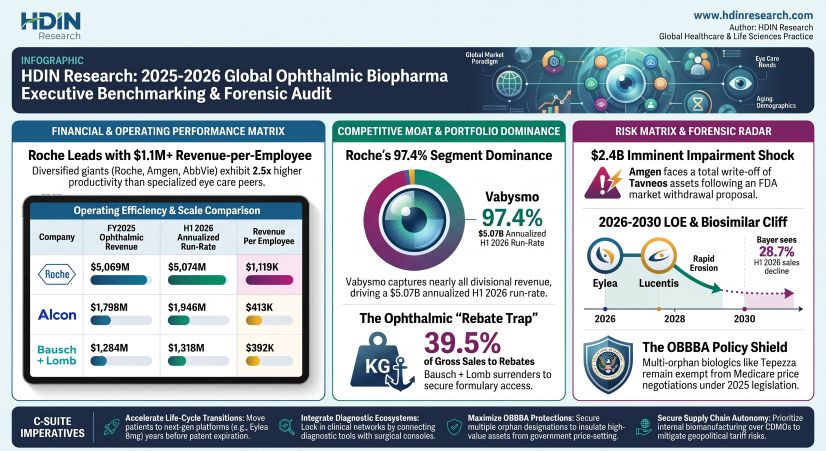
1. A sharp structural divide separates diversified biopharma operators from specialized vision care players: F. Hoffmann-La Roche Ltd. and Amgen Inc. extract superior operational leverage, generating $1,119.28K and $1,166.70K per full-time employee (FTE) via concentrated clinician networks, whereas Alcon Inc. and Bausch + Lomb Corporation face structural promotional dilution, delivering $412.76K and $392.38K per FTE across broad primary care optometry channels.
2. Gross-to-net (GTN) pricing erosion and manufacturing disruptions have escalated across major production nodes, led by Bausch + Lomb Corporation surrendering 39.47% ($3,313 million) of gross product sales in FY2025 to channel rebates alongside an Official Action Indicated (OAI) citation at its sterile Tampa, Florida facility in June 2026.
3. Balance sheet risk is heavily bifurcated between fortress balance sheets like F. Hoffmann-La Roche Ltd. (Core Net Debt-to-EBITDA of 0.74x) and highly leveraged entities like Bausch + Lomb Corporation (Net Debt-to-EBITDA of 4.05x, 0.27x GAAP interest coverage), which faces an imminent $1.91 billion debt maturity wall in 2028.
Figure 2025-2026 Global Ophthalmic Biopharma Market
 Segmental Realities, Labor Productivity, and Capital Allocation Dynamics
Financial analysis across pure-play ophthalmic pharmaceutical divisions indicates that commercial overhead scales inversely with clinician concentration. Originators targeting dense retinal specialist networks achieve SG&A intensities below 20%, whereas players commercializing topical formulations for Dry Eye Disease (DED) across fragmented optometric and primary-care practices absorb commercial SG&A costs exceeding 35% to 43%.
All corporate financials are standardized to USD based on audited average exchange rates (1 EUR = 1.1306 USD; 1 USD = 0.8305 CHF / implied 1 CHF = 1.20409 USD).
Table Ophthalmic Pharmaceutical Segment Benchmarking and Operating Efficiency Comparison (FY2025)
* F. Hoffmann-La Roche Ltd. [SIX: ROG]: Total ophthalmic sales rose 10.00% at Constant Exchange Rates (CER) in FY2025 to CHF 4,210 million ($5,069.24 million), catalyzed by Vabysmo (faricimab), which generated CHF 4,102 million ($4,939.19 million) or 97.43% of segment sales. In H1 2026, Vabysmo generated CHF 2,059 million ($2,479.23 million; +8% CER), keeping the division's annualized run-rate at $5,074.05 million. Legacy Lucentis dropped 58% CER in FY2025 to CHF 58 million ($69.84 million) due to biosimilar erosion. Operating working capital expanded as Roche offered extended U.S. commercial credit terms on Vabysmo to cushion retinal practices navigating buy-and-bill inventory carrying charges.
* Bayer AG [XETRA: BAYN]: Confronted severe patent cliffs on Eylea (aflibercept 2 mg), which declined 5.93% reported in FY2025 to €3,110 million ($3,516.17 million). Generic and biosimilar competition accelerated in H1 2026, forcing a 28.7% reported decline (26.8% CER) to €1,196 million ($1,352.20 million; annualized run-rate of $2,704.40 million). The life-cycle migration to high-dose Eylea 8 mg reached 50% of the franchise in H1 2026 and 55% in Q2 2026.
* AbbVie Inc. [NYSE: ABBV]: FY2025 ophthalmic sales contracted 5.93% reported (-5.00% weighted CER) to $2,109 million. Ozurdex registered $493 million (-0.2%), Lumigan/Ganfort slipped to $410 million (-4.4%), and Alphagan/Combigan dropped 20.4% reported (-19.4% CER) to $197 million following generic entry. Other Eye Care revenues (including Restasis) dropped 5.8% to $1,009 million. In H1 2026, AbbVie ceased dedicated segmental reporting for Eye Care. Corporate FCF conversion reached 421.21%, with $19,030 million in operating cash flow offsetting GAAP net earnings of $4,233 million via non-cash amortization add-backs ($7,380 million) and contingent consideration revisions ($6,500 million).
* Amgen Inc. [NASDAQ: AMGN]: Monotherapy asset TEPEZZA (teprotumumab) grew 2.81% reported (+3% volume) in FY2025 to $1,903 million, accelerating 20.32% in H1 2026 to $1,066 million (annualized run-rate of $2,132 million). Geographic expansion outside the U.S. grew from $55 million in H1 2025 to $122 million in H1 2026. Amgen carries the highest DSO in the peer group at 95.0 days, driven by complex prior-authorization protocols for Thyroid Eye Disease (TED).
* Alcon Inc. [NYSE: ALC]: Ocular Health rose 5.45% reported (+5.00% CER) to $1,798 million in FY2025, accelerating by 12.88% reported (+11.00% CER) in H1 2026 to $973 million (annualized run-rate of $1,946 million) on the commercial rollout of TRYPTYR (acoltremon) and Systane line extensions. Commercial SG&A intensity in Vision Care held at 35.66%.
* Bausch + Lomb Corporation [NYSE: BLCO]: Recorded $1,284 million in FY2025 Pharmaceuticals revenue (+6.20% reported; +6.00% CER), driven by branded dry-eye products XIIDRA and MIEBO ($1,076 million, or 83.80% of segment revenue; generics delivered $201 million). H1 2026 segment sales expanded 14.41% reported (+13.00% CER) to $659 million (annualized run-rate of $1,318 million; branded assets at $564 million, generics at $94 million). Pharmaceutical SG&A reached 43.55% in H1 2026. Operating cash flows recovered from $10 million in H1 2025 to $185 million in H1 2026, pivoting calculated FCF from -$189 million to +$14 million.
Infrastructure Layout, Regulatory Friction, and Balance Sheet Vulnerabilities
Physical supply chain infrastructure and regulatory compliance dictate downside operational variances. Manufacturing facilities face distinct jurisdictional frictions, with firms accelerating internal biomanufacturing investments to counter localized trade friction, tariffs, and sterility interventions.
Table Forensic Solvency, Balance Sheet Risk, and Supply Chain Resilience Benchmark (FY2025)
* Manufacturing Footprint and Operational Interruptions:
* Bausch + Lomb Corporation: Received an Official Action Indicated (OAI) classification from the U.S. FDA in June 2026 across its core 193,000-square-foot sterile pharmaceutical plant in Tampa, Florida. This followed a March 2025 Class I voluntary recall of enVista intraocular lenses triggered by monomer contamination linked to Toxic Anterior Segment Syndrome (TASS). The firm outsources ~37% of product sales to third parties and relies on sole-source finished product contracts for XIIDRA, MIEBO, Lumify, Vyzulta, SofLens, and PureVision. It completed the acquisition of a finished pharmaceutical plant in Mexico on December 9, 2025.
* Alcon Inc.: Operates 16 facilities (9 Surgical, 7 Vision Care) across Fort Worth (Texas), Batam (Indonesia), Cork (Ireland), Erlangen and Grosswallstadt (Germany), Puurs (Belgium), Schaffhausen (Switzerland), Singapore, and Johor (Malaysia). Manufacturing autonomy stands at 90%, mitigating third-party supply shocks, though exposed to an estimated net annual tariff headwind of $40 million to $90 million. CapEx programs include $314 million (2027 completion) and $157 million (2030 completion) in Singapore, alongside $162 million in Grosswallstadt for automated contact lens production.
* Amgen Inc.: Relies on Amgen Manufacturing Limited LLC (AML) in Puerto Rico for the majority of its commercial biomanufacturing, exposing output to local power-grid volatility. Drug substance for TEPEZZA remains 100% dependent on a single third-party contract manufacturing organization (CMO) inherited from Horizon Therapeutics, alongside single-sourced SureClick autoinjector assemblies. Amgen opened its Holly Springs, North Carolina single-use bioreactor facility in January 2025 and broke ground on a twin plant on-site, allocating $2,600 million in projected FY2026 CapEx.
* F. Hoffmann-La Roche Ltd.: Backs Vabysmo via internal Genentech and Chugai biomanufacturing hubs, initiating a $50 billion, 5-year investment program in the United States. However, its dry-AMD allogeneic cell therapy OpRegen (RG6501, Phase IIa GAlette study) is 100% dependent on Lineage Cell Therapeutics' single cGMP master cell banking facility (CCN) in Jerusalem, Israel, exposing the clinical asset to regional geopolitical conflict.
* AbbVie Inc.: Pledged $100 billion in U.S. capital expenditures and R&D over 10 years, constructing an AI-integrated pharmaceutical production campus in North Carolina and expanding facilities in Illinois to insulate living cell-line inputs (Botox) and oncology assets.
* Regulatory Ceilings and Policy Intervention:
* Under the U.S. Medicare Part D redesign, manufacturer mandatory discounts adjusted to 10% in the initial coverage phase and 20% in the catastrophic phase above the $2,000 out-of-pocket cap ($2,100 in 2026). In FY2025, Bausch + Lomb absorbed $3,313 million in Gross-to-Net provisions on $8,393 million in gross product sales (39.47% GTN deduction), comprising $2,049 million in rebates, $611 million in chargebacks, $476 million in discounts/allowances, $98 million in distribution fees, and $79 million in returns.
* The Centers for Medicare & Medicaid Services (CMS) selected Botox for price negotiations in January 2026 under the Inflation Reduction Act (IRA), effective 2028. This establishes a precedent for high-expenditure Part B/D ophthalmology biologics approaching their 13-year exclusivity ceiling. Conversely, the One Big Beautiful Bill Act (OBBBA), signed July 4, 2025, broadened the orphan drug exemption to protect multi-indication rare-disease products, insulating Amgen's TEPEZZA prior to any non-orphan label approvals.
* Roche's Vabysmo gained inclusion in Mainland China’s National Reimbursement Drug List (NRDL) in 2025, driving an International volume surge of 116% CER to CHF 358 million ($431.07 million), while European revenue faced mandatory reference price cuts across the UK and Switzerland. Bayer absorbed margin dilution in China following centralized Volume-Based Procurement (VBP) bidding rounds. In late 2024, Alcon divested its Chinese commercial rights for Bion Tears and Tears Naturale to Ocumension Therapeutics for a 16.7% equity holding.
HDIN Institutional Verdict
Forensic balance sheet stress testing highlights extreme variations in earnings quality and asset valuation risk. Operating models relying on aggressive non-GAAP exclusions mask structural R&D setbacks, while high intangible balances leave leveraged balance sheets exposed to impairment shocks:
* Aggressive Non-GAAP Add-Back Structures: Alcon Inc. reported IFRS Operating Income of $303 million in H1 2026, but adjusted this figure upward by $840 million (a 277.2% upward revision) to report Core Operating Income of $1,143 million. This adjustment was driven by adding back a $402 million pre-tax net loss on the termination of its PowerVision fluid-based accommodating intraocular lens program (a $505 million pre-tax impairment offset by a $103 million fair value adjustment in contingent liabilities), along with $257 million in intangible asset amortization. Similarly, AbbVie adjusted out a $6.50 billion non-cash GAAP expense tied to Skyrizi contingent royalty liabilities, while F. Hoffmann-La Roche Ltd. added back CHF 1,045 million in H1 2026 clinical pipeline stop-development impairments (Carmot’s acmopatide and Inflazome’s selnoflast) alongside CHF 765 million in restructuring charges.
* Impairment Vulnerability and Valuation Cliff: Amgen Inc. carries $2.40 billion in net developed product rights for TAVNEOS ($2.30 billion U.S.), which faces potential complete non-cash write-offs following the FDA CDER's April 2026 proposal to withdraw marketing authorization due to hepatotoxicity risks and efficacy disputes. Bausch + Lomb carries a $1,595 million XIIDRA product brand intangible (8.75-year amortization life) subject to mounting impairment triggers as Aurobindo's generic lifitegrast approaches its negotiated market entry date of June 30, 2027. AbbVie carries $88,281 million in goodwill and net intangibles (65.90% of assets), exposing its capital structure to write-downs as Botox enters IRA price controls, mirroring its $847 million Q3 2025 impairment across Durysta ($440 million) and Resonic ($407 million).
* Refinancing Friction: Bausch + Lomb Corporation remains in a strained solvency position with an operating interest coverage of 0.27x and non-investment-grade ratings of B1/B. Facing a 7.43% weighted average interest rate and an 87% controlling ownership overhang from Bausch Health Companies Inc. [NYSE: BHC], B+L must navigate a $1.91 billion debt maturity wall in 2028 with cash balances falling to $1,130 million and undrawn revolver capacity tightening to $618 million as of June 30, 2026.
Presentation Download & Video Access:
Presentation Download: Click the PDF download link under 'Related Topics' to access the full institutional presentation of this report.
Video Link: Click this link to watch the HDIN analyst briefing on YouTube.
About HDIN Research:
HDIN Research is a global market intelligence and strategic advisory firm specializing in institutional-grade financial analysis, supply chain audits, and macroeconomic forecasting. Our dedicated sector analysts deliver actionable, data-driven insights tailored for private equity, hedge funds, and corporate strategy teams. Visit us at http://www.hdinresearch.com.
2026 AI Transparency Footer:
"This intelligence report was authored by HDIN Research analysts following an audit of official corporate filings. AI was utilized for massive-scale data synthesis and structural drafting, ensuring 100% inclusion of reported data points. All strategic insights, financial modeling, and final verdicts were verified by our editorial board to ensure professional accuracy and compliance with 2026 Google Search E-E-A-T standards."
1. A sharp structural divide separates diversified biopharma operators from specialized vision care players: F. Hoffmann-La Roche Ltd. and Amgen Inc. extract superior operational leverage, generating $1,119.28K and $1,166.70K per full-time employee (FTE) via concentrated clinician networks, whereas Alcon Inc. and Bausch + Lomb Corporation face structural promotional dilution, delivering $412.76K and $392.38K per FTE across broad primary care optometry channels.
2. Gross-to-net (GTN) pricing erosion and manufacturing disruptions have escalated across major production nodes, led by Bausch + Lomb Corporation surrendering 39.47% ($3,313 million) of gross product sales in FY2025 to channel rebates alongside an Official Action Indicated (OAI) citation at its sterile Tampa, Florida facility in June 2026.
3. Balance sheet risk is heavily bifurcated between fortress balance sheets like F. Hoffmann-La Roche Ltd. (Core Net Debt-to-EBITDA of 0.74x) and highly leveraged entities like Bausch + Lomb Corporation (Net Debt-to-EBITDA of 4.05x, 0.27x GAAP interest coverage), which faces an imminent $1.91 billion debt maturity wall in 2028.
Figure 2025-2026 Global Ophthalmic Biopharma Market
Segmental Realities, Labor Productivity, and Capital Allocation DynamicsFinancial analysis across pure-play ophthalmic pharmaceutical divisions indicates that commercial overhead scales inversely with clinician concentration. Originators targeting dense retinal specialist networks achieve SG&A intensities below 20%, whereas players commercializing topical formulations for Dry Eye Disease (DED) across fragmented optometric and primary-care practices absorb commercial SG&A costs exceeding 35% to 43%.
All corporate financials are standardized to USD based on audited average exchange rates (1 EUR = 1.1306 USD; 1 USD = 0.8305 CHF / implied 1 CHF = 1.20409 USD).
Table Ophthalmic Pharmaceutical Segment Benchmarking and Operating Efficiency Comparison (FY2025)
| Operational Benchmark Metric (FY2025) | Roche | Bayer | AbbVie | Amgen | Alcon | Bausch + Lomb |
|---|---|---|---|---|---|---|
| Ophthalmic Pharma Revenue | $5,069.24M | $3,516.17M | $2,109.00M | $1,903.00M | $1,798.00M | $1,284.00M |
| Primary Core Products | Vabysmo, Lucentis | Eylea, Eylea 8 mg | Ozurdex, Lumigan | TEPEZZA | Systane, TRYPTYR | XIIDRA, MIEBO |
| Estimated Headcount (FTE) | 4,529 | 6,010 | 1,966 | 1,631 | 4,356 | 3,272 |
| Revenue per Employee | $1,119.28K | $585.02K | $1,072.98K | $1,166.70K | $412.76K | $392.38K |
| Commercial SG&A Intensity | ~15.2% (Core) | 27.5% (Group) | 22.9% (Corporate) | 19.2% (Corporate) | 35.7% (Vision Care) | 43.6% (Pharma) |
| Estimated Segment Gross Margin | 81.8% | 58.8% | 70.2% | 67.2% | ~66.5% | ~74.6% |
| Free Cash Flow (Group) | $14,216.70M | $2,356.20M | $17,830.00M | $8,100.00M | $1,922.00M | $(66.00)M |
| FCF-to-Net Income Ratio | 85.56% | 59.82% (Core) | 421.21% | 105.04% | 196.12% | N/M (Loss) |
| Days Sales Outstanding (DSO) | 66.6 days | 72.7 days | 75.1 days | 95.0 days | 68.7 days | 87.4 days |
| CapEx-to-D&A Ratio | 110.69% | 89.30% | 14.74% | 36.77% | 27.05% | 82.90% |
* Bayer AG [XETRA: BAYN]: Confronted severe patent cliffs on Eylea (aflibercept 2 mg), which declined 5.93% reported in FY2025 to €3,110 million ($3,516.17 million). Generic and biosimilar competition accelerated in H1 2026, forcing a 28.7% reported decline (26.8% CER) to €1,196 million ($1,352.20 million; annualized run-rate of $2,704.40 million). The life-cycle migration to high-dose Eylea 8 mg reached 50% of the franchise in H1 2026 and 55% in Q2 2026.
* AbbVie Inc. [NYSE: ABBV]: FY2025 ophthalmic sales contracted 5.93% reported (-5.00% weighted CER) to $2,109 million. Ozurdex registered $493 million (-0.2%), Lumigan/Ganfort slipped to $410 million (-4.4%), and Alphagan/Combigan dropped 20.4% reported (-19.4% CER) to $197 million following generic entry. Other Eye Care revenues (including Restasis) dropped 5.8% to $1,009 million. In H1 2026, AbbVie ceased dedicated segmental reporting for Eye Care. Corporate FCF conversion reached 421.21%, with $19,030 million in operating cash flow offsetting GAAP net earnings of $4,233 million via non-cash amortization add-backs ($7,380 million) and contingent consideration revisions ($6,500 million).
* Amgen Inc. [NASDAQ: AMGN]: Monotherapy asset TEPEZZA (teprotumumab) grew 2.81% reported (+3% volume) in FY2025 to $1,903 million, accelerating 20.32% in H1 2026 to $1,066 million (annualized run-rate of $2,132 million). Geographic expansion outside the U.S. grew from $55 million in H1 2025 to $122 million in H1 2026. Amgen carries the highest DSO in the peer group at 95.0 days, driven by complex prior-authorization protocols for Thyroid Eye Disease (TED).
* Alcon Inc. [NYSE: ALC]: Ocular Health rose 5.45% reported (+5.00% CER) to $1,798 million in FY2025, accelerating by 12.88% reported (+11.00% CER) in H1 2026 to $973 million (annualized run-rate of $1,946 million) on the commercial rollout of TRYPTYR (acoltremon) and Systane line extensions. Commercial SG&A intensity in Vision Care held at 35.66%.
* Bausch + Lomb Corporation [NYSE: BLCO]: Recorded $1,284 million in FY2025 Pharmaceuticals revenue (+6.20% reported; +6.00% CER), driven by branded dry-eye products XIIDRA and MIEBO ($1,076 million, or 83.80% of segment revenue; generics delivered $201 million). H1 2026 segment sales expanded 14.41% reported (+13.00% CER) to $659 million (annualized run-rate of $1,318 million; branded assets at $564 million, generics at $94 million). Pharmaceutical SG&A reached 43.55% in H1 2026. Operating cash flows recovered from $10 million in H1 2025 to $185 million in H1 2026, pivoting calculated FCF from -$189 million to +$14 million.
Infrastructure Layout, Regulatory Friction, and Balance Sheet Vulnerabilities
Physical supply chain infrastructure and regulatory compliance dictate downside operational variances. Manufacturing facilities face distinct jurisdictional frictions, with firms accelerating internal biomanufacturing investments to counter localized trade friction, tariffs, and sterility interventions.
Table Forensic Solvency, Balance Sheet Risk, and Supply Chain Resilience Benchmark (FY2025)
| Forensic Solvency / Asset Risk Metric (FY2025) | Roche | Bayer | AbbVie | Amgen | Alcon | Bausch + Lomb |
|---|---|---|---|---|---|---|
| Total Assets | $121,255.88M | $118,194.05M | $133,960.00M | $90,586.00M | $31,555.00M | $14,022.00M |
| Total Carrying Debt | $38,092.72M | $42,400.89M | $67,496.00M | $54,623.00M | $4,737.00M | $5,082.00M |
| Net Debt-to-EBITDA (x) | 0.74x | 3.09x (Core) | 2.68x | 3.19x | 1.18x | 4.05x |
| Operating Interest Coverage | 13.70x | N/M (Negative) | 5.21x | 3.30x | 6.67x | 0.27x |
| Goodwill & Intangibles (% of Total Assets) | 26.63% | 46.57% | 65.90% | 45.21% | 57.87% | 57.33% |
| Total Debt / Capital (%) | 45.51% | 59.00% | 105.02% (Deficit Equity) | 86.32% | 17.69% | 43.81% |
| Primary Supply Node Concentration / CDMO Vulnerability | Internal manufacturing network; Genentech / CCN (Israel) exposure | Leverkusen and Berlin facilities; API sourcing concentration risk | NC biologics manufacturing; Waco (TX) single-source exposure | AML Puerto Rico and Holly Springs (NC) manufacturing concentration | 16 global plants; ~90% internally manufactured | 25 in-house facilities; 37% outsourced production; Tampa (OAI) exposure |
* Bausch + Lomb Corporation: Received an Official Action Indicated (OAI) classification from the U.S. FDA in June 2026 across its core 193,000-square-foot sterile pharmaceutical plant in Tampa, Florida. This followed a March 2025 Class I voluntary recall of enVista intraocular lenses triggered by monomer contamination linked to Toxic Anterior Segment Syndrome (TASS). The firm outsources ~37% of product sales to third parties and relies on sole-source finished product contracts for XIIDRA, MIEBO, Lumify, Vyzulta, SofLens, and PureVision. It completed the acquisition of a finished pharmaceutical plant in Mexico on December 9, 2025.
* Alcon Inc.: Operates 16 facilities (9 Surgical, 7 Vision Care) across Fort Worth (Texas), Batam (Indonesia), Cork (Ireland), Erlangen and Grosswallstadt (Germany), Puurs (Belgium), Schaffhausen (Switzerland), Singapore, and Johor (Malaysia). Manufacturing autonomy stands at 90%, mitigating third-party supply shocks, though exposed to an estimated net annual tariff headwind of $40 million to $90 million. CapEx programs include $314 million (2027 completion) and $157 million (2030 completion) in Singapore, alongside $162 million in Grosswallstadt for automated contact lens production.
* Amgen Inc.: Relies on Amgen Manufacturing Limited LLC (AML) in Puerto Rico for the majority of its commercial biomanufacturing, exposing output to local power-grid volatility. Drug substance for TEPEZZA remains 100% dependent on a single third-party contract manufacturing organization (CMO) inherited from Horizon Therapeutics, alongside single-sourced SureClick autoinjector assemblies. Amgen opened its Holly Springs, North Carolina single-use bioreactor facility in January 2025 and broke ground on a twin plant on-site, allocating $2,600 million in projected FY2026 CapEx.
* F. Hoffmann-La Roche Ltd.: Backs Vabysmo via internal Genentech and Chugai biomanufacturing hubs, initiating a $50 billion, 5-year investment program in the United States. However, its dry-AMD allogeneic cell therapy OpRegen (RG6501, Phase IIa GAlette study) is 100% dependent on Lineage Cell Therapeutics' single cGMP master cell banking facility (CCN) in Jerusalem, Israel, exposing the clinical asset to regional geopolitical conflict.
* AbbVie Inc.: Pledged $100 billion in U.S. capital expenditures and R&D over 10 years, constructing an AI-integrated pharmaceutical production campus in North Carolina and expanding facilities in Illinois to insulate living cell-line inputs (Botox) and oncology assets.
* Regulatory Ceilings and Policy Intervention:
* Under the U.S. Medicare Part D redesign, manufacturer mandatory discounts adjusted to 10% in the initial coverage phase and 20% in the catastrophic phase above the $2,000 out-of-pocket cap ($2,100 in 2026). In FY2025, Bausch + Lomb absorbed $3,313 million in Gross-to-Net provisions on $8,393 million in gross product sales (39.47% GTN deduction), comprising $2,049 million in rebates, $611 million in chargebacks, $476 million in discounts/allowances, $98 million in distribution fees, and $79 million in returns.
* The Centers for Medicare & Medicaid Services (CMS) selected Botox for price negotiations in January 2026 under the Inflation Reduction Act (IRA), effective 2028. This establishes a precedent for high-expenditure Part B/D ophthalmology biologics approaching their 13-year exclusivity ceiling. Conversely, the One Big Beautiful Bill Act (OBBBA), signed July 4, 2025, broadened the orphan drug exemption to protect multi-indication rare-disease products, insulating Amgen's TEPEZZA prior to any non-orphan label approvals.
* Roche's Vabysmo gained inclusion in Mainland China’s National Reimbursement Drug List (NRDL) in 2025, driving an International volume surge of 116% CER to CHF 358 million ($431.07 million), while European revenue faced mandatory reference price cuts across the UK and Switzerland. Bayer absorbed margin dilution in China following centralized Volume-Based Procurement (VBP) bidding rounds. In late 2024, Alcon divested its Chinese commercial rights for Bion Tears and Tears Naturale to Ocumension Therapeutics for a 16.7% equity holding.
HDIN Institutional Verdict
Forensic balance sheet stress testing highlights extreme variations in earnings quality and asset valuation risk. Operating models relying on aggressive non-GAAP exclusions mask structural R&D setbacks, while high intangible balances leave leveraged balance sheets exposed to impairment shocks:
* Aggressive Non-GAAP Add-Back Structures: Alcon Inc. reported IFRS Operating Income of $303 million in H1 2026, but adjusted this figure upward by $840 million (a 277.2% upward revision) to report Core Operating Income of $1,143 million. This adjustment was driven by adding back a $402 million pre-tax net loss on the termination of its PowerVision fluid-based accommodating intraocular lens program (a $505 million pre-tax impairment offset by a $103 million fair value adjustment in contingent liabilities), along with $257 million in intangible asset amortization. Similarly, AbbVie adjusted out a $6.50 billion non-cash GAAP expense tied to Skyrizi contingent royalty liabilities, while F. Hoffmann-La Roche Ltd. added back CHF 1,045 million in H1 2026 clinical pipeline stop-development impairments (Carmot’s acmopatide and Inflazome’s selnoflast) alongside CHF 765 million in restructuring charges.
* Impairment Vulnerability and Valuation Cliff: Amgen Inc. carries $2.40 billion in net developed product rights for TAVNEOS ($2.30 billion U.S.), which faces potential complete non-cash write-offs following the FDA CDER's April 2026 proposal to withdraw marketing authorization due to hepatotoxicity risks and efficacy disputes. Bausch + Lomb carries a $1,595 million XIIDRA product brand intangible (8.75-year amortization life) subject to mounting impairment triggers as Aurobindo's generic lifitegrast approaches its negotiated market entry date of June 30, 2027. AbbVie carries $88,281 million in goodwill and net intangibles (65.90% of assets), exposing its capital structure to write-downs as Botox enters IRA price controls, mirroring its $847 million Q3 2025 impairment across Durysta ($440 million) and Resonic ($407 million).
* Refinancing Friction: Bausch + Lomb Corporation remains in a strained solvency position with an operating interest coverage of 0.27x and non-investment-grade ratings of B1/B. Facing a 7.43% weighted average interest rate and an 87% controlling ownership overhang from Bausch Health Companies Inc. [NYSE: BHC], B+L must navigate a $1.91 billion debt maturity wall in 2028 with cash balances falling to $1,130 million and undrawn revolver capacity tightening to $618 million as of June 30, 2026.
Presentation Download & Video Access:
Presentation Download: Click the PDF download link under 'Related Topics' to access the full institutional presentation of this report.
Video Link: Click this link to watch the HDIN analyst briefing on YouTube.
About HDIN Research:
HDIN Research is a global market intelligence and strategic advisory firm specializing in institutional-grade financial analysis, supply chain audits, and macroeconomic forecasting. Our dedicated sector analysts deliver actionable, data-driven insights tailored for private equity, hedge funds, and corporate strategy teams. Visit us at http://www.hdinresearch.com.
2026 AI Transparency Footer:
"This intelligence report was authored by HDIN Research analysts following an audit of official corporate filings. AI was utilized for massive-scale data synthesis and structural drafting, ensuring 100% inclusion of reported data points. All strategic insights, financial modeling, and final verdicts were verified by our editorial board to ensure professional accuracy and compliance with 2026 Google Search E-E-A-T standards."