Lakewood-Amedex Biotherapeutics Inc.: Pipeline Capitalization Constrained by Toxic Equity Overhang and Imminent Liquidity Wall
Date : 2026-09-22
Reading : 248
HDIN Executive Takeaways
1. Lakewood-Amedex Biotherapeutics Inc. [NASDAQ: LABT] faces an immediate liquidity wall with $4,584,774 in total cash and certificates of deposit against an accelerated monthly burn rate of $408,954, yielding an 11.2-month runway through Q1 2027 under active ASC 205-40 going concern warnings.
2. The registration of 4,512,400 resale common shares driven by an unadjusted $1.00 conversion floor post-reverse split imposes an immediate 190.42% dilution overhang on outstanding common equity, exacerbated by senior 12.0% cumulative dividend drains.
3. Pipeline monetization remains entirely binary: lead asset Nu-3 (Phase 2a dose-comparison) operates under single-blind design constraints and a zero-infrastructure commercial footprint (5 full-time employees), requiring immediate out-licensing post-readout to avert severe balance sheet distress.
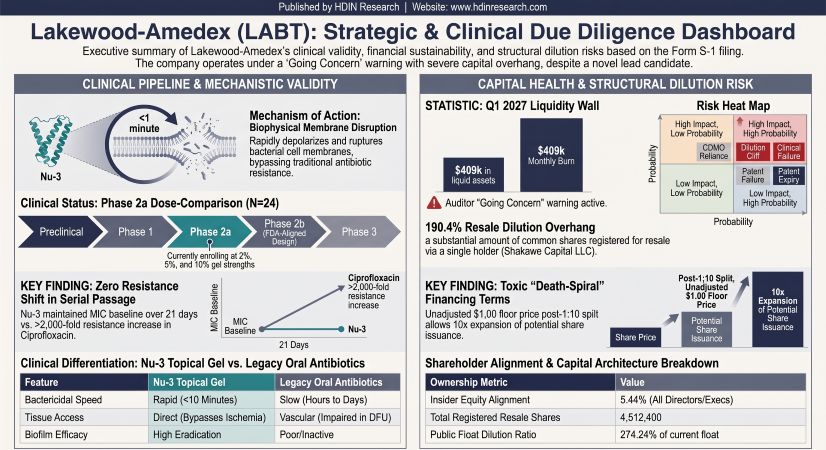
Figure Lakewood-Amedex (LABT): Strategic & Clinical Due Diligence Dashboard
 Balance Sheet Contraction, Operating Leverage, and Structural Dilution
The financial architecture of Lakewood-Amedex Biotherapeutics Inc. illustrates an acute disconnect between clinical-stage capital requirements and balance sheet durability. Across all historical operating periods (FY 2024, FY 2025, and 1H 2026), the company generated zero recognized revenue across commercial product sales, government grants, and licensing milestones.
Operating cash burn contracted significantly from $5,723,322 ($476,944 per month) in FY 2024 to $1,944,698 ($162,058 per month) in FY 2025 due to an operational pause in clinical trial development while managing financing and public listing preparations. However, operational cash burn re-accelerated to $2,453,721 ($408,954 per month) during 1H 2026 as Phase 2a clinical preparation resumed and public company compliance costs took effect. Current liquid resources as of June 30, 2026, total $4,584,774, comprising $2,584,774 in cash and cash equivalents alongside $2,000,000 in short-term bank-issued Certificates of Deposit (maturities between 90 and 365 days). This yields a remaining operating runway of 11.2 months, exhausting liquid funds in Q1/Q2 2027.
Independent auditors CBIZ CPAs P.C. (FY 2025) and Marcum LLP (FY 2024) each issued formal Going Concern explanatory paragraphs pursuant to ASC 205-40. The company recorded recurring net losses of $4,855,405 in FY 2024, $3,847,637 in FY 2025, and $4,695,299 in 1H 2026, widening the accumulated balance sheet deficit to $68,639,996 as of June 30, 2026.
Table Pre-Commercial Operating Burn, R&D Allocation, and Liquidity Position (FY2024–H1 2026)
*Note: 1H 2026 professional services include a non-cash advisory equity fee of $2,359,080 via the issuance of 27,273 common shares to RBW Capital Partners LLC (Dawson James Securities).*
The company executed an emergency recapitalization via a Series C Convertible Preferred Stock financing on April 21, 2026, issuing 937,500 shares at a 20% Original Issue Discount (stated value of $9,375,000) for $7,500,000 gross proceeds ($6,800,000 net proceeds). Concurrently, during the April 23, 2026 direct listing, $1,500,000 in 10% related-party convertible bridge notes ($380,000 held by officers Doug Manion, Leonard DeRoma, and Peter Ceccacci) plus $147,319 in accrued interest converted into 20,600 common shares at $80.00 per share. An additional $168,158 in 12% short-term promissory notes issued between February and April 2026 ($93,158 from Chairman Doug Manion and $75,000 from three 5%+ holders) was repaid in full with Series C cash proceeds.
Total balance sheet liabilities due within 12 to 24 months stand at $628,926, with zero non-current liabilities. Current obligations consist of accounts payable ($165,942), accrued expenses ($361,365), and the current portion of operating lease liabilities ($101,619). Non-balance sheet clinical trial contractual obligations comprise $783,717 in remaining fees payable to CRO PERI LLC (out of a $974,099 total contract; $190,382 incurred through June 30, 2026) and $138,515 in remaining fixed fees payable to CDMO Pace Life Sciences (out of a $197,125 contract; $58,610 incurred through June 30, 2026) plus estimated pass-through costs of 40% to 45%.
The structural flaw in the capital architecture centers on the Certificate of Designation for the Series C Preferred Stock held entirely by Shakawe Capital LLC. On June 19, 2026, Lakewood-Amedex executed a 1-for-10 reverse stock split; however, the Certificate of Designation explicitly specified that the $1.00 conversion floor price was not adjusted upward. Consequently, with the common stock trading at $1.86 as of September 17, 2026, the 20% floating conversion discount (80% of the 5-day VWAP) triggered an obligation to register 4,512,400 common resale shares to cover the remaining 451,240 Series C Preferred shares (which hold a stated value of $4,512,400).
The preferred stock carries a 12.0% cumulative annual dividend ($1.20 per share, or $541,488 per year across the remaining 451,240 preferred shares), payable monthly in cash or kind beginning October 2026, alongside senior liquidation rights and full-ratchet anti-dilution protections below $10.00. While conversion is governed by a standard 4.99% (expandable to 9.99%) beneficial ownership blocker, this does not limit aggregate supply; rather, it facilitates iterative tranche conversions and immediate liquidations into secondary markets.
Asset Architecture, Clinical Protocols, and Virtual Supply Chains
Lakewood-Amedex operates an entirely virtual, asset-light biopharmaceutical development model. The company owns zero wet laboratories, pilot plants, fermentation suites, or manufacturing real estate. Physical operations are anchored in a single leased 1,600-square-foot administrative corporate headquarters at 8332 Market Street, University Park, Florida 34201, United States (operating lease ending September 30, 2027, with total contractual liabilities of $101,619). The enterprise employs 5 full-time personnel, all located in the United States, focused exclusively on executive administration, R&D management, and regulatory compliance.
The core therapeutic platform comprises synthetic antimicrobial nucleotide derivatives designated as Bisphosphocins®. Unlike conventional classes (beta-lactams, fluoroquinolones, macrolides) that act on internal bacterial enzymes and metabolic pathways, Bisphosphocins® exert a biophysical mechanism of action: concentration- and pH-dependent destabilization and depolarization of bacterial cell membranes, causing complete lysis in under one minute. In non-clinical 21-day serial passage assays against *Escherichia coli* and methicillin-resistant *Staphylococcus aureus* (MRSA), lead asset Nu-3 induced zero MIC shift for MRSA and minimal shift for *E. coli*, whereas ciprofloxacin generated an increase of >600-fold for MRSA and >2,000-fold for *E. coli*.
Lead asset Nu-3 (topical gel) is actively enrolling in an open-label/single-blind Phase 2a dose-comparison trial (NCT0765506) involving 24 patients presenting with mildly infected diabetic foot ulcers (iDFU) across clinical sites in the United States. Chaired by Dr. David G. Armstrong and managed by CRO PERI LLC, the study evaluates 2%, 5%, and 10% gel concentrations administered twice daily (BID) across 8-patient cohorts. The trial is positioned to establish dose-response characteristics, microbiological eradication, and safety prior to advancing into an FDA-aligned, double-blind, randomized, placebo-controlled Phase 2b trial (NCT06020235) testing 5% and 10% concentrations (QD vs. BID). This follows historical clinical friction: in March 2022, the FDA placed a clinical hold on a proposed Phase 2 study in complicated DFU, requiring extensive porcine wound toxicology studies before permitting trials at higher gel concentrations.
Manufacturing risk is highly concentrated. Lakewood-Amedex is 100% reliant on a single CDMO, Pace Life Sciences in San Diego, California, under an April 2026 Statement of Work ($197,125 fixed fee) covering Phase A (cGMP topical gel manufacturing), Phase B (applicator labeling and kitting), and Phase C (18-month ICH stability testing). Raw nucleotide starting materials are procured from single-source suppliers with no qualified secondary vendors. Bulk Nu-3 drug substance possesses verified chemical stability of ≥5 years; finished drug product topical gel maintains stability for ≥24 months (sterile without preservatives for ≥18 months). Preclinical candidate Nu-10 has completed a 1 kg cGMP scale-up, requiring cold-chain distribution at 0–5°C (6-month solution stability).
The intellectual property estate is 100% internally discovered between 2012 and 2013, completely free of university royalties, earn-outs, or third-party milestones. As of August 2026, the portfolio includes 74 issued patents and 27 pending applications. The core patent cliff for Nu-3 gel formulations and broad Bisphosphocin® compositions terminates on March 12, 2038, and June 12, 2038 across the United States, the European Patent Office (validated in 17 states), Japan, China (ZL201880030624.4), India, and Australia. Pending US Continuation-in-Part (CIP) application #18/933,370, if granted, provides lifecycle extension through October 31, 2044. Upon NDA approval, the asset is positioned for up to 5 years of Hatch-Waxman Patent Term Extension (subject to the 14-year post-approval statutory cap) and 5 years of New Chemical Entity (NCE) regulatory exclusivity.
The commercial footprint is nonexistent. Lakewood-Amedex maintains zero sales infrastructure, zero marketing personnel, and zero commercial partnerships. The target patient population across key markets includes 18.22 million diabetic foot ulcer sufferers: 4.89 million in the United States (26.8%), 1.24 million in selected European nations (France, Germany, Italy, Spain, United Kingdom; 6.8%), and 12.09 million across Rest of World territories (Australia, Brazil, Canada, China including Taiwan, Province of China, India, Japan, Mexico, Republic of Korea, Russian Federation, South Africa; 66.4%). Management's target value proposition relies on preventing the 20% lower-limb amputation rate associated with unmanaged DFU (a disease state representing an estimated $80 billion in annual direct and indirect US healthcare expenditures), but the drug will compete against entrenched, low-cost generic oral standard-of-care antibiotics (ciprofloxacin, cephalexin) and navigate mandatory pricing discounts under the Inflation Reduction Act and 340B Drug Pricing ceilings.
HDIN Institutional Verdict
Lakewood-Amedex presents a structural disconnect between its proprietary biophysical antimicrobial chemistry and its fragile corporate architecture. The platform demonstrates legitimate differentiation: rapid sub-minute membrane lysis, activity against recalcitrant biofilms, an exceptionally high barrier to resistance selection, and topical delivery that completely bypasses the peripheral arterial disease (PAD) perfusion failures typical of oral antibiotics in diabetic limbs.
However, the capital structure creates severe friction that impairs fundamental common equity value:
First, the unadjusted $1.00 conversion floor for the Series C Preferred Stock following the 1-for-10 reverse stock split creates continuous structural selling pressure. By registering 4,512,400 common shares—representing 190.42% of total shares outstanding and 274.24% of the float—for a single institutional holder with a guaranteed 20% discount to 5-day VWAP, management has instituted a classic "death-spiral" convertible mechanic. This dynamic will suppress equity valuation regardless of clinical operational progress.
Second, the operational cash runway through Q1 2027 ($4.58M in cash and short-term CDs against an accelerating burn rate of ~$409,000 per month) provides insufficient leeway to absorb clinical bottlenecks. The ongoing Phase 2a trial (NCT0765506) suffers from acute design limitations: a small, single-blind cohort of 24 patients evaluated over short 14-day endpoints introduces potential investigator evaluation bias and lacks the definitive, sustained wound closure readouts required for pivotal approval. Any regulatory friction analogous to the March 2022 FDA clinical hold, or batch failure at Pace Life Sciences' sole-source CDMO facility, will breach the company's liquid runway and force severe balance sheet restructuring.
Third, the complete lack of commercial capabilities within a 5-person organization renders internal commercialization untenable. Entrenched guideline inertia among wound care specialists and hospital Pharmacy & Therapeutics (P&T) committees favoring low-cost oral generics requires clinical infrastructure and capital reserves that Lakewood-Amedex does not possess.
Executive leadership (salaries doubled post-April 2026 financing: CEO Kelvin Cooper at $490,000, CMO Thomas Balzer at $440,000, CFO Peter Ceccacci at $405,000) maintains minimal common equity alignment, holding only 5.44% of common stock (CEO Cooper holds 0 direct common shares, relying on options). Consequently, the sole rational corporate strategy is an outright out-licensing transaction or whole-company sale to a global biopharmaceutical partner immediately following Phase 2a dose-response readouts in 1H 2027. If an out-licensing partner cannot be secured prior to the Q1 2027 cash boundary, the combination of preferred dividend drains ($541k+ annually), sole-source supply chain vulnerabilities, and preferred conversion dilution will severely erode common shareholder equity.
Presentation Download & Video Access:
- Presentation Download: Click the PDF download link under 'Related Topics' to access the full institutional presentation of this report.
- Video Link: Click this link to watch the HDIN analyst briefing on YouTube.
About HDIN Research:
HDIN Research is a premier global market intelligence and strategic advisory firm specializing in institutional-grade financial analysis, supply chain audits, and macroeconomic forecasting. Our dedicated sector analysts deliver actionable, data-driven insights tailored for private equity, hedge funds, and corporate strategy teams. Visit us at http://www.hdinresearch.com.
2026 AI Transparency Footer:
"This intelligence report was authored by HDIN Research analysts following a rigorous audit of official corporate filings. AI was utilized for massive-scale data synthesis and structural drafting, ensuring 100% inclusion of reported data points. All strategic insights, financial modeling, and final verdicts were verified by our editorial board to ensure professional accuracy and compliance with 2026 Google Search E-E-A-T standards."
1. Lakewood-Amedex Biotherapeutics Inc. [NASDAQ: LABT] faces an immediate liquidity wall with $4,584,774 in total cash and certificates of deposit against an accelerated monthly burn rate of $408,954, yielding an 11.2-month runway through Q1 2027 under active ASC 205-40 going concern warnings.
2. The registration of 4,512,400 resale common shares driven by an unadjusted $1.00 conversion floor post-reverse split imposes an immediate 190.42% dilution overhang on outstanding common equity, exacerbated by senior 12.0% cumulative dividend drains.
3. Pipeline monetization remains entirely binary: lead asset Nu-3 (Phase 2a dose-comparison) operates under single-blind design constraints and a zero-infrastructure commercial footprint (5 full-time employees), requiring immediate out-licensing post-readout to avert severe balance sheet distress.
Figure Lakewood-Amedex (LABT): Strategic & Clinical Due Diligence Dashboard
Balance Sheet Contraction, Operating Leverage, and Structural DilutionThe financial architecture of Lakewood-Amedex Biotherapeutics Inc. illustrates an acute disconnect between clinical-stage capital requirements and balance sheet durability. Across all historical operating periods (FY 2024, FY 2025, and 1H 2026), the company generated zero recognized revenue across commercial product sales, government grants, and licensing milestones.
Operating cash burn contracted significantly from $5,723,322 ($476,944 per month) in FY 2024 to $1,944,698 ($162,058 per month) in FY 2025 due to an operational pause in clinical trial development while managing financing and public listing preparations. However, operational cash burn re-accelerated to $2,453,721 ($408,954 per month) during 1H 2026 as Phase 2a clinical preparation resumed and public company compliance costs took effect. Current liquid resources as of June 30, 2026, total $4,584,774, comprising $2,584,774 in cash and cash equivalents alongside $2,000,000 in short-term bank-issued Certificates of Deposit (maturities between 90 and 365 days). This yields a remaining operating runway of 11.2 months, exhausting liquid funds in Q1/Q2 2027.
Independent auditors CBIZ CPAs P.C. (FY 2025) and Marcum LLP (FY 2024) each issued formal Going Concern explanatory paragraphs pursuant to ASC 205-40. The company recorded recurring net losses of $4,855,405 in FY 2024, $3,847,637 in FY 2025, and $4,695,299 in 1H 2026, widening the accumulated balance sheet deficit to $68,639,996 as of June 30, 2026.
Table Pre-Commercial Operating Burn, R&D Allocation, and Liquidity Position (FY2024–H1 2026)
| Operating Statement & Capital Metric | FY 2024 (Audited) | FY 2025 (Audited) | 1H 2025 (Unaudited) | 1H 2026 (Unaudited) |
| Commercial Revenue Recognized | $0 | $0 | $0 | $0 |
| Research & Development (R&D) Expense | $2,103,366 | $1,255,266 | $316,605 | $685,167 |
| — Personnel-Related R&D | $1,793,458 | $1,158,074 | $280,233 | $428,599 |
| — Clinical & Preclinical | $262,833 | $82,016 | $29,112 | $246,608 |
| — Other R&D Costs | $47,075 | $15,176 | $7,260 | $9,960 |
| General & Administrative (G&A) Expense | $1,917,154 | $2,512,470 | $861,071 | $3,988,926 |
| — Professional Services | $754,503 | $898,044 | $470,128 | $3,247,071* |
| — Personnel-Related G&A | $510,396 | $1,084,329 | $189,049 | $390,905 |
| — Corporate Expenses | $499,017 | $378,341 | $126,794 | $274,333 |
| — Facility Costs | $153,238 | $151,756 | $75,100 | $76,617 |
| Depreciation Expense | $6,300 | $4,634 | $2,317 | $2,317 |
| Total Operating Expenses | $4,026,820 | $3,772,370 | $1,179,993 | $4,676,410 |
| Net Loss | ($4,855,405) | ($3,847,637) | ($1,179,993) | ($4,695,299) |
| Net Operating Cash Outflow | ($5,723,322) | ($1,944,698) | — | ($2,453,721) |
| Total Liquid Cash & Short-Term CDs | $305,389 | $305,389 | — | $4,584,774 |
| Accumulated Balance Sheet Deficit | ($49,503,493) | ($53,351,130) | — | ($68,639,996) |
The company executed an emergency recapitalization via a Series C Convertible Preferred Stock financing on April 21, 2026, issuing 937,500 shares at a 20% Original Issue Discount (stated value of $9,375,000) for $7,500,000 gross proceeds ($6,800,000 net proceeds). Concurrently, during the April 23, 2026 direct listing, $1,500,000 in 10% related-party convertible bridge notes ($380,000 held by officers Doug Manion, Leonard DeRoma, and Peter Ceccacci) plus $147,319 in accrued interest converted into 20,600 common shares at $80.00 per share. An additional $168,158 in 12% short-term promissory notes issued between February and April 2026 ($93,158 from Chairman Doug Manion and $75,000 from three 5%+ holders) was repaid in full with Series C cash proceeds.
Total balance sheet liabilities due within 12 to 24 months stand at $628,926, with zero non-current liabilities. Current obligations consist of accounts payable ($165,942), accrued expenses ($361,365), and the current portion of operating lease liabilities ($101,619). Non-balance sheet clinical trial contractual obligations comprise $783,717 in remaining fees payable to CRO PERI LLC (out of a $974,099 total contract; $190,382 incurred through June 30, 2026) and $138,515 in remaining fixed fees payable to CDMO Pace Life Sciences (out of a $197,125 contract; $58,610 incurred through June 30, 2026) plus estimated pass-through costs of 40% to 45%.
The structural flaw in the capital architecture centers on the Certificate of Designation for the Series C Preferred Stock held entirely by Shakawe Capital LLC. On June 19, 2026, Lakewood-Amedex executed a 1-for-10 reverse stock split; however, the Certificate of Designation explicitly specified that the $1.00 conversion floor price was not adjusted upward. Consequently, with the common stock trading at $1.86 as of September 17, 2026, the 20% floating conversion discount (80% of the 5-day VWAP) triggered an obligation to register 4,512,400 common resale shares to cover the remaining 451,240 Series C Preferred shares (which hold a stated value of $4,512,400).
The preferred stock carries a 12.0% cumulative annual dividend ($1.20 per share, or $541,488 per year across the remaining 451,240 preferred shares), payable monthly in cash or kind beginning October 2026, alongside senior liquidation rights and full-ratchet anti-dilution protections below $10.00. While conversion is governed by a standard 4.99% (expandable to 9.99%) beneficial ownership blocker, this does not limit aggregate supply; rather, it facilitates iterative tranche conversions and immediate liquidations into secondary markets.
Asset Architecture, Clinical Protocols, and Virtual Supply Chains
Lakewood-Amedex operates an entirely virtual, asset-light biopharmaceutical development model. The company owns zero wet laboratories, pilot plants, fermentation suites, or manufacturing real estate. Physical operations are anchored in a single leased 1,600-square-foot administrative corporate headquarters at 8332 Market Street, University Park, Florida 34201, United States (operating lease ending September 30, 2027, with total contractual liabilities of $101,619). The enterprise employs 5 full-time personnel, all located in the United States, focused exclusively on executive administration, R&D management, and regulatory compliance.
The core therapeutic platform comprises synthetic antimicrobial nucleotide derivatives designated as Bisphosphocins®. Unlike conventional classes (beta-lactams, fluoroquinolones, macrolides) that act on internal bacterial enzymes and metabolic pathways, Bisphosphocins® exert a biophysical mechanism of action: concentration- and pH-dependent destabilization and depolarization of bacterial cell membranes, causing complete lysis in under one minute. In non-clinical 21-day serial passage assays against *Escherichia coli* and methicillin-resistant *Staphylococcus aureus* (MRSA), lead asset Nu-3 induced zero MIC shift for MRSA and minimal shift for *E. coli*, whereas ciprofloxacin generated an increase of >600-fold for MRSA and >2,000-fold for *E. coli*.
Lead asset Nu-3 (topical gel) is actively enrolling in an open-label/single-blind Phase 2a dose-comparison trial (NCT0765506) involving 24 patients presenting with mildly infected diabetic foot ulcers (iDFU) across clinical sites in the United States. Chaired by Dr. David G. Armstrong and managed by CRO PERI LLC, the study evaluates 2%, 5%, and 10% gel concentrations administered twice daily (BID) across 8-patient cohorts. The trial is positioned to establish dose-response characteristics, microbiological eradication, and safety prior to advancing into an FDA-aligned, double-blind, randomized, placebo-controlled Phase 2b trial (NCT06020235) testing 5% and 10% concentrations (QD vs. BID). This follows historical clinical friction: in March 2022, the FDA placed a clinical hold on a proposed Phase 2 study in complicated DFU, requiring extensive porcine wound toxicology studies before permitting trials at higher gel concentrations.
Manufacturing risk is highly concentrated. Lakewood-Amedex is 100% reliant on a single CDMO, Pace Life Sciences in San Diego, California, under an April 2026 Statement of Work ($197,125 fixed fee) covering Phase A (cGMP topical gel manufacturing), Phase B (applicator labeling and kitting), and Phase C (18-month ICH stability testing). Raw nucleotide starting materials are procured from single-source suppliers with no qualified secondary vendors. Bulk Nu-3 drug substance possesses verified chemical stability of ≥5 years; finished drug product topical gel maintains stability for ≥24 months (sterile without preservatives for ≥18 months). Preclinical candidate Nu-10 has completed a 1 kg cGMP scale-up, requiring cold-chain distribution at 0–5°C (6-month solution stability).
The intellectual property estate is 100% internally discovered between 2012 and 2013, completely free of university royalties, earn-outs, or third-party milestones. As of August 2026, the portfolio includes 74 issued patents and 27 pending applications. The core patent cliff for Nu-3 gel formulations and broad Bisphosphocin® compositions terminates on March 12, 2038, and June 12, 2038 across the United States, the European Patent Office (validated in 17 states), Japan, China (ZL201880030624.4), India, and Australia. Pending US Continuation-in-Part (CIP) application #18/933,370, if granted, provides lifecycle extension through October 31, 2044. Upon NDA approval, the asset is positioned for up to 5 years of Hatch-Waxman Patent Term Extension (subject to the 14-year post-approval statutory cap) and 5 years of New Chemical Entity (NCE) regulatory exclusivity.
The commercial footprint is nonexistent. Lakewood-Amedex maintains zero sales infrastructure, zero marketing personnel, and zero commercial partnerships. The target patient population across key markets includes 18.22 million diabetic foot ulcer sufferers: 4.89 million in the United States (26.8%), 1.24 million in selected European nations (France, Germany, Italy, Spain, United Kingdom; 6.8%), and 12.09 million across Rest of World territories (Australia, Brazil, Canada, China including Taiwan, Province of China, India, Japan, Mexico, Republic of Korea, Russian Federation, South Africa; 66.4%). Management's target value proposition relies on preventing the 20% lower-limb amputation rate associated with unmanaged DFU (a disease state representing an estimated $80 billion in annual direct and indirect US healthcare expenditures), but the drug will compete against entrenched, low-cost generic oral standard-of-care antibiotics (ciprofloxacin, cephalexin) and navigate mandatory pricing discounts under the Inflation Reduction Act and 340B Drug Pricing ceilings.
HDIN Institutional Verdict
Lakewood-Amedex presents a structural disconnect between its proprietary biophysical antimicrobial chemistry and its fragile corporate architecture. The platform demonstrates legitimate differentiation: rapid sub-minute membrane lysis, activity against recalcitrant biofilms, an exceptionally high barrier to resistance selection, and topical delivery that completely bypasses the peripheral arterial disease (PAD) perfusion failures typical of oral antibiotics in diabetic limbs.
However, the capital structure creates severe friction that impairs fundamental common equity value:
First, the unadjusted $1.00 conversion floor for the Series C Preferred Stock following the 1-for-10 reverse stock split creates continuous structural selling pressure. By registering 4,512,400 common shares—representing 190.42% of total shares outstanding and 274.24% of the float—for a single institutional holder with a guaranteed 20% discount to 5-day VWAP, management has instituted a classic "death-spiral" convertible mechanic. This dynamic will suppress equity valuation regardless of clinical operational progress.
Second, the operational cash runway through Q1 2027 ($4.58M in cash and short-term CDs against an accelerating burn rate of ~$409,000 per month) provides insufficient leeway to absorb clinical bottlenecks. The ongoing Phase 2a trial (NCT0765506) suffers from acute design limitations: a small, single-blind cohort of 24 patients evaluated over short 14-day endpoints introduces potential investigator evaluation bias and lacks the definitive, sustained wound closure readouts required for pivotal approval. Any regulatory friction analogous to the March 2022 FDA clinical hold, or batch failure at Pace Life Sciences' sole-source CDMO facility, will breach the company's liquid runway and force severe balance sheet restructuring.
Third, the complete lack of commercial capabilities within a 5-person organization renders internal commercialization untenable. Entrenched guideline inertia among wound care specialists and hospital Pharmacy & Therapeutics (P&T) committees favoring low-cost oral generics requires clinical infrastructure and capital reserves that Lakewood-Amedex does not possess.
Executive leadership (salaries doubled post-April 2026 financing: CEO Kelvin Cooper at $490,000, CMO Thomas Balzer at $440,000, CFO Peter Ceccacci at $405,000) maintains minimal common equity alignment, holding only 5.44% of common stock (CEO Cooper holds 0 direct common shares, relying on options). Consequently, the sole rational corporate strategy is an outright out-licensing transaction or whole-company sale to a global biopharmaceutical partner immediately following Phase 2a dose-response readouts in 1H 2027. If an out-licensing partner cannot be secured prior to the Q1 2027 cash boundary, the combination of preferred dividend drains ($541k+ annually), sole-source supply chain vulnerabilities, and preferred conversion dilution will severely erode common shareholder equity.
Presentation Download & Video Access:
- Presentation Download: Click the PDF download link under 'Related Topics' to access the full institutional presentation of this report.
- Video Link: Click this link to watch the HDIN analyst briefing on YouTube.
About HDIN Research:
HDIN Research is a premier global market intelligence and strategic advisory firm specializing in institutional-grade financial analysis, supply chain audits, and macroeconomic forecasting. Our dedicated sector analysts deliver actionable, data-driven insights tailored for private equity, hedge funds, and corporate strategy teams. Visit us at http://www.hdinresearch.com.
2026 AI Transparency Footer:
"This intelligence report was authored by HDIN Research analysts following a rigorous audit of official corporate filings. AI was utilized for massive-scale data synthesis and structural drafting, ensuring 100% inclusion of reported data points. All strategic insights, financial modeling, and final verdicts were verified by our editorial board to ensure professional accuracy and compliance with 2026 Google Search E-E-A-T standards."