Neuphoria Therapeutics Inc.: Reverse Triangular Merger Sells Operating Shell to Scancell Holdings plc as Failed Phase 3 SAD Trial Triggers $5.36M Goodwill Write-Down
Date : 2026-09-23
Reading : 182
HDIN Executive Takeaways
1. Neuphoria Therapeutics Inc. [NASDAQ: NEUP] pivoted into a 1-FTE virtual shell following the Phase 3 AFFIRM-1 trial failure of lead asset BNC210, terminating internal preclinical R&D and reducing FY2026 operating loss to $(16.45M) while cutting full-year R&D expenditures by 60.6% YoY to $3.55M.
2. The Company executed a reverse triangular merger with Scancell Holdings plc on July 23, 2026; post-closing, legacy Neuphoria holders retain ~11.1% equity and receive a 15-year Contingent Value Right (CVR) capturing 100% of net proceeds from Merck & Co., Inc., Pfizer Inc./CTx CRC, and Carina Biotech Pty Ltd.
3. Deal consummation hinges on Neuphoria delivering at least $10.0M in Closing Net Cash and Scancell securing not less than $75.0M in concurrent gross PIPE proceeds, backed by an unyielding "force-the-vote" covenant and mutual out-of-pocket transaction expense-reimbursement penalties.
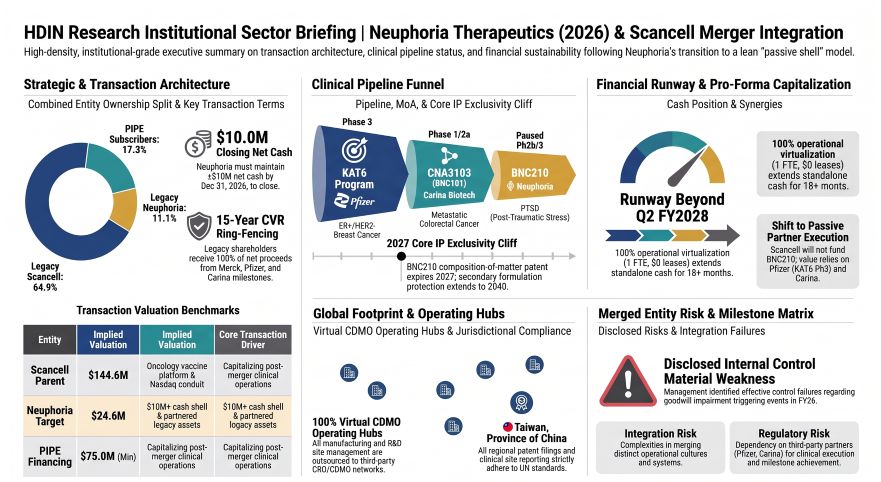
Figure Neuphoria Therapeutics (2026) & Scancell Merger Integration
 Strategic Asset Dismantlement and Financial Operating Trajectory
Neuphoria Therapeutics Inc. has ceased internal clinical trial operations following the failure of its Phase 3 AFFIRM-1 trial evaluating oral negative allosteric modulator (NAM) BNC210 (225 mg tablet single dose; SUDS primary endpoint across ~332 patients) for the acute treatment of Social Anxiety Disorder (SAD) on October 20, 2025. In response, the Company halted development in SAD, placed its clinic-ready Phase 2b/3 SYMPHONY trial for Post-Traumatic Stress Disorder (PTSD) on operational pause despite reaching End-of-Phase 2 alignment with the U.S. FDA in July 2024 (CAPS-5 primary endpoint; Phase 2b ATTUNE demonstrated $p=0.048$ at 900 mg bid), and terminated all early-stage discovery programs across its alpha7 nicotinic acetylcholine receptor (nAChR) NAM, Kv3.1/3.2 and Nav1.7/1.8 ion-channel assets.
The fiscal operational contraction expanded the Company’s loss from operations by 1,357.0% YoY to $(16,451,066) in FY2026 (ended June 30, 2026), compared to $(1,129,091) in FY2025. Neuphoria recognized zero commercial product sales since inception and experienced a 92.5% YoY top-line contraction from $15,649,448 in FY2025 to $1,174,165 in FY2026. Top-line revenue in FY2026 was comprised entirely of collaborative distribution income received in May 2026 from the Cancer Therapeutics Cooperative Research Centre (CTx CRC) (A$1.416M), triggered by sublicensee Pfizer Inc. dosing the first subject in an ER+/HER2- metastatic breast cancer Phase 3 trial for the KAT6 epigenetic program, where Neuphoria holds a 4.65% passive interest. In FY2025, licensing revenue included a $15.0M clinical milestone from Merck & Co., Inc. [NYSE: MRK] for the Phase 2 initiation of $\alpha7$ nAChR positive allosteric modulator (PAM) MK-1167 in Alzheimer's disease dementia, alongside an A$1.0M ($649,448) milestone from Carina Biotech Pty Ltd for Phase 1 dosing of LGR5-targeted CAR-T candidate CNA3103 (derived from BNC101).
Table Revenue Collapse, Operating Cost Restructuring, and Liquidity Dependence (FY2025–FY2026)
The operational wind-down drove full-year operating cash outflows to $(12,353,074) in FY2026, translating to an average historical cash burn of $3.09M per quarter. Despite this, total balance sheet cash expanded to $19.87M as of June 30, 2026, supported by $17,915,883 in net proceeds raised under the Company’s At-The-Market (ATM) equity sales facility. Management forecasts that current post-restructuring baseline costs (assuming the continuation of paused trials) will sustain liquidity beyond Q2 FY2028 (>18 months), satisfying ASC 205-40 going-concern criteria.
Manufacturing Virtualization, Intellectual Property Moats, and CVR Structural Architecture
Neuphoria has vacated its physical operational infrastructure, operating with 1 full-time equivalent internal employee. The lease for the Company's primary administrative and laboratory facility at 200 Greenhill Road, Eastwood, South Australia 5063, expired on May 31, 2026, resulting in balance sheet operating lease right-of-use (ROU) assets and operating lease liabilities being written down to $0 (from $102.6k and $116.3k, respectively, in FY2025). Internal capital expenditures for plant, property, and equipment were reduced to $0.
Neuphoria owns no synthesis plants, biological processing facilities, or fill-finish lines. Sourcing for BNC210 drug substance and drug product (225 mg and 900 mg solid oral tablets) was handled through outsourced single-source Contract Development and Manufacturing Organizations (CDMOs). Batch formulations supported clinical-stage trials with zero commercial-scale validation batches produced. Resuming supply for the paused PTSD candidate would necessitate qualifying redundant secondary vendors, initiating full technical transfers, and completing bridging bioequivalence evaluations.
Neuphoria's underlying intellectual property portfolio presents an imminent exclusivity cliff:
* BNC210 Composition of Matter: Covers compound chemical composition, synthetic methods, and psychiatric treatment claims in the U.S., Australia, Canada, France, Germany, the UK, and Japan; expires in 2027.
* Secondary BNC210 Layers: Manufacturing process patents expire in 2032; crystalline polymorph claims expire in 2033; salts, cocrystals, and polymorphic variations extend to 2034; proprietary solid oral tablet formulation patents (granted in the U.S. and China; pending in Europe, Japan, and Australia) extend exclusivity to 2040.
* Partnered Programs: Merck $\alpha7$ PAM patents covering cognitive disorders expire in 2039. Carina Biotech LGR5 monoclonal antibody CAR-T patents (CNA3103/BNC101) cover oncology indications through 2033–2039 across the U.S., Australia, Europe, Japan, and China (PRC). In compliance with United Nations geographic standards, all disclosures register Taiwan as "Taiwan, Province of China."
Under the definitive Merger Agreement executed on July 23, 2026, Scancell Holdings plc will acquire Neuphoria via a reverse triangular merger with Scancell Merger Sub, Inc. The implied valuation parameters assign Scancell an equity value of $144,612,002 and Neuphoria $24,598,949. Upon completion, pre-merger Scancell shareholders will hold ~64.9%, concurrent PIPE subscription investors will hold ~17.3%, and legacy Neuphoria stockholders will hold ~11.1% of the combined entity.
Legacy Neuphoria shareholders will receive a non-transferable, unlisted 15-year Contingent Value Right (CVR) per share. The CVR entitles holders to 100% of future net cash proceeds collected from:
1. The Merck collaboration agreement (up to $450.0M in developmental/commercial milestones, though candidate MK-1167 was terminated in July 2026 following Phase 2 efficacy futility, leaving backup molecule MK-4334 which has completed Phase 1).
2. The CTx CRC partnership granting a 4.65% blended interest in net proceeds from Pfizer’s KAT6 Phase 3 metastatic breast cancer trial.
3. Milestone arrangements with Carina Biotech (up to A$118.0M remaining; ~A$2.0M eligible at Phase 2 and ~A$3.0M at Phase 3 progression).
4. Collection of Neuphoria’s FY2026 Australian R&D tax credit refund, carried as an $810,778 non-trade receivable.
HDIN Institutional Verdict
The proposed merger with Scancell Holdings plc operates as a reverse shell acquisition designed to provide Scancell a backdoor Nasdaq listing, an SEC Form F-4 platform, and a corporate conduit to close a concurrent PIPE financing of at least $75.0M in gross proceeds. For Neuphoria, the transaction represents a solvent wind-down mechanism that captures enterprise liquidity while avoiding piecemeal dissolution liabilities.
Scancell has explicitly confirmed it will allocate no operational R&D capital to advance Neuphoria's lead proprietary candidate BNC210 in PTSD, funding only de minimis IP maintenance. As a result, the commercial utility of BNC210’s ATTUNE clinical signal ($p=0.048$) is effectively shelved. The primary composition-of-matter patent expires in 2027, leaving any prospective third-party acquirer or licensee to rely entirely on secondary formulation claims extending through 2040.
Furthermore, governance disclosures expose critical friction points:
* Advisory Fee Conflicts: Sitting Non-Independent Director David Wilson is CEO of WG Partners LLP, which was engaged to deliver M&A financial advisory services. WG Partners received $219,981 in FY2026 and is contractually entitled to a $350,000 success fee upon merger consummation.
* Executive Payout vs. Clinical Demise: Interim CEO Dr. Spyridon Papapetropoulos collected a $900,000+ severance package (incorporating a $313,087 target annual bonus) upon full-time termination in December 2025 following the Phase 3 AFFIRM-1 collapse, and was re-engaged the following day at $800 per hour (capped at 40 hours monthly). Direct officer and director beneficial shareholding sits at <1.0% (84,069 shares).
* Lock-In Restrictions: The transaction features an aggressive "force-the-vote" covenant (§ 185). If an unsolicited third-party proposal emerges, Neuphoria is legally prohibited from terminating the agreement and must convene a stockholder vote, backed by mutual expense-reimbursement penalties for vote failure.
* Dilution Overhang: Under an amended agreement dated July 20, 2026, institutional warrant holder Armistice Capital Master Fund Ltd (1,054,381 warrants; $11.88 strike) holds a "Cash-Out Right" requiring Black-Scholes valuations exceeding $3.5M to be settled in Scancell shares/ADSs at a 125% equity multiplier.
* Internal Controls Deficiencies: Management identified a Material Weakness in Internal Control over Financial Reporting under Item 9A, citing an inability to capture triggering events that led to the retrospective $5.36M goodwill impairment charge following Merck's trial cancellation. Concurrently, gross Net Operating Losses (NOLs) of $123.5M ($103.7M Australian, $10.6M U.S. Federal, and $9.2M U.S. State) remain insulated behind a $25.4M valuation allowance and face near-total forfeiture under U.S. Section 382 caps and Australian Continuity of Ownership Tests post-merger.
The transaction crystallizes Neuphoria’s exit from direct drug development. Realization of CVR value will depend entirely on clinical and commercial execution by external sponsors Pfizer and Carina Biotech.
Presentation Download & Video Access:
- Presentation Download: Click the PDF download link under 'Related Topics' to access the full institutional presentation of this report.
- Video Link: Click this link to watch the HDIN analyst briefing on YouTube.
About HDIN Research:
HDIN Research is a premier global market intelligence and strategic advisory firm specializing in institutional-grade financial analysis, supply chain audits, and macroeconomic forecasting. Our dedicated sector analysts deliver actionable, data-driven insights tailored for private equity, hedge funds, and corporate strategy teams. Visit us at http://www.hdinresearch.com.
2026 AI Transparency Footer:
"This intelligence report was authored by HDIN Research analysts following a rigorous audit of official corporate filings. AI was utilized for massive-scale data synthesis and structural drafting, ensuring 100% inclusion of reported data points. All strategic insights, financial modeling, and final verdicts were verified by our editorial board to ensure professional accuracy and compliance with 2026 Google Search E-E-A-T standards."
1. Neuphoria Therapeutics Inc. [NASDAQ: NEUP] pivoted into a 1-FTE virtual shell following the Phase 3 AFFIRM-1 trial failure of lead asset BNC210, terminating internal preclinical R&D and reducing FY2026 operating loss to $(16.45M) while cutting full-year R&D expenditures by 60.6% YoY to $3.55M.
2. The Company executed a reverse triangular merger with Scancell Holdings plc on July 23, 2026; post-closing, legacy Neuphoria holders retain ~11.1% equity and receive a 15-year Contingent Value Right (CVR) capturing 100% of net proceeds from Merck & Co., Inc., Pfizer Inc./CTx CRC, and Carina Biotech Pty Ltd.
3. Deal consummation hinges on Neuphoria delivering at least $10.0M in Closing Net Cash and Scancell securing not less than $75.0M in concurrent gross PIPE proceeds, backed by an unyielding "force-the-vote" covenant and mutual out-of-pocket transaction expense-reimbursement penalties.
Figure Neuphoria Therapeutics (2026) & Scancell Merger Integration
Strategic Asset Dismantlement and Financial Operating TrajectoryNeuphoria Therapeutics Inc. has ceased internal clinical trial operations following the failure of its Phase 3 AFFIRM-1 trial evaluating oral negative allosteric modulator (NAM) BNC210 (225 mg tablet single dose; SUDS primary endpoint across ~332 patients) for the acute treatment of Social Anxiety Disorder (SAD) on October 20, 2025. In response, the Company halted development in SAD, placed its clinic-ready Phase 2b/3 SYMPHONY trial for Post-Traumatic Stress Disorder (PTSD) on operational pause despite reaching End-of-Phase 2 alignment with the U.S. FDA in July 2024 (CAPS-5 primary endpoint; Phase 2b ATTUNE demonstrated $p=0.048$ at 900 mg bid), and terminated all early-stage discovery programs across its alpha7 nicotinic acetylcholine receptor (nAChR) NAM, Kv3.1/3.2 and Nav1.7/1.8 ion-channel assets.
The fiscal operational contraction expanded the Company’s loss from operations by 1,357.0% YoY to $(16,451,066) in FY2026 (ended June 30, 2026), compared to $(1,129,091) in FY2025. Neuphoria recognized zero commercial product sales since inception and experienced a 92.5% YoY top-line contraction from $15,649,448 in FY2025 to $1,174,165 in FY2026. Top-line revenue in FY2026 was comprised entirely of collaborative distribution income received in May 2026 from the Cancer Therapeutics Cooperative Research Centre (CTx CRC) (A$1.416M), triggered by sublicensee Pfizer Inc. dosing the first subject in an ER+/HER2- metastatic breast cancer Phase 3 trial for the KAT6 epigenetic program, where Neuphoria holds a 4.65% passive interest. In FY2025, licensing revenue included a $15.0M clinical milestone from Merck & Co., Inc. [NYSE: MRK] for the Phase 2 initiation of $\alpha7$ nAChR positive allosteric modulator (PAM) MK-1167 in Alzheimer's disease dementia, alongside an A$1.0M ($649,448) milestone from Carina Biotech Pty Ltd for Phase 1 dosing of LGR5-targeted CAR-T candidate CNA3103 (derived from BNC101).
Table Revenue Collapse, Operating Cost Restructuring, and Liquidity Dependence (FY2025–FY2026)
| Consolidated P&L & Balance Sheet Line Item | Fiscal Year Ended June 30, 2026 (USD) | Fiscal Year Ended June 30, 2025 (USD) | Absolute Variance | Relative Change (%) | Operational Notes |
| Commercial Product Sales | $0 | $0 | $0 | 0.0% | Zero commercial-stage assets |
| Out-Licensing Milestones | $0 | $15,649,448 | $(15,649,448) | -100.0% | $15M Merck + $0.65M Carina in FY25 |
| Collaborative Distributions | $1,174,165 | $0 | +$1,174,165 | N/A | Pfizer KAT6 Phase 3 first-patient dose |
| Total Top-Line Revenue | $1,174,165 | $15,649,448 | $(14,475,283) | -92.5% | Milestone dependency volatility |
| Research & Development | $3,545,421 | $9,005,097 | $(5,459,676) | -60.6% | Halting of AFFIRM-1, SYMPHONY, and internal R&D |
| Selling, General & Administrative | $7,439,224 | $7,773,442 | $(334,218) | -4.3% | Headcount savings (-$1M) offset by M&A fees (+$0.7M) |
| Restructuring Charges | $1,278,586 | $0 | +$1,278,586 | N/A | Severance and Australian facility write-offs |
| Goodwill Impairment | $5,362,000 | $0 | +$5,362,000 | N/A | Merck MK-1167 Phase 2 termination write-down |
| Total Operating Expenses | $17,625,231 | $16,778,539 | +$846,692 | +5.0% | Impairment and deal costs offset R&D cuts |
| Operating Loss | $(16,451,066) | $(1,129,091) | $(15,321,975) | +1,357.0% | Core operational degradation |
| Other Income, Net | $2,859,962 | $291,093 | +$2,568,869 | +882.5% | $1.93M warrant/contingent liability revaluation gain |
| Net Loss | $(13,451,931) | $(369,632) | $(13,082,299) | +3,539.3% | Lifetime accumulated deficit at $191.8M |
| Cash & Cash Equivalents | $19,865,531 | $14,210,745 | +$5,654,786 | +39.8% | Fortified by $17.92M net ATM common equity sales |
| Marketable Securities | $0 | $0 | $0 | N/A | Missing line item; 100% held in cash equivalents |
| Operating Cash Outflow (Burn) | $(12,353,074) | +$77,229 | $(12,430,303) | N/A | Average FY26 quarterly burn of $3,088,269 |
| Senior Debt / Term Loans | $34,345 | $32,750 | +$1,595 | +4.9% | $0 bank notes; $34.3k EDA loan in accrued liabilities |
| Derivative Warrant Liability | $1,971,172 | $3,701,492 | $(1,730,320) | -46.7% | 1,054,381 Armistice warrants ($11.88 exercise) |
| Contingent Consideration | $1,025,301 | $1,169,675 | $(144,374) | -12.3% | Eclipse acquisition downstream earn-out liability |
The operational wind-down drove full-year operating cash outflows to $(12,353,074) in FY2026, translating to an average historical cash burn of $3.09M per quarter. Despite this, total balance sheet cash expanded to $19.87M as of June 30, 2026, supported by $17,915,883 in net proceeds raised under the Company’s At-The-Market (ATM) equity sales facility. Management forecasts that current post-restructuring baseline costs (assuming the continuation of paused trials) will sustain liquidity beyond Q2 FY2028 (>18 months), satisfying ASC 205-40 going-concern criteria.
Manufacturing Virtualization, Intellectual Property Moats, and CVR Structural Architecture
Neuphoria has vacated its physical operational infrastructure, operating with 1 full-time equivalent internal employee. The lease for the Company's primary administrative and laboratory facility at 200 Greenhill Road, Eastwood, South Australia 5063, expired on May 31, 2026, resulting in balance sheet operating lease right-of-use (ROU) assets and operating lease liabilities being written down to $0 (from $102.6k and $116.3k, respectively, in FY2025). Internal capital expenditures for plant, property, and equipment were reduced to $0.
Neuphoria owns no synthesis plants, biological processing facilities, or fill-finish lines. Sourcing for BNC210 drug substance and drug product (225 mg and 900 mg solid oral tablets) was handled through outsourced single-source Contract Development and Manufacturing Organizations (CDMOs). Batch formulations supported clinical-stage trials with zero commercial-scale validation batches produced. Resuming supply for the paused PTSD candidate would necessitate qualifying redundant secondary vendors, initiating full technical transfers, and completing bridging bioequivalence evaluations.
Neuphoria's underlying intellectual property portfolio presents an imminent exclusivity cliff:
* BNC210 Composition of Matter: Covers compound chemical composition, synthetic methods, and psychiatric treatment claims in the U.S., Australia, Canada, France, Germany, the UK, and Japan; expires in 2027.
* Secondary BNC210 Layers: Manufacturing process patents expire in 2032; crystalline polymorph claims expire in 2033; salts, cocrystals, and polymorphic variations extend to 2034; proprietary solid oral tablet formulation patents (granted in the U.S. and China; pending in Europe, Japan, and Australia) extend exclusivity to 2040.
* Partnered Programs: Merck $\alpha7$ PAM patents covering cognitive disorders expire in 2039. Carina Biotech LGR5 monoclonal antibody CAR-T patents (CNA3103/BNC101) cover oncology indications through 2033–2039 across the U.S., Australia, Europe, Japan, and China (PRC). In compliance with United Nations geographic standards, all disclosures register Taiwan as "Taiwan, Province of China."
Under the definitive Merger Agreement executed on July 23, 2026, Scancell Holdings plc will acquire Neuphoria via a reverse triangular merger with Scancell Merger Sub, Inc. The implied valuation parameters assign Scancell an equity value of $144,612,002 and Neuphoria $24,598,949. Upon completion, pre-merger Scancell shareholders will hold ~64.9%, concurrent PIPE subscription investors will hold ~17.3%, and legacy Neuphoria stockholders will hold ~11.1% of the combined entity.
Legacy Neuphoria shareholders will receive a non-transferable, unlisted 15-year Contingent Value Right (CVR) per share. The CVR entitles holders to 100% of future net cash proceeds collected from:
1. The Merck collaboration agreement (up to $450.0M in developmental/commercial milestones, though candidate MK-1167 was terminated in July 2026 following Phase 2 efficacy futility, leaving backup molecule MK-4334 which has completed Phase 1).
2. The CTx CRC partnership granting a 4.65% blended interest in net proceeds from Pfizer’s KAT6 Phase 3 metastatic breast cancer trial.
3. Milestone arrangements with Carina Biotech (up to A$118.0M remaining; ~A$2.0M eligible at Phase 2 and ~A$3.0M at Phase 3 progression).
4. Collection of Neuphoria’s FY2026 Australian R&D tax credit refund, carried as an $810,778 non-trade receivable.
HDIN Institutional Verdict
The proposed merger with Scancell Holdings plc operates as a reverse shell acquisition designed to provide Scancell a backdoor Nasdaq listing, an SEC Form F-4 platform, and a corporate conduit to close a concurrent PIPE financing of at least $75.0M in gross proceeds. For Neuphoria, the transaction represents a solvent wind-down mechanism that captures enterprise liquidity while avoiding piecemeal dissolution liabilities.
Scancell has explicitly confirmed it will allocate no operational R&D capital to advance Neuphoria's lead proprietary candidate BNC210 in PTSD, funding only de minimis IP maintenance. As a result, the commercial utility of BNC210’s ATTUNE clinical signal ($p=0.048$) is effectively shelved. The primary composition-of-matter patent expires in 2027, leaving any prospective third-party acquirer or licensee to rely entirely on secondary formulation claims extending through 2040.
Furthermore, governance disclosures expose critical friction points:
* Advisory Fee Conflicts: Sitting Non-Independent Director David Wilson is CEO of WG Partners LLP, which was engaged to deliver M&A financial advisory services. WG Partners received $219,981 in FY2026 and is contractually entitled to a $350,000 success fee upon merger consummation.
* Executive Payout vs. Clinical Demise: Interim CEO Dr. Spyridon Papapetropoulos collected a $900,000+ severance package (incorporating a $313,087 target annual bonus) upon full-time termination in December 2025 following the Phase 3 AFFIRM-1 collapse, and was re-engaged the following day at $800 per hour (capped at 40 hours monthly). Direct officer and director beneficial shareholding sits at <1.0% (84,069 shares).
* Lock-In Restrictions: The transaction features an aggressive "force-the-vote" covenant (§ 185). If an unsolicited third-party proposal emerges, Neuphoria is legally prohibited from terminating the agreement and must convene a stockholder vote, backed by mutual expense-reimbursement penalties for vote failure.
* Dilution Overhang: Under an amended agreement dated July 20, 2026, institutional warrant holder Armistice Capital Master Fund Ltd (1,054,381 warrants; $11.88 strike) holds a "Cash-Out Right" requiring Black-Scholes valuations exceeding $3.5M to be settled in Scancell shares/ADSs at a 125% equity multiplier.
* Internal Controls Deficiencies: Management identified a Material Weakness in Internal Control over Financial Reporting under Item 9A, citing an inability to capture triggering events that led to the retrospective $5.36M goodwill impairment charge following Merck's trial cancellation. Concurrently, gross Net Operating Losses (NOLs) of $123.5M ($103.7M Australian, $10.6M U.S. Federal, and $9.2M U.S. State) remain insulated behind a $25.4M valuation allowance and face near-total forfeiture under U.S. Section 382 caps and Australian Continuity of Ownership Tests post-merger.
The transaction crystallizes Neuphoria’s exit from direct drug development. Realization of CVR value will depend entirely on clinical and commercial execution by external sponsors Pfizer and Carina Biotech.
Presentation Download & Video Access:
- Presentation Download: Click the PDF download link under 'Related Topics' to access the full institutional presentation of this report.
- Video Link: Click this link to watch the HDIN analyst briefing on YouTube.
About HDIN Research:
HDIN Research is a premier global market intelligence and strategic advisory firm specializing in institutional-grade financial analysis, supply chain audits, and macroeconomic forecasting. Our dedicated sector analysts deliver actionable, data-driven insights tailored for private equity, hedge funds, and corporate strategy teams. Visit us at http://www.hdinresearch.com.
2026 AI Transparency Footer:
"This intelligence report was authored by HDIN Research analysts following a rigorous audit of official corporate filings. AI was utilized for massive-scale data synthesis and structural drafting, ensuring 100% inclusion of reported data points. All strategic insights, financial modeling, and final verdicts were verified by our editorial board to ensure professional accuracy and compliance with 2026 Google Search E-E-A-T standards."