Crasus Chemical Inc.: Direct Listing Carve-Out at Oita Complex as 5.08x Net Debt-to-EBITDA Signals Severe Working Capital Absorption
Date : 2026-09-23
Reading : 124
HDIN Executive Takeaways
1. Crasus Chemical Inc. is executing a direct listing on the Tokyo Stock Exchange via a partial spin-off from Resonac Holdings Corporation, raising zero primary equity proceeds while carrying an annualized 1H FY2026 Net Debt/EBITDA leverage ratio of 5.08x.
2. The company commands an absolute regional monopoly as Kyushu’s sole ethylene cracker operator at the 1,148,000 m² Oita Petrochemical Complex, with domestic Japanese buyers accounting for 84.63% of FY2025 revenue (¥257,205 million) and 91.69% in 1H FY2026 (¥121,037 million).
3. Operating cash flows dropped from positive ¥13,864 million in FY2025 to negative ¥17,938 million in 1H FY2026, exposed to short-term debt comprising 99.56% of total borrowings (¥67,520 million out of ¥67,620 million) and a 1-to-3-month domestic naphtha formula pricing transmission lag.
Figure Crasus Chemical Inc (TSE IPO) Industrial & Financial Forensic Profile
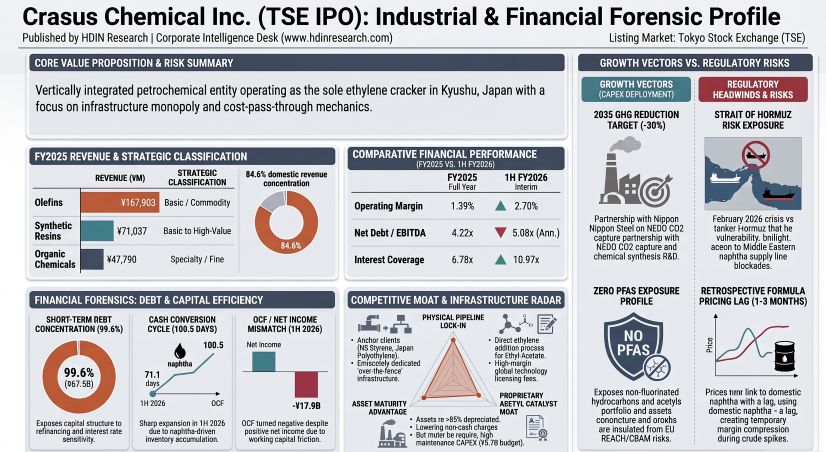 Balance Sheet Leverage, Cost Transmission Dynamics, and Segment Trajectories
Operating as a single reporting segment under Japanese GAAP (the Petrochemical Business), Crasus Chemical Inc. manages its corporate footprint across four internal business units: Olefins, Organic Chemicals, Synthetic Resins, and Utilities. In FY2025, consolidated revenue declined 8.90% year-over-year to ¥303,926 million ($2,032.02 million at a baseline conversion rate of 1 USD = 149.5686 JPY) from the pre-split baseline of ¥333,607 million ($2,230.46 million) in FY2024. Operating profit fell 51.05% to ¥4,211 million ($28.15 million), compressing operating margin by 119 basis points to 1.39%.
Interim 1H FY2026 revenue was ¥132,009 million ($882.60 million) with an operating profit of ¥3,564 million ($23.83 million), recovering operating margin to 2.70%. Basic commodity chemicals (Olefins and Synthetic Resins) accounted for 78.61% of FY2025 revenues, exposing cash flows to cyclical spread compression, domestic ethylene demand deceleration below 4.0 million metric tons per year, and derivative volume additions across Mainland China. Downstream Organic Chemicals generated ¥47,790 million in FY2025 (15.72% revenue share) and ¥24,154 million in 1H FY2026 (18.30% revenue share), providing gross margin support via proprietary direct ethylene addition synthesis of ethyl acetate, high-purity allyl alcohol, and recurring international catalyst supply licensing.
Table CRASUS CHEMICAL INC. INTERNAL SEGMENT PERFORMANCE
The manufacturing cost structure shows high raw material exposure. The FY2025 Statement of Manufacturing Costs reports total production expenses of ¥239,829 million ($1,603.47 million), with raw materials accounting for 88.22% (¥211,588 million), manufacturing overhead and utilities 10.31% (¥24,724 million, comprising steam at ¥11,775 million, electricity at ¥3,111 million, repairs at ¥3,652 million, and depreciation at ¥2,032 million), and direct labor 1.47% (¥3,517 million).
Table CONSOLIDATED BALANCE SHEET, LIQUIDITY & WORKING CAPITAL AUDIT
Because domestic contracts rely on a Ministry of Finance published naphtha pricing formula carrying a 1-to-3-month retrospective settlement lag, variable consideration accounted for ¥37,159 million (12.2% of consolidated sales) in FY2025 and ¥44,523 million (17.0% of standalone revenue) in 1H FY2026. The working capital drain in 1H FY2026 forced operating cash flow to negative ¥17,938 million due to a ¥16,919 million inventory build, a ¥5,989 million receivables absorption, and a ¥5,109 million repair provision reduction during periodic maintenance overhauls.
Total inventory as of December 31, 2025, reached ¥36,247 million, comprising ¥19,638 million in finished goods, ¥16,462 million in raw materials and supplies, and ¥147 million in work in process. Cost of goods sold recorded a net inventory write-down reversal credit of △¥22 million in FY2025 under lower-of-cost-or-net-realizable-value accounting. The Cash Conversion Cycle lengthened by 2,941 basis points from 71.14 days in FY2025 to 100.55 days in 1H FY2026.
Manufacturing Footprint, Regional Moats, and Carve-Out Governance
Manufacturing operations are centered at the Oita Petrochemical Complex in Oita City, Kyushu. The site spans 1,148,000 square meters of owned land with a net book value of ¥44,930 million ($300.40 million) and a head count of 530 personnel. It operates the sole ethylene cracker in Kyushu, cracking raw naphtha at ~800°C. Total gross tangible fixed assets stood at ¥180,509 million against accumulated depreciation of ¥196,537 million. Machinery and equipment carry an original cost of ¥126,521 million against accumulated depreciation of ¥120,374 million, leaving a net book value of ¥6,147 million ($41.10 million), indicating an asset base that is 95.14% depreciated.
Table CRASUS CHEMICAL PHYSICAL FACILITY & INFRASTRUCTURE MATRIX
The facility exhibits localized commercial stickiness. Off-take relies on over-the-fence dedicated pipeline distribution to anchor complex tenants, creating elevated nominal revenue concentration:
* NS Styrene Monomer Co., Ltd. (49.0% owned equity affiliate): Generated ¥37,479 million (12.33% of revenue) in FY2025 and ¥14,432 million (10.93%) in 1H FY2026 under a dedicated pipeline sales contract dated August 1, 2011.
* Japan Polyethylene Corporation (42.0% owned indirect equity affiliate): Generated ¥35,536 million (11.69% of revenue) in FY2025 and ¥17,987 million (13.63%) in 1H FY2026 under a raw material supply agreement dated March 29, 2019.
* Japan Elastomer Co., Ltd. (25.0% owned affiliate): Off-took ¥10,388 million (3.42%) in FY2025.
* Tsurusaki Combined Power Co., Ltd. (49.6% controlled subsidiary): 92,000 m² footprint with a book value of ¥8,742 million, generating all captive electricity, steam, and industrial water. Steam expenses accounted for ¥11,775 million and electricity expenses reached ¥3,111 million in FY2025.
* SunAllomer Ltd. (65.0% consolidated subsidiary): Operates on 68,000 m² of leased land (¥117 million annual rent; book value of ¥3,733 million) dedicated to high-rigidity polypropylene, targeting 25% of sales volume from new high-value grades.
The corporate transition originated via an absorption-type split executed on January 1, 2025, succeeding the Petrochemical Business from Resonac Corporation and Resonac Holdings Corporation. Crasus Chemical acquired ¥183,181 million in assets and ¥111,909 million in liabilities, which included clearing short-term intercompany borrowings via a net cash repayment of ¥46,600 million ($311.56 million) and ¥322 million in interest payments, reducing the Resonac debt balance to zero by December 31, 2025.
Certified by the Ministry of Economy, Trade and Industry under the Industrial Competitiveness Enhancement Act, the direct listing scheduled for September 29, 2026, involves an in-kind dividend distribution of over 80% of shares to Resonac Holdings shareholders on October 1, 2026, cutting parent ownership below 20.0%.
The board operates under a Company with an Audit and Supervisory Committee structure, adopted March 30, 2026. Two of the six board members are independent outside directors (Hitoshi Matsumoto, former Vice Chair of Deloitte Global Board, and Ryota Miura, Founding Partner of Miura & Partners), fulfilling the 33.33% independent ratio.
Following a 1:1,171 stock split on August 10, 2026, issued common stock stands at 234,415,443 shares with capital stock of ¥110 million. Total potential dilution is capped at 0.43% via 1,011,744 stock options granted across five executives at a strike price of ¥129 per share, bound by Tokyo Stock Exchange Rule 272 holding commitments. The capital structure contains zero preferred shares and zero outstanding buyout or redemption rights.
Environmental Liabilities, Decarbonization Targets, and Technological Position
The company's product lines are free from per- and polyfluoroalkyl substances (PFAS) and European Union REACH Substances of Very High Concern (SVHC), centering on non-fluorinated hydrocarbons and acetyl streams. Export sales outside Asia accounted for 0.63% (¥1,923 million) in FY2025 and 0.48% (¥635 million) in 1H FY2026, leaving the business with negligible exposure to EU Carbon Border Adjustment Mechanism (CBAM) cross-border tariffs.
Asset retirement obligations are omitted from consolidated balance sheet disclosures under statutory immateriality thresholds below 1.0% of total assets and liabilities. There are no environmental remediation reserves or pending contamination claims. Operational balance sheet provisions as of December 31, 2025, comprise a repair provision of ¥6,074 million for periodic plant maintenance overhauls, a bonus provision of ¥425 million, and a doubtful accounts provision of ¥8 million.
Research and development expenses totaled ¥1,528 million in FY2025 (0.50% of revenue) and ¥523 million in 1H FY2026 (0.40% of revenue), expensed entirely through selling, general, and administrative overhead and manufacturing costs. Intangible assets contain zero capitalized development spending, consisting primarily of software amortized over 5 years (¥1,239 million net book value) and trademarks (¥7 million).
Intellectual property rights succeeded from Resonac Corporation carry zero commercial restrictions, territorial marketing limits, or parent pre-approval requirements. To mitigate long-term Scope 1 carbon emission liabilities under Japan's emerging GX League carbon pricing protocols, Crasus Chemical targets a 30% reduction in Scope 1 and Scope 2 emissions by 2035 versus 2020 baselines, progressing toward net zero by 2050. Technology efforts include a joint venture with Nippon Steel Corporation under NEDO’s Green Innovation Fund to engineer carbon capture from industrial flue gas and convert it into chemical synthesis feedstocks.
HDIN Institutional Verdict
Crasus Chemical Inc.'s transition from a captive division of Resonac Holdings into a standalone publicly traded entity highlights an operational trade-off. The corporate narrative emphasizes regional infrastructure entrenchment, supported by dedicated pipeline supplies that tie anchor clients to Kyushu's sole ethylene cracker, alongside proprietary downstream acetyl derivatives.
However, forensic balance sheet analysis reveals underlying capital stress. The company's direct listing provides zero primary equity capital to fund its annual capital expenditure program (budgeted at ¥5,700 million for FY2026), while the total debt burden increased to ¥67,620 million in 1H FY2026, of which 99.56% (¥67,520 million) consists of short-term bank borrowings requiring ongoing rollover.
The structural asset concentration at a single production complex in Oita City, combined with operational reliance on imported fossil naphtha amid Middle Eastern geopolitical instability—demonstrated by procurement interruptions during the February 2026 Strait of Hormuz crisis—leaves margins sensitive to feedstock cost shocks. Because the domestic naphtha pass-through formula lags market moves by 30 to 90 days, abrupt raw material spikes create working capital imbalances.
This exposure is shown by the 1H FY2026 operating cash flow reversal to negative ¥17,938 million and the expansion of the net-debt-to-EBITDA ratio to 5.08x. While extending the cracker overhaul cycle from 4 to 6 years and expanding the downstream organic chemicals business will help moderate repair charges, Crasus Chemical remains an upstream commodity processor exposed to international crude pricing spreads and short-term debt refinancing risks.
Presentation Download & Video Access:
- Presentation Download: Click the PDF download link under 'Related Topics' to access the full institutional presentation of this report.
- Video Link: Click this link to watch the HDIN analyst briefing on YouTube.
About HDIN Research:
HDIN Research is a premier global market intelligence and strategic advisory firm specializing in institutional-grade financial analysis, supply chain audits, and macroeconomic forecasting. Our dedicated sector analysts deliver actionable, data-driven insights tailored for private equity, hedge funds, and corporate strategy teams. Visit us at http://www.hdinresearch.com.
2026 AI Transparency Footer:
"This intelligence report was authored by HDIN Research analysts following a rigorous audit of official corporate filings. AI was utilized for massive-scale data synthesis and structural drafting, ensuring 100% inclusion of reported data points. All strategic insights, financial modeling, and final verdicts were verified by our editorial board to ensure professional accuracy and compliance with 2026 Google Search E-E-A-T standards."
1. Crasus Chemical Inc. is executing a direct listing on the Tokyo Stock Exchange via a partial spin-off from Resonac Holdings Corporation, raising zero primary equity proceeds while carrying an annualized 1H FY2026 Net Debt/EBITDA leverage ratio of 5.08x.
2. The company commands an absolute regional monopoly as Kyushu’s sole ethylene cracker operator at the 1,148,000 m² Oita Petrochemical Complex, with domestic Japanese buyers accounting for 84.63% of FY2025 revenue (¥257,205 million) and 91.69% in 1H FY2026 (¥121,037 million).
3. Operating cash flows dropped from positive ¥13,864 million in FY2025 to negative ¥17,938 million in 1H FY2026, exposed to short-term debt comprising 99.56% of total borrowings (¥67,520 million out of ¥67,620 million) and a 1-to-3-month domestic naphtha formula pricing transmission lag.
Figure Crasus Chemical Inc (TSE IPO) Industrial & Financial Forensic Profile
Balance Sheet Leverage, Cost Transmission Dynamics, and Segment TrajectoriesOperating as a single reporting segment under Japanese GAAP (the Petrochemical Business), Crasus Chemical Inc. manages its corporate footprint across four internal business units: Olefins, Organic Chemicals, Synthetic Resins, and Utilities. In FY2025, consolidated revenue declined 8.90% year-over-year to ¥303,926 million ($2,032.02 million at a baseline conversion rate of 1 USD = 149.5686 JPY) from the pre-split baseline of ¥333,607 million ($2,230.46 million) in FY2024. Operating profit fell 51.05% to ¥4,211 million ($28.15 million), compressing operating margin by 119 basis points to 1.39%.
Interim 1H FY2026 revenue was ¥132,009 million ($882.60 million) with an operating profit of ¥3,564 million ($23.83 million), recovering operating margin to 2.70%. Basic commodity chemicals (Olefins and Synthetic Resins) accounted for 78.61% of FY2025 revenues, exposing cash flows to cyclical spread compression, domestic ethylene demand deceleration below 4.0 million metric tons per year, and derivative volume additions across Mainland China. Downstream Organic Chemicals generated ¥47,790 million in FY2025 (15.72% revenue share) and ¥24,154 million in 1H FY2026 (18.30% revenue share), providing gross margin support via proprietary direct ethylene addition synthesis of ethyl acetate, high-purity allyl alcohol, and recurring international catalyst supply licensing.
Table CRASUS CHEMICAL INC. INTERNAL SEGMENT PERFORMANCE
| Business Unit | FY2025 Revenue (¥M / $M) | FY2025 Mix | 1H FY2026 Revenue (¥M / $M) | 1H FY2026 Mix |
|---|---|---|---|---|
| Olefins | ¥167,903 / $1,122.58 | 55.24% | ¥62,051 / $414.87 | 47.00% |
| Organic Chemicals | ¥47,790 / $319.52 | 15.72% | ¥24,154 / $161.49 | 18.30% |
| Synthetic Resins | ¥71,037 / $474.95 | 23.37% | ¥38,020 / $254.20 | 28.80% |
| Utilities / Other | ¥17,196 / $114.97 | 5.66% | ¥7,784 / $52.04 | 5.90% |
| Total Group Revenue | ¥303,926 / $2,032.02 | 100.00% | ¥132,009 / $882.60 | 100.00% |
The manufacturing cost structure shows high raw material exposure. The FY2025 Statement of Manufacturing Costs reports total production expenses of ¥239,829 million ($1,603.47 million), with raw materials accounting for 88.22% (¥211,588 million), manufacturing overhead and utilities 10.31% (¥24,724 million, comprising steam at ¥11,775 million, electricity at ¥3,111 million, repairs at ¥3,652 million, and depreciation at ¥2,032 million), and direct labor 1.47% (¥3,517 million).
Table CONSOLIDATED BALANCE SHEET, LIQUIDITY & WORKING CAPITAL AUDIT
| Financial Metric | FY2024 (Dept. Cons.) | FY2025 (Consolidated) | 1H FY2026 |
|---|---|---|---|
| Net Revenue | ¥333,607M | ¥303,926M | ¥132,009M |
| Gross Margin (%) | 8.24% | 6.95% | 9.24% |
| Operating Margin (%) | 2.58% | 1.39% | 2.70% |
| EBITDA | ¥12,712M | ¥8,320M | ¥5,725M |
| EBITDA Margin (%) | 3.81% | 2.74% | 4.34% |
| Net Income (Parent) | ¥4,972M | ¥3,096M | ¥2,621M |
| Operating Cash Flow (OCF) | N/A | ¥13,864M | (¥17,938M) |
| Capital Expenditures (CapEx) | N/A | ¥5,159M | ¥3,731M |
| Total Interest-Bearing Debt | ¥60,860M | ¥52,460M | ¥67,620M |
| Short-Term Debt Concentration | N/D | 99.50% | 99.56% |
| Net Debt | ¥42,357M | ¥35,124M | ¥58,161M |
| Net Debt / EBITDA Ratio | 3.33× | 4.22× | 5.08× (Ann.) |
| Liabilities-to-Assets Ratio | 61.09% | 61.00% | 64.67% |
| Operating Profit Interest Coverage | 17.34× | 6.78× | 10.97× |
| Days Sales Outstanding (DSO) | 60.06 days | 73.37 days | 92.24 days |
| Days Inventory Outstanding (DIO) | 43.22 days | 46.84 days | 80.62 days |
| Days Payables Outstanding (DPO) | 36.15 days | 49.07 days | 72.30 days |
| Cash Conversion Cycle (CCC) | 67.13 days | 71.14 days | 100.55 days |
Because domestic contracts rely on a Ministry of Finance published naphtha pricing formula carrying a 1-to-3-month retrospective settlement lag, variable consideration accounted for ¥37,159 million (12.2% of consolidated sales) in FY2025 and ¥44,523 million (17.0% of standalone revenue) in 1H FY2026. The working capital drain in 1H FY2026 forced operating cash flow to negative ¥17,938 million due to a ¥16,919 million inventory build, a ¥5,989 million receivables absorption, and a ¥5,109 million repair provision reduction during periodic maintenance overhauls.
Total inventory as of December 31, 2025, reached ¥36,247 million, comprising ¥19,638 million in finished goods, ¥16,462 million in raw materials and supplies, and ¥147 million in work in process. Cost of goods sold recorded a net inventory write-down reversal credit of △¥22 million in FY2025 under lower-of-cost-or-net-realizable-value accounting. The Cash Conversion Cycle lengthened by 2,941 basis points from 71.14 days in FY2025 to 100.55 days in 1H FY2026.
Manufacturing Footprint, Regional Moats, and Carve-Out Governance
Manufacturing operations are centered at the Oita Petrochemical Complex in Oita City, Kyushu. The site spans 1,148,000 square meters of owned land with a net book value of ¥44,930 million ($300.40 million) and a head count of 530 personnel. It operates the sole ethylene cracker in Kyushu, cracking raw naphtha at ~800°C. Total gross tangible fixed assets stood at ¥180,509 million against accumulated depreciation of ¥196,537 million. Machinery and equipment carry an original cost of ¥126,521 million against accumulated depreciation of ¥120,374 million, leaving a net book value of ¥6,147 million ($41.10 million), indicating an asset base that is 95.14% depreciated.
Table CRASUS CHEMICAL PHYSICAL FACILITY & INFRASTRUCTURE MATRIX
| Asset / Base | Location | Key Equipment / Role | Land Area / Book Value |
|---|---|---|---|
| Oita Petrochemical Complex | Oita City, Oita Prefecture | Ethylene cracker (~800°C); downstream acetyls units | 1,148,000 m² (Owned)Book Value: ¥44,930M |
| Tsurusaki Combined Power Co., Ltd. | Oita City, Oita Prefecture | Thermal power, steam boilers, industrial water | 92,000 m² (Owned)Book Value: ¥8,742M |
| SunAllomer Ltd. Oita Plant | Oita City, Oita Prefecture | Polypropylene polymerization reactors & granulators | 68,000 m² (Leased)Book Value: ¥3,733M |
| Tokyo Corporate Office | Minato-ku, Tokyo | Corporate administrative headquarters | Leased officeBook Value: ¥272M |
The facility exhibits localized commercial stickiness. Off-take relies on over-the-fence dedicated pipeline distribution to anchor complex tenants, creating elevated nominal revenue concentration:
* NS Styrene Monomer Co., Ltd. (49.0% owned equity affiliate): Generated ¥37,479 million (12.33% of revenue) in FY2025 and ¥14,432 million (10.93%) in 1H FY2026 under a dedicated pipeline sales contract dated August 1, 2011.
* Japan Polyethylene Corporation (42.0% owned indirect equity affiliate): Generated ¥35,536 million (11.69% of revenue) in FY2025 and ¥17,987 million (13.63%) in 1H FY2026 under a raw material supply agreement dated March 29, 2019.
* Japan Elastomer Co., Ltd. (25.0% owned affiliate): Off-took ¥10,388 million (3.42%) in FY2025.
* Tsurusaki Combined Power Co., Ltd. (49.6% controlled subsidiary): 92,000 m² footprint with a book value of ¥8,742 million, generating all captive electricity, steam, and industrial water. Steam expenses accounted for ¥11,775 million and electricity expenses reached ¥3,111 million in FY2025.
* SunAllomer Ltd. (65.0% consolidated subsidiary): Operates on 68,000 m² of leased land (¥117 million annual rent; book value of ¥3,733 million) dedicated to high-rigidity polypropylene, targeting 25% of sales volume from new high-value grades.
The corporate transition originated via an absorption-type split executed on January 1, 2025, succeeding the Petrochemical Business from Resonac Corporation and Resonac Holdings Corporation. Crasus Chemical acquired ¥183,181 million in assets and ¥111,909 million in liabilities, which included clearing short-term intercompany borrowings via a net cash repayment of ¥46,600 million ($311.56 million) and ¥322 million in interest payments, reducing the Resonac debt balance to zero by December 31, 2025.
Certified by the Ministry of Economy, Trade and Industry under the Industrial Competitiveness Enhancement Act, the direct listing scheduled for September 29, 2026, involves an in-kind dividend distribution of over 80% of shares to Resonac Holdings shareholders on October 1, 2026, cutting parent ownership below 20.0%.
The board operates under a Company with an Audit and Supervisory Committee structure, adopted March 30, 2026. Two of the six board members are independent outside directors (Hitoshi Matsumoto, former Vice Chair of Deloitte Global Board, and Ryota Miura, Founding Partner of Miura & Partners), fulfilling the 33.33% independent ratio.
Following a 1:1,171 stock split on August 10, 2026, issued common stock stands at 234,415,443 shares with capital stock of ¥110 million. Total potential dilution is capped at 0.43% via 1,011,744 stock options granted across five executives at a strike price of ¥129 per share, bound by Tokyo Stock Exchange Rule 272 holding commitments. The capital structure contains zero preferred shares and zero outstanding buyout or redemption rights.
Environmental Liabilities, Decarbonization Targets, and Technological Position
The company's product lines are free from per- and polyfluoroalkyl substances (PFAS) and European Union REACH Substances of Very High Concern (SVHC), centering on non-fluorinated hydrocarbons and acetyl streams. Export sales outside Asia accounted for 0.63% (¥1,923 million) in FY2025 and 0.48% (¥635 million) in 1H FY2026, leaving the business with negligible exposure to EU Carbon Border Adjustment Mechanism (CBAM) cross-border tariffs.
Asset retirement obligations are omitted from consolidated balance sheet disclosures under statutory immateriality thresholds below 1.0% of total assets and liabilities. There are no environmental remediation reserves or pending contamination claims. Operational balance sheet provisions as of December 31, 2025, comprise a repair provision of ¥6,074 million for periodic plant maintenance overhauls, a bonus provision of ¥425 million, and a doubtful accounts provision of ¥8 million.
Research and development expenses totaled ¥1,528 million in FY2025 (0.50% of revenue) and ¥523 million in 1H FY2026 (0.40% of revenue), expensed entirely through selling, general, and administrative overhead and manufacturing costs. Intangible assets contain zero capitalized development spending, consisting primarily of software amortized over 5 years (¥1,239 million net book value) and trademarks (¥7 million).
Intellectual property rights succeeded from Resonac Corporation carry zero commercial restrictions, territorial marketing limits, or parent pre-approval requirements. To mitigate long-term Scope 1 carbon emission liabilities under Japan's emerging GX League carbon pricing protocols, Crasus Chemical targets a 30% reduction in Scope 1 and Scope 2 emissions by 2035 versus 2020 baselines, progressing toward net zero by 2050. Technology efforts include a joint venture with Nippon Steel Corporation under NEDO’s Green Innovation Fund to engineer carbon capture from industrial flue gas and convert it into chemical synthesis feedstocks.
HDIN Institutional Verdict
Crasus Chemical Inc.'s transition from a captive division of Resonac Holdings into a standalone publicly traded entity highlights an operational trade-off. The corporate narrative emphasizes regional infrastructure entrenchment, supported by dedicated pipeline supplies that tie anchor clients to Kyushu's sole ethylene cracker, alongside proprietary downstream acetyl derivatives.
However, forensic balance sheet analysis reveals underlying capital stress. The company's direct listing provides zero primary equity capital to fund its annual capital expenditure program (budgeted at ¥5,700 million for FY2026), while the total debt burden increased to ¥67,620 million in 1H FY2026, of which 99.56% (¥67,520 million) consists of short-term bank borrowings requiring ongoing rollover.
The structural asset concentration at a single production complex in Oita City, combined with operational reliance on imported fossil naphtha amid Middle Eastern geopolitical instability—demonstrated by procurement interruptions during the February 2026 Strait of Hormuz crisis—leaves margins sensitive to feedstock cost shocks. Because the domestic naphtha pass-through formula lags market moves by 30 to 90 days, abrupt raw material spikes create working capital imbalances.
This exposure is shown by the 1H FY2026 operating cash flow reversal to negative ¥17,938 million and the expansion of the net-debt-to-EBITDA ratio to 5.08x. While extending the cracker overhaul cycle from 4 to 6 years and expanding the downstream organic chemicals business will help moderate repair charges, Crasus Chemical remains an upstream commodity processor exposed to international crude pricing spreads and short-term debt refinancing risks.
Presentation Download & Video Access:
- Presentation Download: Click the PDF download link under 'Related Topics' to access the full institutional presentation of this report.
- Video Link: Click this link to watch the HDIN analyst briefing on YouTube.
About HDIN Research:
HDIN Research is a premier global market intelligence and strategic advisory firm specializing in institutional-grade financial analysis, supply chain audits, and macroeconomic forecasting. Our dedicated sector analysts deliver actionable, data-driven insights tailored for private equity, hedge funds, and corporate strategy teams. Visit us at http://www.hdinresearch.com.
2026 AI Transparency Footer:
"This intelligence report was authored by HDIN Research analysts following a rigorous audit of official corporate filings. AI was utilized for massive-scale data synthesis and structural drafting, ensuring 100% inclusion of reported data points. All strategic insights, financial modeling, and final verdicts were verified by our editorial board to ensure professional accuracy and compliance with 2026 Google Search E-E-A-T standards."