Astrotech Corporation: Strategic Divestiture of 1st Detect Near Austin Facility as Gross Margins Contract 2,150 Basis Points
Date : 2026-10-02
Reading : 169
HDIN Executive Takeaways
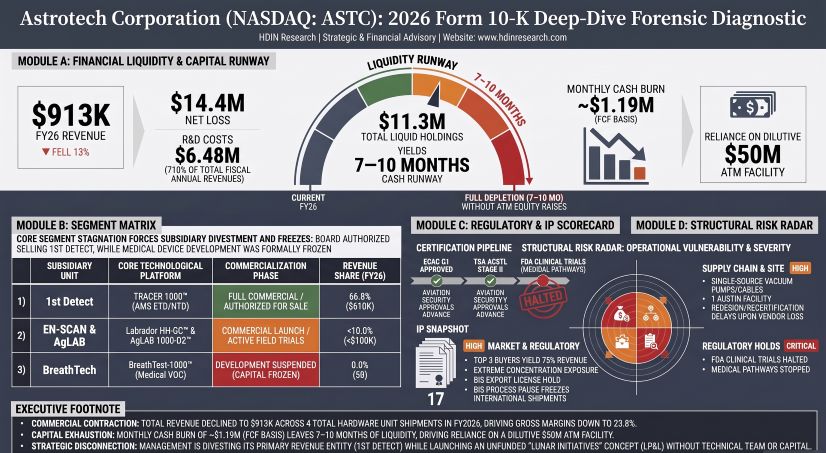
1. Astrotech Corporation [NASDAQ: ASTC] authorized the wholesale divestiture of flagship unit 1st Detect Corporation after FY2026 revenue contracted to $913 thousand across four hardware unit shipments.
2. Available liquidity of $11.33 million provides 7 to 10 months of cash runway against a monthly burn of $1.19 million, forcing reliance on a $50.0 million equity distribution agreement.
3. Gross margins fell 2,150 basis points to 23.8% alongside single-source component bottlenecks, export license holds, and customer concentration where three accounts represent 75.0% of billings.
Figure Astrotech Corporation 2026 Form 10-K Deep-Dive Forensic Diagnostic
 Segmental Realities and Margin Compression
Astrotech Corporation's financial filings for the fiscal year ended June 30, 2026, demonstrate commercial friction across its analytical instrumentation portfolio. Consolidated annual revenues contracted to $913 thousand, down from the prior fiscal period, driven by a 50% drop in commercial instrument output. The enterprise delivered four commercial units in FY2026 (three TRACER 1000 trace detectors and one Labrador handheld gas chromatograph), compared to eight total units in FY2025.
Gross profit for FY2026 settled at $217 thousand, generating a gross margin of 23.8%. This represents a contraction of 2,150 basis points from the 45.3% gross margin recorded in FY2025, driven by fixed overhead under-absorption at its Austin manufacturing location and a warranty reserve accrual of $199 thousand.
Table ASTROTECH CORPORATION: REVENUE BREAKDOWN & COST DYNAMICS (FY2026)
Unit economics for the flagship TRACER 1000 reveal structural imbalances. The implied average selling price (ASP) ranges between $110,000 and $135,000 per unit, against an underlying bill of materials (BOM), outsourced manufacturing, and internal assembly cost of $85,000 to $100,000 per unit. Standalone unit gross profit yields $25,000 to $35,000. While customer lifetime value (LTV) is modeled at $150,000 to $200,000 across an assumed five-year cycle—bolstered by $15,000 in annual consumable swabbing media and $10,000 in annualized extended service contracts—customer acquisition costs (CAC) remain elevated due to regulatory qualification periods spanning 18 to 36 months.
Operating losses for FY2026 expanded to $(14,138) thousand, generating a consolidated net loss of $(14,427) thousand. Total operating cash burn reached $(13,453) thousand, translating to an average operational cash drain of $1.12 million to $1.19 million per month. Cumulative balance sheet losses reached an accumulated deficit of $265.3 million.
Balance sheet inventory stood at $4.11 million net as of June 30, 2026, comprising $2.93 million in raw materials, $9 thousand in work-in-process (WIP), and $1.18 million in finished goods inventory, offset by valuation reserves of $338 thousand (compared to $346 thousand in FY2025). Measured against annual COGS of $696 thousand, Days Inventory Outstanding (DIO) exceeds 1,800 days (~5.0 years), indicating persistent inventory obsolescence risks.
Table TOP-DOWN TARGET ADDRESSABLE MARKETS (TAM) VS. BOTTOM-UP REALIZATION
Commercial revenues demonstrate severe customer concentration. Three primary accounts contributed 75.0% of total FY2026 revenue, divided among Customer 1 at $265 thousand (29.0%), Customer 2 at $219 thousand (24.0%), and Customer 3 at $201 thousand (22.0%), leaving $228 thousand (25.0%) across all remaining accounts. International purchasers generated 24.9% of top-line revenue. Astrotech Corporation maintains no long-term master purchase agreements with these primary clients.
Table CUSTOMER CHURN SENSITIVITY STRESS TEST
Infrastructure Layout, Regulatory Gates, and Capital Architecture
Astrotech Corporation executes a hybrid manufacturing and technology integration model. Core physical integration, quality control, calibration, and software loading occur at its sole operational hub: the 17,628-square-foot leased Metric Facility located in Austin, Texas. Operating lease liabilities for this facility run through November 2032, carrying total future undiscounted lease obligations of $2.65 million. All 28 full-time personnel operate out of this location.
The upstream supply chain contains critical single points of failure. The specialized vacuum pumps essential to sustaining the high-vacuum envelope of the Astrotech Mass Spectrometer Technology (AMS Technology), alongside custom electrical signal wiring assemblies, are purchased from single-source suppliers. Astrotech Corporation procures these parts via individual purchase orders without long-term supply contracts, creating operational exposure to supplier lead-time changes or component redesign mandates. Sub-assembly electronics manufacturing services (EMS) are outsourced to Sanmina Corporation under an established Letter of Agreement framework.
The regulatory roadmap exhibits sharp bifurcation between aviation certifications and suspended healthcare initiatives:
* European Aviation Mandates: The European Civil Aviation Conference (ECAC) granted Explosives Detection Standard G1 approval on May 11, 2026, followed by Wand Swabbing certification under Concept of Operations Revision 38 on June 8, 2026.
* Domestic Aviation Approvals: The Transportation Security Administration (TSA) accepted the TRACER 1000 onto the Air Cargo Security Technology List (ACSTL), advancing it through active Stage II field evaluations in June 2024. Passenger checkpoint deployment remains tied to ongoing Developmental Test and Evaluation (DTE) workflows at the Transportation Security Laboratory (TSL).
* Procurement Frameworks: Astrotech Corporation maintains access to United States federal procurement through a General Services Administration (GSA) IT Schedule 70 contract (Contract No. GS-35F-250GA) executed via partner SRI Group LLC.
* Export Administration Bottlenecks: Since February 5, 2025, the United States Department of Commerce Bureau of Industry and Security (BIS) placed new export licenses on a "Hold without action" administrative status, freezing cross-border equipment shipments.
* Agricultural Reclassifications: AgLAB operations face downstream legal uncertainty linked to the 2026 Appropriations Act (H.R. 5371) enacted November 12, 2025. While Congress delayed statutory execution by 365 days to December 11, 2026, proposed modifications to the 2018 Farm Bill redefine hemp parameters to restrict consumable hemp-derived THC products. Federal criminal exposure under 18 U.S.C. § 2(a) and 21 U.S.C. § 863 (drug paraphernalia definitions) remains an unadjudicated industry overhang.
* Medical Diagnostic Cancellation: Development of the BreathTest-1000 has been suspended. The Investigator-Initiated Study Agreement (CCF IISA) with The Cleveland Clinic Foundation terminated on February 7, 2025. All contractual payments were satisfied, zero clinical trials were completed, and management halted further R&D allocation due to the multi-million dollar overhead required for FDA Class II 510(k), De Novo, or Class III Premarket Approval (PMA) applications.
The technology portfolio is consolidated under licensing subsidiary Astrotech Technologies, Inc. (ATI), which maintains 17 granted patents and proprietary trade secrets encompassing micro-ion trap configurations and Maximum Value Processing (MVP) distillation algorithms. Unauthorized European web distributors that infringed TRACER 1000 trademarks and copyrights in October 2024 were formally resolved through legal demand letters on July 10, 2025, without litigation. The Form 10-K confirms zero active intellectual property infringement lawsuits or Inter Partes Review (IPR) proceedings.
Capital structure records reflect heavy historical restructuring, headlined by a 1-for-30 reverse stock split completed on November 22, 2022. Common shares outstanding reached 1,998,734 as of June 30, 2026, and expanded to 2,100,664 shares as of September 23, 2026.
Table FULLY DILUTED CAPITALIZATION PROFILE (TREASURY STOCK METHOD SENSITIVITY)
Convertible Series D Preferred stock stands at 280,898 issued shares ($0.001 par value), convertible on a 1-for-30 basis into 9,363 common shares. Stock options total 193,656 units with a weighted average exercise price (WAEP) of $11.67, of which 81,283 are exercisable (WAEP $16.92). Tranche distributions show 65,400 options priced between $4.73 and $9.69 (WAEP $5.49); 60,462 options between $10.10 and $11.27 (WAEP $10.10); 65,853 options between $11.51 and $19.20 (WAEP $14.57); and 1,941 options between $159.00 and $175.50 (WAEP $170.33). Unvested restricted stock units (RSUs) account for 53,451 shares (weighted average grant-date fair value of $8.42). All 77,000 legacy warrants outstanding at June 30, 2025 (WAEP $69.04) expired unexercised during FY2026, leaving zero active warrants and zero convertible debt.
To bridge cash burn, Astrotech Corporation expanded its At-The-Market (ATM) equity facility with sales agent H.C. Wainwright & Co., LLC. An initial $24.4 million capacity registered on June 3, 2026 (Registration No. 333-293023) was superseded on August 19, 2026, via a prospectus supplement to a $200 million base shelf (File No. 333-297144, effective July 7, 2026), setting registered ATM distribution capacity at $50.0 million.
Astrotech Corporation equity has traded between $2.17 (March 26, 2026) and $49.80 (May 29, 2026) over the trailing 52 weeks. Public float held by non-affiliates totaled $5,264,687 as of December 31, 2025. Although compliant with the Nasdaq Listing Rule 5550(a)(1) minimum bid price of $1.00 as of late September 2026, executing the unissued $42.1 million ATM facility at current equity prices would add 5.67 million shares to the float, creating downward price pressure.
HDIN Institutional Verdict
Astrotech Corporation exhibits an extreme governance concentration profile. Thomas B. Pickens III has served as Chief Executive Officer since October 2008 and currently executes a quadruple executive role as CEO, Chief Technology Officer, Chairman of the Board, and Principal Financial Officer (PFO) / Principal Accounting Officer. This concentration intensified following the resignation of the Chief Financial Officer in FY2026, which incurred severance accruals within general and administrative expenses.
While the board includes six non-executive directors (Charles Winn, Tom Wilkinson, John Halinski, Bob McFarland, Eric Stober, and Matthew Kreps), executive oversight remains constrained by the absence of an independent chief financial officer. Independent auditor RBSM LLP issued an unqualified audit opinion for FY2026 citing zero Critical Audit Matters (CAMs), but the enterprise utilizes SOX 404(b) exemptions from auditor attestation on internal controls as a non-accelerated Smaller Reporting Company.
Corporate governance is further complicated by related-party transactions and executive compensation structures:
* Related-Party Cash Outflows: Under Note 13 disclosure, Astrotech Corporation remitted $290 thousand during FY2026 ($235 thousand in FY2025) in software consulting fees to Jordan Dinwiddy, the son-in-law of CEO Thomas B. Pickens III. These payments, expensed entirely within research and development, equaled 31.8% of the company's total FY2026 consolidated revenue of $913 thousand.
* Compensation Alignment: Consolidated stock-based compensation totaled $921 thousand in FY2026 ($251 thousand in SG&A, $670 thousand in R&D), reflecting an 11.0% increase over FY2025 ($830 thousand). Stock-based compensation outstripped consolidated top-line revenue ($913 thousand) by 100.9%. On November 12, 2025, the board adopted an executive Transaction Bonus Plan (Exhibit 10.8) rewarding management upon closing asset dispositions.
* Anti-Takeover Provisions: The board extended its December 21, 2022 Stockholder Rights Plan (Poison Pill) through Amendment No. 3 on December 12, 2025, pushing expiration to December 20, 2026. The plan carries a $58.00 exercise threshold per 1/1,000th Series A Junior Preferred share, triggered if any outside entity acquires 10% or more of outstanding common equity.
In June 2026, the board formally authorized management to divest 1st Detect Corporation. 1st Detect constitutes the company's primary certified revenue-producing asset, housing the ECAC G1 and TSA ACSTL qualifications. Concurrently, management initiated "Lunar Initiatives" through newly formed subsidiary Lunar Projects & Laboratories, Inc. (LP&L), announcing intents to evaluate off-world solar generation, lunar semiconductor processing, and autonomous mining while submitting bids under NASA NextSTEP-3 Appendix A.
Filings state that Astrotech Corporation possesses zero technical expertise, operational infrastructure, launch service agreements, or dedicated capital to execute off-world industrial operations. Divesting 1st Detect to capitalize unvalidated aerospace concepts removes the core analytical instrumentation platform without a self-sustaining terrestrial replacement. With $11.33 million in liquid assets providing 7 to 10 months of operating runway against a $1.19 million monthly cash deficit, the business remains dependent on continuous ATM equity dilution to maintain operational solvency.
Presentation Download & Video Access:
- Presentation Download: Click the PDF download link under 'Related Topics' to access the full institutional presentation of this report.
- Video Link: Click this link to watch the HDIN analyst briefing on YouTube.
About HDIN Research:
HDIN Research is a premier global market intelligence and strategic advisory firm specializing in institutional-grade financial analysis, supply chain audits, and macroeconomic forecasting. Our dedicated sector analysts deliver actionable, data-driven insights tailored for private equity, hedge funds, and corporate strategy teams. Visit us at http://www.hdinresearch.com.
2026 AI Transparency Footer:
"This intelligence report was authored by HDIN Research analysts following a rigorous audit of official corporate filings. AI was utilized for massive-scale data synthesis and structural drafting, ensuring 100% inclusion of reported data points. All strategic insights, financial modeling, and final verdicts were verified by our editorial board to ensure professional accuracy and compliance with 2026 Google Search E-E-A-T standards."
1. Astrotech Corporation [NASDAQ: ASTC] authorized the wholesale divestiture of flagship unit 1st Detect Corporation after FY2026 revenue contracted to $913 thousand across four hardware unit shipments.
2. Available liquidity of $11.33 million provides 7 to 10 months of cash runway against a monthly burn of $1.19 million, forcing reliance on a $50.0 million equity distribution agreement.
3. Gross margins fell 2,150 basis points to 23.8% alongside single-source component bottlenecks, export license holds, and customer concentration where three accounts represent 75.0% of billings.
Figure Astrotech Corporation 2026 Form 10-K Deep-Dive Forensic Diagnostic
Segmental Realities and Margin CompressionAstrotech Corporation's financial filings for the fiscal year ended June 30, 2026, demonstrate commercial friction across its analytical instrumentation portfolio. Consolidated annual revenues contracted to $913 thousand, down from the prior fiscal period, driven by a 50% drop in commercial instrument output. The enterprise delivered four commercial units in FY2026 (three TRACER 1000 trace detectors and one Labrador handheld gas chromatograph), compared to eight total units in FY2025.
Gross profit for FY2026 settled at $217 thousand, generating a gross margin of 23.8%. This represents a contraction of 2,150 basis points from the 45.3% gross margin recorded in FY2025, driven by fixed overhead under-absorption at its Austin manufacturing location and a warranty reserve accrual of $199 thousand.
Table ASTROTECH CORPORATION: REVENUE BREAKDOWN & COST DYNAMICS (FY2026)
| Revenue Stream / Financial Item | Amount (US$ Thousand) | Share (%) |
|---|---|---|
| Hardware Product Deliveries | $610.0 | 66.8% |
| Government Grants & Milestone Funding | $205.0 | 22.5% |
| Commercial Services Performed | $97.0 | 10.6% |
| Operator Training Billings | $28.0 | 3.1% |
| Total Top-Line Billings | $913.0 | 100.0% |
| Consumables Revenue Expansion (YoY Growth Delta) | +$264.0 | N/A |
| Cost of Goods Sold (COGS) | $696.0 | 76.2% |
| Consolidated Gross Profit | $217.0 | 23.8% |
Unit economics for the flagship TRACER 1000 reveal structural imbalances. The implied average selling price (ASP) ranges between $110,000 and $135,000 per unit, against an underlying bill of materials (BOM), outsourced manufacturing, and internal assembly cost of $85,000 to $100,000 per unit. Standalone unit gross profit yields $25,000 to $35,000. While customer lifetime value (LTV) is modeled at $150,000 to $200,000 across an assumed five-year cycle—bolstered by $15,000 in annual consumable swabbing media and $10,000 in annualized extended service contracts—customer acquisition costs (CAC) remain elevated due to regulatory qualification periods spanning 18 to 36 months.
Operating losses for FY2026 expanded to $(14,138) thousand, generating a consolidated net loss of $(14,427) thousand. Total operating cash burn reached $(13,453) thousand, translating to an average operational cash drain of $1.12 million to $1.19 million per month. Cumulative balance sheet losses reached an accumulated deficit of $265.3 million.
Balance sheet inventory stood at $4.11 million net as of June 30, 2026, comprising $2.93 million in raw materials, $9 thousand in work-in-process (WIP), and $1.18 million in finished goods inventory, offset by valuation reserves of $338 thousand (compared to $346 thousand in FY2025). Measured against annual COGS of $696 thousand, Days Inventory Outstanding (DIO) exceeds 1,800 days (~5.0 years), indicating persistent inventory obsolescence risks.
Table TOP-DOWN TARGET ADDRESSABLE MARKETS (TAM) VS. BOTTOM-UP REALIZATION
| Subsidiary / Platform | Claimed TAM | Realistic SAM | FY2026 SOM Output | Status / Core Operational Bottleneck |
|---|---|---|---|---|
| 1st Detect (Security ETD) | $1.0B+ Security Market | $1.2B ETD Replacement Market | <$1.0M (<0.08%) | Board-authorized outright subsidiary sale; limited market adoption due to IMS industry inertia |
| AgLAB (Hemp / Distillation) | $6.0B+ Crop Market | $150M Equipment Market | <$100k | Regulatory uncertainty from Farm Bill revisions (H.R. 5371) |
| BreathTech (Medical VOC Diagnostics) | $30.0B+ Diagnostics Market | Suspended | $0.00 | Cleveland Clinic JDA terminated in February 2025; clinical trials halted |
| Pro-Control (Petrochemical Process Monitoring) | $10.0B+ Process Market | $500M Process Market | $0.00 | Field concept validation stage; conservative industrial adoption |
| EN-SCAN (Environmental GC Platform) | $5.0B+ Testing Market | $300M Portable Testing Market | ~$110k (1 unit) | Direct enterprise sales network not yet established |
Commercial revenues demonstrate severe customer concentration. Three primary accounts contributed 75.0% of total FY2026 revenue, divided among Customer 1 at $265 thousand (29.0%), Customer 2 at $219 thousand (24.0%), and Customer 3 at $201 thousand (22.0%), leaving $228 thousand (25.0%) across all remaining accounts. International purchasers generated 24.9% of top-line revenue. Astrotech Corporation maintains no long-term master purchase agreements with these primary clients.
Table CUSTOMER CHURN SENSITIVITY STRESS TEST
| Operational Scenario | Total Revenue (US$ Thousand) | Gross Profit (US$ Thousand) | Gross Margin (%) | Operational Consequence |
|---|---|---|---|---|
| Baseline Run-Rate (FY2026 Actual) | $913.0 | $217.0 | 23.8% | Current unhedged operating profile |
| Loss of Customer 1 (-29.0%) | $648.0 | $154.1 | 23.8% | Insufficient recovery of fixed plant overhead costs |
| Loss of Customer 2 (-24.0%) | $694.0 | $165.1 | 23.8% | Disruption of core export channel flows |
| Loss of Customers 1 & 2 (-53.0%) | $429.0 | $102.1 | 23.8% | Cash flow deterioration below maintenance threshold |
| Loss of Top 3 Customers (-75.0%) | $228.0 | $54.2 | 23.8% | Full commercial operating shutdown scenario |
Infrastructure Layout, Regulatory Gates, and Capital Architecture
Astrotech Corporation executes a hybrid manufacturing and technology integration model. Core physical integration, quality control, calibration, and software loading occur at its sole operational hub: the 17,628-square-foot leased Metric Facility located in Austin, Texas. Operating lease liabilities for this facility run through November 2032, carrying total future undiscounted lease obligations of $2.65 million. All 28 full-time personnel operate out of this location.
The upstream supply chain contains critical single points of failure. The specialized vacuum pumps essential to sustaining the high-vacuum envelope of the Astrotech Mass Spectrometer Technology (AMS Technology), alongside custom electrical signal wiring assemblies, are purchased from single-source suppliers. Astrotech Corporation procures these parts via individual purchase orders without long-term supply contracts, creating operational exposure to supplier lead-time changes or component redesign mandates. Sub-assembly electronics manufacturing services (EMS) are outsourced to Sanmina Corporation under an established Letter of Agreement framework.
The regulatory roadmap exhibits sharp bifurcation between aviation certifications and suspended healthcare initiatives:
* European Aviation Mandates: The European Civil Aviation Conference (ECAC) granted Explosives Detection Standard G1 approval on May 11, 2026, followed by Wand Swabbing certification under Concept of Operations Revision 38 on June 8, 2026.
* Domestic Aviation Approvals: The Transportation Security Administration (TSA) accepted the TRACER 1000 onto the Air Cargo Security Technology List (ACSTL), advancing it through active Stage II field evaluations in June 2024. Passenger checkpoint deployment remains tied to ongoing Developmental Test and Evaluation (DTE) workflows at the Transportation Security Laboratory (TSL).
* Procurement Frameworks: Astrotech Corporation maintains access to United States federal procurement through a General Services Administration (GSA) IT Schedule 70 contract (Contract No. GS-35F-250GA) executed via partner SRI Group LLC.
* Export Administration Bottlenecks: Since February 5, 2025, the United States Department of Commerce Bureau of Industry and Security (BIS) placed new export licenses on a "Hold without action" administrative status, freezing cross-border equipment shipments.
* Agricultural Reclassifications: AgLAB operations face downstream legal uncertainty linked to the 2026 Appropriations Act (H.R. 5371) enacted November 12, 2025. While Congress delayed statutory execution by 365 days to December 11, 2026, proposed modifications to the 2018 Farm Bill redefine hemp parameters to restrict consumable hemp-derived THC products. Federal criminal exposure under 18 U.S.C. § 2(a) and 21 U.S.C. § 863 (drug paraphernalia definitions) remains an unadjudicated industry overhang.
* Medical Diagnostic Cancellation: Development of the BreathTest-1000 has been suspended. The Investigator-Initiated Study Agreement (CCF IISA) with The Cleveland Clinic Foundation terminated on February 7, 2025. All contractual payments were satisfied, zero clinical trials were completed, and management halted further R&D allocation due to the multi-million dollar overhead required for FDA Class II 510(k), De Novo, or Class III Premarket Approval (PMA) applications.
The technology portfolio is consolidated under licensing subsidiary Astrotech Technologies, Inc. (ATI), which maintains 17 granted patents and proprietary trade secrets encompassing micro-ion trap configurations and Maximum Value Processing (MVP) distillation algorithms. Unauthorized European web distributors that infringed TRACER 1000 trademarks and copyrights in October 2024 were formally resolved through legal demand letters on July 10, 2025, without litigation. The Form 10-K confirms zero active intellectual property infringement lawsuits or Inter Partes Review (IPR) proceedings.
Capital structure records reflect heavy historical restructuring, headlined by a 1-for-30 reverse stock split completed on November 22, 2022. Common shares outstanding reached 1,998,734 as of June 30, 2026, and expanded to 2,100,664 shares as of September 23, 2026.
Table FULLY DILUTED CAPITALIZATION PROFILE (TREASURY STOCK METHOD SENSITIVITY)
| Share Price Scenario | Baseline Common Shares | Series D Preferred Shares | Unvested RSUs | In-the-Money Options | Diluted Share Count | Dilution Delta (%) |
|---|---|---|---|---|---|---|
| $3.00 | 1,998,734 | 9,363 | 53,451 | 0 | 2,061,548 | +3.1% |
| $5.49 | 1,998,734 | 9,363 | 53,451 | 0 | 2,061,548 | +3.1% |
| $7.42 (Current Base) | 1,998,734 | 9,363 | 53,451 | 17,011 | 2,078,559 | +4.0% |
| $10.10 | 1,998,734 | 9,363 | 53,451 | 29,852 | 2,091,400 | +4.6% |
| $15.00 | 1,998,734 | 9,363 | 53,451 | 63,102 | 2,124,650 | +6.3% |
| $25.00 | 1,998,734 | 9,363 | 53,451 | 114,547 | 2,176,095 | +8.9% |
| $180.00 | 1,998,734 | 9,363 | 53,451 | 181,102 | 2,242,650 | +12.2% |
Convertible Series D Preferred stock stands at 280,898 issued shares ($0.001 par value), convertible on a 1-for-30 basis into 9,363 common shares. Stock options total 193,656 units with a weighted average exercise price (WAEP) of $11.67, of which 81,283 are exercisable (WAEP $16.92). Tranche distributions show 65,400 options priced between $4.73 and $9.69 (WAEP $5.49); 60,462 options between $10.10 and $11.27 (WAEP $10.10); 65,853 options between $11.51 and $19.20 (WAEP $14.57); and 1,941 options between $159.00 and $175.50 (WAEP $170.33). Unvested restricted stock units (RSUs) account for 53,451 shares (weighted average grant-date fair value of $8.42). All 77,000 legacy warrants outstanding at June 30, 2025 (WAEP $69.04) expired unexercised during FY2026, leaving zero active warrants and zero convertible debt.
To bridge cash burn, Astrotech Corporation expanded its At-The-Market (ATM) equity facility with sales agent H.C. Wainwright & Co., LLC. An initial $24.4 million capacity registered on June 3, 2026 (Registration No. 333-293023) was superseded on August 19, 2026, via a prospectus supplement to a $200 million base shelf (File No. 333-297144, effective July 7, 2026), setting registered ATM distribution capacity at $50.0 million.
Astrotech Corporation equity has traded between $2.17 (March 26, 2026) and $49.80 (May 29, 2026) over the trailing 52 weeks. Public float held by non-affiliates totaled $5,264,687 as of December 31, 2025. Although compliant with the Nasdaq Listing Rule 5550(a)(1) minimum bid price of $1.00 as of late September 2026, executing the unissued $42.1 million ATM facility at current equity prices would add 5.67 million shares to the float, creating downward price pressure.
HDIN Institutional Verdict
Astrotech Corporation exhibits an extreme governance concentration profile. Thomas B. Pickens III has served as Chief Executive Officer since October 2008 and currently executes a quadruple executive role as CEO, Chief Technology Officer, Chairman of the Board, and Principal Financial Officer (PFO) / Principal Accounting Officer. This concentration intensified following the resignation of the Chief Financial Officer in FY2026, which incurred severance accruals within general and administrative expenses.
While the board includes six non-executive directors (Charles Winn, Tom Wilkinson, John Halinski, Bob McFarland, Eric Stober, and Matthew Kreps), executive oversight remains constrained by the absence of an independent chief financial officer. Independent auditor RBSM LLP issued an unqualified audit opinion for FY2026 citing zero Critical Audit Matters (CAMs), but the enterprise utilizes SOX 404(b) exemptions from auditor attestation on internal controls as a non-accelerated Smaller Reporting Company.
Corporate governance is further complicated by related-party transactions and executive compensation structures:
* Related-Party Cash Outflows: Under Note 13 disclosure, Astrotech Corporation remitted $290 thousand during FY2026 ($235 thousand in FY2025) in software consulting fees to Jordan Dinwiddy, the son-in-law of CEO Thomas B. Pickens III. These payments, expensed entirely within research and development, equaled 31.8% of the company's total FY2026 consolidated revenue of $913 thousand.
* Compensation Alignment: Consolidated stock-based compensation totaled $921 thousand in FY2026 ($251 thousand in SG&A, $670 thousand in R&D), reflecting an 11.0% increase over FY2025 ($830 thousand). Stock-based compensation outstripped consolidated top-line revenue ($913 thousand) by 100.9%. On November 12, 2025, the board adopted an executive Transaction Bonus Plan (Exhibit 10.8) rewarding management upon closing asset dispositions.
* Anti-Takeover Provisions: The board extended its December 21, 2022 Stockholder Rights Plan (Poison Pill) through Amendment No. 3 on December 12, 2025, pushing expiration to December 20, 2026. The plan carries a $58.00 exercise threshold per 1/1,000th Series A Junior Preferred share, triggered if any outside entity acquires 10% or more of outstanding common equity.
In June 2026, the board formally authorized management to divest 1st Detect Corporation. 1st Detect constitutes the company's primary certified revenue-producing asset, housing the ECAC G1 and TSA ACSTL qualifications. Concurrently, management initiated "Lunar Initiatives" through newly formed subsidiary Lunar Projects & Laboratories, Inc. (LP&L), announcing intents to evaluate off-world solar generation, lunar semiconductor processing, and autonomous mining while submitting bids under NASA NextSTEP-3 Appendix A.
Filings state that Astrotech Corporation possesses zero technical expertise, operational infrastructure, launch service agreements, or dedicated capital to execute off-world industrial operations. Divesting 1st Detect to capitalize unvalidated aerospace concepts removes the core analytical instrumentation platform without a self-sustaining terrestrial replacement. With $11.33 million in liquid assets providing 7 to 10 months of operating runway against a $1.19 million monthly cash deficit, the business remains dependent on continuous ATM equity dilution to maintain operational solvency.
Presentation Download & Video Access:
- Presentation Download: Click the PDF download link under 'Related Topics' to access the full institutional presentation of this report.
- Video Link: Click this link to watch the HDIN analyst briefing on YouTube.
About HDIN Research:
HDIN Research is a premier global market intelligence and strategic advisory firm specializing in institutional-grade financial analysis, supply chain audits, and macroeconomic forecasting. Our dedicated sector analysts deliver actionable, data-driven insights tailored for private equity, hedge funds, and corporate strategy teams. Visit us at http://www.hdinresearch.com.
2026 AI Transparency Footer:
"This intelligence report was authored by HDIN Research analysts following a rigorous audit of official corporate filings. AI was utilized for massive-scale data synthesis and structural drafting, ensuring 100% inclusion of reported data points. All strategic insights, financial modeling, and final verdicts were verified by our editorial board to ensure professional accuracy and compliance with 2026 Google Search E-E-A-T standards."