Lycia Therapeutics Reclaims 100% Global Pipeline Control Following Eli Lilly Contract Dissolution as $148.1M Liquid Reserves Anchor Phase 1 Clinical Transition
Date : 2026-10-07
Reading : 536
HDIN Executive Takeaways
1. Lycia Therapeutics, Inc. terminated its multi-target collaboration with Eli Lilly and Company effective February 12, 2026, eliminating future partnership milestones while reclaiming 100% worldwide commercial rights across its targeted protein degradation assets.
2. Balance sheet liquidity expanded to $148.091 million as of June 30, 2026, bolstered by a $74.715 million net Series D financing that extended operational cash runway to 49.0 months at current run-rates.
3. Chemistry, Manufacturing, and Controls operations carry elevated geopolitical concentration, relying on China-based WuXi AppTec and WuXi Biologics for Phase 1 clinical drug supply amid BIOSECURE Act restrictions.
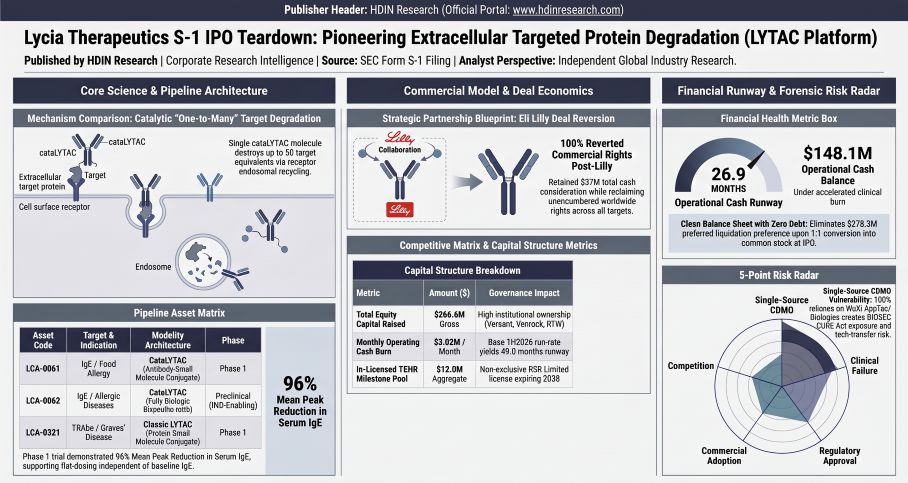
Figure Lycia Therapeutics S-1 lPO Teardown Pioneering Extracellular Targeted Protein Degradation
 Segmental Operating Realities, Revenue Halts, and Pro-Forma Capitalization
Lycia Therapeutics, Inc. completed a structural corporate pivot in the first half of 2026, transitioning from a pharmaceutical-partnered research model to an unencumbered, clinical-stage biotechnology entity. Historically, top-line collaboration revenue was 100% concentrated in the August 2021 Research and Collaboration Agreement with Eli Lilly and Company. Under the contract, Lycia Therapeutics received an initial $35.0 million non-refundable cash upfront payment to discover degraders across up to five targets, followed by a $2.0 million cash option extension fee in August 2025. Following Eli Lilly’s election in November 2025 to terminate the collaboration without cause, effective February 12, 2026, Lycia Therapeutics accelerated its remaining unamortized deferred revenue ($4.741 million as of year-end 2024) into fiscal year 2025 under ASC 606 input-cost accounting. Consequently, collaboration revenue contracted from $14.936 million in FY2024 and $6.741 million in FY2025 to $0 in the six months ended June 30, 2026. Zero performance milestones were realized over the partnership lifespan, and no upfront funds were subject to clawback.
Table Financial Performance, Operating Cash Burn and Liquidity Position
Operating expenditures decreased by 31.91% in 1H2026 relative to 1H2025, falling from $30.652 million to $20.870 million. This deflation was engineered via a June 2025 corporate restructuring that reduced full-time headcount by approximately 42% and produced a $0.489 million equipment impairment charge. Net property and equipment stood at $1.238 million as of June 30, 2026. As of June 30, 2026, full-time headcount was 31 employees, with 23 personnel dedicated to R&D (58% holding Ph.D. or M.D. degrees).
Research and development expenses totaled $17.312 million in 1H2026, decomposed into $9.370 million (54.12%) in direct program expenses and $7.942 million (45.88%) in indirect support costs:
* Fast-follower IgE degrader LCA-0062 absorbed $4.110 million in direct costs during 1H2026 (expanding from $0.300 million in 1H2025) due to cell-line development and IND-enabling toxicology.
* Graves' disease candidate LCA-0321 registered $2.410 million in direct costs.
* Clinical lead IgE candidate LCA-0061 registered $2.050 million in direct costs.
* Other preclinical discovery programs represented $0.800 million.
* Manufacturing-related liabilities peaked in FY2024 at approximately $11.4 million as initial clinical lots were secured, declining by $6.9 million in 1H2026 as Phase 1 batch campaigns finalized. Direct clinical research organization (CRO) spend expanded by $2.4 million in 1H2026.
* Indirect R&D overhead decreased by $4.250 million year-over-year in 1H2026, consisting of $3.820 million in personnel compensation, $2.480 million in consulting and laboratory supplies, and $1.640 million in facility, depreciation, and IT allocations. Non-cash stock-based compensation totaled $0.791 million in FY2024, $1.098 million in FY2025, and $0.476 million in 1H2026, with $2.100 million in unrecognized stock option expense remaining across a 2.4-year weighted-average period.
General and administrative costs tracked at $3.558 million in 1H2026 ($2.010 million personnel, $1.120 million legal and audit), with management modeling post-IPO public company compliance overhead to step up by $3.0 million to $5.0 million annually.
Capitalization and cumulative equity financing through June 30, 2026, totaled $266.6 million in gross convertible preferred proceeds and $1.2 million from common stock sales:
* Series A Preferred Stock: 25,390,410 shares ($25.39 million gross at $1.00 per share).
* Series B Preferred Stock: 39,597,569 shares ($71.32 million gross at $1.80 per share).
* Series C Preferred Stock: 52,211,394 shares ($106.60 million gross at $2.0417 per share).
* Series D Preferred Stock: 36,734,094 shares ($75.00 million gross, $74.715 million net at $2.0417 per share, closed June 2026).
* Total Preferred Liquidation Preference: $278.310 million across 153,933,467 shares, carrying a balance sheet value of $277.056 million classified in temporary equity.
A June 2026 charter amendment increased the minimum net IPO proceeds threshold required to mandate automatic 1:1 preferred-to-common conversion from $50.0 million to $75.0 million. Upon closing, preferred stock converts into common shares, eliminating temporary equity. Historical common stock outstanding stands at 14,650,145 shares (8.69% of the as-converted pre-IPO base of 168,583,612 shares). Historical net tangible book deficit was $(134.0) million, or $(9.15) per common share, shifting pro forma to approximately $143.1 million ($0.85 per share) prior to offering proceeds. Outstanding equity overhang includes 13,095,167 stock options under the 2020 Plan (weighted-average exercise price of $0.47 per share, 7,614,220 vested) and 7,361,856 options granted in August 2026 at $0.82 per share, totaling 20,457,023 options, supplemented by 18.56 million unallocated shares reserved for the 2026 Plan. Underwriting lock-up covenants with Jefferies LLC and TD Securities (USA) LLC govern 100% of pre-IPO equity holders for 180 days.
Multi-Jurisdictional Clinical Footprint, CDMO Chokepoints, and Intellectual Property Architecture
Lycia Therapeutics conducts translational platform activities from its sole leased headquarters encompassing 13,558 square feet at 400 East Jamie Court, Suite 200, South San Francisco, California 94080, United States of America, under an operating lease expiring October 31, 2028. Total operating lease liabilities stood at $3.162 million ($1.455 million current; $1.707 million non-current) offset by $3.112 million in right-of-use assets. Undiscounted lease obligations total $3.484 million ($0.682 million remaining in FY2026, $1.678 million in FY2027 reflecting March 2027 facility extensions, and $1.124 million in FY2028).
The clinical and regulatory operations span two international trial jurisdictions:
* Canada: Clinical site network for lead candidate LCA-0061, an antibody-small molecule conjugate cataLYTAC targeting Immunoglobulin E (IgE). In Phase 1 Part A single-ascending-dose (SAD) testing, a single 70 mg subcutaneous dose in healthy atopic participants (n=6 active) demonstrated a 96% mean maximum reduction of total and free serum IgE, maintaining reductions above 95% through Day 28 post-administration.
* Kingdom of the Netherlands: Multi-center clinical footprint conducting a randomized, double-blind, placebo-controlled Phase 1 SAD/MAD trial for LCA-0321 in adult patients with serologically confirmed Graves' disease, evaluating thyroid-stimulating hormone receptor (TSHR) autoantibody (TRAb) clearance and thyroid hormone levels (T3, T4, TSH).
Table Financial Performance, Operating Cash Burn and Liquidity Position
Lycia Therapeutics possesses zero internal Good Manufacturing Practice (GMP) manufacturing assets, executing 100% of drug substance (DS) and drug product (DP) synthesis through contract suppliers. The supply chain exhibits critical operational concentration in China-based vendors WuXi AppTec, WuXi Biologics, and their affiliates for LCA-0061 and LCA-0062 development. This structure introduces significant regulatory exposure following the enactment of the BIOSECURE Act within the FY2026 National Defense Authorization Act (NDAA) in December 2025, alongside the U.S. Department of Defense's inclusion of WuXi AppTec on its Section 1260H list in June 2026. Operations are conducted entirely through short-term purchase orders without binding Master Supply Agreements (MSAs) or secondary source qualifiers. Transferring bioconjugation protocols to North American or European CDMO alternatives is modeled to require 12 to 24 months for cell banking, analytical re-validation, and comparability testing. Specialty raw materials, including synthetic asialoglycoprotein receptor (ASGPR) glycan ligands and linkers, remain sole-sourced from specialized chemistry houses.
The intellectual property estate comprises 21 patent families:
* Core LYTAC Estate: 16 families (15 owned, one exclusively in-licensed from Leland Stanford Junior University based on the discoveries of Nobel Laureate Dr. Carolyn Bertozzi). Coverage contains three granted U.S. patents, one granted foreign patent, three pending U.S. provisionals, 11 pending U.S. utility applications, one pending PCT application, and over 70 pending foreign applications across Australia, Canada, China, Europe, Japan, and South Korea, with statutory expirations projected between 2039 and 2047.
* IgE Franchise: Four owned patent families covering LCA-0061 and LCA-0062 compositions of matter and conjugate linkers (zero granted; two U.S. provisionals, two PCT, one foreign application pending; expirations projected between 2045 and 2047).
* Graves' Disease Franchise: One owned composition-of-matter family (zero granted; one PCT, one foreign pending; expiring 2045).
* RSR Limited License Agreement: Non-exclusive worldwide license secured in July 2025 for thermostable TSHR extracellular domain constructs. Lycia Therapeutics remitted a $0.300 million upfront fee, carries annual maintenance fees scaling from $50,000 to $0.300 million by Year 5, and faces aggregate milestone liabilities of up to $12.0 million ($0.300 million recognized as an accrued liability in 1H2026 ahead of U.S. IND submission or January 31, 2027), alongside mid-single-digit sublicensing surcharges. The underlying RSR patent estate expires in 2035, leaving LCA-0321 vulnerable to competitive non-exclusive licensing and loss of antigen exclusivity 10 to 12 years prior to Lycia's owned conjugate IP expiration. Additional active vendor covenants include up to $1.9 million in development milestones per product under the core LYTAC platform license, up to $8.3 million per plan under a secondary research license, and up to $4.0 million to a preclinical CRO.
HDIN Institutional Verdict
Lycia Therapeutics, Inc.’s post-restructuring profile presents an operational dichotomy for institutional investors. On mechanical grounds, the catalytic cataLYTAC architecture provides clear technical differentiation over conventional 1:1 stoichiometric inhibitors and non-selective systemic degraders:
While Part A Phase 1 clinical data demonstrated a 96% reduction in circulating IgE, verifying human endosomal degradation, management's narrative of unencumbered autonomy masks three operational and balance sheet vulnerabilities:
1. Eli Lilly Partnership Departure: The February 2026 termination permanently extinguished external milestone non-dilutive inflows, forcing Lycia Therapeutics to self-fund capital-intensive Phase 2 expansions. Standalone cash burn models confirm that while the current $3.021 million monthly burn provides 49.0 months of runway ($148.091 million reserve through Q2 2030), transitioning LCA-0061 into multi-center Phase 2 allergic challenge studies, initiating LCA-0062 Phase 1 cohorts, and funding LCA-0321 Phase 2b Graves' trials will accelerate cash burn to approximately $5.500 million per month. Under this accelerated clinical scenario, standalone liquidity contracts to 26.9 months (depletion by Q3 2028). An assumed $80.0 million net IPO capital raise expands accelerated runway to 41.5 months (Q4 2029), leaving the enterprise dependent on dilutive equity financing prior to Phase 3 pivotal trial initiation.
2. Geopolitical BIOSECURE Exposure: Total operational reliance on WuXi AppTec and WuXi Biologics for Phase 1 DS and DP production exposes Lycia Therapeutics directly to federal contracting disqualifications and supply embargos following the FY2026 NDAA enactment and DoD 1260H listing. Because Lycia operates on purchase orders without long-term reservation slots or qualified secondary Western suppliers, an enforced vendor transition would halt Phase 2 clinical programs for 12 to 24 months. Developing LCA-0062 as a fully biologic bispecific antibody to bypass bioconjugation unit operations is a sound engineering mitigation, but LCA-0062 remains in IND-enabling stages and cannot alleviate immediate supply shocks on clinical-stage LCA-0061.
3. Asymmetric Intellectual Property Defense: Lycia Therapeutics holds only three granted U.S. patents across its platform, with zero granted composition-of-matter claims defending its lead clinical assets LCA-0061, LCA-0062, or LCA-0321. Crucially, LCA-0321 relies entirely on a non-exclusive license from RSR Limited that expires in 2035 and permits third-party licensing outside Lycia's specific field. The platform also faces rising litigation standards under the U.S. Supreme Court's *Amgen v. Sanofi* enablement doctrine, requiring narrow structural rather than broad functional claims for lysosomal receptor targeting.
Corporate governance transitioned toward public standards via the resignation of three venture directors—Tim Anderson (Blue Owl Capital), Ming Fang (Redmile Group), and Dr. Clare Ozawa (Versant Ventures)—yielding a board that is 75% independent, chaired by Non-Executive Chairman William J. Rieflin, with Jane Pritchett Henderson heading the Audit Committee alongside Chief Executive Officer Dr. Aetna Wun Trombley. The enterprise carries zero long-term debt and pristine litigation records. However, institutional allocation requires discounting for single-platform ASGPR hepatic delivery risks, CDMO single-source vulnerabilities, and the impending secondary market supply expansion when 168.58 million pre-IPO shares unlock 180 days post-offering.
Presentation Download & Video Access
Presentation Download: Click the PDF download link under 'Related Topics' to access the full institutional presentation of this report.
Video Link: Click this link to watch the HDIN analyst briefing on YouTube.
About HDIN Research
HDIN Research is a premier global market intelligence and strategic advisory firm specializing in institutional-grade financial analysis, supply chain audits, and macroeconomic forecasting. Our dedicated sector analysts deliver actionable, data-driven insights tailored for private equity, hedge funds, and corporate strategy teams. Visit us at http://www.hdinresearch.com.
2026 AI Transparency Footer
"This intelligence report was authored by HDIN Research analysts following a rigorous audit of official corporate filings. AI was utilized for massive-scale data synthesis and structural drafting, ensuring 100% inclusion of reported data points. All strategic insights, financial modeling, and final verdicts were verified by our editorial board to ensure professional accuracy and compliance with 2026 Google Search E-E-A-T standards."
1. Lycia Therapeutics, Inc. terminated its multi-target collaboration with Eli Lilly and Company effective February 12, 2026, eliminating future partnership milestones while reclaiming 100% worldwide commercial rights across its targeted protein degradation assets.
2. Balance sheet liquidity expanded to $148.091 million as of June 30, 2026, bolstered by a $74.715 million net Series D financing that extended operational cash runway to 49.0 months at current run-rates.
3. Chemistry, Manufacturing, and Controls operations carry elevated geopolitical concentration, relying on China-based WuXi AppTec and WuXi Biologics for Phase 1 clinical drug supply amid BIOSECURE Act restrictions.
Figure Lycia Therapeutics S-1 lPO Teardown Pioneering Extracellular Targeted Protein Degradation
Segmental Operating Realities, Revenue Halts, and Pro-Forma CapitalizationLycia Therapeutics, Inc. completed a structural corporate pivot in the first half of 2026, transitioning from a pharmaceutical-partnered research model to an unencumbered, clinical-stage biotechnology entity. Historically, top-line collaboration revenue was 100% concentrated in the August 2021 Research and Collaboration Agreement with Eli Lilly and Company. Under the contract, Lycia Therapeutics received an initial $35.0 million non-refundable cash upfront payment to discover degraders across up to five targets, followed by a $2.0 million cash option extension fee in August 2025. Following Eli Lilly’s election in November 2025 to terminate the collaboration without cause, effective February 12, 2026, Lycia Therapeutics accelerated its remaining unamortized deferred revenue ($4.741 million as of year-end 2024) into fiscal year 2025 under ASC 606 input-cost accounting. Consequently, collaboration revenue contracted from $14.936 million in FY2024 and $6.741 million in FY2025 to $0 in the six months ended June 30, 2026. Zero performance milestones were realized over the partnership lifespan, and no upfront funds were subject to clawback.
Table Financial Performance, Operating Cash Burn and Liquidity Position
| Financial Metric (in $ thousands) | FY2024 (Audited) | FY2025 (Audited) | 1H2025 (Unaudited) | 1H2026 (Unaudited) |
| Collaboration Revenue Recognized | $14,936 | $6,741 | $2,306 | $0 |
| Research & Development Expense | $41,069 | $40,507 | $25,804 | $17,312 |
| General & Administrative Expense | $6,400 | $6,112 | $3,441 | $3,558 |
| Restructuring & Impairment Charges | $0 | $1,528 | $1,407 | $0 |
| Total Operating Expenses | $47,469 | $48,147 | $30,652 | $20,870 |
| Net Loss | $(26,503) | $(36,460) | $(25,624) | $(19,196) |
| Net Cash Used in Operating Activities | $(29,502) | $(51,362) | $(35,734) | $(18,125) |
| Average Monthly Operating Cash Burn | $2,458 / mo | $4,280 / mo | $5,956 / mo | $3,021 / mo |
| Capital Expenditures (Property & Equipment) | $1,271 | $194 | $160 | $0 |
| Cash, Cash Equivalents & ST Securities | $138,018 | $79,122 | $83,576 | $124,321 |
| Non-Current Marketable Securities | $3,007 | $12,069 | N/A | $23,770 |
| Total Liquid Reserves (Cash + Securities) | $141,025 | $91,191 | $83,576 | $148,091 |
| Working Capital Balance | $116,501 | $74,146 | N/A | $117,581 |
Operating expenditures decreased by 31.91% in 1H2026 relative to 1H2025, falling from $30.652 million to $20.870 million. This deflation was engineered via a June 2025 corporate restructuring that reduced full-time headcount by approximately 42% and produced a $0.489 million equipment impairment charge. Net property and equipment stood at $1.238 million as of June 30, 2026. As of June 30, 2026, full-time headcount was 31 employees, with 23 personnel dedicated to R&D (58% holding Ph.D. or M.D. degrees).
Research and development expenses totaled $17.312 million in 1H2026, decomposed into $9.370 million (54.12%) in direct program expenses and $7.942 million (45.88%) in indirect support costs:
* Fast-follower IgE degrader LCA-0062 absorbed $4.110 million in direct costs during 1H2026 (expanding from $0.300 million in 1H2025) due to cell-line development and IND-enabling toxicology.
* Graves' disease candidate LCA-0321 registered $2.410 million in direct costs.
* Clinical lead IgE candidate LCA-0061 registered $2.050 million in direct costs.
* Other preclinical discovery programs represented $0.800 million.
* Manufacturing-related liabilities peaked in FY2024 at approximately $11.4 million as initial clinical lots were secured, declining by $6.9 million in 1H2026 as Phase 1 batch campaigns finalized. Direct clinical research organization (CRO) spend expanded by $2.4 million in 1H2026.
* Indirect R&D overhead decreased by $4.250 million year-over-year in 1H2026, consisting of $3.820 million in personnel compensation, $2.480 million in consulting and laboratory supplies, and $1.640 million in facility, depreciation, and IT allocations. Non-cash stock-based compensation totaled $0.791 million in FY2024, $1.098 million in FY2025, and $0.476 million in 1H2026, with $2.100 million in unrecognized stock option expense remaining across a 2.4-year weighted-average period.
General and administrative costs tracked at $3.558 million in 1H2026 ($2.010 million personnel, $1.120 million legal and audit), with management modeling post-IPO public company compliance overhead to step up by $3.0 million to $5.0 million annually.
Capitalization and cumulative equity financing through June 30, 2026, totaled $266.6 million in gross convertible preferred proceeds and $1.2 million from common stock sales:
* Series A Preferred Stock: 25,390,410 shares ($25.39 million gross at $1.00 per share).
* Series B Preferred Stock: 39,597,569 shares ($71.32 million gross at $1.80 per share).
* Series C Preferred Stock: 52,211,394 shares ($106.60 million gross at $2.0417 per share).
* Series D Preferred Stock: 36,734,094 shares ($75.00 million gross, $74.715 million net at $2.0417 per share, closed June 2026).
* Total Preferred Liquidation Preference: $278.310 million across 153,933,467 shares, carrying a balance sheet value of $277.056 million classified in temporary equity.
A June 2026 charter amendment increased the minimum net IPO proceeds threshold required to mandate automatic 1:1 preferred-to-common conversion from $50.0 million to $75.0 million. Upon closing, preferred stock converts into common shares, eliminating temporary equity. Historical common stock outstanding stands at 14,650,145 shares (8.69% of the as-converted pre-IPO base of 168,583,612 shares). Historical net tangible book deficit was $(134.0) million, or $(9.15) per common share, shifting pro forma to approximately $143.1 million ($0.85 per share) prior to offering proceeds. Outstanding equity overhang includes 13,095,167 stock options under the 2020 Plan (weighted-average exercise price of $0.47 per share, 7,614,220 vested) and 7,361,856 options granted in August 2026 at $0.82 per share, totaling 20,457,023 options, supplemented by 18.56 million unallocated shares reserved for the 2026 Plan. Underwriting lock-up covenants with Jefferies LLC and TD Securities (USA) LLC govern 100% of pre-IPO equity holders for 180 days.
Multi-Jurisdictional Clinical Footprint, CDMO Chokepoints, and Intellectual Property Architecture
Lycia Therapeutics conducts translational platform activities from its sole leased headquarters encompassing 13,558 square feet at 400 East Jamie Court, Suite 200, South San Francisco, California 94080, United States of America, under an operating lease expiring October 31, 2028. Total operating lease liabilities stood at $3.162 million ($1.455 million current; $1.707 million non-current) offset by $3.112 million in right-of-use assets. Undiscounted lease obligations total $3.484 million ($0.682 million remaining in FY2026, $1.678 million in FY2027 reflecting March 2027 facility extensions, and $1.124 million in FY2028).
The clinical and regulatory operations span two international trial jurisdictions:
* Canada: Clinical site network for lead candidate LCA-0061, an antibody-small molecule conjugate cataLYTAC targeting Immunoglobulin E (IgE). In Phase 1 Part A single-ascending-dose (SAD) testing, a single 70 mg subcutaneous dose in healthy atopic participants (n=6 active) demonstrated a 96% mean maximum reduction of total and free serum IgE, maintaining reductions above 95% through Day 28 post-administration.
* Kingdom of the Netherlands: Multi-center clinical footprint conducting a randomized, double-blind, placebo-controlled Phase 1 SAD/MAD trial for LCA-0321 in adult patients with serologically confirmed Graves' disease, evaluating thyroid-stimulating hormone receptor (TSHR) autoantibody (TRAb) clearance and thyroid hormone levels (T3, T4, TSH).
| Asset / Technology Code | Molecular Architecture & Target Mechanism | Clinical / Operational Stage | Primary Sourcing & CDMO Partners | Geographic Jurisdiction | Strategic / Licensing Counterparty & Financial Commitments |
| LCA-0061 | cataLYTAC Conjugate: pH-sensitive IgG1 mAb + synthetic ASGPR ligand | Phase 1 SAD/MAD Trial | WuXi AppTec / WuXi Biologics & Affiliates | Canada / United States / China | 100% owned; former Eli Lilly collaboration rights fully reverted in Feb 2026. |
| LCA-0062 | cataLYTAC Bispecific: Fully biologic bispecific antibody (IgE × ASGPR) | IND-Enabling Studies | Third-Party CDMOs / External Cell Banking | United States / International | 100% owned proprietary sequence and bispecific construct; IND targeted post-studies. |
| LCA-0321 | Classic LYTAC Conjugate: Recombinant TSHR ECD + synthetic ASGPR ligand | Phase 1 SAD/MAD Trial | Specialized Conjugation CDMOs | Kingdom of the Netherlands | RSR Limited in-license; $0.3M paid upfront July 2025; up to
0.3M accrued in 1H2026). |
| Platform IP | Lysosome-Targeting Chimera (LYTAC) System | Preclinical Platform Discovery | Internal wet labs / Contract Discovery Vendors | South San Francisco, CA | Leland Stanford Junior University; exclusive license; Bayh-Dole federal march-in provisions. |
Lycia Therapeutics possesses zero internal Good Manufacturing Practice (GMP) manufacturing assets, executing 100% of drug substance (DS) and drug product (DP) synthesis through contract suppliers. The supply chain exhibits critical operational concentration in China-based vendors WuXi AppTec, WuXi Biologics, and their affiliates for LCA-0061 and LCA-0062 development. This structure introduces significant regulatory exposure following the enactment of the BIOSECURE Act within the FY2026 National Defense Authorization Act (NDAA) in December 2025, alongside the U.S. Department of Defense's inclusion of WuXi AppTec on its Section 1260H list in June 2026. Operations are conducted entirely through short-term purchase orders without binding Master Supply Agreements (MSAs) or secondary source qualifiers. Transferring bioconjugation protocols to North American or European CDMO alternatives is modeled to require 12 to 24 months for cell banking, analytical re-validation, and comparability testing. Specialty raw materials, including synthetic asialoglycoprotein receptor (ASGPR) glycan ligands and linkers, remain sole-sourced from specialized chemistry houses.
The intellectual property estate comprises 21 patent families:
* Core LYTAC Estate: 16 families (15 owned, one exclusively in-licensed from Leland Stanford Junior University based on the discoveries of Nobel Laureate Dr. Carolyn Bertozzi). Coverage contains three granted U.S. patents, one granted foreign patent, three pending U.S. provisionals, 11 pending U.S. utility applications, one pending PCT application, and over 70 pending foreign applications across Australia, Canada, China, Europe, Japan, and South Korea, with statutory expirations projected between 2039 and 2047.
* IgE Franchise: Four owned patent families covering LCA-0061 and LCA-0062 compositions of matter and conjugate linkers (zero granted; two U.S. provisionals, two PCT, one foreign application pending; expirations projected between 2045 and 2047).
* Graves' Disease Franchise: One owned composition-of-matter family (zero granted; one PCT, one foreign pending; expiring 2045).
* RSR Limited License Agreement: Non-exclusive worldwide license secured in July 2025 for thermostable TSHR extracellular domain constructs. Lycia Therapeutics remitted a $0.300 million upfront fee, carries annual maintenance fees scaling from $50,000 to $0.300 million by Year 5, and faces aggregate milestone liabilities of up to $12.0 million ($0.300 million recognized as an accrued liability in 1H2026 ahead of U.S. IND submission or January 31, 2027), alongside mid-single-digit sublicensing surcharges. The underlying RSR patent estate expires in 2035, leaving LCA-0321 vulnerable to competitive non-exclusive licensing and loss of antigen exclusivity 10 to 12 years prior to Lycia's owned conjugate IP expiration. Additional active vendor covenants include up to $1.9 million in development milestones per product under the core LYTAC platform license, up to $8.3 million per plan under a secondary research license, and up to $4.0 million to a preclinical CRO.
HDIN Institutional Verdict
Lycia Therapeutics, Inc.’s post-restructuring profile presents an operational dichotomy for institutional investors. On mechanical grounds, the catalytic cataLYTAC architecture provides clear technical differentiation over conventional 1:1 stoichiometric inhibitors and non-selective systemic degraders:
While Part A Phase 1 clinical data demonstrated a 96% reduction in circulating IgE, verifying human endosomal degradation, management's narrative of unencumbered autonomy masks three operational and balance sheet vulnerabilities:
1. Eli Lilly Partnership Departure: The February 2026 termination permanently extinguished external milestone non-dilutive inflows, forcing Lycia Therapeutics to self-fund capital-intensive Phase 2 expansions. Standalone cash burn models confirm that while the current $3.021 million monthly burn provides 49.0 months of runway ($148.091 million reserve through Q2 2030), transitioning LCA-0061 into multi-center Phase 2 allergic challenge studies, initiating LCA-0062 Phase 1 cohorts, and funding LCA-0321 Phase 2b Graves' trials will accelerate cash burn to approximately $5.500 million per month. Under this accelerated clinical scenario, standalone liquidity contracts to 26.9 months (depletion by Q3 2028). An assumed $80.0 million net IPO capital raise expands accelerated runway to 41.5 months (Q4 2029), leaving the enterprise dependent on dilutive equity financing prior to Phase 3 pivotal trial initiation.
2. Geopolitical BIOSECURE Exposure: Total operational reliance on WuXi AppTec and WuXi Biologics for Phase 1 DS and DP production exposes Lycia Therapeutics directly to federal contracting disqualifications and supply embargos following the FY2026 NDAA enactment and DoD 1260H listing. Because Lycia operates on purchase orders without long-term reservation slots or qualified secondary Western suppliers, an enforced vendor transition would halt Phase 2 clinical programs for 12 to 24 months. Developing LCA-0062 as a fully biologic bispecific antibody to bypass bioconjugation unit operations is a sound engineering mitigation, but LCA-0062 remains in IND-enabling stages and cannot alleviate immediate supply shocks on clinical-stage LCA-0061.
3. Asymmetric Intellectual Property Defense: Lycia Therapeutics holds only three granted U.S. patents across its platform, with zero granted composition-of-matter claims defending its lead clinical assets LCA-0061, LCA-0062, or LCA-0321. Crucially, LCA-0321 relies entirely on a non-exclusive license from RSR Limited that expires in 2035 and permits third-party licensing outside Lycia's specific field. The platform also faces rising litigation standards under the U.S. Supreme Court's *Amgen v. Sanofi* enablement doctrine, requiring narrow structural rather than broad functional claims for lysosomal receptor targeting.
Corporate governance transitioned toward public standards via the resignation of three venture directors—Tim Anderson (Blue Owl Capital), Ming Fang (Redmile Group), and Dr. Clare Ozawa (Versant Ventures)—yielding a board that is 75% independent, chaired by Non-Executive Chairman William J. Rieflin, with Jane Pritchett Henderson heading the Audit Committee alongside Chief Executive Officer Dr. Aetna Wun Trombley. The enterprise carries zero long-term debt and pristine litigation records. However, institutional allocation requires discounting for single-platform ASGPR hepatic delivery risks, CDMO single-source vulnerabilities, and the impending secondary market supply expansion when 168.58 million pre-IPO shares unlock 180 days post-offering.
Presentation Download & Video Access
Presentation Download: Click the PDF download link under 'Related Topics' to access the full institutional presentation of this report.
Video Link: Click this link to watch the HDIN analyst briefing on YouTube.
About HDIN Research
HDIN Research is a premier global market intelligence and strategic advisory firm specializing in institutional-grade financial analysis, supply chain audits, and macroeconomic forecasting. Our dedicated sector analysts deliver actionable, data-driven insights tailored for private equity, hedge funds, and corporate strategy teams. Visit us at http://www.hdinresearch.com.
2026 AI Transparency Footer
"This intelligence report was authored by HDIN Research analysts following a rigorous audit of official corporate filings. AI was utilized for massive-scale data synthesis and structural drafting, ensuring 100% inclusion of reported data points. All strategic insights, financial modeling, and final verdicts were verified by our editorial board to ensure professional accuracy and compliance with 2026 Google Search E-E-A-T standards."