Centinel Spine Holdco, Inc.: Pure-Play Cervical & Lumbar TDR Platform Scales to $170.5M Run-Rate as Multi-Level PMA Moat Counters 94% Vendor Sourcing Concentration and Up-C Capital Encumbrances
Date : 2026-10-16
Reading : 224
HDIN Executive Takeaways
* Centinel Spine transitioned to pure-play Total Disc Replacement (TDR), achieving $132.16 million in FY2025 net revenue (+39.0% YoY) and $85.24 million in 6M 2026 (+42.0% YoY), swinging from an operating loss in prior years to a positive $13.02 million operating income and $3.82 million in Free Cash Flow through June 30, 2026.
* Operational fragility centers on an entirely outsourced manufacturing model: top five vendors control 94% of inventory procurement, single-source nodes in the US, Germany, and Switzerland carry up to 24-month re-qualification timelines under FDA QMSR, and transatlantic air freight links Swiss gamma sterilization to the central West Chester, Pennsylvania warehouse.
* Balance sheet architecture remains encumbered by $136.1 million in face debt, a punitive $7.19 million Make-Whole penalty payable to insider-controlled lenders, $251.2 million in pre-IPO preferred liquidation preferences, and an 85% Tax Receivable Agreement cash drain under the Up-C reorganization structure.
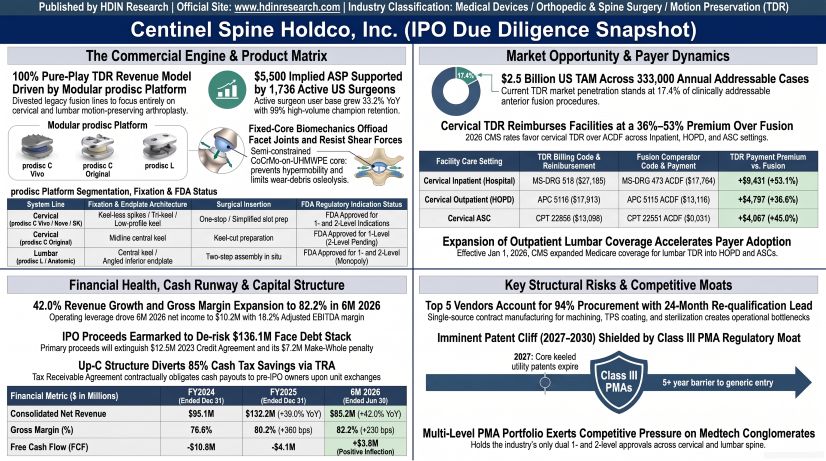
Figure Centinel Spine Holdco Inc IPO Due Diligence Snapshot
 Segmental Realities, Operating Leverage, and Working Capital Friction
Following the 2024 operational divestiture of its legacy STALIF and anterior fusion portfolios, Centinel Spine Holdco, Inc. generates 100% of its commercial revenue through its proprietary prodisc Total Disc Replacement platform. Top-line expansion is primarily volume-driven in the United States, which contributed 91% of incremental revenue dollars in FY2025 and 93% in 6M 2026. Gross margin expanded by 360 basis points in FY2025 and an additional 230 basis points in 6M 2026 to reach 82.2%, benefiting from fixed-cost absorption across centralized warehousing, quality assurance, and surgical instrument set depreciation.
Table Consolidated Financial Performance, Operating Leverage, and Cash Flow Inflection Analysis
The commercial engine pairs an internal team of 48 direct sales leadership and clinical support professionals (including Clinical Account Managers) with an outsourced network of over 400 independent distributor entities. In FY2025, Centinel generated $2.30 million in US net revenue per direct manager. Active US surgeons performing prodisc procedures grew 38.0% YoY in FY2025 to 1,541 and reached 1,736 as of Q2 2026. The high-volume cohort (surgeons performing 12 or more procedures annually) expanded 38.6% YoY to 334 clinicians in Q2 2026, exhibiting a 99% annual retention rate. Total active surgeon retention stood at 83%.
Table Commercial Execution, Surgeon Adoption, and Working Capital Operating Metrics
Operational friction appears in working capital dynamics. To support 1,736 active surgeons across more than 1,700 hospitals and Ambulatory Surgery Centers (ASCs), Centinel operates an in-field consignment inventory model. Net Days Inventory Outstanding sits at 257 days (~8.5 months of COGS), with finished goods representing 80.6% of gross inventory ($22.87 million) at year-end FY2025. Unused sizes in consigned trays create persistent exposure to technical obsolescence, requiring an inventory reserve of $7.93 million (26.3% of gross inventory) as of June 30, 2026.
Surgical instrument trays are capitalized under ASC 360 within Property and Equipment, reaching a gross book value of $30.78 million at December 31, 2025 ($24.42 million in 2024), and are depreciated straight-line over a 3-year useful life directly into Cost of Sales. Instrument set depreciation totaled $3.70 million in FY2025 (14.1% of COGS) and $3.20 million in FY2024 (14.4% of COGS). Pricing elasticity reduced implied US realized ASP by 5.7% from $5,500 to $5,185 in 6M 2026, driven by higher hospital GPO/IDN penetration, volume rebate tiering, and procedure migration into ASCs.
Infrastructure Layout, Transatlantic Nodes, and Single-Source Bottlenecks
Centinel operates with zero internal machining, cleanroom suites, or sterilization facilities. It maintains 16,150 square feet of leased corporate headquarters and warehouse space in West Chester, Pennsylvania (lease expiring June 2027, extendable to 2028), along with leased international administrative offices in Zug, Switzerland, and regional staging facilities in Waalwijk, Netherlands, and Kent Town, Australia.
Physical implant manufacturing is concentrated across five primary vendors accounting for 94% of total inventory purchases in FY2025:
* Raw Material & Machining: Hammill Manufacturing Co. (Toledo, Ohio) serves as the single-source supplier for machining and finishing CoCrMo alloy (ASTM F75/1537) and UHMWPE inlays for prodisc C Vivo, prodisc C Nova, and prodisc C SK distributed in the United States. Bricon Technology GmbH (Wurmlingen/Tuttlingen, Germany) is the sole supplier for machining prodisc C endplates for the US market and finishing Vivo and Nova internationally.
* Surface Treatment: Medicoat AG (Mägenwil, Switzerland and Etupes, France) is the exclusive worldwide single-source partner applying proprietary Titanium Plasma Spray (TPS) coating to establish porous osteointegrative surfaces.
* Cleanroom Packaging & Terminal Gamma Sterilization: Fruh Verpackungstechnik AG (Fehraltorf, Switzerland) operates as the sole global provider of cleanroom packaging, ISO double-barrier sealing, and off-site terminal gamma irradiation. Finished implants are subsequently air-freighted across the Atlantic to West Chester, PA.
* Secondary Contract Machining: Summit Orthopedic Technologies (Exton, Pennsylvania), historically owned by sponsor affiliate VB Watermark Holdings, provides contract machining ($184,000 in FY2025; $120,000 in 6M 2026).
Qualifying and validating a secondary contract manufacturer to replace Hammill, Bricon, Medicoat, or Fruh under FDA Quality Management System Regulation (QMSR 21 CFR Part 820) and EU MDR (2017/745) requires up to 24 months. Vendor-level packaging execution errors triggered two Class 2 FDA recalls for prodisc C SK: a December 31, 2025 recall involving 20 units where 5mm devices were packaged in boxes labeled 6mm (6 units implanted; 1 patient experienced transient pain), and a March 19, 2026 recall affecting two 30-unit lots with cross-mislabeled packaging (7 units implanted; terminated May 15, 2026).
Capital Stack Encumbrances, Up-C Structure, and Insider Entanglements
Centinel Spine operates with an encumbered capital structure featuring $136.1 million in aggregate indebtedness across senior, subordinated, and convertible layers.
Table Credit Facilities, Debt Obligations, and Capital Structure Terms
Pre-IPO mezzanine equity comprises 99,484,939 units with a total carrying value of $133.43 million and an accumulated liquidation preference of $251.20 million as of June 30, 2026. The waterfall gives first priority to Class B Preferred Units ($50.47 million liquidation preference), second priority to Class A Preferred Units ($88.25 million preference), and third priority to a single Special Member Unit ($112.49 million preference, compounding at an 8.0% annual yield). Reorganization into Centinel Spine Holdco, Inc. under an Up-C structure converts these tiers into common equity, contingent upon a Qualified Public Offering threshold of at least $75.0 million in gross proceeds at a price not less than $2.79 per share.
Governance is concentrated among three financial sponsors: Viscogliosi Brothers, LLC (holding two board seats via brothers Anthony and Marc Viscogliosi), Oman Investment Authority / Delac Spine Inc. (two seats: Deepankar Panigrahi and Ali Abdullah Al Amri), and AW Alpha Capital LLC / WJFS, Inc. (two seats: Robert Donohue and Craig Greener). Outside operating veteran Dirk Kuyper holds the sole unaffiliated independent seat. The company relies on NYSE transition rules to seat non-independent sponsor Anthony Viscogliosi on the Audit Committee. Viscogliosi Brothers Co-CEOs also direct VB Spine, LLC and Companion Spine, LLC, creating potential conflicts regarding market opportunities and clinical developments.
Under the Up-C structure, public investors receive Class A Common Stock (one vote, 100% economic interest), while pre-IPO Continuing Equity Owners hold Series B Common Units in Centinel Spine, LLC paired 1:1 with non-economic, one-vote Class B Common Stock in Holdco. This governance structure is coupled with a Tax Receivable Agreement (TRA) obligating Centinel Holdco to remit 85% of realized cash tax benefits (from pre-IPO basis step-ups and unit exchanges) to Continuing Equity Owners and Blocker Stockholders. A change-of-control transaction triggers mandatory acceleration into an immediate lump-sum payout based on hypothetical maximum realization.
Insiders hold $36.92 million of the $46.05 million principal in 4.42% Notes, which convert upon listing at a 30% discount to the IPO price. The embedded derivative liability linked to this discount was valued at $6.64 million at December 31, 2025 and $1.70 million at June 30, 2026, driving non-cash GAAP earnings volatility. Related-party transactions include $5.35 million paid to MCRA (a clinical research organization owned by Viscogliosi Brothers until July 2024; $3.30 million in FY2023 and $2.05 million in FY2024), 717,178 advisory preferred units issued to Viscogliosi Brothers, and an unaccrued Executive Change in Control Bonus Plan of up to $13.0 million (including $2.21 million to CEO Steven Murray and $2.15 million to CFO Varun Gandhi at an EV above $700 million) that terminates upon IPO completion.
Clinical Differentiation, Health Economics, and Regulatory Moats
Centinel positions the prodisc CORE ball-and-socket design against unconstrained mobile-core devices (Highridge Medical's Mobi-C) and viscoelastic polymer units (Orthofix Medical's M6-C). The prodisc construct locks an ultra-high molecular weight polyethylene (UHMWPE) core into the inferior Cobalt-Chromium-Molybdenum (CoCrMo) endplate. This design establishes a fixed center of rotation (COR) that absorbs shear loads and offloads native facet joints, contrasting with mobile cores that transfer shear stresses to posterior facet capsules.
In the prospective, randomized FDA SMART IDE cervical trial (N = 433), prodisc C SK and prodisc C Vivo demonstrated 87.1% Composite Clinical Success (CCS) at 2 years versus 83.7% for the Mobi-C active control, alongside lower secondary surgical interventions (3.1% vs. 4.3%) and lower device-related serious adverse events (1.6% vs. 1.9%). Long-term durability is supported by Marnay et al. (JBJS 2025; N = 1,187), which documented a 0.67% device revision rate over 7 to 21 years. Over a 20-year span in the FDA MAUDE registry (Nunley et al., IJSS 2025), prodisc C recorded 1 reported osteolysis event, compared to 16 reports (25.8% of brand filings) for the PEEK-on-ceramic Simplify disc and 138 reports (36.2%) for the viscoelastic M6-C disc.
Centinel holds five Class III FDA PMA approvals and panel supplements, providing the only US portfolio with both one-level and two-level indications across both cervical (prodisc C Vivo, Nova, SK) and lumbar (prodisc L) spines. Two-level lumbar remains an effective regulatory monopoly. While foundational utility patents covering keeled constructs (US 9,387,086 and EP 2 043 563) expire on July 24, 2027, and prodisc C Vivo utility patents expire between April and May 2030, Class III PMA regulations require potential competitors to conduct multi-year IDE trials (typically 5+ years and $30M+ in capital). Net capitalized patent value on the balance sheet is $12,000 as of December 31, 2025, with 0.11 years of remaining amortization life.
Adoption is reinforced by facility reimbursement economics under 2026 Medicare schedules, where cervical TDR reimburses facilities at a premium over Anterior Cervical Discectomy and Fusion (ACDF):
* Inpatient (MS-DRG 518 vs. MS-DRG 473): Cervical TDR pays $27,195 versus $17,764 for ACDF (+53.1% / +$9,431 margin variance).
* Hospital Outpatient (APC 5116 vs. APC 5115): Cervical TDR pays $17,913 versus $13,116 for ACDF (+36.6% / +$4,797 margin variance).
* Ambulatory Surgery Center (CPT 22856 vs. CPT 22551): Cervical TDR pays $13,098 versus $9,031 for ACDF (+45.0% / +$4,067 margin variance).
* Lumbar Inpatient (MS-DRG 518 vs. MS-DRG 451): Lumbar TDR pays $27,195 versus $23,506 for ALIF (+15.7% / +$3,689 margin variance).
Effective January 1, 2026, CMS established outpatient Medicare access for lumbar TDR under APC 5116 ($17,913) and ASC CPT 22857 ($12,699). Commercial payer coverage for cervical TDR is near-universal for 1- and 2-level indications. Lumbar TDR coverage stands at ~95% of covered lives for 1-level, but drops to ~45% for 2-level indications, requiring practice-level prior authorization navigation. In international markets (16.4% of FY2025 revenue across 35 countries), Centinel secured EU MDR certificates via BSI for prodisc C Nova (September 2025), prodisc C Vivo (July 2026), prodisc L (September 2026), and Class IIa instruments (July 2026), but faces centralized pricing evaluations under the EU Health Technology Assessment (HTA 2021/2282) beginning in 2026.
HDIN Institutional Verdict
Centinel Spine operates as a pure-play total disc replacement asset delivering above-market volume growth (+47.1% US revenue in 6M 2026) within an addressable market where motion preservation accounts for approximately 17.4% of addressable anterior fusions ($2.45 billion US TAM). The platform's commercial defensibility rests on Class III PMA clinical barriers and multi-level regulatory indications rather than its expiring utility patent estate.
However, institutional underwriting must weigh operating momentum against vendor concentration and capital structure encumbrances:
1. Operational Risk: Sourcing 94% of inventory from five European and domestic vendors—combined with a 24-month re-qualification lead time—creates operational vulnerability to single-facility disruptions or regulatory audit findings, as demonstrated by the 2025/2026 Class 2 packaging recalls.
2. Balance Sheet Allocations: IPO proceeds are heavily absorbed by debt retirement, including an estimated $7.19 million Make-Whole penalty to insider lenders and repayment of the SLR Term Loan ($11.07 million cash interest in FY2025).
3. Cash Flow Diversion: The Up-C structure's 85% TRA obligation routes future tax savings back to pre-IPO financial sponsors, reducing the cash flow available to fund consigned inventory sets (DIO: 257 days) and secondary machining qualification.
Centinel's transition from an insider-financed entity to a self-funding public company depends on maintaining >30% organic volume growth while resolving single-source production dependencies.
Presentation Download & Video Access:
- Presentation Download: Click the PDF download link under 'Related Topics' to access the full institutional presentation of this report.
- Video Link: Click this link to watch the HDIN analyst briefing on YouTube.
About HDIN Research:
HDIN Research is a premier global market intelligence and strategic advisory firm specializing in institutional-grade financial analysis, supply chain audits, and macroeconomic forecasting. Our dedicated sector analysts deliver actionable, data-driven insights tailored for private equity, hedge funds, and corporate strategy teams. Visit us at http://www.hdinresearch.com.
2026 AI Transparency Footer:
"This intelligence report was authored by HDIN Research analysts following a rigorous audit of official corporate filings. AI was utilized for massive-scale data synthesis and structural drafting, ensuring 100% inclusion of reported data points. All strategic insights, financial modeling, and final verdicts were verified by our editorial board to ensure professional accuracy and compliance with 2026 Google Search E-E-A-T standards."
* Centinel Spine transitioned to pure-play Total Disc Replacement (TDR), achieving $132.16 million in FY2025 net revenue (+39.0% YoY) and $85.24 million in 6M 2026 (+42.0% YoY), swinging from an operating loss in prior years to a positive $13.02 million operating income and $3.82 million in Free Cash Flow through June 30, 2026.
* Operational fragility centers on an entirely outsourced manufacturing model: top five vendors control 94% of inventory procurement, single-source nodes in the US, Germany, and Switzerland carry up to 24-month re-qualification timelines under FDA QMSR, and transatlantic air freight links Swiss gamma sterilization to the central West Chester, Pennsylvania warehouse.
* Balance sheet architecture remains encumbered by $136.1 million in face debt, a punitive $7.19 million Make-Whole penalty payable to insider-controlled lenders, $251.2 million in pre-IPO preferred liquidation preferences, and an 85% Tax Receivable Agreement cash drain under the Up-C reorganization structure.
Figure Centinel Spine Holdco Inc IPO Due Diligence Snapshot
Segmental Realities, Operating Leverage, and Working Capital FrictionFollowing the 2024 operational divestiture of its legacy STALIF and anterior fusion portfolios, Centinel Spine Holdco, Inc. generates 100% of its commercial revenue through its proprietary prodisc Total Disc Replacement platform. Top-line expansion is primarily volume-driven in the United States, which contributed 91% of incremental revenue dollars in FY2025 and 93% in 6M 2026. Gross margin expanded by 360 basis points in FY2025 and an additional 230 basis points in 6M 2026 to reach 82.2%, benefiting from fixed-cost absorption across centralized warehousing, quality assurance, and surgical instrument set depreciation.
Table Consolidated Financial Performance, Operating Leverage, and Cash Flow Inflection Analysis
| Metric (GAAP & Non-GAAP) | FY2024 (Ended Dec 31) | FY2025 (Ended Dec 31) | YoY Change (%) | 6M 2025 (Ended Jun 30) | 6M 2026 (Ended Jun 30) | YoY Change (%) |
| United States Net Revenue ($M) | $76.62 | $110.46 | +44.2% | $49.54 | $72.88 | +47.1% |
| International Net Revenue ($M) | $18.44 | $21.71 | +17.7% | $10.52 | $12.37 | +17.6% |
| Total Net Revenue ($M) | $95.06 | $132.16 | +39.0% | $60.06 | $85.24 | +42.0% |
| Cost of Sales ($M) | $22.23 | $26.14 | +17.6% | $12.08 | $15.16 | +25.5% |
| Gross Profit ($M) | $72.82 | $106.02 | +45.6% | $47.98 | $70.09 | +46.1% |
| Gross Margin (%) | 76.6% | 80.2% | +360 bps | 79.9% | 82.2% | +230 bps |
| Selling & Marketing ($M) | $49.37 | $67.50 | +36.7% | $31.80 | $42.15 | +32.5% |
| General & Administrative ($M) | $16.75 | $19.16 | +14.4% | $9.23 | $12.09 | +31.0% |
| Research & Development ($M) | $4.95 | $3.66 | -26.1% | $2.47 | $2.82 | +14.1% |
| Operating Income ($M) | $1.75 | $15.71 | +797.0% | $4.47 | $13.02 | +191.3% |
| Operating Margin (%) | 1.8% | 11.9% | +1,004 bps | 7.4% | 15.3% | +784 bps |
| GAAP Net Income / (Loss) ($M) | $(12.12) | $(4.32) | +64.4% | $(0.50) | $10.24 | Turned Profitable |
| Adjusted EBITDA ($M) | $5.91 | $20.15 | +241.2% | $6.55 | $15.51 | +136.8% |
| Adjusted EBITDA Margin (%) | 6.2% | 15.2% | +900 bps | 10.9% | 18.2% | +730 bps |
| Operating Cash Flow ($M) | $(6.96) | $1.65 | Turned Positive | $(4.55) | $7.70 | Turned Positive |
| Capital Expenditures ($M) | $(3.85) | $(5.80) | +50.6% | $(2.89) | $(3.88) | +34.3% |
| Free Cash Flow (FCF) ($M) | $(10.81) | $(4.15) | Deficit Narrowed | $(7.44) | $3.82 | Positive Inflection |
The commercial engine pairs an internal team of 48 direct sales leadership and clinical support professionals (including Clinical Account Managers) with an outsourced network of over 400 independent distributor entities. In FY2025, Centinel generated $2.30 million in US net revenue per direct manager. Active US surgeons performing prodisc procedures grew 38.0% YoY in FY2025 to 1,541 and reached 1,736 as of Q2 2026. The high-volume cohort (surgeons performing 12 or more procedures annually) expanded 38.6% YoY to 334 clinicians in Q2 2026, exhibiting a 99% annual retention rate. Total active surgeon retention stood at 83%.
Table Commercial Execution, Surgeon Adoption, and Working Capital Operating Metrics
| Commercial Performance Metric | FY2024 | FY2025 | YoY Change (%) | 6M 2025 | 6M 2026 | YoY Change (%) |
| Active US Surgeons (Trailing 4Q) | 1,117 | 1,541 | +38.0% | 1,303 | 1,736 | +33.2% |
| High-Volume US Surgeons (≥12/yr) | 191 | 284 | +48.7% | 241 | 334 | +38.6% |
| US Implant Volume (Units, Implied) | ~14,044 | ~20,083 | +43.0% | ~9,008 | ~14,056 | +56.0% |
| Worldwide Implant Volume Growth | — | +30.0% | — | — | +37.0% | — |
| Implied US Realized ASP per Implant | $5,456 | $5,500 | +0.8% | $5,500 | $5,185 | -5.7% |
| Days Sales Outstanding (DSO) | 78.0 days | 74.0 days | -4.0 days | — | 64.8 days | -9.2 days |
| Net Days Inventory Outstanding (DIO) | 270 days | 257 days | -13 days | — | 257 days | Flat |
| Inventory Obsolescence Reserve ($M) | $6.23 | $7.96 | +27.8% | — | $7.93 | -0.4% |
| Obsolescence Reserve % of Gross Inv. | 27.4% | 28.0% | +60 bps | — | 26.3% | -170 bps |
Operational friction appears in working capital dynamics. To support 1,736 active surgeons across more than 1,700 hospitals and Ambulatory Surgery Centers (ASCs), Centinel operates an in-field consignment inventory model. Net Days Inventory Outstanding sits at 257 days (~8.5 months of COGS), with finished goods representing 80.6% of gross inventory ($22.87 million) at year-end FY2025. Unused sizes in consigned trays create persistent exposure to technical obsolescence, requiring an inventory reserve of $7.93 million (26.3% of gross inventory) as of June 30, 2026.
Surgical instrument trays are capitalized under ASC 360 within Property and Equipment, reaching a gross book value of $30.78 million at December 31, 2025 ($24.42 million in 2024), and are depreciated straight-line over a 3-year useful life directly into Cost of Sales. Instrument set depreciation totaled $3.70 million in FY2025 (14.1% of COGS) and $3.20 million in FY2024 (14.4% of COGS). Pricing elasticity reduced implied US realized ASP by 5.7% from $5,500 to $5,185 in 6M 2026, driven by higher hospital GPO/IDN penetration, volume rebate tiering, and procedure migration into ASCs.
Infrastructure Layout, Transatlantic Nodes, and Single-Source Bottlenecks
Centinel operates with zero internal machining, cleanroom suites, or sterilization facilities. It maintains 16,150 square feet of leased corporate headquarters and warehouse space in West Chester, Pennsylvania (lease expiring June 2027, extendable to 2028), along with leased international administrative offices in Zug, Switzerland, and regional staging facilities in Waalwijk, Netherlands, and Kent Town, Australia.
Physical implant manufacturing is concentrated across five primary vendors accounting for 94% of total inventory purchases in FY2025:
* Raw Material & Machining: Hammill Manufacturing Co. (Toledo, Ohio) serves as the single-source supplier for machining and finishing CoCrMo alloy (ASTM F75/1537) and UHMWPE inlays for prodisc C Vivo, prodisc C Nova, and prodisc C SK distributed in the United States. Bricon Technology GmbH (Wurmlingen/Tuttlingen, Germany) is the sole supplier for machining prodisc C endplates for the US market and finishing Vivo and Nova internationally.
* Surface Treatment: Medicoat AG (Mägenwil, Switzerland and Etupes, France) is the exclusive worldwide single-source partner applying proprietary Titanium Plasma Spray (TPS) coating to establish porous osteointegrative surfaces.
* Cleanroom Packaging & Terminal Gamma Sterilization: Fruh Verpackungstechnik AG (Fehraltorf, Switzerland) operates as the sole global provider of cleanroom packaging, ISO double-barrier sealing, and off-site terminal gamma irradiation. Finished implants are subsequently air-freighted across the Atlantic to West Chester, PA.
* Secondary Contract Machining: Summit Orthopedic Technologies (Exton, Pennsylvania), historically owned by sponsor affiliate VB Watermark Holdings, provides contract machining ($184,000 in FY2025; $120,000 in 6M 2026).
Qualifying and validating a secondary contract manufacturer to replace Hammill, Bricon, Medicoat, or Fruh under FDA Quality Management System Regulation (QMSR 21 CFR Part 820) and EU MDR (2017/745) requires up to 24 months. Vendor-level packaging execution errors triggered two Class 2 FDA recalls for prodisc C SK: a December 31, 2025 recall involving 20 units where 5mm devices were packaged in boxes labeled 6mm (6 units implanted; 1 patient experienced transient pain), and a March 19, 2026 recall affecting two 30-unit lots with cross-mislabeled packaging (7 units implanted; terminated May 15, 2026).
Capital Stack Encumbrances, Up-C Structure, and Insider Entanglements
Centinel Spine operates with an encumbered capital structure featuring $136.1 million in aggregate indebtedness across senior, subordinated, and convertible layers.
Table Credit Facilities, Debt Obligations, and Capital Structure Terms
| Credit Facility / Note Instrument | Principal Amount | Carrying Value (6/30/26) | Coupon / Effective Interest Rate | Maturity Date | Strategic / Balance Sheet Terms |
| SLR Senior Loan Agreement | $60.00M | $59.74M | Term SOFR + 5.30% Floating | March 1, 2030 | Senior secured by all IP assets; interest-only to Feb 2028, then $2.5M/mo principal amort; $1.8M IPO exit fee; $3.0M maturity fee. |
| Gemino Revolving Facility |
5M–$10M limit) |
$0.00M | Term SOFR + 3.95% Floating | March 1, 2030 | Senior secured revolving credit; unutilized as of June 30, 2026. |
| 2023 Subordinated Credit Agreement | $5.25M | $12.50M (incl. PIK/premium) | 10.0% PIK per annum | September 30, 2030 | Held by related parties; mandatory Make-Whole penalty triggered at IPO ($7.19M cash cost if settled prior to Dec 31, 2026; escalates up to 3.50x); 564,779 Class B warrants. |
| Vision Biobanc Convertible Note | $10.00M |
10.1M face) |
6.0% per annum (50% Cash / 50% PIK) | September 1, 2030 | Converts to Class B Preferred Units / Class A Common Stock. |
| Subordinated Convertible Notes | $46.05M | $62.14M (incl. PIK) | 4.42% PIK per annum | Nov 2030 – May 2033 | $36.92M (80.2%) held by insiders (VB, OIA, AW Alpha); automatic conversion at a 30% discount to public offering price. |
Pre-IPO mezzanine equity comprises 99,484,939 units with a total carrying value of $133.43 million and an accumulated liquidation preference of $251.20 million as of June 30, 2026. The waterfall gives first priority to Class B Preferred Units ($50.47 million liquidation preference), second priority to Class A Preferred Units ($88.25 million preference), and third priority to a single Special Member Unit ($112.49 million preference, compounding at an 8.0% annual yield). Reorganization into Centinel Spine Holdco, Inc. under an Up-C structure converts these tiers into common equity, contingent upon a Qualified Public Offering threshold of at least $75.0 million in gross proceeds at a price not less than $2.79 per share.
Governance is concentrated among three financial sponsors: Viscogliosi Brothers, LLC (holding two board seats via brothers Anthony and Marc Viscogliosi), Oman Investment Authority / Delac Spine Inc. (two seats: Deepankar Panigrahi and Ali Abdullah Al Amri), and AW Alpha Capital LLC / WJFS, Inc. (two seats: Robert Donohue and Craig Greener). Outside operating veteran Dirk Kuyper holds the sole unaffiliated independent seat. The company relies on NYSE transition rules to seat non-independent sponsor Anthony Viscogliosi on the Audit Committee. Viscogliosi Brothers Co-CEOs also direct VB Spine, LLC and Companion Spine, LLC, creating potential conflicts regarding market opportunities and clinical developments.
Under the Up-C structure, public investors receive Class A Common Stock (one vote, 100% economic interest), while pre-IPO Continuing Equity Owners hold Series B Common Units in Centinel Spine, LLC paired 1:1 with non-economic, one-vote Class B Common Stock in Holdco. This governance structure is coupled with a Tax Receivable Agreement (TRA) obligating Centinel Holdco to remit 85% of realized cash tax benefits (from pre-IPO basis step-ups and unit exchanges) to Continuing Equity Owners and Blocker Stockholders. A change-of-control transaction triggers mandatory acceleration into an immediate lump-sum payout based on hypothetical maximum realization.
Insiders hold $36.92 million of the $46.05 million principal in 4.42% Notes, which convert upon listing at a 30% discount to the IPO price. The embedded derivative liability linked to this discount was valued at $6.64 million at December 31, 2025 and $1.70 million at June 30, 2026, driving non-cash GAAP earnings volatility. Related-party transactions include $5.35 million paid to MCRA (a clinical research organization owned by Viscogliosi Brothers until July 2024; $3.30 million in FY2023 and $2.05 million in FY2024), 717,178 advisory preferred units issued to Viscogliosi Brothers, and an unaccrued Executive Change in Control Bonus Plan of up to $13.0 million (including $2.21 million to CEO Steven Murray and $2.15 million to CFO Varun Gandhi at an EV above $700 million) that terminates upon IPO completion.
Clinical Differentiation, Health Economics, and Regulatory Moats
Centinel positions the prodisc CORE ball-and-socket design against unconstrained mobile-core devices (Highridge Medical's Mobi-C) and viscoelastic polymer units (Orthofix Medical's M6-C). The prodisc construct locks an ultra-high molecular weight polyethylene (UHMWPE) core into the inferior Cobalt-Chromium-Molybdenum (CoCrMo) endplate. This design establishes a fixed center of rotation (COR) that absorbs shear loads and offloads native facet joints, contrasting with mobile cores that transfer shear stresses to posterior facet capsules.
In the prospective, randomized FDA SMART IDE cervical trial (N = 433), prodisc C SK and prodisc C Vivo demonstrated 87.1% Composite Clinical Success (CCS) at 2 years versus 83.7% for the Mobi-C active control, alongside lower secondary surgical interventions (3.1% vs. 4.3%) and lower device-related serious adverse events (1.6% vs. 1.9%). Long-term durability is supported by Marnay et al. (JBJS 2025; N = 1,187), which documented a 0.67% device revision rate over 7 to 21 years. Over a 20-year span in the FDA MAUDE registry (Nunley et al., IJSS 2025), prodisc C recorded 1 reported osteolysis event, compared to 16 reports (25.8% of brand filings) for the PEEK-on-ceramic Simplify disc and 138 reports (36.2%) for the viscoelastic M6-C disc.
Centinel holds five Class III FDA PMA approvals and panel supplements, providing the only US portfolio with both one-level and two-level indications across both cervical (prodisc C Vivo, Nova, SK) and lumbar (prodisc L) spines. Two-level lumbar remains an effective regulatory monopoly. While foundational utility patents covering keeled constructs (US 9,387,086 and EP 2 043 563) expire on July 24, 2027, and prodisc C Vivo utility patents expire between April and May 2030, Class III PMA regulations require potential competitors to conduct multi-year IDE trials (typically 5+ years and $30M+ in capital). Net capitalized patent value on the balance sheet is $12,000 as of December 31, 2025, with 0.11 years of remaining amortization life.
Adoption is reinforced by facility reimbursement economics under 2026 Medicare schedules, where cervical TDR reimburses facilities at a premium over Anterior Cervical Discectomy and Fusion (ACDF):
* Inpatient (MS-DRG 518 vs. MS-DRG 473): Cervical TDR pays $27,195 versus $17,764 for ACDF (+53.1% / +$9,431 margin variance).
* Hospital Outpatient (APC 5116 vs. APC 5115): Cervical TDR pays $17,913 versus $13,116 for ACDF (+36.6% / +$4,797 margin variance).
* Ambulatory Surgery Center (CPT 22856 vs. CPT 22551): Cervical TDR pays $13,098 versus $9,031 for ACDF (+45.0% / +$4,067 margin variance).
* Lumbar Inpatient (MS-DRG 518 vs. MS-DRG 451): Lumbar TDR pays $27,195 versus $23,506 for ALIF (+15.7% / +$3,689 margin variance).
Effective January 1, 2026, CMS established outpatient Medicare access for lumbar TDR under APC 5116 ($17,913) and ASC CPT 22857 ($12,699). Commercial payer coverage for cervical TDR is near-universal for 1- and 2-level indications. Lumbar TDR coverage stands at ~95% of covered lives for 1-level, but drops to ~45% for 2-level indications, requiring practice-level prior authorization navigation. In international markets (16.4% of FY2025 revenue across 35 countries), Centinel secured EU MDR certificates via BSI for prodisc C Nova (September 2025), prodisc C Vivo (July 2026), prodisc L (September 2026), and Class IIa instruments (July 2026), but faces centralized pricing evaluations under the EU Health Technology Assessment (HTA 2021/2282) beginning in 2026.
HDIN Institutional Verdict
Centinel Spine operates as a pure-play total disc replacement asset delivering above-market volume growth (+47.1% US revenue in 6M 2026) within an addressable market where motion preservation accounts for approximately 17.4% of addressable anterior fusions ($2.45 billion US TAM). The platform's commercial defensibility rests on Class III PMA clinical barriers and multi-level regulatory indications rather than its expiring utility patent estate.
However, institutional underwriting must weigh operating momentum against vendor concentration and capital structure encumbrances:
1. Operational Risk: Sourcing 94% of inventory from five European and domestic vendors—combined with a 24-month re-qualification lead time—creates operational vulnerability to single-facility disruptions or regulatory audit findings, as demonstrated by the 2025/2026 Class 2 packaging recalls.
2. Balance Sheet Allocations: IPO proceeds are heavily absorbed by debt retirement, including an estimated $7.19 million Make-Whole penalty to insider lenders and repayment of the SLR Term Loan ($11.07 million cash interest in FY2025).
3. Cash Flow Diversion: The Up-C structure's 85% TRA obligation routes future tax savings back to pre-IPO financial sponsors, reducing the cash flow available to fund consigned inventory sets (DIO: 257 days) and secondary machining qualification.
Centinel's transition from an insider-financed entity to a self-funding public company depends on maintaining >30% organic volume growth while resolving single-source production dependencies.
Presentation Download & Video Access:
- Presentation Download: Click the PDF download link under 'Related Topics' to access the full institutional presentation of this report.
- Video Link: Click this link to watch the HDIN analyst briefing on YouTube.
About HDIN Research:
HDIN Research is a premier global market intelligence and strategic advisory firm specializing in institutional-grade financial analysis, supply chain audits, and macroeconomic forecasting. Our dedicated sector analysts deliver actionable, data-driven insights tailored for private equity, hedge funds, and corporate strategy teams. Visit us at http://www.hdinresearch.com.
2026 AI Transparency Footer:
"This intelligence report was authored by HDIN Research analysts following a rigorous audit of official corporate filings. AI was utilized for massive-scale data synthesis and structural drafting, ensuring 100% inclusion of reported data points. All strategic insights, financial modeling, and final verdicts were verified by our editorial board to ensure professional accuracy and compliance with 2026 Google Search E-E-A-T standards."