vVARDIS Holding AG: Commercial Restorative Expansion Across North America Offsets Upstream CDMO Single-Sourcing as 86.4% Gross Margins Contrast With 31.8% Peak Debt Burden
Date : 2026-10-13
Reading : 334
HDIN Executive Takeaways
1. vVARDIS Holding AG [NYSE: VVVV] expanded H1 2026 net revenue by 214.24% year-over-year to $28.56 million, expanding gross margin by 3,500 basis points to 86.40% via Gen3 packaging efficiencies that compressed unit costs by 77.10% to $20.30 per box.
2. Channel exposure is concentrated, with Henry Schein, Inc. capturing 90.00% of H1 2026 revenues and 93.00% of trade receivables under fixed transfer pricing through January 1, 2027, while peptide P11-4 synthesis relies entirely on a single European CDMO.
3. Balance sheet risk remains elevated, marked by $109.79 million in contractual debt with effective borrowing rates reaching 31.80%, an unadjusted 10.65-month cash runway of $28.97 million, and 10,329,430 founder shares pledged against CHF 105.00 million in personal loans.
Figure VVARDIS Holding AG Form F-1 Registration Statement Strategic & Financial Architecture
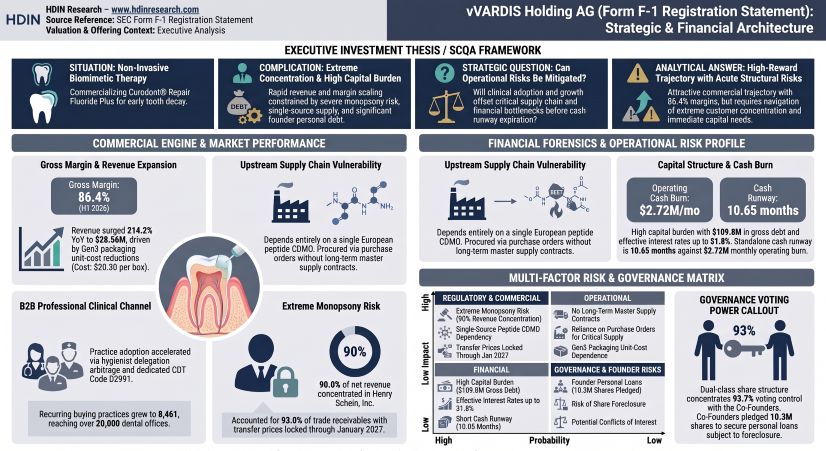 Segmental Realities, Margin Inflection, and Debt Capital Structures
Operating under U.S. GAAP as a single reportable operating segment ("dental care products"), vVARDIS Holding AG reported an inflection in top-line scaling and unit manufacturing economics following the January 2024 launch of Curodont® Repair Fluoride Plus in the United States. Revenue recognition governed by ASC 606 treats wholesale distributors as sole legal customers across a single point-in-time delivery performance obligation, recording zero direct-to-consumer (D2C) transactions.
Table Consolidated Statements of Operations, Product Revenue Mix, and Operating Loss Compression Analysis
The commercial ramp is characterized by an asset-light operational framework. The mid-2025 transition to the third-generation ("Gen3") blister packaging architecture compressed direct manufacturing costs per box from $88.70 in H1 2025 to $20.30 in H1 2026—a 77.10% reduction—lowering aggregate H1 2026 direct COGS by $8.90 million despite a 214.24% volume expansion.
The top-line scaling of $19.17 million in H1 2026 was driven by $17.60 million in organic procedure volume expansion and $1.60 million in realized net price improvements. Recurring Buying Practices (dental practices placing more than one product order over the trailing four months) expanded from 1,084 in Q1 2024 to 8,461 in Q2 2026 (+680.53%). As of June 30, 2026, cumulative penetration reached over 20,000 U.S. practices (~18.18% of the ~110,000 national footprint), with over 3.50 million teeth treated. Conversion from trial to recurring accounts stands at 42.30%.
Table Working Capital Dynamics, Operating Balance Sheet Profile, and Liquidity Analysis
Operating cash flows reflect a temporary distortion. FY2025 operating cash outflow of $(16.33) million and Free Cash Flow of $(19.14) million were subsidized by the $15.00 million customer cash advance from Henry Schein. Normalizing for this transaction, FY2025 operating cash burn was $(31.33) million, and Free Cash Flow burn was $(34.14) million. In H1 2026, operating cash burn was $(16.32) million ($2.72 million per month). The drawdown of the $15.00 million deferred revenue balance against shipments at up to mid-single-digit millions per quarter starting in Q3 2026 creates an operational cash collection deficit through FY2027.
Table Consolidated Debt Capital Structure, Effective Cost of Capital (ASC 470), and Maturity Profile
Contractual principal debt maturities stand at $1.32 million for 2026 (settled April 2026), $29.99 million in 2027 (including $17.20 million in Henry Schein notes), $0 in 2028, $0 in 2029, and $92.61 million in 2030 under the OrbiMed facility. The OrbiMed debt is subject to serial covenant defaults and amendments:
* January 2026: Default on FY2025 minimum revenue targets waived via issuance of 671,528 equity warrants (1.50% fully diluted equity, fair value of $9.88 million at $14.71 per share); establishes a reset revenue test on March 31, 2027.
* April 2026: Default on mandatory $5.00 million ordinary equity financing covenant waived via an $898 thousand (1.00%) PIK fee capitalized into loan principal.
* September 2026: Default from unauthorized liquidation of two corporate subsidiaries waived through March 14, 2027.
Lender equity warrant kickers total 4,052,537 shares, comprising 1,562,081 warrants to Heartland Dental (exercised April 2026), 727,990 warrants to OrbiMed Tranche I (1.75%), 1,090,938 warrants to OrbiMed Tranche II (2.50%), and 671,528 warrants to OrbiMed Amendment (1.50%).
Share-based compensation added $5.89 million in FY2024, $13.88 million in FY2025, and $4.01 million in H1 2026. Pre-IPO options carry nominal par strike prices of CHF 0.006 per share (192,065 options outstanding at June 30, 2026; 892,777 options outstanding at December 31, 2025 with $13.13 million intrinsic value). Unrecognized share compensation totaled $23.09 million at year-end 2025 ($12.70 million RSUs, $10.39 million options), subject to immediate vesting acceleration upon IPO completion. Mezzanine Series B preferred equity carries embedded derivative liabilities bifurcated at $31.40 million fair value under Level 3 Monte Carlo models.
Internal controls over financial reporting audited by Deloitte AG revealed material weaknesses across all five COSO (2013) framework components, specifically involving general IT controls, ERP configurations, access segregation, and revenue monitoring. Foreign exchange sensitivity under ASC 830 indicates that a 10.00% strengthening of the USD relative to the CHF expands the interim operating loss by $6.80 million ($9.10 million for FY2025), with zero active currency derivatives in place.
Supply Chain Architecture, Single-Source CDMO Vulnerabilities, and Geographic Footprint
vVARDIS Holding AG operates an asset-light corporate infrastructure. Global physical footprints encompass three primary leased facilities totaling less than 700 square meters, supporting $812 thousand in net property and equipment:
* Zug, Switzerland: Global corporate headquarters comprising 555.5 square meters at Zug Park Tower, Gubelstrasse 24, leased through 2030. Directs executive administration, intellectual property, and regulatory operations.
* Schlieren, Switzerland: R&D and quality control laboratories occupying 113.2 square meters of leased wet-lab space, handling formulation assays, stability profiles, and analytical testing.
* New York, United States: Commercial operating subsidiary (vVARDIS Inc.) operating from 99 Wall Street, Suite 1836, directing North American sales infrastructure, DSO accounts, and field personnel.
Production and logistics execution are entirely externalized across a multi-tier contract manufacturing framework.
The manufacturing architecture contains operational bottlenecks at the active ingredient and device component stages:
* Single-Source Peptide CDMO: 100% of the active self-assembling 11-amino-acid peptide P11-4 is synthesized by a single European contract development and manufacturing organization via solid-phase peptide synthesis (SPPS). Procurement operates on discrete purchase orders without a long-term master supply agreement. Because peptide tech transfers and Good Manufacturing Practice (GMP) validations require 12 to 24 months, vVARDIS initiated secondary CDMO qualification programs in 2025, lifting H1 2026 R&D expenditures by 257.59% YoY to $7.16 million.
* Single-Source Applicator and Coating Provider: The chairside delivery sponge and proprietary chemical surface coatings are produced by a single specialized vendor under purchase orders.
* Downstream Commercial Fulfillment: Master distribution is concentrated in Henry Schein, Inc., which represented 70.00% of gross revenue in FY2024, 72.00% in FY2025, and 90.00% ($25.70 million) in H1 2026. Trade receivables owed by Henry Schein stood at 93.00% ($6.70 million) on June 30, 2026. Under the Master Distribution Agreement (extended through December 31, 2029 in the U.S. and December 31, 2026 in the U.K.):
* Transfer prices are fixed through January 1, 2027, with price adjustments requiring six months' advance written notice.
* The contract contains no minimum purchase obligations.
* Exclusivity retention is contingent on Henry Schein achieving customer onboarding thresholds by December 31, 2027 (cure to June 30, 2028) and December 31, 2028.
* Accelerated cash repayment of uncredited portions of the $15.00 million advance can be triggered by vVARDIS defaults, corporate change of control, or failure to fulfill purchase orders within 15 days.
* End-Market Consumption: Dental Support Organizations account for 60.00% to 65.00% of end-market consumption. Heartland Dental, LLC (backed by KKR) accounted for 51.00% of U.S. product sales in FY2024 and 31.00% in FY2025, operating under an April 2026 commercial volume-rebate agreement while holding 2,160,651 equity share equivalents (9.24% pre-IPO stake). A secondary European distributor generated 8.00% of FY2024, 13.00% of FY2025, and 5.00% ($1.43 million) of H1 2026 sales, resulting in 95.00% top-two distributor concentration.
Table Geographic Revenue Disaggregation, Market Concentration, and Regulatory Pathway Analysis
Cross-border expansion plans adhere to international geographical naming conventions. Prospective entry into East Asian markets encompasses mainland China alongside administrative filings in Taiwan, Province of China, following PMDA evaluations in Japan.
Regulatory positioning diverges between operating jurisdictions:
* United States: Marketed as an Over-the-Counter (OTC) drug under FDA Monograph M021 (Anticaries Drug Products, 21 CFR Part 355) solely on the basis of its 0.11% w/v sodium fluoride active content. Peptide P11-4 is legally positioned as an inactive excipient. The product holds zero 510(k) clearances or Premarket Approvals (PMA). The delivery sponge carries the risk of FDA reclassification into a drug-device combination product, which would mandate premarket submissions and compliance with the Quality Management System Regulation (QMSR, 21 CFR Part 820 / ISO 13485:2016), effective February 2, 2026.
* Europe & Switzerland: Marketed without fluoride as a Class IIa Medical Device via physical scaffolding action under EU MDR (Regulation (EU) 2017/745). The CE mark has been held via SQS (Notified Body 1250) since January 2012. Legacy transitional provisions expire between 2027 and 2028. Under the Swiss Medical Devices Ordinance (MedDO), mandatory swissdamed device registration must be completed by December 31, 2026, amid an active 2026 Swissmedic surveillance audit campaign on Class IIa post-market surveillance.
* Cosmetic Lines: Remineralization gel Curodont® Protect is regulated under EU Cosmetics Regulation 1223/2009, Swiss VKos, and U.S. MoCRA.
Intellectual property acquired via Credentis AG in 2020 carries zero external university royalties or academic licensing encumbrances. The estate encompasses 83 issued patents (7 U.S. utility patents, 76 foreign patents across 39 jurisdictions) and 119 pending applications (5 U.S., 102 foreign, 12 PCT), alongside 187 trademarks. Statutory expirations extend from 2033 to 2047:
* Family 1 (Stable Formulations, 2033–2035): Ready-to-use aqueous P11-4 peptide solutions.
* Family 2 (Manufacturing Processes, 2034–2036): Solid-phase peptide synthesis and purification protocols.
* Family 3 (Remineralization Methods, 2035–2038): Methods for deep enamel lesion remineralization (ICDAS 1–2).
* Family 4 (Blister Packaging, 2038–2041): Multi-compartment Gen3 activation packaging.
* Family 5 (Pulp Capping & Secondary Caries, 2040–2044): Restorative hard-tissue pipeline formulations.
* Family 6 (Soft-Tissue & Bone Scaffolds, 2042–2047): Periodontal and orthopedic applications.
Scientific efficacy is documented across >250 publications and five clinical studies:
* Godenzi et al. (2023, JADA): 405 proximal early lesions in 219 pediatric patients tracked over 0.4 to 5.5 years demonstrated 93.00% non-progression, 37.00%–40.00% radiographic regression, and >90.00% cavitation avoidance past 2 years.
* Bröseler et al. (2020, Clin Oral Investig): Split-mouth RCT across 88 lesions in 36 patients confirmed statistically superior lesion size reduction versus fluoride varnish (p = 0.001).
* Alkilzy et al. (2018, JDR): RCT across 70 pediatric occlusal lesions showed 80.00% lesion inactivation versus 34.00% for fluoride varnish controls (p < 0.0001), with superior DiagnoDent scores (p = 0.015) and ICDAS regression (p = 0.018).
* Shaalan et al. (2024, Clin Oral Investig): Double-blind RCT on 58 lesions demonstrated a 60.00% lower risk of progression and 65.50% complete lesion reduction versus 13.80% for calcium phosphate varnish (p < 0.05).
* Welk et al. (2020, Sci Rep): Post-orthodontic study across 23 patients showed superior electrical impedance remineralization (p < 0.001) and morphometric area reduction (p = 0.004).
* Cowen et al. (2025, Dental Advisors): Micro-CT confirmed a 14.30% mineral density increase at 2 weeks (p < 0.001) with SEM imaging validating de novo hydroxyapatite crystal integration.
HDIN Institutional Verdict
vVARDIS Holding AG demonstrates commercial adoption for Curodont® Repair Fluoride Plus within corporate dental channels, yet its operational foundations present concentrated risks for public market equity investors.
The commercial engine relies on chairside economic arbitrage. By qualifying under ADA CDT Code D2991 (established January 2024 under Restorative Services; reimbursed across 11 state Medicaid programs and 9 commercial payers), clinics delegating the 3- to 5-minute procedure to dental hygienists generate between $1,950 and $2,250 in gross clinic profit per chair-hour (charging $130 to $150 against a $33 to $38 material cost), compared to $200 to $500 per hour for traditional 30-minute dentist operative drilling. Integration into diagnostic AI platforms (VideaHealth, Pearl, Henry Schein One Dentrix Ascend) drives a three-fold lift in completed treatments.
However, enterprise valuation is constrained by capital structure imbalances, single-channel exposure, and governance provisions:
* Distributor Monopsony and Prepayment Headwind: Selling 90.00% of volume through Henry Schein under transfer prices contractually frozen through January 1, 2027 prevents input cost pass-through. Furthermore, burning down Henry Schein's $15.00 million cash advance starting in Q3 2026 will sever the link between recognized revenues and operational cash collections.
* High Cost of Debt: Carrying $109.79 million in contractual debt obligations bearing effective interest rates up to 31.80% creates a capital cost overhang. Net interest consumed $9.02 million in H1 2026 (31.57% of net revenue). Serial covenant defaults require ongoing lender forbearance, with the subsidiary liquidation waiver set to expire on March 14, 2027, followed by a minimum revenue covenant test on March 31, 2027, and $17.20 million in Henry Schein promissory notes maturing June 30, 2027.
* Founder Debt Overhang and Collateral Foreclosure Risk: Co-Founders Dr. Haley Abivardi and Dr. Goly Abivardi have pledged 10,329,430 ordinary shares to collateralize CHF 105.00 million ($132.40 million) in personal loans. A primary facility of CHF 70.00 million was in default from December 2024 to October 5, 2026, and its maturity was extended only through December 31, 2026. Underwriting lock-up agreements explicitly exempt these lenders from trading restrictions, allowing open-market foreclosure and liquidation of the pledged shares, introducing market overhang and change-of-control risks.
* Dual-Class Control and Governance Exemptions: Utilizing Swiss corporate law mechanisms (Articles 627 and 693 CO), the Founders hold 193,888,790 Class B voting shares (CHF 0.0006 par value) against 23,382,926 Class A ordinary shares (CHF 0.006 par value), securing 93.70% pre-IPO voting control via a 10:1 voting leverage ratio while retaining a 67.80% economic interest. Institutional holdings include Cerebro Equity GmbH (11.20% Class A / 6.10% economic), OrbiMed Advisors (9.70% Class A / 5.60% economic), Heartland Dental (9.20% Class A / 5.10% economic), and Curo Bidco / Apollo (7.80% Class A / 4.30% economic). Co-Founders serve as both Co-CEOs and Co-Chairs, with board independence limited to 33.33% (2 of 6 directors). Opting out of NYSE corporate governance standards via Foreign Private Issuer and Controlled Company status limits minority shareholder protections, while Swiss corporate law precludes Delaware-style derivative and class actions, establishing exclusive jurisdiction in Zug.
vVARDIS has demonstrated clinical product-market fit for Curodont® in the U.S. DSO sector. However, until management diversifies its single-source peptide CDMO supply chain, renegotiates wholesale transfer pricing post-January 2027, refinances its high-cost senior debt, and unwinds founder personal share pledges, the enterprise profile will reflect operational and balance sheet frictions that temper its top-line trajectory.
Presentation Download & Video Access
* Presentation Download: Click the PDF download link under 'Related Topics' to access the full institutional presentation of this report.
* Video Link: Click this link to watch the HDIN analyst briefing on YouTube.
About HDIN Research
HDIN Research is a global market intelligence and strategic advisory firm specializing in institutional-grade financial analysis, supply chain audits, and macroeconomic forecasting. Our dedicated sector analysts deliver actionable, data-driven insights tailored for private equity, hedge funds, and corporate strategy teams. Visit us at http://www.hdinresearch.com.
2026 AI Transparency Footer
"This intelligence report was authored by HDIN Research analysts following a rigorous audit of official corporate filings. AI was utilized for massive-scale data synthesis and structural drafting, ensuring 100% inclusion of reported data points. All strategic insights, financial modeling, and final verdicts were verified by our editorial board to ensure professional accuracy and compliance with 2026 Google Search E-E-A-T standards."
1. vVARDIS Holding AG [NYSE: VVVV] expanded H1 2026 net revenue by 214.24% year-over-year to $28.56 million, expanding gross margin by 3,500 basis points to 86.40% via Gen3 packaging efficiencies that compressed unit costs by 77.10% to $20.30 per box.
2. Channel exposure is concentrated, with Henry Schein, Inc. capturing 90.00% of H1 2026 revenues and 93.00% of trade receivables under fixed transfer pricing through January 1, 2027, while peptide P11-4 synthesis relies entirely on a single European CDMO.
3. Balance sheet risk remains elevated, marked by $109.79 million in contractual debt with effective borrowing rates reaching 31.80%, an unadjusted 10.65-month cash runway of $28.97 million, and 10,329,430 founder shares pledged against CHF 105.00 million in personal loans.
Figure VVARDIS Holding AG Form F-1 Registration Statement Strategic & Financial Architecture
Segmental Realities, Margin Inflection, and Debt Capital StructuresOperating under U.S. GAAP as a single reportable operating segment ("dental care products"), vVARDIS Holding AG reported an inflection in top-line scaling and unit manufacturing economics following the January 2024 launch of Curodont® Repair Fluoride Plus in the United States. Revenue recognition governed by ASC 606 treats wholesale distributors as sole legal customers across a single point-in-time delivery performance obligation, recording zero direct-to-consumer (D2C) transactions.
Table Consolidated Statements of Operations, Product Revenue Mix, and Operating Loss Compression Analysis
| Financial Statement Metric ($ in thousands) | FY2024 (Audited) | FY2025 (Audited) | YoY Shift (%) | H1 2025 (Unaudited) | H1 2026 (Unaudited) | YoY Shift (%) |
| Professional In-Office (Curodont® Repair) | $10,938 | $28,737 | +162.73% | $7,972 | $27,138 | +240.42% |
| Consumer Home-Care (Curodont® Protect) | $1,219 | $1,472 | +20.75% | $1,116 | $1,420 | +27.24% |
| Direct-to-Consumer (D2C) Revenue | $0 | $0 | 0.00% | $0 | $0 | 0.00% |
| Total Consolidated Net Revenue | $12,157 | $30,209 | +148.49% | $9,088 | $28,558 | +214.24% |
| Cost of Goods Sold (COGS) | $(8,269) | $(7,792) | -5.77% | $(4,417) | $(3,885) | -12.04% |
| Gross Profit | $3,888 | $22,417 | +476.57% | $4,671 | $24,673 | +428.22% |
| Gross Margin (%) | 31.98% | 74.21% | +4,223 bps | 51.40% | 86.40% | +3,500 bps |
| Research & Development (R&D) | $(2,641) | $(4,575) | +73.23% | $(2,002) | $(7,159) | +257.59% |
| SG&A: Commercial & Personnel Costs | $(18,582) | $(37,324) | +100.86% | $(16,082) | $(19,876) | +23.59% |
| SG&A: Marketing & Promotion | $(2,445) | $(5,905) | +141.51% | $(3,236) | $(4,253) | +31.43% |
| SG&A: Non-Personnel Operating G&A | $(6,698) | $(12,015) | +79.38% | $(5,617) | $(8,037) | +43.08% |
| SG&A: Restructuring & Advisory | $(593) | $(725) | +22.26% | $0 | $(605) | N/A |
| SG&A: Depreciation & Amortization | $(3,895) | $(3,958) | +1.62% | $(1,815) | $(2,293) | +26.34% |
| Total Operating Expenses | $(34,854) | $(64,500) | +85.06% | $(28,752) | $(42,223) | +46.85% |
| Operating Loss (EBIT) | $(30,966) | $(42,084) | +35.90% | $(24,081) | $(17,550) | -27.12% |
| Operating Margin (%) | -254.72% | -139.31% | +11,541 bps | -264.98% | -61.45% | +20,353 bps |
| Interest Expense | $(3,942) | $(11,753) | +198.15% | $(4,061) | $(9,015) | +122.00% |
| Fair Value Loss on Loans | $(412) | $(1,647) | +299.76% | $(1,474) | $(1,205) | -18.25% |
| Gain on Loan Conversion | $0 | $0 | N/A | $0 | $1,613 | N/A |
| Change in Derivative Liabilities | $0 | $0 | N/A | $0 | $(8) | N/A |
| Loss on Term Loan Extinguishment | $0 | $(1,628) | N/A | $(1,245) | $(1,580) | +26.91% |
| Other Income / (Expense), net | $184 | $298 | +61.96% | $(1,169) | $(412) | -64.76% |
| Loss Before Taxes | $(35,135) | $(56,813) | +61.70% | $(32,030) | $(28,157) | -12.09% |
| Income Tax Benefit / (Expense) | $398 | $366 | -8.04% | $(26) | $350 | N/A |
| Net Loss | $(34,737) | $(56,447) | +62.50% | $(32,057) | $(27,807) | -13.26% |
The commercial ramp is characterized by an asset-light operational framework. The mid-2025 transition to the third-generation ("Gen3") blister packaging architecture compressed direct manufacturing costs per box from $88.70 in H1 2025 to $20.30 in H1 2026—a 77.10% reduction—lowering aggregate H1 2026 direct COGS by $8.90 million despite a 214.24% volume expansion.
The top-line scaling of $19.17 million in H1 2026 was driven by $17.60 million in organic procedure volume expansion and $1.60 million in realized net price improvements. Recurring Buying Practices (dental practices placing more than one product order over the trailing four months) expanded from 1,084 in Q1 2024 to 8,461 in Q2 2026 (+680.53%). As of June 30, 2026, cumulative penetration reached over 20,000 U.S. practices (~18.18% of the ~110,000 national footprint), with over 3.50 million teeth treated. Conversion from trial to recurring accounts stands at 42.30%.
Table Working Capital Dynamics, Operating Balance Sheet Profile, and Liquidity Analysis
| Working Capital & Operating Balance Sheet Metrics ($ in thousands) | FY2024 (Dec 31) | FY2025 (Dec 31) | H1 2026 (Jun 30) | Balance Sheet Dynamic |
| Cash and Cash Equivalents | $2,343 | $17,470 | $28,974 | Standalone runway: 10.65 months at $2.72M/mo burn |
| Restricted Cash (Escrow & Collateral) | $62 | $211 | $207 | Statutory lease and escrow deposits |
| Net Accounts Receivable | $2,037 | $3,042 | $7,220 | Gross A/R grew 128.80% in H1 2026 to $7,420k |
| Days Sales Outstanding (DSO) - Net / Gross | 61.16 / 66.45 | 36.75 / 39.19 | 45.81 / 47.09 | Henry Schein concentration drives receivable terms |
| Raw Materials & Components Inventory | $3,171 | $3,534 | $6,142 | Safety stock accumulation of peptide active ingredient |
| Work in Process (WIP) Inventory | $3,450 | $3,176 | $2,875 | Unfinished blister filling and packaging batches |
| Finished Goods Inventory | $5,629 | $2,185 | $2,116 | Gen3 finished inventory; 34-month shelf life |
| Excess & Obsolescence Reserve | $(3,916) | $(279) | $(422) | $3.92M older-gen inventory scrapped in 2025 |
| Total Net Inventory | $8,334 | $8,616 | $10,711 | Gross inventory stands at $11,133k |
| Days Inventory Outstanding (DIO) - Net / Gross | 367.92 / 540.80 | 403.62 / 416.70 | 499.04 / 518.70 | Mathematical elevation via 77.10% Gen3 unit COGS cut |
| Current Advances to Suppliers | $47 | $2,065 | $2,813 | Purchase order prepayments for CDMO capacity slots |
| Non-Current Advances to Suppliers | $0 | $1,002 | $982 | Contractual inventory deliveries due in 2027–2028 |
| Accounts Payable | $4,653 | $6,857 | $6,876 | CMO, commercial, advisory, and IT implementations |
| Days Payable Outstanding (DPO) | 205.38 | 321.23 | 320.30 | Normalizes to 50–60 days against total cash opex |
| Cash Conversion Cycle (CCC) | 223.70 days | 119.14 days | 224.55 days | Working capital absorption across receivables and stock |
| Accrued Distributor Rebates | $260 | $1,358 | $5,359 | Surged 294.62% in H1 2026 on volume-tier achievement |
| Deferred Revenue (Henry Schein Cash Prepayment) | $0 | $15,000 | $15,000 | Reclassified as current liability; burns down from Q3 2026 |
| Operating Lease Right-of-Use (ROU) Assets | $0 | $2,370 | $1,730 | Zug Park Tower headquarters sublease; expiry 2030 |
| Total Operating Lease Liabilities | $0 | $2,462 | $2,160 | $512k current; $1,648k non-current (3.0% discount rate) |
| Capitalized Intangibles: Patents (Credentis AG) | $32,270 | $27,968 | $23,666 | $53,200k cost basis; 7-year remaining useful life |
| Capitalized Intangibles: Trademarks | $4,418 | $4,008 | $3,597 | $8,198k cost basis; 6-year remaining useful life |
| Capitalized Intangibles: Software (ERP / CRM) | $278 | $2,323 | $1,813 | $2,223k cost basis; 4-year remaining useful life |
| Goodwill (Credentis AG Acquisition, ASC 805) | $13,120 | $13,390 | $13,120 | Tested annually via DCF; zero historical impairments |
| Accumulated Balance Sheet Deficit | $(172,066) | $(228,513) | $(256,320) | Reflects cumulative commercial and financing burn |
Operating cash flows reflect a temporary distortion. FY2025 operating cash outflow of $(16.33) million and Free Cash Flow of $(19.14) million were subsidized by the $15.00 million customer cash advance from Henry Schein. Normalizing for this transaction, FY2025 operating cash burn was $(31.33) million, and Free Cash Flow burn was $(34.14) million. In H1 2026, operating cash burn was $(16.32) million ($2.72 million per month). The drawdown of the $15.00 million deferred revenue balance against shipments at up to mid-single-digit millions per quarter starting in Q3 2026 creates an operational cash collection deficit through FY2027.
Table Consolidated Debt Capital Structure, Effective Cost of Capital (ASC 470), and Maturity Profile
| Debt Instrument & Lender Facility ($ in thousands) | Contractual Face Value | Carrying Value (Jun 30, 2026) | Stated Nominal Interest Rate | Effective Interest Rate (ASC 470) | Contractual Maturity Date | Covenant Compliance & Legal Status |
| Henry Schein 2026 Term Loan Tranche I | $11,568 | $11,568 | 8.00% PIK | 8.00% | June 30, 2027 | Extended to 2027; classified as current liability |
| Henry Schein 2026 Term Loan Tranche II | $5,636 | $5,636 | 8.00% PIK | 8.00% | June 30, 2027 | Subordinated promissory notes |
| OrbiMed 2030 Term Loan Tranche I | $37,485 | Gross: $37,485k | SOFR + 7.50% (3.5% floor) | 24.60% | February 2030 | Unamortized discounts reflect warrant allocations |
| OrbiMed 2030 Term Loan Tranche II | $55,125 | Gross: $55,125k | SOFR + 12.50% (3.5% floor) | 31.80% | February 2030 | Unamortized discount total: $(25,607)k |
| Total Consolidated Debt Obligations | $109,794 | $84,207 | Floating High Cost | Up to 31.80% | 2027–2030 | Net Interest H1 2026: $9,015k (31.57% of rev) |
Contractual principal debt maturities stand at $1.32 million for 2026 (settled April 2026), $29.99 million in 2027 (including $17.20 million in Henry Schein notes), $0 in 2028, $0 in 2029, and $92.61 million in 2030 under the OrbiMed facility. The OrbiMed debt is subject to serial covenant defaults and amendments:
* January 2026: Default on FY2025 minimum revenue targets waived via issuance of 671,528 equity warrants (1.50% fully diluted equity, fair value of $9.88 million at $14.71 per share); establishes a reset revenue test on March 31, 2027.
* April 2026: Default on mandatory $5.00 million ordinary equity financing covenant waived via an $898 thousand (1.00%) PIK fee capitalized into loan principal.
* September 2026: Default from unauthorized liquidation of two corporate subsidiaries waived through March 14, 2027.
Lender equity warrant kickers total 4,052,537 shares, comprising 1,562,081 warrants to Heartland Dental (exercised April 2026), 727,990 warrants to OrbiMed Tranche I (1.75%), 1,090,938 warrants to OrbiMed Tranche II (2.50%), and 671,528 warrants to OrbiMed Amendment (1.50%).
Share-based compensation added $5.89 million in FY2024, $13.88 million in FY2025, and $4.01 million in H1 2026. Pre-IPO options carry nominal par strike prices of CHF 0.006 per share (192,065 options outstanding at June 30, 2026; 892,777 options outstanding at December 31, 2025 with $13.13 million intrinsic value). Unrecognized share compensation totaled $23.09 million at year-end 2025 ($12.70 million RSUs, $10.39 million options), subject to immediate vesting acceleration upon IPO completion. Mezzanine Series B preferred equity carries embedded derivative liabilities bifurcated at $31.40 million fair value under Level 3 Monte Carlo models.
Internal controls over financial reporting audited by Deloitte AG revealed material weaknesses across all five COSO (2013) framework components, specifically involving general IT controls, ERP configurations, access segregation, and revenue monitoring. Foreign exchange sensitivity under ASC 830 indicates that a 10.00% strengthening of the USD relative to the CHF expands the interim operating loss by $6.80 million ($9.10 million for FY2025), with zero active currency derivatives in place.
Supply Chain Architecture, Single-Source CDMO Vulnerabilities, and Geographic Footprint
vVARDIS Holding AG operates an asset-light corporate infrastructure. Global physical footprints encompass three primary leased facilities totaling less than 700 square meters, supporting $812 thousand in net property and equipment:
* Zug, Switzerland: Global corporate headquarters comprising 555.5 square meters at Zug Park Tower, Gubelstrasse 24, leased through 2030. Directs executive administration, intellectual property, and regulatory operations.
* Schlieren, Switzerland: R&D and quality control laboratories occupying 113.2 square meters of leased wet-lab space, handling formulation assays, stability profiles, and analytical testing.
* New York, United States: Commercial operating subsidiary (vVARDIS Inc.) operating from 99 Wall Street, Suite 1836, directing North American sales infrastructure, DSO accounts, and field personnel.
Production and logistics execution are entirely externalized across a multi-tier contract manufacturing framework.
The manufacturing architecture contains operational bottlenecks at the active ingredient and device component stages:
* Single-Source Peptide CDMO: 100% of the active self-assembling 11-amino-acid peptide P11-4 is synthesized by a single European contract development and manufacturing organization via solid-phase peptide synthesis (SPPS). Procurement operates on discrete purchase orders without a long-term master supply agreement. Because peptide tech transfers and Good Manufacturing Practice (GMP) validations require 12 to 24 months, vVARDIS initiated secondary CDMO qualification programs in 2025, lifting H1 2026 R&D expenditures by 257.59% YoY to $7.16 million.
* Single-Source Applicator and Coating Provider: The chairside delivery sponge and proprietary chemical surface coatings are produced by a single specialized vendor under purchase orders.
* Downstream Commercial Fulfillment: Master distribution is concentrated in Henry Schein, Inc., which represented 70.00% of gross revenue in FY2024, 72.00% in FY2025, and 90.00% ($25.70 million) in H1 2026. Trade receivables owed by Henry Schein stood at 93.00% ($6.70 million) on June 30, 2026. Under the Master Distribution Agreement (extended through December 31, 2029 in the U.S. and December 31, 2026 in the U.K.):
* Transfer prices are fixed through January 1, 2027, with price adjustments requiring six months' advance written notice.
* The contract contains no minimum purchase obligations.
* Exclusivity retention is contingent on Henry Schein achieving customer onboarding thresholds by December 31, 2027 (cure to June 30, 2028) and December 31, 2028.
* Accelerated cash repayment of uncredited portions of the $15.00 million advance can be triggered by vVARDIS defaults, corporate change of control, or failure to fulfill purchase orders within 15 days.
* End-Market Consumption: Dental Support Organizations account for 60.00% to 65.00% of end-market consumption. Heartland Dental, LLC (backed by KKR) accounted for 51.00% of U.S. product sales in FY2024 and 31.00% in FY2025, operating under an April 2026 commercial volume-rebate agreement while holding 2,160,651 equity share equivalents (9.24% pre-IPO stake). A secondary European distributor generated 8.00% of FY2024, 13.00% of FY2025, and 5.00% ($1.43 million) of H1 2026 sales, resulting in 95.00% top-two distributor concentration.
Table Geographic Revenue Disaggregation, Market Concentration, and Regulatory Pathway Analysis
| Geographic Destination ($ in thousands) | FY2024 | Share (%) | FY2025 | Share (%) | H1 2025 | Share (%) | H1 2026 | Share (%) | Regulatory Vehicle & Commercial Model |
| United States (North America) | $10,938 | 89.97% | $28,737 | 95.13% | $7,972 | 87.72% | $27,138 | 95.03% | FDA OTC Monograph M021; Henry Schein Exclusive |
| Switzerland | $451 | 3.71% | $583 | 1.93% | $635 | 6.99% | $317 | 1.11% | Swiss MedDO Class IIa; swissdamed Dec-26 deadline |
| Italy | $288 | 2.37% | $354 | 1.17% | $261 | 2.87% | $533 | 1.87% | EU MDR Class IIa; direct wholesale distributor |
| United Kingdom | $136 | 1.12% | $225 | 0.74% | $0 | 0.00% | $442 | 1.55% | UKCA / CE mark; Henry Schein exclusive to Dec 2026 |
| Other International Markets | $344 | 2.83% | $310 | 1.03% | $220 | 2.42% | $128 | 0.45% | Includes Greater China regulatory evaluations |
| Total Net Revenues | $12,157 | 100.0% | $30,209 | 100.0% | $9,088 | 100.0% | $28,558 | 100.0% | U.S. represents 95.03% of H1 2026 geographic mix |
Cross-border expansion plans adhere to international geographical naming conventions. Prospective entry into East Asian markets encompasses mainland China alongside administrative filings in Taiwan, Province of China, following PMDA evaluations in Japan.
Regulatory positioning diverges between operating jurisdictions:
* United States: Marketed as an Over-the-Counter (OTC) drug under FDA Monograph M021 (Anticaries Drug Products, 21 CFR Part 355) solely on the basis of its 0.11% w/v sodium fluoride active content. Peptide P11-4 is legally positioned as an inactive excipient. The product holds zero 510(k) clearances or Premarket Approvals (PMA). The delivery sponge carries the risk of FDA reclassification into a drug-device combination product, which would mandate premarket submissions and compliance with the Quality Management System Regulation (QMSR, 21 CFR Part 820 / ISO 13485:2016), effective February 2, 2026.
* Europe & Switzerland: Marketed without fluoride as a Class IIa Medical Device via physical scaffolding action under EU MDR (Regulation (EU) 2017/745). The CE mark has been held via SQS (Notified Body 1250) since January 2012. Legacy transitional provisions expire between 2027 and 2028. Under the Swiss Medical Devices Ordinance (MedDO), mandatory swissdamed device registration must be completed by December 31, 2026, amid an active 2026 Swissmedic surveillance audit campaign on Class IIa post-market surveillance.
* Cosmetic Lines: Remineralization gel Curodont® Protect is regulated under EU Cosmetics Regulation 1223/2009, Swiss VKos, and U.S. MoCRA.
Intellectual property acquired via Credentis AG in 2020 carries zero external university royalties or academic licensing encumbrances. The estate encompasses 83 issued patents (7 U.S. utility patents, 76 foreign patents across 39 jurisdictions) and 119 pending applications (5 U.S., 102 foreign, 12 PCT), alongside 187 trademarks. Statutory expirations extend from 2033 to 2047:
* Family 1 (Stable Formulations, 2033–2035): Ready-to-use aqueous P11-4 peptide solutions.
* Family 2 (Manufacturing Processes, 2034–2036): Solid-phase peptide synthesis and purification protocols.
* Family 3 (Remineralization Methods, 2035–2038): Methods for deep enamel lesion remineralization (ICDAS 1–2).
* Family 4 (Blister Packaging, 2038–2041): Multi-compartment Gen3 activation packaging.
* Family 5 (Pulp Capping & Secondary Caries, 2040–2044): Restorative hard-tissue pipeline formulations.
* Family 6 (Soft-Tissue & Bone Scaffolds, 2042–2047): Periodontal and orthopedic applications.
Scientific efficacy is documented across >250 publications and five clinical studies:
* Godenzi et al. (2023, JADA): 405 proximal early lesions in 219 pediatric patients tracked over 0.4 to 5.5 years demonstrated 93.00% non-progression, 37.00%–40.00% radiographic regression, and >90.00% cavitation avoidance past 2 years.
* Bröseler et al. (2020, Clin Oral Investig): Split-mouth RCT across 88 lesions in 36 patients confirmed statistically superior lesion size reduction versus fluoride varnish (p = 0.001).
* Alkilzy et al. (2018, JDR): RCT across 70 pediatric occlusal lesions showed 80.00% lesion inactivation versus 34.00% for fluoride varnish controls (p < 0.0001), with superior DiagnoDent scores (p = 0.015) and ICDAS regression (p = 0.018).
* Shaalan et al. (2024, Clin Oral Investig): Double-blind RCT on 58 lesions demonstrated a 60.00% lower risk of progression and 65.50% complete lesion reduction versus 13.80% for calcium phosphate varnish (p < 0.05).
* Welk et al. (2020, Sci Rep): Post-orthodontic study across 23 patients showed superior electrical impedance remineralization (p < 0.001) and morphometric area reduction (p = 0.004).
* Cowen et al. (2025, Dental Advisors): Micro-CT confirmed a 14.30% mineral density increase at 2 weeks (p < 0.001) with SEM imaging validating de novo hydroxyapatite crystal integration.
HDIN Institutional Verdict
vVARDIS Holding AG demonstrates commercial adoption for Curodont® Repair Fluoride Plus within corporate dental channels, yet its operational foundations present concentrated risks for public market equity investors.
The commercial engine relies on chairside economic arbitrage. By qualifying under ADA CDT Code D2991 (established January 2024 under Restorative Services; reimbursed across 11 state Medicaid programs and 9 commercial payers), clinics delegating the 3- to 5-minute procedure to dental hygienists generate between $1,950 and $2,250 in gross clinic profit per chair-hour (charging $130 to $150 against a $33 to $38 material cost), compared to $200 to $500 per hour for traditional 30-minute dentist operative drilling. Integration into diagnostic AI platforms (VideaHealth, Pearl, Henry Schein One Dentrix Ascend) drives a three-fold lift in completed treatments.
However, enterprise valuation is constrained by capital structure imbalances, single-channel exposure, and governance provisions:
* Distributor Monopsony and Prepayment Headwind: Selling 90.00% of volume through Henry Schein under transfer prices contractually frozen through January 1, 2027 prevents input cost pass-through. Furthermore, burning down Henry Schein's $15.00 million cash advance starting in Q3 2026 will sever the link between recognized revenues and operational cash collections.
* High Cost of Debt: Carrying $109.79 million in contractual debt obligations bearing effective interest rates up to 31.80% creates a capital cost overhang. Net interest consumed $9.02 million in H1 2026 (31.57% of net revenue). Serial covenant defaults require ongoing lender forbearance, with the subsidiary liquidation waiver set to expire on March 14, 2027, followed by a minimum revenue covenant test on March 31, 2027, and $17.20 million in Henry Schein promissory notes maturing June 30, 2027.
* Founder Debt Overhang and Collateral Foreclosure Risk: Co-Founders Dr. Haley Abivardi and Dr. Goly Abivardi have pledged 10,329,430 ordinary shares to collateralize CHF 105.00 million ($132.40 million) in personal loans. A primary facility of CHF 70.00 million was in default from December 2024 to October 5, 2026, and its maturity was extended only through December 31, 2026. Underwriting lock-up agreements explicitly exempt these lenders from trading restrictions, allowing open-market foreclosure and liquidation of the pledged shares, introducing market overhang and change-of-control risks.
* Dual-Class Control and Governance Exemptions: Utilizing Swiss corporate law mechanisms (Articles 627 and 693 CO), the Founders hold 193,888,790 Class B voting shares (CHF 0.0006 par value) against 23,382,926 Class A ordinary shares (CHF 0.006 par value), securing 93.70% pre-IPO voting control via a 10:1 voting leverage ratio while retaining a 67.80% economic interest. Institutional holdings include Cerebro Equity GmbH (11.20% Class A / 6.10% economic), OrbiMed Advisors (9.70% Class A / 5.60% economic), Heartland Dental (9.20% Class A / 5.10% economic), and Curo Bidco / Apollo (7.80% Class A / 4.30% economic). Co-Founders serve as both Co-CEOs and Co-Chairs, with board independence limited to 33.33% (2 of 6 directors). Opting out of NYSE corporate governance standards via Foreign Private Issuer and Controlled Company status limits minority shareholder protections, while Swiss corporate law precludes Delaware-style derivative and class actions, establishing exclusive jurisdiction in Zug.
vVARDIS has demonstrated clinical product-market fit for Curodont® in the U.S. DSO sector. However, until management diversifies its single-source peptide CDMO supply chain, renegotiates wholesale transfer pricing post-January 2027, refinances its high-cost senior debt, and unwinds founder personal share pledges, the enterprise profile will reflect operational and balance sheet frictions that temper its top-line trajectory.
Presentation Download & Video Access
* Presentation Download: Click the PDF download link under 'Related Topics' to access the full institutional presentation of this report.
* Video Link: Click this link to watch the HDIN analyst briefing on YouTube.
About HDIN Research
HDIN Research is a global market intelligence and strategic advisory firm specializing in institutional-grade financial analysis, supply chain audits, and macroeconomic forecasting. Our dedicated sector analysts deliver actionable, data-driven insights tailored for private equity, hedge funds, and corporate strategy teams. Visit us at http://www.hdinresearch.com.
2026 AI Transparency Footer
"This intelligence report was authored by HDIN Research analysts following a rigorous audit of official corporate filings. AI was utilized for massive-scale data synthesis and structural drafting, ensuring 100% inclusion of reported data points. All strategic insights, financial modeling, and final verdicts were verified by our editorial board to ensure professional accuracy and compliance with 2026 Google Search E-E-A-T standards."