ITI Limited: Asset Monetization Shields Pre-Tax Losses as Working Capital Deficit and ₹2,241 Crore Unbilled Revenue Strain Operations
Date : 2026-10-20
Reading : 115
HDIN Market Intelligence Brief
1. ITI Limited [NSE: ITIL / BSE: 523610] posted FY2025–26 net profit of ₹292.84 crore, reversing a ₹214.89 crore loss, entirely driven by ₹832.19 crore in real estate disposal gains that masked a ₹156.36 crore core operating loss before tax.
2. In-house manufacturing accounted for 1.47% of revenue while the true cash cycle stretched to 466.8 days, encumbering ₹2,241.11 crore in unbilled contract assets across BharatNet Phase-III and ASCON Phase-IV execution corridors.
3. Statutory auditors issued a blanket Disclaimer of Opinion across standalone and consolidated statements, citing absent Internal Financial Controls Over Financial Reporting (IFCoFR), unverified fixed assets, and ₹2,568.19 crore in off-balance-sheet contingent claims against ₹24.40 crore in cash.
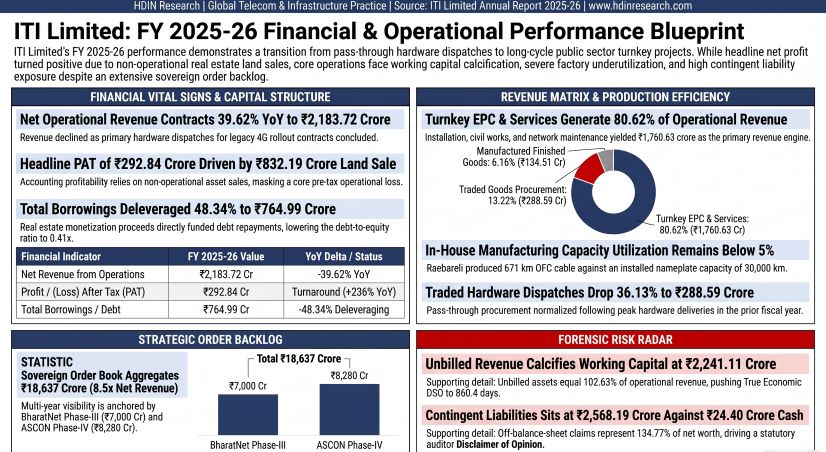
Figure ITl Limited FY 2025-26 Financial & Operational Performance Blueprint
 Segmental Realities and Capital Structure Divergence
ITI Limited’s financial architecture for FY2025–26 demonstrates an operational profile decoupled from its stated positioning as an integrated hardware original equipment manufacturer (OEM). The apparent return to net profitability was driven by non-operational asset disposals rather than manufacturing expansion.
Table OPERATIONAL THROUGHPUT DIVERGENCE (FY2025–26 GROSS TURNOVER: ₹2,464.77 CR)
Consolidated revenue from operations contracted 39.62% year-over-year to ₹2,183.72 crore, compared to ₹3,616.42 crore in FY2024–25. This contraction resulted from an 87.98% drop in direct purchases of traded stock (from ₹2,346.34 crore to ₹282.08 crore) and a 42.58% reduction in service turnover following the completion of primary wireless hardware deliveries for the Bharat Sanchar Nigam Limited [BSNL] 4G West Zone project, where revenue fell 96.87% from ₹2,394.28 crore to ₹74.92 crore.
Table Consolidated Financial Performance and Cash Flow Analysis (FY2025–26 vs. FY2024–25)
The enterprise financed its debt retirement through asset disposals rather than operational cash generation. Generating negative operating cash flow of ₹33.37 crore, the company utilized ₹884.22 crore in cash proceeds from selling 21 acres at KR Puram, Bengaluru, to the Central Tax Department to repay ₹715.79 crore in bank debt and cover ₹217.05 crore in interest charges. This deleveraging brought total debt down 48.34% to ₹764.99 crore and reduced the debt-to-equity ratio from 0.94x to 0.41x.
However, current liabilities of ₹7,261.53 crore continue to exceed current assets of ₹6,760.27 crore, leaving a negative net working capital position of ₹501.25 crore and a Current Ratio of 0.93x. In the Companies (Auditor's Report) Order, 2020 (CARO) disclosures, statutory auditors highlighted that ITI Limited diverted ₹533.86 crore in short-term bank borrowings to fund long-term assets.
Working Capital Calcification and Manufacturing Utilization
ITI Limited holds an order backlog of ₹18,637 crore (8.53x net operational revenue), but conversion into cash remains constrained by milestone billing dependencies.
Customer payment terms across public sector contracts resulted in a Days Sales Outstanding (DSO) of 485.7 days on net trade receivables of ₹2,985.24 crore. Incorporating ₹2,241.11 crore of unbilled contract assets (Note 9b), where work is accrued on an input-cost basis without billing clearance, extends True Economic DSO to 860.4 days.
To bridge this liquidity gap, ITI Limited extended its own trade payables to 437.0 days, accumulating ₹2,890.74 crore in trade liabilities, including ₹740.76 crore overdue for more than three years and ₹34.72 crore in overdue Micro, Small, and Medium Enterprises (MSME) principal balances.
Receivables aging analysis reveals that dues older than two years represent 49.41% (₹1,477.70 crore) of total book receivables, with ₹1,324.04 crore overdue beyond three years. The company maintains an Expected Credit Loss (ECL) allowance under Ind AS 109 of only ₹33.47 crore (1.12% total coverage; 2.26% on dues older than two years). Management bases this on sovereign credit immunity, asserting that state-owned entities such as BSNL, Mahanagar Telephone Nigam Limited [MTNL], and the Ministry of Defence carry minimal default risk.
However, this assumption is challenged by ₹459.22 crore in debt write-offs recognized during the year, including ₹192.59 crore at the Bengaluru Plant against BSNL, MTNL, Alcatel, and turnkey partners, and ₹24.45 crore at the Delhi Regional Office.
Of ₹274.86 crore in gross inventories, 25.16% (₹69.15 crore) is impaired for technological obsolescence, including an exceptional write-off of ₹26.57 crore taken in FY2025–26. Physical verification and Net Realizable Value (NRV) testing across operating units were omitted, drawing a formal qualification from statutory auditors.
Infrastructure Layout and Regional Moats
ITI Limited’s operational footprint comprises six production complexes, a dedicated Network Systems Unit (NSU), 15 Marketing, Services & Projects (MSP) hubs, and eight Regional Offices. Factory throughput remains below nameplate capacity:
* Raebareli Plant (Uttar Pradesh): Generated gross turnover of ₹58.48 crore. Operates an Optical Fiber Cable (OFC) manufacturing facility with a nameplate capacity of 30,000 km per year, but produced only 671 km of 24F/48F All-Dielectric Self-Supporting (ADSS) cable in FY2025–26 (utilization below 2.5%, yielding ₹37.58 crore in revenue). Its 28,000 km per year High-Density Polyethylene (HDPE) duct line was essentially idle, recording ₹0.04 crore in output. Switched-Mode Power Supply (SMPS) assemblies generated ₹9.96 crore.
* Mankapur Plant (Uttar Pradesh): Generated gross turnover of ₹135.72 crore. Houses three HDPE duct extrusion lines that supplied ₹8.45 crore of ducts to Terasoft, with a production backlog of 14,464 km. SMT electronic manufacturing lines (capacities of 210,000 and 40,000 components per hour) processed contract surface-mount assemblies for Wishtel tablets and BSNL GPON units. Mankapur fabricates prototype BharatNet Phase-III Smart Racks with BSNL TSEC approvals and commissioned a 700 kWp captive solar plant under PM Surya Ghar Muft Bijli Yojana.
* Naini Plant (Prayagraj, Uttar Pradesh): Generated gross turnover of ₹126.19 crore. Focused on solar energy manufacturing with an 18 MW per year module line. Supplied 10,997 crystalline modules (₹2.89 crore) and 30,592 Solar Street Lighting Systems (SSLS) to the Bihar Renewable Energy Development Agency (BREDA). Developed a 10 MW ground-mounted open-access solar project across 35 acres of surplus factory land on a 12.5% to 13.0% recurring revenue-sharing model.
* Bengaluru Plant (Karnataka): Generated gross turnover of ₹68.04 crore. Houses ITI’s primary sovereign engineering operations, including NABL-accredited EMI/EMC testing chambers and military cryptography facilities. Produced G4-graded E1 Bulk Encryption Units (BEU) and Terminal End Secrecy Devices (TESD) for the Indian Army, Indo-Tibetan Border Police, and Prime Minister’s Office Dedicated Communication Network (PMO DCN: ₹11.10 crore order). Bengaluru manufactured 95 Remote Radio Heads (RRHs) and 43 Baseband Units (BBUs) for Indian Railways’ 4G LTE-R/Kavach 4.0 trials across 500 route kilometers in South Central Railway. The campus operates a Tier-III Data Centre (revenue rose 40.98% to ₹47.96 crore), utilizing DC-1 (350 racks via EbixTech) and DC-2 (937 racks, with 658 commercialized via Subha Technical Services).
* Palakkad Plant (Kerala): Generated gross turnover of ₹39.52 crore. Houses the Space Electronics Fabrication Centre (SEFC) supporting the Vikram Sarabhai Space Centre (VSSC) and ISRO. The unit has screened over 150,000 components and assembled 4,000 flight packages since inception (generating ₹3.06 crore in FY2025–26), securing qualification for the Gaganyaan human spaceflight mission. However, operational continuity is affected by the Government of Kerala's resumption of 77 acres of plant industrial land (carrying value of ₹60.90 crore), an action currently contested before the Supreme Court of India.
* Srinagar Plant (Union Territory of Jammu and Kashmir): Operates on 30 kanals of leasehold land under lease renewal review with the Union Territory administration. The facility conducts non-manufacturing operations, acting as a regional skill development center and northern field logistics depot for forward defense nodes under the ASCON Phase-IV tactical communication network.
Supply chain audits indicate that while ITI reports 100% domestic input sourcing in its Business Responsibility and Sustainability Report (BRSR) by procuring through domestic distributors on the Government e-Marketplace (GeM), Note 31(11) reveals that direct consumption of imported raw materials and production stores increased 293.7% to ₹44.79 crore, or 31.44% of total manufacturing material consumption.
Lacking in-house silicon fabrication or packaging capabilities, delivery schedules across defense and wireless programs were disrupted by shortages of overseas semiconductor integrated circuits (ICs), requiring ministerial interventions to mitigate vendor delays. R&D spending was ₹12.00 crore (0.55% of net operational turnover), down 7.69% YoY, with zero capital R&D expenditure. The enterprise registered zero patents and wrote down its capitalized software to ₹0.00.
Governance Framework and Audit Qualifications
ITI Limited operates under structural corporate governance challenges that led to a statutory auditor Disclaimer of Opinion:
The statutory auditor (M/s B.K. Ramadhyani & Co. LLP) issued a Disclaimer of Opinion on both Standalone and Consolidated Financial Statements, as well as on Internal Financial Controls Over Financial Reporting (IFCoFR), citing six primary factors:
1. Premature Recognition of Land Monetization Profits: ITI recognized ₹832.19 crore in pre-tax profits on the sale of 21 acres at KR Puram, Bengaluru, to the Central Tax Department under an agreement to sell dated March 27, 2026. The transaction lacked a registered sale deed, ₹30.11 crore in consideration was uncollected, property possession was incomplete, and bank mortgage releases remained unexecuted. Excluding this transaction, ITI would have posted a consolidated net loss of ₹539.35 crore and EPS would drop from +₹3.04 to -₹8.65.
2. Defective Property, Plant & Equipment (PPE) Registers: Quantitative asset ledgers were absent across factories, asset transfers went unrecorded, and depreciation reconciliations were incomplete. In addition, 77 acres of land in Palakkad (carrying value of ₹60.90 crore) was resumed by the state government and is currently contested before the Supreme Court.
3. Revenue Recognition on Uncertified Network Deliveries: Cumulative revenue of ₹1,920.95 crore was recognized on the ASCON Phase-IV project prior to formal approval of the Proof-of-Concept (PoC) test bed at the Army Headquarters 5 Signal premises, departing from Ind AS 115 control-transfer requirements.
4. Retirement Trust Deficits and Statutory Arrears: ITI treated its Employees Provident Fund (EPF) Trust as a defined contribution scheme rather than a defined benefit plan under Ind AS 19, leaving statutory interest shortfalls unquantified. The Gratuity Trust is 1.85% funded, carrying ₹1.79 crore in plan assets against ₹96.84 crore in obligations (a ₹95.04 crore deficit). The company also accumulated ₹107.24 crore in statutory PF remittance arrears overdue beyond six months (Raebareli: ₹48.93 Cr; Naini: ₹27.54 Cr; Mankapur: ₹25.54 Cr; Bengaluru: ₹3.99 Cr; Palakkad: ₹1.24 Cr).
5. Breach of Preferential Equity Allotment Rules: Allotment of 19,65,029 equity shares to the President of India on July 30, 2025 (aggregating ₹59.00 crore at ₹300.25 per share) under the 2014 CCEA Revival Package did not fully comply with procedural requirements under Sections 42 and 62 of the Companies Act, 2013. The promoter group currently holds 89.99% equity, operating under a Ministry of Finance exemption to meet the 25% public float requirement by August 1, 2026.
6. Chronic Debt Default to the Central Government: Under CARO Clause ix(a), ITI remains in default on a ₹300.00 crore unsecured soft loan granted by the Department of Telecommunications (DoT) in FY2014–15. Both principal (₹300.00 crore) and penal interest (₹37.31 crore) are overdue for more than 1,000 days.
Board independence metrics also reflect governance gaps. As of March 31, 2026, the Board comprised five directors: three executive directors, one government nominee director, and one independent director (20% independence ratio versus the 50% mandated by SEBI LODR Regulation 17(1)). The board operated without an independent woman director. From April 1, 2025, to July 13, 2025, the Board functioned with zero independent directors, creating a quorum defect under Regulation 17(2A). The Audit Committee consists of two executive directors and one independent director, which does not meet the statutory two-thirds independence requirement under Section 177 of the Companies Act.
Off-balance-sheet commitments total ₹2,568.19 crore, representing 134.77% of reported equity. This includes ₹1,723.26 crore in performance and financial bank guarantees and ₹141.52 crore in letters of credit, supported by ₹24.40 crore in unencumbered cash and ₹0.71 crore in pledged margin deposits. If stressed adjustments—such as derecognizing the premature land sale gain (₹832.19 Cr) and applying haircuts to unbilled revenue (₹336.17 Cr) and litigated vendor claims (₹84.22 Cr)—crystallize on the balance sheet, ITI Limited’s effective tangible net worth would contract to ₹540.74 crore.
HDIN Institutional Verdict
ITI Limited operates primarily as a public-sector project aggregator and engineering conduit, rather than an indigenous technology designer. The reported earnings turnaround masks an operational deficit of ₹156.36 crore and ongoing negative operating cash flow, balanced by one-off land sales. The company's ₹18,637 crore order backlog provides revenue visibility, but also exposes it to multi-year working capital absorption across 10-year DBOM contracts.
With ₹2,241.11 crore tied up in unbilled contract assets, an aging trade payable cycle of 437 days, underutilized manufacturing infrastructure, and an extensive statutory audit disclaimer, ITI Limited's near-term operational stability remains closely tied to sovereign procurement protections, regulatory forbearance, and further non-core real estate sales.
Presentation Download & Video Access:
* Presentation Download: Click the PDF download link under 'Related Topics' to access the full institutional presentation of this report.
* Video Link: Click this link to watch the HDIN analyst briefing on YouTube.
About HDIN Research:
HDIN Research is a global market intelligence and strategic advisory firm specializing in institutional-grade financial analysis, supply chain audits, and macroeconomic forecasting. Our dedicated sector analysts deliver data-driven insights tailored for private equity, hedge funds, and corporate strategy teams. Visit us at http://www.hdinresearch.com.
2026 AI Transparency Footer:
"This intelligence report was authored by HDIN Research analysts following a rigorous audit of official corporate filings. AI was utilized for massive-scale data synthesis and structural drafting, ensuring 100% inclusion of reported data points. All strategic insights, financial modeling, and final verdicts were verified by our editorial board to ensure professional accuracy and compliance with 2026 Google Search E-E-A-T standards."
1. ITI Limited [NSE: ITIL / BSE: 523610] posted FY2025–26 net profit of ₹292.84 crore, reversing a ₹214.89 crore loss, entirely driven by ₹832.19 crore in real estate disposal gains that masked a ₹156.36 crore core operating loss before tax.
2. In-house manufacturing accounted for 1.47% of revenue while the true cash cycle stretched to 466.8 days, encumbering ₹2,241.11 crore in unbilled contract assets across BharatNet Phase-III and ASCON Phase-IV execution corridors.
3. Statutory auditors issued a blanket Disclaimer of Opinion across standalone and consolidated statements, citing absent Internal Financial Controls Over Financial Reporting (IFCoFR), unverified fixed assets, and ₹2,568.19 crore in off-balance-sheet contingent claims against ₹24.40 crore in cash.
Figure ITl Limited FY 2025-26 Financial & Operational Performance Blueprint
Segmental Realities and Capital Structure DivergenceITI Limited’s financial architecture for FY2025–26 demonstrates an operational profile decoupled from its stated positioning as an integrated hardware original equipment manufacturer (OEM). The apparent return to net profitability was driven by non-operational asset disposals rather than manufacturing expansion.
Table OPERATIONAL THROUGHPUT DIVERGENCE (FY2025–26 GROSS TURNOVER: ₹2,464.77 CR)
|
Business Model |
Revenue (₹ Cr) |
Revenue Share (%) |
|---|---|---|
|
Turnkey EPC Projects & Regional Systems Integration |
1,407.41 |
57.10% |
|
Back-to-Back Services & Subcontracted Operations |
1,022.85 |
41.50% |
|
In-House Equipment & Hardware Manufacturing |
34.51 |
1.40% |
|
Total |
2,464.77 |
100.00% |
Consolidated revenue from operations contracted 39.62% year-over-year to ₹2,183.72 crore, compared to ₹3,616.42 crore in FY2024–25. This contraction resulted from an 87.98% drop in direct purchases of traded stock (from ₹2,346.34 crore to ₹282.08 crore) and a 42.58% reduction in service turnover following the completion of primary wireless hardware deliveries for the Bharat Sanchar Nigam Limited [BSNL] 4G West Zone project, where revenue fell 96.87% from ₹2,394.28 crore to ₹74.92 crore.
Table Consolidated Financial Performance and Cash Flow Analysis (FY2025–26 vs. FY2024–25)
| Segment / Financial Dimension | FY2025–26 (₹ Cr) | FY2024–25 (₹ Cr) | YoY Change (%) / Delta |
| Consolidated Revenue from Operations | 2,183.72 | 3,616.42 | -39.62% |
| — Sale of Services (Turnkey EPC / O&M) | 1,760.63 | 3,066.46 | -42.58% |
| — Sale of Traded Goods (Pass-Through) | 288.59 | 451.84 | -36.13% |
| — Sale of Manufactured Finished Goods | 134.51 | 98.13 | +37.08% |
| Other Income | 53.40 | 85.20 | -37.32% |
| Core Operating EBITDA | 63.75 | (59.88) | +206.45% (+458 bps margin to 2.92%) |
| Operating Loss Pre-Exceptional Items (EBIT) | (156.36) | (268.19) | +41.70% (Loss narrowed) |
| Net Exceptional Items Gain | 449.15 | 35.04 | +1,181.97% |
| — Profit on Disposal of Fixed Assets (Land) | 832.19 | 121.29 | +586.11% |
| — Bad Debts & Receivables Written Off | (459.22) | (0.81) | +56,593.83% |
| — Liquidated Damages Charge | (38.84) | 0.00 | N/A (Direct contractual write-off) |
| Profit / (Loss) After Tax (PAT - Consolidated) | 292.84 | (214.89) | Turnaround (+236.27%) |
| Cash Flow from Operating Activities (CFO) | (33.37) | (135.31) | +75.34% (Cash drain persists) |
| Cash Realized from Land Monetization (CFI) | 884.22 | 213.87 | +313.43% |
| Borrowings Repaid (CFF) | (715.79) | (319.92) | +123.74% |
| Finance Costs Paid (CFF) | (217.05) | (224.30) | -3.23% |
| Unencumbered Cash & Cash Equivalents | 24.40 | 148.77 | -83.60% |
| Total Borrowings (Consolidated Debt) | 764.99 | 1,480.78 | -48.34% |
| Current Liabilities | 7,261.53 | 8,506.94 | -14.64% |
| Current Assets | 6,760.27 | 7,452.62 | -9.29% |
| Net Working Capital Deficit | (501.25) | (1,054.32) | +52.46% (Deficit narrowed) |
The enterprise financed its debt retirement through asset disposals rather than operational cash generation. Generating negative operating cash flow of ₹33.37 crore, the company utilized ₹884.22 crore in cash proceeds from selling 21 acres at KR Puram, Bengaluru, to the Central Tax Department to repay ₹715.79 crore in bank debt and cover ₹217.05 crore in interest charges. This deleveraging brought total debt down 48.34% to ₹764.99 crore and reduced the debt-to-equity ratio from 0.94x to 0.41x.
However, current liabilities of ₹7,261.53 crore continue to exceed current assets of ₹6,760.27 crore, leaving a negative net working capital position of ₹501.25 crore and a Current Ratio of 0.93x. In the Companies (Auditor's Report) Order, 2020 (CARO) disclosures, statutory auditors highlighted that ITI Limited diverted ₹533.86 crore in short-term bank borrowings to fund long-term assets.
Working Capital Calcification and Manufacturing Utilization
ITI Limited holds an order backlog of ₹18,637 crore (8.53x net operational revenue), but conversion into cash remains constrained by milestone billing dependencies.
Customer payment terms across public sector contracts resulted in a Days Sales Outstanding (DSO) of 485.7 days on net trade receivables of ₹2,985.24 crore. Incorporating ₹2,241.11 crore of unbilled contract assets (Note 9b), where work is accrued on an input-cost basis without billing clearance, extends True Economic DSO to 860.4 days.
To bridge this liquidity gap, ITI Limited extended its own trade payables to 437.0 days, accumulating ₹2,890.74 crore in trade liabilities, including ₹740.76 crore overdue for more than three years and ₹34.72 crore in overdue Micro, Small, and Medium Enterprises (MSME) principal balances.
Receivables aging analysis reveals that dues older than two years represent 49.41% (₹1,477.70 crore) of total book receivables, with ₹1,324.04 crore overdue beyond three years. The company maintains an Expected Credit Loss (ECL) allowance under Ind AS 109 of only ₹33.47 crore (1.12% total coverage; 2.26% on dues older than two years). Management bases this on sovereign credit immunity, asserting that state-owned entities such as BSNL, Mahanagar Telephone Nigam Limited [MTNL], and the Ministry of Defence carry minimal default risk.
However, this assumption is challenged by ₹459.22 crore in debt write-offs recognized during the year, including ₹192.59 crore at the Bengaluru Plant against BSNL, MTNL, Alcatel, and turnkey partners, and ₹24.45 crore at the Delhi Regional Office.
Of ₹274.86 crore in gross inventories, 25.16% (₹69.15 crore) is impaired for technological obsolescence, including an exceptional write-off of ₹26.57 crore taken in FY2025–26. Physical verification and Net Realizable Value (NRV) testing across operating units were omitted, drawing a formal qualification from statutory auditors.
Infrastructure Layout and Regional Moats
ITI Limited’s operational footprint comprises six production complexes, a dedicated Network Systems Unit (NSU), 15 Marketing, Services & Projects (MSP) hubs, and eight Regional Offices. Factory throughput remains below nameplate capacity:
* Raebareli Plant (Uttar Pradesh): Generated gross turnover of ₹58.48 crore. Operates an Optical Fiber Cable (OFC) manufacturing facility with a nameplate capacity of 30,000 km per year, but produced only 671 km of 24F/48F All-Dielectric Self-Supporting (ADSS) cable in FY2025–26 (utilization below 2.5%, yielding ₹37.58 crore in revenue). Its 28,000 km per year High-Density Polyethylene (HDPE) duct line was essentially idle, recording ₹0.04 crore in output. Switched-Mode Power Supply (SMPS) assemblies generated ₹9.96 crore.
* Mankapur Plant (Uttar Pradesh): Generated gross turnover of ₹135.72 crore. Houses three HDPE duct extrusion lines that supplied ₹8.45 crore of ducts to Terasoft, with a production backlog of 14,464 km. SMT electronic manufacturing lines (capacities of 210,000 and 40,000 components per hour) processed contract surface-mount assemblies for Wishtel tablets and BSNL GPON units. Mankapur fabricates prototype BharatNet Phase-III Smart Racks with BSNL TSEC approvals and commissioned a 700 kWp captive solar plant under PM Surya Ghar Muft Bijli Yojana.
* Naini Plant (Prayagraj, Uttar Pradesh): Generated gross turnover of ₹126.19 crore. Focused on solar energy manufacturing with an 18 MW per year module line. Supplied 10,997 crystalline modules (₹2.89 crore) and 30,592 Solar Street Lighting Systems (SSLS) to the Bihar Renewable Energy Development Agency (BREDA). Developed a 10 MW ground-mounted open-access solar project across 35 acres of surplus factory land on a 12.5% to 13.0% recurring revenue-sharing model.
* Bengaluru Plant (Karnataka): Generated gross turnover of ₹68.04 crore. Houses ITI’s primary sovereign engineering operations, including NABL-accredited EMI/EMC testing chambers and military cryptography facilities. Produced G4-graded E1 Bulk Encryption Units (BEU) and Terminal End Secrecy Devices (TESD) for the Indian Army, Indo-Tibetan Border Police, and Prime Minister’s Office Dedicated Communication Network (PMO DCN: ₹11.10 crore order). Bengaluru manufactured 95 Remote Radio Heads (RRHs) and 43 Baseband Units (BBUs) for Indian Railways’ 4G LTE-R/Kavach 4.0 trials across 500 route kilometers in South Central Railway. The campus operates a Tier-III Data Centre (revenue rose 40.98% to ₹47.96 crore), utilizing DC-1 (350 racks via EbixTech) and DC-2 (937 racks, with 658 commercialized via Subha Technical Services).
* Palakkad Plant (Kerala): Generated gross turnover of ₹39.52 crore. Houses the Space Electronics Fabrication Centre (SEFC) supporting the Vikram Sarabhai Space Centre (VSSC) and ISRO. The unit has screened over 150,000 components and assembled 4,000 flight packages since inception (generating ₹3.06 crore in FY2025–26), securing qualification for the Gaganyaan human spaceflight mission. However, operational continuity is affected by the Government of Kerala's resumption of 77 acres of plant industrial land (carrying value of ₹60.90 crore), an action currently contested before the Supreme Court of India.
* Srinagar Plant (Union Territory of Jammu and Kashmir): Operates on 30 kanals of leasehold land under lease renewal review with the Union Territory administration. The facility conducts non-manufacturing operations, acting as a regional skill development center and northern field logistics depot for forward defense nodes under the ASCON Phase-IV tactical communication network.
Supply chain audits indicate that while ITI reports 100% domestic input sourcing in its Business Responsibility and Sustainability Report (BRSR) by procuring through domestic distributors on the Government e-Marketplace (GeM), Note 31(11) reveals that direct consumption of imported raw materials and production stores increased 293.7% to ₹44.79 crore, or 31.44% of total manufacturing material consumption.
Lacking in-house silicon fabrication or packaging capabilities, delivery schedules across defense and wireless programs were disrupted by shortages of overseas semiconductor integrated circuits (ICs), requiring ministerial interventions to mitigate vendor delays. R&D spending was ₹12.00 crore (0.55% of net operational turnover), down 7.69% YoY, with zero capital R&D expenditure. The enterprise registered zero patents and wrote down its capitalized software to ₹0.00.
Governance Framework and Audit Qualifications
ITI Limited operates under structural corporate governance challenges that led to a statutory auditor Disclaimer of Opinion:
The statutory auditor (M/s B.K. Ramadhyani & Co. LLP) issued a Disclaimer of Opinion on both Standalone and Consolidated Financial Statements, as well as on Internal Financial Controls Over Financial Reporting (IFCoFR), citing six primary factors:
1. Premature Recognition of Land Monetization Profits: ITI recognized ₹832.19 crore in pre-tax profits on the sale of 21 acres at KR Puram, Bengaluru, to the Central Tax Department under an agreement to sell dated March 27, 2026. The transaction lacked a registered sale deed, ₹30.11 crore in consideration was uncollected, property possession was incomplete, and bank mortgage releases remained unexecuted. Excluding this transaction, ITI would have posted a consolidated net loss of ₹539.35 crore and EPS would drop from +₹3.04 to -₹8.65.
2. Defective Property, Plant & Equipment (PPE) Registers: Quantitative asset ledgers were absent across factories, asset transfers went unrecorded, and depreciation reconciliations were incomplete. In addition, 77 acres of land in Palakkad (carrying value of ₹60.90 crore) was resumed by the state government and is currently contested before the Supreme Court.
3. Revenue Recognition on Uncertified Network Deliveries: Cumulative revenue of ₹1,920.95 crore was recognized on the ASCON Phase-IV project prior to formal approval of the Proof-of-Concept (PoC) test bed at the Army Headquarters 5 Signal premises, departing from Ind AS 115 control-transfer requirements.
4. Retirement Trust Deficits and Statutory Arrears: ITI treated its Employees Provident Fund (EPF) Trust as a defined contribution scheme rather than a defined benefit plan under Ind AS 19, leaving statutory interest shortfalls unquantified. The Gratuity Trust is 1.85% funded, carrying ₹1.79 crore in plan assets against ₹96.84 crore in obligations (a ₹95.04 crore deficit). The company also accumulated ₹107.24 crore in statutory PF remittance arrears overdue beyond six months (Raebareli: ₹48.93 Cr; Naini: ₹27.54 Cr; Mankapur: ₹25.54 Cr; Bengaluru: ₹3.99 Cr; Palakkad: ₹1.24 Cr).
5. Breach of Preferential Equity Allotment Rules: Allotment of 19,65,029 equity shares to the President of India on July 30, 2025 (aggregating ₹59.00 crore at ₹300.25 per share) under the 2014 CCEA Revival Package did not fully comply with procedural requirements under Sections 42 and 62 of the Companies Act, 2013. The promoter group currently holds 89.99% equity, operating under a Ministry of Finance exemption to meet the 25% public float requirement by August 1, 2026.
6. Chronic Debt Default to the Central Government: Under CARO Clause ix(a), ITI remains in default on a ₹300.00 crore unsecured soft loan granted by the Department of Telecommunications (DoT) in FY2014–15. Both principal (₹300.00 crore) and penal interest (₹37.31 crore) are overdue for more than 1,000 days.
Board independence metrics also reflect governance gaps. As of March 31, 2026, the Board comprised five directors: three executive directors, one government nominee director, and one independent director (20% independence ratio versus the 50% mandated by SEBI LODR Regulation 17(1)). The board operated without an independent woman director. From April 1, 2025, to July 13, 2025, the Board functioned with zero independent directors, creating a quorum defect under Regulation 17(2A). The Audit Committee consists of two executive directors and one independent director, which does not meet the statutory two-thirds independence requirement under Section 177 of the Companies Act.
Off-balance-sheet commitments total ₹2,568.19 crore, representing 134.77% of reported equity. This includes ₹1,723.26 crore in performance and financial bank guarantees and ₹141.52 crore in letters of credit, supported by ₹24.40 crore in unencumbered cash and ₹0.71 crore in pledged margin deposits. If stressed adjustments—such as derecognizing the premature land sale gain (₹832.19 Cr) and applying haircuts to unbilled revenue (₹336.17 Cr) and litigated vendor claims (₹84.22 Cr)—crystallize on the balance sheet, ITI Limited’s effective tangible net worth would contract to ₹540.74 crore.
HDIN Institutional Verdict
ITI Limited operates primarily as a public-sector project aggregator and engineering conduit, rather than an indigenous technology designer. The reported earnings turnaround masks an operational deficit of ₹156.36 crore and ongoing negative operating cash flow, balanced by one-off land sales. The company's ₹18,637 crore order backlog provides revenue visibility, but also exposes it to multi-year working capital absorption across 10-year DBOM contracts.
With ₹2,241.11 crore tied up in unbilled contract assets, an aging trade payable cycle of 437 days, underutilized manufacturing infrastructure, and an extensive statutory audit disclaimer, ITI Limited's near-term operational stability remains closely tied to sovereign procurement protections, regulatory forbearance, and further non-core real estate sales.
Presentation Download & Video Access:
* Presentation Download: Click the PDF download link under 'Related Topics' to access the full institutional presentation of this report.
* Video Link: Click this link to watch the HDIN analyst briefing on YouTube.
About HDIN Research:
HDIN Research is a global market intelligence and strategic advisory firm specializing in institutional-grade financial analysis, supply chain audits, and macroeconomic forecasting. Our dedicated sector analysts deliver data-driven insights tailored for private equity, hedge funds, and corporate strategy teams. Visit us at http://www.hdinresearch.com.
2026 AI Transparency Footer:
"This intelligence report was authored by HDIN Research analysts following a rigorous audit of official corporate filings. AI was utilized for massive-scale data synthesis and structural drafting, ensuring 100% inclusion of reported data points. All strategic insights, financial modeling, and final verdicts were verified by our editorial board to ensure professional accuracy and compliance with 2026 Google Search E-E-A-T standards."