Blue Laser Fusion 9M 2026 S-1 Analysis: Cash & Defense Pivot
Date : 2026-11-16
Reading : 149
BEIJING— HDIN Market Intelligence Brief | Audited by HDIN Equity Research Desk | Source Filing: Form S-1 Registration Statement (9M 2026 / Reverse Recapitalization)
HDIN Executive Takeaways
1. OpEx & Liquidity Shift: Blue Laser Fusion, Inc. narrowed its 9M 2026 net loss to $6.46 million as R&D fell 40.8% YoY to $4.05 million, while a $34.12 million gross private placement lifted pro-forma cash to $38.52 million (44.2–54.5 months runway).
2. Bifurcated Goleta-Tokyo Footprint: Operating from Goleta, California and Tokyo, Japan, BLF targets a $20 billion directed-energy defense market by 2028 (1 kJ, 10 GW laser) before 2032–2034+ $50/MWh fusion plants.
3. Institutional Verdict: Zero S-1 primary proceeds, a 28.58% secondary resale overhang, and 80% board non-independence constrain equity valuation.
Figure Blue Laser Fusion S-1 Analysis Strategic & Capital Architecture Matrix
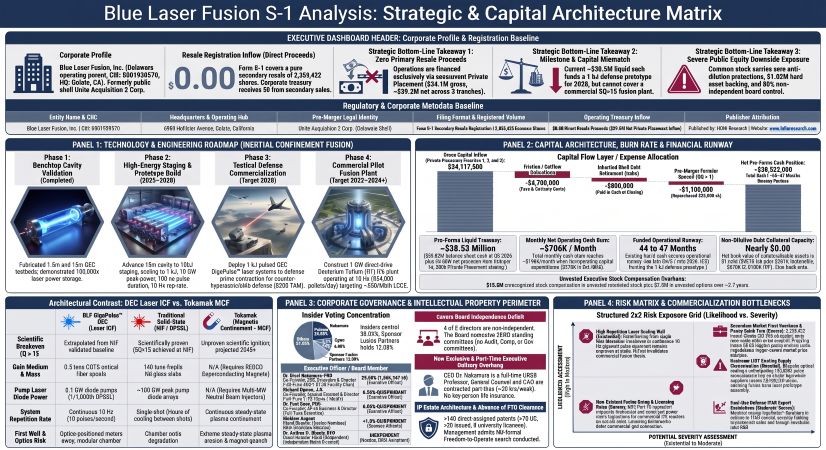 Blue Laser Fusion 9M 2026 Financial Performance, Cash Burn, and Reverse Recapitalization Mechanics
Blue Laser Fusion, Inc. [Unlisted / Form S-1 Filing] ("BLF") recorded commercial software licensing revenue of $57,000 and a net loss of $6,461,000 during the nine months ended September 30, 2026 (9M 2026), compared to $0 revenue and a net loss of $7,440,000 in 9M 2025. For full-year FY2025 (audited), BLF recognized $56,000 in revenue and a net loss of $9,115,000, following a FY2024 (audited) net loss of $9,530,000. On September 4, 2026, BLF completed a reverse recapitalization under ASC 805 with Delaware public reporting shell Unite Acquisition 2 Corp. ("Unite"), wherein Private BLF acted as the accounting acquirer and Unite acted as the legal acquirer.
Operating Expense Disaggregation and Stock-Based Compensation Overhang
While BLF has not yet adopted FASB ASU No. 2024-03 (Expense Disaggregation Disclosures Subtopic 220-40), its operating expenditure trajectory demonstrates a cyclical shift from hardware prototype fabrication toward public-company administrative overhead and non-cash equity compensation.
Table. Operating Expenses, Revenue, and Stock-Based Compensation Analysis, FY2024–FY2025 and 9M 2025–9M 2026 ($ Thousands)
The $2.80 million (-40.8%) reduction in 9M 2026 R&D expense was driven by an approximate $2.70 million decline in prototype equipment purchases and outsourced engineering consulting following the completion of the 1.5-meter and 15-meter Optical Enhancement Cavity (OEC) builds by Q3 2026, partially offset by higher laboratory consumable materials. Conversely, G&A expanded by $1.53 million (+118.8%) in 9M 2026 due to a $0.40 million increase in audit, tax, legal, and reverse-merger professional fees, a $0.30 million rise in G&A stock-based compensation, and expanded corporate personnel overhead across BLF's 19 total employees (13 in R&D, 1 in sales/marketing, 5 in G&A as of September 30, 2026).
Forward income statements face a non-cash amortization overhang from unvested equity awards:
* Unvested Stock Options: $1.2 million in unrecognized compensation cost as of September 30, 2026, to be recognized over a weighted-average period of 2.6 years.
* Unvested Restricted Stock Awards (RSAs): On September 4, 2026, BLF granted 505,098 recast restricted common shares to seven officers, employees, and a consultant, generating $13.8 million in unrecognized stock-based compensation as of September 30, 2026, amortizable over a weighted-average period of 2.7 years (an annualized non-cash expense run-rate of ~$5.1 million).
Cash Flow Dynamics, Pro-Forma Liquidity, and Multi-Scenario Runway Audit
BLF's historical operations have been funded entirely through financing inflows. In 9M 2026, net loss of $(6,461,000) was adjusted for $769,000 in non-cash items—comprising $428,000 in SBC, $217,000 in depreciation, and $124,000 in operating lease right-of-use (ROU) asset amortization—and $(661,000) in working capital uses (accounts payable, accrued expenses, and prepaids), resulting in $(6,353,000) of net cash used in operating activities.
Table. Cash Flow, Capital Expenditure, and Cash Runway Analysis, FY2024–FY2025 and 9M 2025–9M 2026 ($ Thousands)
In 9M 2026, financing inflows of $23,209,000 reflected $24,611,000 in Private Placement proceeds net of initial offering costs, offset by $(1,402,000) in share repurchases and inherited shell debt repayments. As of September 30, 2026, BLF held $33,022,000 in cash and cash equivalents, of which $29,722,000 was invested in Level 1 money market funds. Across three tranches of its Rule 506(b) Private Placement of 1,240,632 common shares at $27.50 per share, BLF raised $34,117,380 ($34.12 million) in gross proceeds:
* Closings 1 & 2 (September 2026): 1,032,550 shares issued, generating $23.7 million in net proceeds through September 30, 2026.
* Closing 3 (October 14, 2026): 208,082 shares issued post-Q3 close, generating $5.7 million in gross proceeds (~$5.50 million net proceeds after fees), bringing aggregate Private Placement net proceeds to ~$29.2 million (after $4.70 million in total placement fees, commissions, and advisory costs).
* Net Deployable Capital & Pro-Forma Treasury: After deducting $4.70 million in offering costs, $0.80 million to retire Unite's inherited shell liabilities, and $1.10 million for a pre-merger founder equity buyout, net deployable capital inflow totaled ~$27.52 million through Q3 2026 (resulting in $33.02 million Q3 cash), and expanded by +$5.50 million on October 14, 2026 to a pro-forma liquid treasury of ~$38.52 million ($38.5 million).
* S-1 Primary & Contingent Proceeds: The Form S-1 secondary resale of 2,353,422 shares yields $0.00 in gross proceeds to the corporate treasury. BLF can receive a maximum contingent inflow of $3,722,070 only if Laidlaw & Company (UK) Ltd. exercises its 112,790 placement agent warrants at $33.00 per share for cash (which is not guaranteed due to a cashless exercise net-share provision if the registration statement is not kept effective).
Balance Sheet De-Leveraging and Reverse Merger Cost-Basis Asymmetry
Upon closing the reverse recapitalization on September 4, 2026, all historical private shares and options were retrospectively recast at an exchange ratio of 0.6314 shares of Unite common stock per private BLF share. Prior to the merger, BLF had issued a $500,000 Simple Agreement for Future Equity (SAFE) in December 2022 that converted in July 2023 into 64,065 shares of Series Seed-2 Convertible Preferred Stock ($7.80456 pre-recast), alongside 3,876,721 total shares of Series Seed-1 Convertible Preferred Stock ($37.67 million carrying value; $37,820,127 gross raised, including a March 2024 raise of $5.0 million via 512,520 shares at $9.7557 per share). Classified as temporary mezzanine equity ($38,172,616 aggregate liquidation preference) under ASC 480-10-S99-3A due to deemed liquidation redemption features, all 3,876,721 Series Seed-1 and 64,065 Series Seed-2 shares converted 1-for-1 into private common stock and exchanged into 2,488,103 public common shares, eliminating 100% of mezzanine leverage.
Additionally, the Private Placement Registration Rights Agreement (Exhibit 10.4) includes a contingent liquidated damages clause requiring payments of 12% per annum of the offering price (capped at 8% or ~$4.7 million aggregate) if the resale S-1 is not declared effective within 120 days of closing; evaluated under ASC 825-20 and ASC 450-20, BLF booked $0 accrual as default was deemed not probable.
A reconstruction of pre- and post-merger financing tranches highlights severe cost-basis asymmetry across stockholder cohorts relative to the $27.50 S-1 resale price:
Table. Historical Equity Financing, Share Issuances, and Effective Investor Entry Costs (Recast Basis)
Fully Diluted Capitalization Waterfall and Rule 415 Secondary Float Stress Simulation
Combining the 5,993,834 recast pre-merger BLF common shares (3,000,633 founder/employee common + 2,488,103 converted preferred + 505,098 RSAs) with 1,000,000 Unite shell shares and 1,240,632 Private Placement shares yields 8,234,466 basic shares outstanding as of October 31, 2026. Including rollover options, placement warrants, and the 2026 Stock Incentive Plan (which contains an evergreen provision from January 1, 2027 through 2036 automatically increasing the reserve annually by the lesser of 4% of outstanding shares or a Board-determined amount) expands fully diluted shares by +41.3% to 11,631,896:
Table. Fully Diluted Share Capitalization and Potential Equity Dilution by Security Layer (October 31, 2026)
Prior to S-1 effectiveness, BLF's publicly tradable float is 0.0 shares. Under Rule 415, the registration statement registers 2,353,422 common shares for immediate secondary resale—representing 28.58% of basic common stock and $64,719,105 in aggregate liquidation value at $27.50 per share (nearly double BLF's $33.02 million Q3 cash balance):
Table. Registered Selling Stockholders and Secondary Resale Float by Investor Category (Valued at $27.50 per Share)
Because no underwriter has been retained to stabilize prices under Regulation M and no OTCQB market maker application has been approved, secondary trading faces three distinct float-absorption stress scenarios:
* Scenario A (Orderly Flow — 10% Float Liquidation): Selling 235,342 shares siphons $6.47 million from market bids over 60–90 days, maintaining a $20.00–$27.50 trading band.
* Scenario B (Lucius Sponsor Exit — 995,000 Shares): Lucius Partners liquidates its nominal-cost stake to extract up to $27.36 million (comparable to BLF's entire $29.2 million net Private Placement proceeds), overwhelming OTC bid depth and compressing the share price to $10.00–$15.00.
* Scenario C (Cascading Dump — 50% Float / 1,176,711 Shares): Simultaneous liquidation by PIPE holders and shell sponsors siphons $32.36 million, collapsing the share price below $5.00 per share and triggering Exchange Act Rule 3a51-1 and FINRA Rule 15g-9 "penny stock" restrictions.
GigaPulse Optical Enhancement Cavity Architecture, Supply Chain Footprint, and Regional Moats
Founded by 2014 Nobel laureate Dr. Shuji Nakamura, BLF is commercializing its GigaPulse™ pulsed laser platform, replacing monolithic solid-state glass slab architectures with a resonant Optical Enhancement Cavity (OEC) ("photon capacitor") that stacks and recirculates low-power fiber laser pulses 100,000 to 150,000 times before switching out 100-nanosecond (ns), gigawatt-class pulses.
GigaPulse OEC Platform Engineering and Commercial Milestone KPIs
In a 1 GW fusion power plant baseline, BLF's OEC architecture reduces pump laser diode capacity by a factor of 1,000 and driver system cost to 1/10th of conventional Diode-Pumped Solid-State Laser (DPSSL) systems, while pairing with Direct Drive Deuterium-Tritium (DT) fuel pellets to achieve a simulated 10x higher target gain than indirect-drive (hohlraum) configurations.
To bridge the multi-year gap to commercial fusion, BLF is executing four commercialization waves governed by explicit engineering KPIs:
* Wave 1 (Immediate / Current — Simulation Software Licensing): Outbound 12-month non-exclusive, non-transferable Software License and Service Agreement (effective April 1, 2026) for BLF's radiation-hydrodynamics simulation code with a Japanese research institution, generating ¥18.0 million (~$114,000) in fixed, non-refundable annual fees paid in equal monthly installments ($56,000 recognized in FY2025 under a prior 6-month contract; $57,000 recognized in 9M 2026 under ASC 606).
* Wave 2 (Near-Term 2028 — Directed Energy Defense OEM): Addressing a $20 billion annual directed-energy market reinforced by $175 billion in proposed U.S. Golden Dome missile defense funding through 2029. Unlike continuous-wave (CW) chemical or fiber lasers requiring 1 to 10 seconds of dwell time, BLF's 1 kJ OEC prototype delivers 100,000x higher peak power (10 GW) in 100 ns pulses for immediate engagement of hypersonic missiles, unmanned aerial vehicle (UAV) swarms, and satellite sensors. Target customers include the U.S. Department of War, prime contractors, and allied ministries in Japan, the UK, the EU, and Israel.
* Wave 3 (Medium-Term 2028+ — Industrial & Nuclear Spinoffs): High-throughput precision cutting, deep welding, metal additive manufacturing (3D printing), biomedical photonics, and laser-driven particle acceleration for nuclear spent fuel transmutation.
* Wave 4 (Long-Term 2032–2034+ — Core Fusion Island OEM & Licensor): Multi-gigawatt inertial fusion energy (IFE) power plants targeting an LCOE of ~$50/MWh (1/4 of competing fusion designs estimated at ~$200/MWh). Rather than operating as a balance-sheet Independent Power Producer (IPP), BLF intends to license core IP and supply optical drivers while shifting plant construction, site permitting, and operational regulatory compliance to utility developers and EPC system integrators.
Confinement Strategy Matrix and Horizontal Inertial Fusion Peer Benchmarks
Across global fusion paradigms, laser inertial confinement is the only architecture to have experimentally achieved laboratory net energy gain ($Q > 1$, first demonstrated in December 2022 at Lawrence Livermore National Laboratory's National Ignition Facility using a 2.05 MJ UV laser drive, whereas international magnetic projects like ITER face delays to 2045–2055). However, within the commercial ICF segment, BLF operates on a substantially leaner capital base than venture-backed peers.
Upstream Optical Supply Chain Vulnerability and Dual-Use Export Control Regimes
BLF's operational and research footprint spans four primary facilities alongside three commercial offtake Memoranda of Understanding (MOUs) and two national grant programs:
* Corporate & Engineering HQ: 6950 Hollister Avenue, Goleta, California (executive offices, cleanroom assembly, commercial laser engineering, and customer pilot facility).
* Tokyo Subsidiary Hub: Blue Laser Fusion GK (wholly owned subsidiary established March 2024 in Tokyo, Japan).
* Academic Collaboration Labs: Caltech (Pasadena, California; supported by two U.S. Department of Energy INFUSE program contracts) and Osaka University (Japan; Osaka University Blue Laser Fusion Institute, supported by Japan Fusion Moonshot Program grant validation).
* Commercial Offtake MOUs: (1) REACH (Central California) to evaluate pilot plant siting and CAISO grid interconnection (addressing California Energy Commission projections of +20 GW capacity needed between 2025 and 2045); (2) RSE (Ricerca sul Sistema Energetico, Italy) to evaluate European fusion pilot projects; and (3) a Confidential Japanese AI/Datacenter Leader for behind-the-meter 24/7/365 baseload power (subject to 99.999% "five nines" availability SLAs and unverified Mean Time Between Failures).
While BLF internalizes seed laser design, fiber amplifier staging, Coherent Beam Combination (CBC) control algorithms, and OEC cavity locking software, it operates zero captive optical coating or crystal growth foundries. Upstream procurement is restricted via Request for Information (RFI) and Request for Quote (RFQ) protocols under bilateral NDAs to vendors in the United States, the United Kingdom, the European Union, and Japan, with zero long-term fixed-price supply contracts. Furthermore, regional semiconductor laser packaging and optoelectronics across the Asia-Pacific corridor—anchored in Japan, the Republic of Korea, and Taiwan, Province of China—expose BLF to U.S.-China Section 301 tariffs and retaliatory trade barriers.
Cross-border operations are further constrained by a dual-use regulatory dichotomy:
1. Export Administration Regulations (EAR — U.S. Dept. of Commerce BIS): Civilian fusion lasers and simulation code fall under Commerce Control List (CCL) Category 6 (Sensors and Lasers) or EAR99, permitting international academic collaboration with Osaka University and RSE subject to end-user screening.
2. International Traffic in Arms Regulations (ITAR — U.S. Dept. of State DDTC): Directed energy weapons configured for counter-hypersonic or counter-UAS defense are classified as defense articles on the U.S. Munitions List (USML Category XII), requiring State Department export licenses, Foreign Military Sales (FMS) reviews, Technical Assistance Agreements (TAAs), and "Deemed Export" licenses for non-U.S. citizen engineers employed in the United States.
3. Nuclear Siting & Fuel Cycle Regimes: Although the U.S. Nuclear Regulatory Commission (NRC) voted in 2023 to regulate fusion under 10 CFR Part 30 (byproduct material framework) rather than 10 CFR Part 50/52 fission rules, the S-1 concedes that formal commercial fusion power plant licensing regulations "do not yet exist," and BLF discloses no proprietary tritium breeding blanket design (e.g., lithium-lead) to mitigate global tritium scarcity from aging Canadian CANDU reactors.
HDIN Institutional Verdict: Commercial Fusion Narrative vs. Governance and Capital Reality
A forensic cross-examination of BLF's Form S-1 reveals a pronounced divergence between its long-term clean energy narrative and its near-term governance, intellectual property, and capital allocation realities.
Executive Bandwidth, Insider Control Concentration, and Related-Party Entanglements
BLF's corporate governance is characterized by part-time executive commitments, an 80% non-independent staggered board, zero standing board committees (no Audit, Compensation, or Nominating committee), and four foundational material weaknesses in internal control over financial reporting: (1) inadequate segregation of duties in accounting, (2) insufficient financial close review controls, (3) lack of an audit committee with an independent financial expert, and (4) ineffective IT general access controls. Furthermore, BLF maintains zero key-person life insurance on CEO Dr. Shuji Nakamura or any other officer.
The reverse merger also involved extensive related-party cash extractions across the Lucius Partners LLC / Laidlaw & Company (UK) Ltd. nexus (jointly controlled by Matthew Eitner, James Ahern, and Patrick Gallagher) and former insiders:
* Unite Shell Debt Settlement ($458K Related-Party / Shell Cash Outflow): Out of $0.80 million paid at closing to extinguish Unite's $780,000 net liabilities, BLF paid $336,000 ($275,000 principal + $61,000 accrued interest) to Lucius Partners Opportunity Fund, LP, $95,000 in loan repayments to Lucius Partners LLC, $8,000 in administrative fees to Lucius Partners, and $19,000 in director fees to Unite's former sole officer/director.
* Laidlaw Syndicate Commissions & Warrants: Laidlaw received $3.4 million in initial cash placement commissions and expense reimbursements (within the $4.70 million total offering costs), a $50,000 non-refundable activation fee, up to $100,000 in tail expenses, and 112,790 seven-year warrants struck at $33.00/share (containing a weighted-average anti-dilution price ratchet that adjusts downward if BLF issues equity below $33.00).
* WUV 1 Limited Partnership Buyout ($1.1M Cash Outflow): On September 4, 2026, immediately prior to the merger, BLF spent $1.1 million in cash ($2.09/share) to repurchase 505,098 recast common shares from WUV 1 LP (affiliated with a former co-founder terminated on April 27, 2026), immediately reissuing those shares as RSAs to seven active insiders. WUV 1 retains a 4.3% equity stake post-closing.
Intellectual Property Chain of Title and Freedom-to-Operate Exposures
An audit of Item 16 (Exhibits 10.1 through 10.10) confirms that BLF owns 100% of its >140 patents and applications (>70 U.S. patents, >20 issued U.S. patents, >60 pending U.S. applications, and >40 foreign filings across China, Japan, India, the UAE, Saudi Arabia, Canada, the Republic of Korea, Europe, and Great Britain) via direct assignment from inventors Dr. Nakamura, Mr. Ogawa, and engineering staff. Contrary to typical university spin-outs, BLF holds zero inbound technology transfer or patent license agreements with UC Santa Barbara, Caltech, or Osaka University, and carries $0 in accrued royalty or milestone liabilities.
However, while BLF is not currently party to active litigation (Page 60), management explicitly concedes on Page 21 of the S-1 that it has not conducted a comprehensive Freedom-to-Operate (FTO) search or analysis. Because Coherent Beam Combination (CBC), fiber laser amplification, and optical resonators are heavily patented by Lawrence Livermore National Laboratory (LLNL), IPG Photonics, Coherent, and defense prime contractors, BLF faces acute latent exposure to third-party infringement claims, inter partes review (IPR) challenges, compulsory royalties, or permanent injunctions halting 2028 defense deliveries.
LCOE Structural Sensitivities and Capital-to-Milestone Probability Calibration
In its "Use of Proceeds" and MD&A disclosures, management provides zero quantitative dollar or percentage capital allocation schedules across directed energy prototypes, IFE drivers, Goleta manufacturing expansion, or G&A, retaining "broad discretion" over the ~$38.52 million pro-forma cash balance. Furthermore, with only $1,021,000 in net property and equipment ($961,000 lab equipment, $261,000 leasehold improvements, $220,000 laptops/IT, and $100,000 construction in progress), BLF possesses virtually zero secured senior debt capacity. Meanwhile, public common stockholders lack contractual anti-dilution protections and remain subordinated to the Board's unilateral authority to issue up to 10,000,000 shares of blank-check Preferred Stock.
While current liquidity funds the 1 kJ (10 GW peak) tactical defense prototype through 2028, commercial net-gain fusion ($Q > 1$) requires megajoule-scale laser drivers (a 2,000x energy gap vs. the 1 kJ prototype) and automated cryogenic target factories producing 864,000 DT pellets per day (>315 million/year) at pennies per unit—without which the stated ~$50/MWh LCOE (and unmodeled CapEx/kW) cannot be achieved.
Key Financial Questions From the 9M 2026 Form S-1 Filing
What drove Blue Laser Fusion's operating expense shift and cash runway in 9M 2026?
Blue Laser Fusion reduced total operating expenses by 15.6% YoY to $6.86 million in 9M 2026 as R&D fell 40.8% to $4.05 million following the completion of its 1.5-meter and 15-meter OEC builds, which was partially offset by a 118.8% surge in G&A to $2.82 million from reverse-merger legal fees and $428,000 in total stock-based compensation. Coupled with $34.12 million in gross private placement proceeds ($29.2 million net across three closings through October 14, 2026), pro-forma cash reached $38.52 million, securing a 51.5-month (~4.3-year) total cash runway at the 9M 2026 total burn rate of $747.89K per month.
How is Blue Laser Fusion allocating capital across its 2028 defense and 2032 fusion roadmaps?
Although management discloses zero quantitative CapEx budgets across specific project line items, its $38.52 million pro-forma liquidity is calibrated to fund the 100-Joule intermediate staging and full-scale 1 kilojoule (10 GW peak power, 100 ns pulse, 10 Hz) OEC prototype for 2028 directed-energy defense deliveries across a $20 billion addressable market. Commercial 1 GW fusion power plants—targeted for 2032–2034+ at an LCOE of ~$50/MWh—remain unfunded and depend on non-dilutive 2028 defense cash flows, consortium project finance, and external utility integrators.
What structural dilution and secondary float risks confront Blue Laser Fusion investors?
The Form S-1 registers 2,353,422 secondary shares (28.58% of the 8,234,466 basic shares outstanding and $64.72 million at $27.50 per share) with zero underwriter stabilization and $0 corporate proceeds, including 995,000 nominal-cost shares held by reverse-merger sponsor Lucius Partners LLC. Furthermore, 1,155,632 rollover options (WAEP $4.06), 112,790 Laidlaw warrants ($33.00 strike with a weighted-average anti-dilution ratchet), and 2,129,008 unallocated 2026 Plan shares expand fully diluted capitalization by 41.3% to 11,631,896 shares while imposing $15.0 million in unrecognized non-cash SBC ($13.8 million RSAs and $1.2 million options).
Presentation Download & Analyst Briefing Access:
- Institutional Presentation: Download the full "Blue_Laser_Fusion_S1_Forensic_Audit" PDF under the 'Related Topics' section.
- Analyst Video Briefing: Watch the "Blue Laser Fusion (BLF): Can $38.5M Cash & 2028 Defense Lasers Survive a $64.7M S-1 Resale Overhang?" on the HDIN Research YouTube Channel.
About HDIN Research:
HDIN Research is a premier global market intelligence and strategic advisory firm specializing in institutional-grade financial analysis, supply chain audits, and macroeconomic forecasting. Our dedicated sector analysts deliver actionable, data-driven insights tailored for private equity, hedge funds, and corporate strategy teams. Visit us at https://www.hdinresearch.com.
Editorial & Methodology Disclosure:
"This market intelligence brief was researched, modeled, and audited by the HDIN Research Equity Desk based on official primary corporate filings (Blue Laser Fusion, Inc. Form S-1 Registration Statement / 9M 2026 & FY2025 Audited Financial Statements). Proprietary quantitative extraction tools were utilized to ensure 100% fidelity to reported financial line items and footnotes. All forensic interpretations, segmental benchmarks, and institutional verdicts were independently written and verified by HDIN senior sector analysts in accordance with institutional research standards."
HDIN Executive Takeaways
1. OpEx & Liquidity Shift: Blue Laser Fusion, Inc. narrowed its 9M 2026 net loss to $6.46 million as R&D fell 40.8% YoY to $4.05 million, while a $34.12 million gross private placement lifted pro-forma cash to $38.52 million (44.2–54.5 months runway).
2. Bifurcated Goleta-Tokyo Footprint: Operating from Goleta, California and Tokyo, Japan, BLF targets a $20 billion directed-energy defense market by 2028 (1 kJ, 10 GW laser) before 2032–2034+ $50/MWh fusion plants.
3. Institutional Verdict: Zero S-1 primary proceeds, a 28.58% secondary resale overhang, and 80% board non-independence constrain equity valuation.
Figure Blue Laser Fusion S-1 Analysis Strategic & Capital Architecture Matrix
Blue Laser Fusion 9M 2026 Financial Performance, Cash Burn, and Reverse Recapitalization MechanicsBlue Laser Fusion, Inc. [Unlisted / Form S-1 Filing] ("BLF") recorded commercial software licensing revenue of $57,000 and a net loss of $6,461,000 during the nine months ended September 30, 2026 (9M 2026), compared to $0 revenue and a net loss of $7,440,000 in 9M 2025. For full-year FY2025 (audited), BLF recognized $56,000 in revenue and a net loss of $9,115,000, following a FY2024 (audited) net loss of $9,530,000. On September 4, 2026, BLF completed a reverse recapitalization under ASC 805 with Delaware public reporting shell Unite Acquisition 2 Corp. ("Unite"), wherein Private BLF acted as the accounting acquirer and Unite acted as the legal acquirer.
Operating Expense Disaggregation and Stock-Based Compensation Overhang
While BLF has not yet adopted FASB ASU No. 2024-03 (Expense Disaggregation Disclosures Subtopic 220-40), its operating expenditure trajectory demonstrates a cyclical shift from hardware prototype fabrication toward public-company administrative overhead and non-cash equity compensation.
Table. Operating Expenses, Revenue, and Stock-Based Compensation Analysis, FY2024–FY2025 and 9M 2025–9M 2026 ($ Thousands)
| Financial Metric ($ in thousands) | FY2024 (Audited) | FY2025 (Audited) | YoY Δ (%) | 9M 2025 (Unaudited) | 9M 2026 (Unaudited) | YoY Δ (%) |
| Commercial Software Revenue | $0 | $56 | N/A | $0 | $57 | N/A |
| Research & Development (R&D) | $9,681 | $8,271 | -14.6% | $6,843 | $4,048 | -40.8% |
| General & Administrative (G&A) | $1,237 | $1,761 | +42.3% | $1,287 | $2,816 | +118.8% |
| Total Operating Expenses | $10,918 | $10,032 | -8.1% | $8,130 | $6,864 | -15.6% |
| R&D % of Total OpEx | 88.7% | 82.4% | -630 bps (-6.3 ppt) | 84.2% | 59.0% | -2,520 bps (-25.2 ppt) |
| G&A % of Total OpEx | 11.3% | 17.6% | +630 bps (+6.3 ppt) | 15.8% | 41.0% | +2,520 bps (+25.2 ppt) |
| Net Interest Income | N/A | N/A | N/A | N/A | $354 | N/A |
| Net Loss | $(9,530) | $(9,115) | -4.4% | $(7,440) | $(6,461) | -13.2% |
| Total Stock-Based Compensation (SBC) | $96.013 | $124.847 | +30.0% | $85.000 | $428.000 | +403.5% |
| — SBC Allocated to R&D | $68.281 (71.1%) | $81.015 (64.9%) | +18.6% | N/A | $74.000 (17.3%) | N/A |
| — SBC Allocated to G&A | $27.732 (28.9%) | $43.832 (35.1%) | +58.1% | N/A | $354.000 (82.7%) | N/A |
The $2.80 million (-40.8%) reduction in 9M 2026 R&D expense was driven by an approximate $2.70 million decline in prototype equipment purchases and outsourced engineering consulting following the completion of the 1.5-meter and 15-meter Optical Enhancement Cavity (OEC) builds by Q3 2026, partially offset by higher laboratory consumable materials. Conversely, G&A expanded by $1.53 million (+118.8%) in 9M 2026 due to a $0.40 million increase in audit, tax, legal, and reverse-merger professional fees, a $0.30 million rise in G&A stock-based compensation, and expanded corporate personnel overhead across BLF's 19 total employees (13 in R&D, 1 in sales/marketing, 5 in G&A as of September 30, 2026).
Forward income statements face a non-cash amortization overhang from unvested equity awards:
* Unvested Stock Options: $1.2 million in unrecognized compensation cost as of September 30, 2026, to be recognized over a weighted-average period of 2.6 years.
* Unvested Restricted Stock Awards (RSAs): On September 4, 2026, BLF granted 505,098 recast restricted common shares to seven officers, employees, and a consultant, generating $13.8 million in unrecognized stock-based compensation as of September 30, 2026, amortizable over a weighted-average period of 2.7 years (an annualized non-cash expense run-rate of ~$5.1 million).
Cash Flow Dynamics, Pro-Forma Liquidity, and Multi-Scenario Runway Audit
BLF's historical operations have been funded entirely through financing inflows. In 9M 2026, net loss of $(6,461,000) was adjusted for $769,000 in non-cash items—comprising $428,000 in SBC, $217,000 in depreciation, and $124,000 in operating lease right-of-use (ROU) asset amortization—and $(661,000) in working capital uses (accounts payable, accrued expenses, and prepaids), resulting in $(6,353,000) of net cash used in operating activities.
Table. Cash Flow, Capital Expenditure, and Cash Runway Analysis, FY2024–FY2025 and 9M 2025–9M 2026 ($ Thousands)
| Cash Flow & Runway Metric ($ in thousands) | FY2024 (Audited) | FY2025 (Audited) | 9M 2025 (Unaudited) | 9M 2026 (Unaudited) |
| Net Loss | $(9,530) | $(9,115) | $(7,440) | $(6,461) |
| Non-Cash Adjustments (Depr., SBC, ROU) | $2,251 | $507 | $360 | $769 |
| Working Capital Changes | $23 | $(485) | $(250) | $(661) |
| Net Cash Used in Operating Activities | $(7,256) | $(9,093) | $(7,330) | $(6,353) |
| Capital Expenditures (Purchases of P&E) | $(835) | $(252) | $(173) | $(378) |
| Free Cash Flow / Net Cash Outflow | $(8,091) | $(9,345) | $(7,503) | $(6,731) |
| Financing Cash Inflows (Net Equity & Warrants) | $4,986 | $10 | $10 | $23,209 |
| Net Cash Increase (Decrease) | $(3,105) | $(9,346) | $(7,493) | +$16,475 |
| Ending Cash & Cash Equivalents | $25,893 | $16,547 | $18,394 | $33,022 |
In 9M 2026, financing inflows of $23,209,000 reflected $24,611,000 in Private Placement proceeds net of initial offering costs, offset by $(1,402,000) in share repurchases and inherited shell debt repayments. As of September 30, 2026, BLF held $33,022,000 in cash and cash equivalents, of which $29,722,000 was invested in Level 1 money market funds. Across three tranches of its Rule 506(b) Private Placement of 1,240,632 common shares at $27.50 per share, BLF raised $34,117,380 ($34.12 million) in gross proceeds:
* Closings 1 & 2 (September 2026): 1,032,550 shares issued, generating $23.7 million in net proceeds through September 30, 2026.
* Closing 3 (October 14, 2026): 208,082 shares issued post-Q3 close, generating $5.7 million in gross proceeds (~$5.50 million net proceeds after fees), bringing aggregate Private Placement net proceeds to ~$29.2 million (after $4.70 million in total placement fees, commissions, and advisory costs).
* Net Deployable Capital & Pro-Forma Treasury: After deducting $4.70 million in offering costs, $0.80 million to retire Unite's inherited shell liabilities, and $1.10 million for a pre-merger founder equity buyout, net deployable capital inflow totaled ~$27.52 million through Q3 2026 (resulting in $33.02 million Q3 cash), and expanded by +$5.50 million on October 14, 2026 to a pro-forma liquid treasury of ~$38.52 million ($38.5 million).
* S-1 Primary & Contingent Proceeds: The Form S-1 secondary resale of 2,353,422 shares yields $0.00 in gross proceeds to the corporate treasury. BLF can receive a maximum contingent inflow of $3,722,070 only if Laidlaw & Company (UK) Ltd. exercises its 112,790 placement agent warrants at $33.00 per share for cash (which is not guaranteed due to a cashless exercise net-share provision if the registration statement is not kept effective).
Balance Sheet De-Leveraging and Reverse Merger Cost-Basis Asymmetry
Upon closing the reverse recapitalization on September 4, 2026, all historical private shares and options were retrospectively recast at an exchange ratio of 0.6314 shares of Unite common stock per private BLF share. Prior to the merger, BLF had issued a $500,000 Simple Agreement for Future Equity (SAFE) in December 2022 that converted in July 2023 into 64,065 shares of Series Seed-2 Convertible Preferred Stock ($7.80456 pre-recast), alongside 3,876,721 total shares of Series Seed-1 Convertible Preferred Stock ($37.67 million carrying value; $37,820,127 gross raised, including a March 2024 raise of $5.0 million via 512,520 shares at $9.7557 per share). Classified as temporary mezzanine equity ($38,172,616 aggregate liquidation preference) under ASC 480-10-S99-3A due to deemed liquidation redemption features, all 3,876,721 Series Seed-1 and 64,065 Series Seed-2 shares converted 1-for-1 into private common stock and exchanged into 2,488,103 public common shares, eliminating 100% of mezzanine leverage.
Additionally, the Private Placement Registration Rights Agreement (Exhibit 10.4) includes a contingent liquidated damages clause requiring payments of 12% per annum of the offering price (capped at 8% or ~$4.7 million aggregate) if the resale S-1 is not declared effective within 120 days of closing; evaluated under ASC 825-20 and ASC 450-20, BLF booked $0 accrual as default was deemed not probable.
A reconstruction of pre- and post-merger financing tranches highlights severe cost-basis asymmetry across stockholder cohorts relative to the $27.50 S-1 resale price:
Table. Historical Equity Financing, Share Issuances, and Effective Investor Entry Costs (Recast Basis)
| Financing Round / Investor Class | Securities Issued (Recast Public Shares) | Pre-Merger Issue Price | Post-Recast Effective Cost (0.6314 Ratio) | Capital Raised / (Outflow) Gross | Discount / (Premium) to $27.50 S-1 Price |
| Founders Common Equity (2022) | 3,000,633 sh (from 5,544,050 pre-recast, excl. RSAs) |
0.0002 |
~$0.0003 | $22,934 | -99.99% |
| Unite Shell Founders (Lucius & Counsel) | 1,000,000 sh | Nominal | Nominal ($0.0001) | Nominal | -99.99% |
| Founder Buyout / RSA Reissuance (Sept 4, 2026) | 505,098 sh (WUV 1 LP buyback -> RSAs) | $2.09000 | $2.09 | $(1,100,000) outflow | -92.40% |
| Series Seed-2 (Dec 2022 SAFE / July 2023) | Exchanged with Seed-1 into 2,488,103 sh | $7.80456 | $12.36 | $500,000 | -55.05% |
| Series Seed-1 (Through March 2024) | Exchanged with Seed-2 into 2,488,103 sh | $9.75570 | $15.45 | $37,820,127 | -43.82% |
| Private Placement (Tranches 1, 2 & 3) | 1,240,632 sh | $27.50000 | $27.50 | $34,117,380 | 0.00% (Parity) |
| Laidlaw Placement Agent Warrants (7-Yr) | 112,790 warrants (exp. Oct 14, 2033) | $33.00 strike | $33.00 | $3,722,070 (if exercised) | +20.00% (Premium) |
Fully Diluted Capitalization Waterfall and Rule 415 Secondary Float Stress Simulation
Combining the 5,993,834 recast pre-merger BLF common shares (3,000,633 founder/employee common + 2,488,103 converted preferred + 505,098 RSAs) with 1,000,000 Unite shell shares and 1,240,632 Private Placement shares yields 8,234,466 basic shares outstanding as of October 31, 2026. Including rollover options, placement warrants, and the 2026 Stock Incentive Plan (which contains an evergreen provision from January 1, 2027 through 2036 automatically increasing the reserve annually by the lesser of 4% of outstanding shares or a Board-determined amount) expands fully diluted shares by +41.3% to 11,631,896:
Table. Fully Diluted Share Capitalization and Potential Equity Dilution by Security Layer (October 31, 2026)
| Equity Tranche / Security Layer | Incremental Shares | Cumulative Shares (% of Fully Diluted) | Key Terms & Valuation Parameters |
| Basic Common Stock Issued & Outstanding (Oct 31, 2026) | 8,234,466 | 8,234,466 (70.79%) | Includes 505,098 legally issued RSAs |
| Layer 1: Unexercised Rollover Stock Options | +1,155,632 | 9,390,098 (80.73%) | 508,338 exercisable within 60 days (WAEP $2.71); 647,294 unvested; overall WAEP $4.06; $23,293K intrinsic value; 9.0-yr term |
| Layer 2: Placement Agent Warrants (Laidlaw & Co.) | +112,790 | 9,502,888 (81.70%) | 90,027 (Closing 1) + 11,592 (Closing 2) + 11,171 (Closing 3); $33.00 strike; 101,619 valued at
14.39/sh) via Black-Scholes |
| Layer 3: Debt Conversion / Convertible Notes | 0 | 9,502,888 (81.70%) | $336K note and $95K loan paid in cash |
| Layer 4: Unallocated 2026 Stock Incentive Plan Reserve | +2,129,008 | 11,631,896 (100.00%) | Subject to 4% annual evergreen expansion (2027–2036) |
Prior to S-1 effectiveness, BLF's publicly tradable float is 0.0 shares. Under Rule 415, the registration statement registers 2,353,422 common shares for immediate secondary resale—representing 28.58% of basic common stock and $64,719,105 in aggregate liquidation value at $27.50 per share (nearly double BLF's $33.02 million Q3 cash balance):
Table. Registered Selling Stockholders and Secondary Resale Float by Investor Category (Valued at $27.50 per Share)
| Selling Stockholder Segment / Entity | Shares Registered (% of Resale Float) | Entry Cost per Share | Aggregate Value at $27.50 Parity |
| 1. Private Placement Investors (Total) | 1,240,632 (52.72%) | $27.50 | $34,117,380 |
| — SMBC Trust Bank Ltd. (Mirai Creation Fund) | 145,455 | $27.50 | $4,000,013 |
| — Yusaku Maezawa | 36,364 | $27.50 | $1,000,010 |
| — Executive Officers & Directors (Nakamura 9,091; Ogawa 7,273; Rudy 3,637; Shealy 3,637) | 23,636 | $27.50 | $650,000 |
| — Non-Affiliated Private Accredited Investors | 1,035,177 | $27.50 | $28,467,357 |
| 2. Former Unite Shell Holders (Total) | 1,000,000 (42.49%) | Nominal ($0.0001) | $27,500,000 |
| — Lucius Partners LLC | 995,000 | Nominal ($0.0001) | $27,362,500 |
| — Sichenzia Ross Ference Carmel LLP (Unite Legal Counsel) | 5,000 | Nominal ($0.0001) | $137,500 |
| 3. Placement Agent Underlying Warrants (Laidlaw & Co.) | 112,790 (4.79%) | $33.00 strike | $3,101,725 (at $27.50 underlying) |
| Total Registered Secondary Resale Float | 2,353,422 (100.00%) | Weighted Mixed | $64,719,105 |
Because no underwriter has been retained to stabilize prices under Regulation M and no OTCQB market maker application has been approved, secondary trading faces three distinct float-absorption stress scenarios:
* Scenario A (Orderly Flow — 10% Float Liquidation): Selling 235,342 shares siphons $6.47 million from market bids over 60–90 days, maintaining a $20.00–$27.50 trading band.
* Scenario B (Lucius Sponsor Exit — 995,000 Shares): Lucius Partners liquidates its nominal-cost stake to extract up to $27.36 million (comparable to BLF's entire $29.2 million net Private Placement proceeds), overwhelming OTC bid depth and compressing the share price to $10.00–$15.00.
* Scenario C (Cascading Dump — 50% Float / 1,176,711 Shares): Simultaneous liquidation by PIPE holders and shell sponsors siphons $32.36 million, collapsing the share price below $5.00 per share and triggering Exchange Act Rule 3a51-1 and FINRA Rule 15g-9 "penny stock" restrictions.
GigaPulse Optical Enhancement Cavity Architecture, Supply Chain Footprint, and Regional Moats
Founded by 2014 Nobel laureate Dr. Shuji Nakamura, BLF is commercializing its GigaPulse™ pulsed laser platform, replacing monolithic solid-state glass slab architectures with a resonant Optical Enhancement Cavity (OEC) ("photon capacitor") that stacks and recirculates low-power fiber laser pulses 100,000 to 150,000 times before switching out 100-nanosecond (ns), gigawatt-class pulses.
GigaPulse OEC Platform Engineering and Commercial Milestone KPIs
In a 1 GW fusion power plant baseline, BLF's OEC architecture reduces pump laser diode capacity by a factor of 1,000 and driver system cost to 1/10th of conventional Diode-Pumped Solid-State Laser (DPSSL) systems, while pairing with Direct Drive Deuterium-Tritium (DT) fuel pellets to achieve a simulated 10x higher target gain than indirect-drive (hohlraum) configurations.
To bridge the multi-year gap to commercial fusion, BLF is executing four commercialization waves governed by explicit engineering KPIs:
* Wave 1 (Immediate / Current — Simulation Software Licensing): Outbound 12-month non-exclusive, non-transferable Software License and Service Agreement (effective April 1, 2026) for BLF's radiation-hydrodynamics simulation code with a Japanese research institution, generating ¥18.0 million (~$114,000) in fixed, non-refundable annual fees paid in equal monthly installments ($56,000 recognized in FY2025 under a prior 6-month contract; $57,000 recognized in 9M 2026 under ASC 606).
* Wave 2 (Near-Term 2028 — Directed Energy Defense OEM): Addressing a $20 billion annual directed-energy market reinforced by $175 billion in proposed U.S. Golden Dome missile defense funding through 2029. Unlike continuous-wave (CW) chemical or fiber lasers requiring 1 to 10 seconds of dwell time, BLF's 1 kJ OEC prototype delivers 100,000x higher peak power (10 GW) in 100 ns pulses for immediate engagement of hypersonic missiles, unmanned aerial vehicle (UAV) swarms, and satellite sensors. Target customers include the U.S. Department of War, prime contractors, and allied ministries in Japan, the UK, the EU, and Israel.
* Wave 3 (Medium-Term 2028+ — Industrial & Nuclear Spinoffs): High-throughput precision cutting, deep welding, metal additive manufacturing (3D printing), biomedical photonics, and laser-driven particle acceleration for nuclear spent fuel transmutation.
* Wave 4 (Long-Term 2032–2034+ — Core Fusion Island OEM & Licensor): Multi-gigawatt inertial fusion energy (IFE) power plants targeting an LCOE of ~$50/MWh (1/4 of competing fusion designs estimated at ~$200/MWh). Rather than operating as a balance-sheet Independent Power Producer (IPP), BLF intends to license core IP and supply optical drivers while shifting plant construction, site permitting, and operational regulatory compliance to utility developers and EPC system integrators.
Confinement Strategy Matrix and Horizontal Inertial Fusion Peer Benchmarks
Across global fusion paradigms, laser inertial confinement is the only architecture to have experimentally achieved laboratory net energy gain ($Q > 1$, first demonstrated in December 2022 at Lawrence Livermore National Laboratory's National Ignition Facility using a 2.05 MJ UV laser drive, whereas international magnetic projects like ITER face delays to 2045–2055). However, within the commercial ICF segment, BLF operates on a substantially leaner capital base than venture-backed peers.
Upstream Optical Supply Chain Vulnerability and Dual-Use Export Control Regimes
BLF's operational and research footprint spans four primary facilities alongside three commercial offtake Memoranda of Understanding (MOUs) and two national grant programs:
* Corporate & Engineering HQ: 6950 Hollister Avenue, Goleta, California (executive offices, cleanroom assembly, commercial laser engineering, and customer pilot facility).
* Tokyo Subsidiary Hub: Blue Laser Fusion GK (wholly owned subsidiary established March 2024 in Tokyo, Japan).
* Academic Collaboration Labs: Caltech (Pasadena, California; supported by two U.S. Department of Energy INFUSE program contracts) and Osaka University (Japan; Osaka University Blue Laser Fusion Institute, supported by Japan Fusion Moonshot Program grant validation).
* Commercial Offtake MOUs: (1) REACH (Central California) to evaluate pilot plant siting and CAISO grid interconnection (addressing California Energy Commission projections of +20 GW capacity needed between 2025 and 2045); (2) RSE (Ricerca sul Sistema Energetico, Italy) to evaluate European fusion pilot projects; and (3) a Confidential Japanese AI/Datacenter Leader for behind-the-meter 24/7/365 baseload power (subject to 99.999% "five nines" availability SLAs and unverified Mean Time Between Failures).
While BLF internalizes seed laser design, fiber amplifier staging, Coherent Beam Combination (CBC) control algorithms, and OEC cavity locking software, it operates zero captive optical coating or crystal growth foundries. Upstream procurement is restricted via Request for Information (RFI) and Request for Quote (RFQ) protocols under bilateral NDAs to vendors in the United States, the United Kingdom, the European Union, and Japan, with zero long-term fixed-price supply contracts. Furthermore, regional semiconductor laser packaging and optoelectronics across the Asia-Pacific corridor—anchored in Japan, the Republic of Korea, and Taiwan, Province of China—expose BLF to U.S.-China Section 301 tariffs and retaliatory trade barriers.
Cross-border operations are further constrained by a dual-use regulatory dichotomy:
1. Export Administration Regulations (EAR — U.S. Dept. of Commerce BIS): Civilian fusion lasers and simulation code fall under Commerce Control List (CCL) Category 6 (Sensors and Lasers) or EAR99, permitting international academic collaboration with Osaka University and RSE subject to end-user screening.
2. International Traffic in Arms Regulations (ITAR — U.S. Dept. of State DDTC): Directed energy weapons configured for counter-hypersonic or counter-UAS defense are classified as defense articles on the U.S. Munitions List (USML Category XII), requiring State Department export licenses, Foreign Military Sales (FMS) reviews, Technical Assistance Agreements (TAAs), and "Deemed Export" licenses for non-U.S. citizen engineers employed in the United States.
3. Nuclear Siting & Fuel Cycle Regimes: Although the U.S. Nuclear Regulatory Commission (NRC) voted in 2023 to regulate fusion under 10 CFR Part 30 (byproduct material framework) rather than 10 CFR Part 50/52 fission rules, the S-1 concedes that formal commercial fusion power plant licensing regulations "do not yet exist," and BLF discloses no proprietary tritium breeding blanket design (e.g., lithium-lead) to mitigate global tritium scarcity from aging Canadian CANDU reactors.
HDIN Institutional Verdict: Commercial Fusion Narrative vs. Governance and Capital Reality
A forensic cross-examination of BLF's Form S-1 reveals a pronounced divergence between its long-term clean energy narrative and its near-term governance, intellectual property, and capital allocation realities.
Executive Bandwidth, Insider Control Concentration, and Related-Party Entanglements
BLF's corporate governance is characterized by part-time executive commitments, an 80% non-independent staggered board, zero standing board committees (no Audit, Compensation, or Nominating committee), and four foundational material weaknesses in internal control over financial reporting: (1) inadequate segregation of duties in accounting, (2) insufficient financial close review controls, (3) lack of an audit committee with an independent financial expert, and (4) ineffective IT general access controls. Furthermore, BLF maintains zero key-person life insurance on CEO Dr. Shuji Nakamura or any other officer.
The reverse merger also involved extensive related-party cash extractions across the Lucius Partners LLC / Laidlaw & Company (UK) Ltd. nexus (jointly controlled by Matthew Eitner, James Ahern, and Patrick Gallagher) and former insiders:
* Unite Shell Debt Settlement ($458K Related-Party / Shell Cash Outflow): Out of $0.80 million paid at closing to extinguish Unite's $780,000 net liabilities, BLF paid $336,000 ($275,000 principal + $61,000 accrued interest) to Lucius Partners Opportunity Fund, LP, $95,000 in loan repayments to Lucius Partners LLC, $8,000 in administrative fees to Lucius Partners, and $19,000 in director fees to Unite's former sole officer/director.
* Laidlaw Syndicate Commissions & Warrants: Laidlaw received $3.4 million in initial cash placement commissions and expense reimbursements (within the $4.70 million total offering costs), a $50,000 non-refundable activation fee, up to $100,000 in tail expenses, and 112,790 seven-year warrants struck at $33.00/share (containing a weighted-average anti-dilution price ratchet that adjusts downward if BLF issues equity below $33.00).
* WUV 1 Limited Partnership Buyout ($1.1M Cash Outflow): On September 4, 2026, immediately prior to the merger, BLF spent $1.1 million in cash ($2.09/share) to repurchase 505,098 recast common shares from WUV 1 LP (affiliated with a former co-founder terminated on April 27, 2026), immediately reissuing those shares as RSAs to seven active insiders. WUV 1 retains a 4.3% equity stake post-closing.
Intellectual Property Chain of Title and Freedom-to-Operate Exposures
An audit of Item 16 (Exhibits 10.1 through 10.10) confirms that BLF owns 100% of its >140 patents and applications (>70 U.S. patents, >20 issued U.S. patents, >60 pending U.S. applications, and >40 foreign filings across China, Japan, India, the UAE, Saudi Arabia, Canada, the Republic of Korea, Europe, and Great Britain) via direct assignment from inventors Dr. Nakamura, Mr. Ogawa, and engineering staff. Contrary to typical university spin-outs, BLF holds zero inbound technology transfer or patent license agreements with UC Santa Barbara, Caltech, or Osaka University, and carries $0 in accrued royalty or milestone liabilities.
However, while BLF is not currently party to active litigation (Page 60), management explicitly concedes on Page 21 of the S-1 that it has not conducted a comprehensive Freedom-to-Operate (FTO) search or analysis. Because Coherent Beam Combination (CBC), fiber laser amplification, and optical resonators are heavily patented by Lawrence Livermore National Laboratory (LLNL), IPG Photonics, Coherent, and defense prime contractors, BLF faces acute latent exposure to third-party infringement claims, inter partes review (IPR) challenges, compulsory royalties, or permanent injunctions halting 2028 defense deliveries.
LCOE Structural Sensitivities and Capital-to-Milestone Probability Calibration
In its "Use of Proceeds" and MD&A disclosures, management provides zero quantitative dollar or percentage capital allocation schedules across directed energy prototypes, IFE drivers, Goleta manufacturing expansion, or G&A, retaining "broad discretion" over the ~$38.52 million pro-forma cash balance. Furthermore, with only $1,021,000 in net property and equipment ($961,000 lab equipment, $261,000 leasehold improvements, $220,000 laptops/IT, and $100,000 construction in progress), BLF possesses virtually zero secured senior debt capacity. Meanwhile, public common stockholders lack contractual anti-dilution protections and remain subordinated to the Board's unilateral authority to issue up to 10,000,000 shares of blank-check Preferred Stock.
While current liquidity funds the 1 kJ (10 GW peak) tactical defense prototype through 2028, commercial net-gain fusion ($Q > 1$) requires megajoule-scale laser drivers (a 2,000x energy gap vs. the 1 kJ prototype) and automated cryogenic target factories producing 864,000 DT pellets per day (>315 million/year) at pennies per unit—without which the stated ~$50/MWh LCOE (and unmodeled CapEx/kW) cannot be achieved.
Key Financial Questions From the 9M 2026 Form S-1 Filing
What drove Blue Laser Fusion's operating expense shift and cash runway in 9M 2026?
Blue Laser Fusion reduced total operating expenses by 15.6% YoY to $6.86 million in 9M 2026 as R&D fell 40.8% to $4.05 million following the completion of its 1.5-meter and 15-meter OEC builds, which was partially offset by a 118.8% surge in G&A to $2.82 million from reverse-merger legal fees and $428,000 in total stock-based compensation. Coupled with $34.12 million in gross private placement proceeds ($29.2 million net across three closings through October 14, 2026), pro-forma cash reached $38.52 million, securing a 51.5-month (~4.3-year) total cash runway at the 9M 2026 total burn rate of $747.89K per month.
How is Blue Laser Fusion allocating capital across its 2028 defense and 2032 fusion roadmaps?
Although management discloses zero quantitative CapEx budgets across specific project line items, its $38.52 million pro-forma liquidity is calibrated to fund the 100-Joule intermediate staging and full-scale 1 kilojoule (10 GW peak power, 100 ns pulse, 10 Hz) OEC prototype for 2028 directed-energy defense deliveries across a $20 billion addressable market. Commercial 1 GW fusion power plants—targeted for 2032–2034+ at an LCOE of ~$50/MWh—remain unfunded and depend on non-dilutive 2028 defense cash flows, consortium project finance, and external utility integrators.
What structural dilution and secondary float risks confront Blue Laser Fusion investors?
The Form S-1 registers 2,353,422 secondary shares (28.58% of the 8,234,466 basic shares outstanding and $64.72 million at $27.50 per share) with zero underwriter stabilization and $0 corporate proceeds, including 995,000 nominal-cost shares held by reverse-merger sponsor Lucius Partners LLC. Furthermore, 1,155,632 rollover options (WAEP $4.06), 112,790 Laidlaw warrants ($33.00 strike with a weighted-average anti-dilution ratchet), and 2,129,008 unallocated 2026 Plan shares expand fully diluted capitalization by 41.3% to 11,631,896 shares while imposing $15.0 million in unrecognized non-cash SBC ($13.8 million RSAs and $1.2 million options).
Presentation Download & Analyst Briefing Access:
- Institutional Presentation: Download the full "Blue_Laser_Fusion_S1_Forensic_Audit" PDF under the 'Related Topics' section.
- Analyst Video Briefing: Watch the "Blue Laser Fusion (BLF): Can $38.5M Cash & 2028 Defense Lasers Survive a $64.7M S-1 Resale Overhang?" on the HDIN Research YouTube Channel.
About HDIN Research:
HDIN Research is a premier global market intelligence and strategic advisory firm specializing in institutional-grade financial analysis, supply chain audits, and macroeconomic forecasting. Our dedicated sector analysts deliver actionable, data-driven insights tailored for private equity, hedge funds, and corporate strategy teams. Visit us at https://www.hdinresearch.com.
Editorial & Methodology Disclosure:
"This market intelligence brief was researched, modeled, and audited by the HDIN Research Equity Desk based on official primary corporate filings (Blue Laser Fusion, Inc. Form S-1 Registration Statement / 9M 2026 & FY2025 Audited Financial Statements). Proprietary quantitative extraction tools were utilized to ensure 100% fidelity to reported financial line items and footnotes. All forensic interpretations, segmental benchmarks, and institutional verdicts were independently written and verified by HDIN senior sector analysts in accordance with institutional research standards."