SunScout FY2026 Financial Analysis: -17.28% Operating Margin Amid Zero Mower Sales and FCC Onshoring Mandate
Date : 2026-11-26
Reading : 216
BEIJING — HDIN Market Intelligence Brief | Audited by HDIN Equity Research Desk | Source Filing: FY2026 Annual Report (Form 20-F)
HDIN Executive Takeaways
1. Margin Collapse & Insolvency: FY2026 revenue fell 16.20% YoY to US$4.03M on zero mower sales, cutting operating margin 3,784 bps to -17.28% and pushing equity to US$(104,748).
2. FCC Mandate & Capital Calls: August's US$12.34M net IPO proceeds back a US$2.83M Austin plant and US$4.10M Triaxis contract to bypass FCC bans, while US$1.46M stays locked at Hoffen Asia.
3. Institutional Verdict: Dual-class CEO control (60.18% votes), ICFR material weaknesses, and US$2.18M in 11.84% government debt create acute FY2027 execution risk.
Figure SunScout Holding Ltd Executive Performance, Governance & Strategic Audit
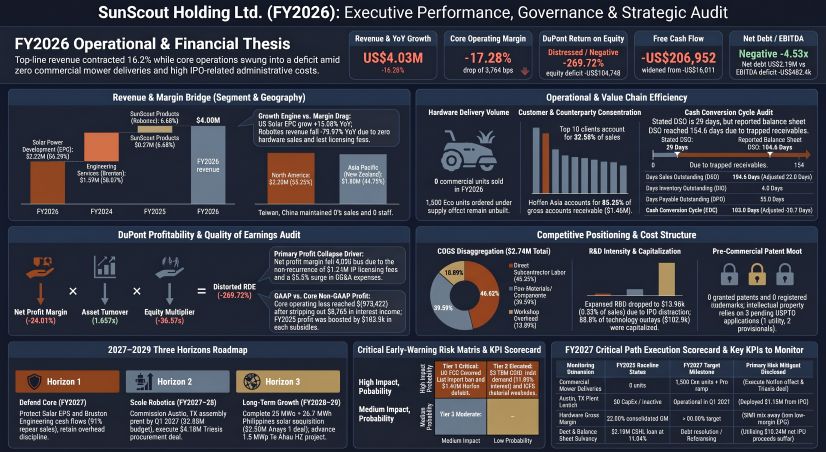 SunScout FY2026 Segmental Revenue, Margin Compression, and Balance Sheet Solvency
SunScout Holding Limited [NASDAQ/NYSE American Listed Post-IPO; SEC Form 20-F FPI] reported FY2026 consolidated revenue of US$4,026,452 for the fiscal year ended June 30, 2026, representing a 16.20% YoY contraction (-US$778,531) from US$4,804,983 in FY2025, while GAAP net income swung by -222.88% (-US$1,753,304) from a profit of US$786,647 to a net loss of US$(966,657). Prepared under U.S. GAAP with the United States Dollar (USD) as the reporting currency—and functional currencies split between USD for U.S. subsidiary Brightway Energy LLC and the New Zealand Dollar (NZD) for SunScout New Zealand Limited and SunScout Limited—the audited financials demonstrate a sharp operational divergence from management's autonomous robotics positioning.
Multi-Year Financial Trajectory, Segmental Mix, and Cost Disaggregation
In FY2026, SunScout’s commercial autonomous robotic mower lines (SunScout Eco, Pro, and ProMax) recorded zero physical unit deliveries. Reported revenue of US$268,959 (6.68% of group revenue, down 79.97% YoY) within the SunScout Products segment was derived 100% from an ad-hoc feasibility consulting study evaluating an Asian wind farm development, compared with US$1,343,052 in FY2025 generated by an upfront intellectual property licensing transaction with Hoffen Asia Co., Ltd. Consequently, top-line activity relied entirely on turnkey commercial rooftop solar Engineering, Procurement, and Construction (EPC) installations in the United States via Brightway Energy (55.25% of revenue; up 13.08% YoY to US$2,224,667) and legacy CNC precision metal fabrication via Brunton Engineering in New Zealand (38.07% of revenue; up 2.56% YoY to US$1,532,826).
Table: SunScout Holding Limited Consolidated Financial Performance and Profitability Metrics (FY2024–FY2026)
Gross margin contracted by 1,885 bps YoY to 32.05% as Cost of Goods Sold (COGS) rose 15.98% to US$2,736,143 (67.95% of revenue, versus 49.10% in FY2025 and 57.99% in FY2024). Under SunScout's accounting policy, depreciation and amortization (US$213,330 in FY2026) is recorded within Operating Expenses rather than COGS. Simultaneously, General and Administrative (G&A) expenses expanded by US$377,115 (+35.74% YoY) from US$1,055,284 to US$1,432,399, while professional fees climbed from US$17,100 to US$209,020 due to audit, legal, and IPO readiness expenditures. External audit fees billed by Fruci & Associates II, PLLC (PCAOB ID: 05525) rose from US$20,000 in FY2025 to US$171,039 in FY2026.
Geographically, North America (United States) became SunScout’s largest market in FY2026, rising 13.08% YoY from US$1,967,328 (40.94% share) to US$2,224,667 (55.25% share; FY2024: US$1,849,853) as commercial clients accelerated rooftop solar projects ahead of scheduled 2025/2026 federal tax incentive expirations. Asia-Pacific revenue—booked entirely in New Zealand—declined 36.50% YoY from US$2,837,655 (59.06% share) to US$1,801,785 (44.75% share; FY2024: US$631,490), combining US$1.53M from Brunton Engineering and US$269k from wind farm consulting. Direct booked revenue in the Rest of Asia-Pacific and Europe remained US$0 across FY2024–FY2026. Customer concentration remained elevated: top 10 clients represented 32.58% of FY2026 revenue, led by LT McGuinness Ltd (US$421,152; 10.32%) and Downer NZ Ltd (US$303,863; 7.44%), following the New Zealand Defence Force’s 9.4% contribution (US$450,751) in FY2025.
DuPont Decomposition, Working Capital Efficiency, and Solvency Architecture
Five-step DuPont decomposition isolates net profit margin deterioration (-4,038 bps) and technical balance sheet insolvency as the twin anomalies of FY2026. Ending shareholders' equity declined from US$821,537 in FY2025 to negative US$(104,748) as of June 30, 2026 (average FY2026 equity: US$358,395), generating an average-equity ROE of -269.72% (while ending-equity ROE mathematically inverted to +922.84% due to two negative components). Across the five-step components, Tax Burden remained 1.0000 in both FY2025 and FY2026; Interest Burden deteriorated from 0.7964x to 1.3895x as US$279,729 in net interest widened negative EBIT; Operating Margin fell from +20.56% to -17.28%; Asset Turnover slowed 15.6% from 1.2518x to 1.0570x on ~US$3.81M of total assets; and Financial Leverage (Equity Multiplier) shifted from 4.6722x in FY2025 (when ROE was 95.75%) to -36.3667x in FY2026.
Working capital metrics display a severe disconnect between active contracting accounts and a frozen legacy receivable. Gross trade receivables stood at US$1,714,794 as of June 30, 2026 (FY2025: US$1,753,833; net receivables: US$1,705,110 vs. US$1,745,835). Of this total, US$1,461,848 (85.25% of gross receivables, 85.7% of net receivables, and 38.38% of total balance sheet assets; FY2025: US$1,603,987) is owed by Hoffen Asia from a June 2024 licensing contract aged over 720 days (>24 months). Active operational receivables totaled US$252,946 (14.75% of gross receivables, aged 0–60 days). To cushion its US$(103,482) operating cash burn, SunScout expanded trade accounts payable by 76.8% YoY from US$233,450 to US$412,645, stretching supplier payment terms by 18.9 days.
All inventories (US$32,319 as of June 30, 2026; 100% finished goods, US$0 raw materials, US$0 work-in-progress) are held in New Zealand and carried under ASC 330 at the lower of weighted-average cost or net realizable value, with US$0 in inventory write-downs recorded across FY2024–FY2026.
Pre-IPO solvency metrics reached acute distress at fiscal year-end. Total debt reached US$2,535,711 (excluding US$98,042 in current operating lease liabilities and US$0 in non-current lease liabilities), against cash and cash equivalents of US$349,013 (FY2025: US$333,186, with US$0 restricted cash on June 30, 2026, held across operational accounts and a Live Oak high-yield account). Virtually all present and after-acquired assets of SunScout New Zealand Limited are encumbered under General Security Agreements securing Crown Regional Holdings Limited (CRHL) and ASB Bank.
Following the August 13, 2026 IPO (3,100,000 Class A Ordinary Shares issued at US$5.00/share for US$15,500,000 gross proceeds and ~US$12,340,600 net proceeds), the offering triggered a "Qualifying Equity Financing" clause under the CRHL loan. By letter dated July 24, 2026, CRHL waived default rights stemming from the corporate reorganization and declined its option to convert debt into equity at a 15% discount, while formally affirming its commercial preference for full debt repayment from IPO proceeds. As of late October 2026, SunScout had allocated US$0 of IPO proceeds toward retiring the 11.84% CRHL facility. Separately, US$1,550,000 of gross IPO proceeds was placed into an Indemnification Escrow Account with Continental Stock Transfer & Trust Company for underwriter Dominari Securities LLC (expiring February 13, 2027), with US$1,547,750 released to co-underwriter Revere Securities LLC on October 13, 2026.
Market Risk Sensitivities, Tax Posture, and Valuation Allowances
Under Note 9 (Financial Risk Management) and Note 11 (Income Taxes), SunScout discloses unhedged foreign currency exposure, fixed-price input inflation risk, and a 0.00% effective tax rate (ETR) across all three audited fiscal years (FY2024–FY2026). The company held zero derivative financial instruments or forward FX contracts across FY2024–FY2026, and did not publish separate sensitivity tables for EUR, RMB, or JPY despite European and Asian supply relationships, as import settlements are fixed primarily in USD or NZD.
Global Infrastructure Footprint, Post-IPO Capex Allocation, and FCC Onshoring Moats
SunScout operates an asset-light, three-continent supply chain architecture anchored by precision machining and core R&D in New Zealand, a legally mandated assembly plant under construction in Texas, and non-operational or pre-commercial contract manufacturing affiliates in Thailand and Germany. On July 28, 2026, the U.S. Federal Communications Commission (FCC) placed foreign-manufactured "advanced robotic devices" on its Covered List under Section 2 of the Secure and Trusted Communications Networks Act, prohibiting imports of foreign-made autonomous mowers into the United States. While SunScout secured conditional clearance from the U.S. Department of War on October 30, 2026, commercial access to the U.S. market legally requires onshoring final assembly to its Buda/Austin, Texas facility.
Multi-Continent Facility Matrix and Non-Current Asset Concentration
As of June 30, 2026, SunScout's total non-current assets stood at US$1,610,795 (down from US$1,727,222 in FY2025), with over 98% physically located in New Zealand. New Zealand assets comprised US$530,465 in net Property, Plant, and Equipment (plant and machinery US$392,884, vehicles US$90,847, prototype mowers US$34,123, and office equipment US$12,611), US$794,174 in finite-lived acquired intangibles, and US$188,120 in net capitalized software. The United States carried zero owned real estate or manufacturing equipment on the June 30, 2026 balance sheet, with group operating lease right-of-use (ROU) assets totaling US$98,036.
Table: SunScout Global Operating, R&D, and Contract Manufacturing Facility Profile
Post-IPO Capital Commitments, Supply Chain Architecture, and Three Horizons Roadmap
Management’s strategic roadmap follows a Three Horizons transition: defending legacy U.S. rooftop EPC and New Zealand defense/institutional fabrication cash flows (Horizon 1), scaling commercial autonomous robotics via Austin onshoring and distributor activation (Horizon 2), and building a 112.5 MWp utility-scale solar-plus-storage portfolio in the Philippines alongside domestic New Zealand generation (Horizon 3). As a foreign private issuer, management issued no formal numerical FY2027 revenue or EPS guidance, but explicitly targeted sustained gross margins exceeding 50% on SunScout Products hardware sales, Q1 2027 commissioning of the Austin plant, and delivery of 1,500 contracted SunScout Eco units.
Post-period contractual commitments entered between August and October 2026 exceed US$9.4 million, heavily committing the US$12.34 million in net IPO cash proceeds. Beyond the US$1,125,695 deployed toward the US$2.83M Austin build-out (9.12% of net IPO proceeds) and US$645,405 deployed to product development and R&D (5.23%), SunScout New Zealand executed a US$4,100,000 agreement with Triaxis Solutions in October 2026 (33.22% of net IPO proceeds), split between US$3,800,000 in advanced component procurement for SunScout Pro and ProMax units and US$300,000 in supply chain consulting and engineering fees.
Upstream component sourcing relies on Tier-1 Asian, European, and U.S. vendors for lithium-ion battery cells, drive motors, PV modules, sensors, and navigation microcontrollers, with knock-down kits for the SunScout Eco previously contracted to Shanghai Yushiyuan Technology Co., Ltd (Mowsion). Downstream commercial rollout depends on distributor agreements with MowBot Limited (Australia/New Zealand master distribution signed April 1, 2025; first shipment paused pending demo units) and WWS (Europe).
Product Specifications, Intellectual Property Moat, Workforce Productivity, and ESG Compliance
SunScout’s robotics portfolio comprises three off-grid Deployable Solar Array (DSA) models certified under residential safety standards AS/NZS 60335.2.107:2013 A1, ANSI/OPEI 60335-2-107:2020, IEC 60335-2-107:2017, and European CE conformity (completed for Eco and Pro):
* SunScout Eco (Residential): 12,900 sq ft coverage, 10-inch cutting width, <60 dB noise, designated for Thailand/Austin assembly.
* SunScout Pro (Commercial): 2.5-acre coverage, 15.7-inch cutting width, <65 dB noise, crab-steering architecture.
* SunScout ProMax (Large Estate): Up to 24-acre coverage, 600 mm cutting width, 100% aluminum frame, articulated steering.
Competitive rivalry in autonomous mowing is High, dominated by established multinationals Husqvarna, Stiga, Worx, and Segway, alongside High substitution threats from incumbent commercial diesel/petrol ride-on mowers and grid-tied perimeter/RTK robotic systems. Threat of New Entrants is Moderate due to FCC security hurdles and capital intensity, while Supplier Bargaining Power is High and Buyer Power is Moderate to High. Against this oligopoly, SunScout’s defensive intellectual property moat remains nascent: as of June 30, 2026, the company held zero issued patents, zero registered copyrights, and zero registered trademarks (with federal USPTO registration for "SUNSCOUT" still pending). Its IP assets consist of three pending USPTO applications assigned to SunScout Limited: Provisional App. US 63/680,664 (filed August 8, 2024) and Non-Provisional Utility App. US 19/294,535 (filed August 8, 2025) covering the *Solar Powered Robotic Vehicle With Movable Solar Array*, plus Provisional App. US 63/572,756 (filed April 9, 2024) for a *Mulching Mower Blade* (licensed to U.S. distributor Ballard Inc. on September 23, 2024).
Organizational productivity deteriorated sharply as headcount expanded ahead of commercial shipments. Full-time headcount increased 18.18% YoY from 22 in FY2025 (19 in FY2024) to 26 as of June 30, 2026 (average headcount: 24 vs. 20.5, +17.07%), with zero employees covered by collective bargaining agreements. Geographically, 22 staff (84.62%) are based in New Zealand, 4 (15.38%) in the United States, 0 (0.0%) in Taiwan, China, and 0 directly in Thailand or Europe. Functionally, staffing spans Operations (12; 46.15%), Management (4; 15.38%—CEO Edwin Cywinski, COO Marc Cywinski, CFO Jamie Parent, CTO Joshua Marotske), Sales & Marketing (4; 15.38%—3 NZ, 1 US), Finance (2; 7.69%), Human Resources (2; 7.69%), and IT (2; 7.69%), with approximately 19.5% (~5 staff) embedded across research, design, and engineering.
On environmental, health, and safety (ESG) compliance, New Zealand operations fall under the Resource Management Act 1991 (RMA), Waste Minimisation Act 2008 (WMA), Overseas Investment Act 2005 (OIO), and Health and Safety at Work Act 2015 (HSWA / WorkSafe NZ), while U.S. solar crews operate under OSHA. SunScout recorded zero work-related fatalities, zero major lost-time injury incidents (LTIFR not numerically disclosed), zero regulatory safety fines, and zero separately capitalized environmental compliance expenditures across FY2024–FY2026 (treating scrap metal recycling and solvent disposal within routine workshop COGS). Despite its clean-tech commercial positioning, the filing contains zero quantified Scope 1, Scope 2, or Scope 3 greenhouse gas disclosures and no net-zero target dates.
HDIN Institutional Verdict: Forensic Accounting Risks, Governance Deficits, and FY2027 Execution Reality
Cross-referencing SunScout’s audited footnotes against management’s strategic narrative exposes four structural governance and accounting red flags: aggressive credit loss under-provisioning, heavy R&D capitalization masking operating losses, pre-IPO insider value extraction, and concentrated dual-class voting control paired with material internal control weaknesses.
Forensic Accounting Quality, Critical Audit Matters, and R&D Capitalization
Although Fruci & Associates II, PLLC issued an unqualified opinion dated November 13, 2026, the auditor flagged two Critical Audit Matters (CAMs): (1) Valuation and Current Expected Credit Loss (CECL / ASC 326) provisioning on the Hoffen Asia receivable, noting high subjectivity in management's production volume and timeline assumptions; and (2) ASC 606 revenue recognition timing across multi-stage percentage-of-completion (cost-to-cost) EPC contracts, fabrication orders, and consulting deliverables.
Management maintained a total balance sheet Expected Credit Loss (ECL) allowance of just US$9,684 as of June 30, 2026 (0.56% of gross receivables; FY2025: US$7,999; FY2024: US$4,443), allocating only US$8,748 (a 0.59% reserve; net carrying value US$1,453,101) to the US$1,461,848 Hoffen Asia receivable and US$936 to operational receivables. Full recovery is predicated on a non-cash offset against 1,500 SunScout Eco units ordered at ~US$850,000 (~US$566.67/unit) from a Thai partner plant that had not commenced manufacturing as of filing (originally slated for November 2026 delivery, with management now assuming full recovery by March/April 2027). Given >720 days of aging and zero units manufactured, a 0.59% reserve represents an acute balance sheet impairment risk under ASC 326.
Simultaneously, Quality of Earnings adjustments reveal deeper core deterioration. Stripping out non-operating interest/other income (FY2026: US$8,765; FY2025: US$14,146; FY2024: US$18,683) and New Zealand P&L R&D cash subsidies (FY2026: US$0; FY2025: US$183,987, which inflated FY2025 operating income by 18.6%; FY2024: US$85,019; asset disposal gains/losses: US$0 across all periods) lowers Adjusted Core Operating Net Income from US$588,514 in FY2025 (FY2024: US$247,660) to a core deficit of US$(975,422) in FY2026—a negative operational swing of US$1,563,936.
Balance sheet asset quality is further shaped by zero goodwill and aggressive software capitalization. Following the May 27, 2024 cash purchase of Brunton Engineering for US$1,711,034, purchase price allocation under ASC 805 assigned US$617,100 to tangible PP&E, US$873,699 to Customer Relationships (FY2026 net carrying value: US$647,230), US$198,361 to Trade Name (FY2026 net carrying value: US$146,944), and US$21,874 to Inventory, recording US$0 goodwill (finite-lived intangibles are amortized straight-line over 10 years under ASC 360 with US$0 impairment in FY2026). Meanwhile, under ASC 350-40, SunScout capitalized 88.81% of its FY2026 technology outlays onto the balance sheet as internal-use navigation and RTK-GNSS software (gross US$199,461; net US$188,120 vs. US$96,551 in FY2025; placed into production in February 2026 on a 4-year straight-line amortization schedule with US$11,342 depreciated in FY2026), pushing total net intangibles and capitalized software to US$982,294 while P&L R&D expense collapsed 89.03% YoY to 0.32% of sales as staff were diverted to IPO execution.
Related-Party Capital Transfers, Controlled-Company Governance, and Executive Pay Decoupling
SunScout's corporate governance architecture exhibits severe minority shareholder alignment risks. Under a 20:1 dual-class share structure (Class A: 1 vote/share; Class B: 20 votes/share), Founder, Chairman, and CEO Edwin Cywinski holds 300,000 Class A shares (3.66% of Class A) and 2,550,000 Class B shares (85.00% of Class B), representing 25.43% economic equity but 60.18% of total voting power (directly and via the Cywinski Family Trust). CFO and Executive Director Jamie Parent holds 450,000 Class B shares (15.00% of Class B; 4.02% economic equity; 9.53% voting power), while COO Marc Cywinski (the CEO's son) controls 13.89% of voting power under an Acting-in-Concert Agreement with Edwin Cywinski. Collectively, officers and directors control 74.07% of voting power, whereas post-IPO public Class A investors (3,100,000 shares) hold 27.67% of equity but just 3.08% of voting power, with zero external institutional investors holding ≥5%. Although 3 of 5 board seats (60%) are independent—including Audit Committee Chair and SEC Item 407(d)(5) financial expert Albert McLelland (formerly Audit Committee Chairman of YD Bio Pharma Limited, based in Taiwan, China), alongside independent directors David Gray and Grant Verry (with independent director cash fees set at US$60,000/year plus US$3,333.33/month in share allotments across independent director schedules including Jacob Pretorius and Kian Woon Yap)—SunScout relies on NASDAQ Listing Rule 5615(c)(1) controlled-company exemptions (foregoing independent compensation and nominating committees) and Cayman Islands home-country rules, while remaining subject to Section 16 reporting under the U.S. Holding Foreign Insiders Accountable Act (effective March 18, 2026).
In Item 15, the CEO and CFO formally concluded that Internal Control over Financial Reporting (ICFR) and disclosure controls were ineffective as of June 30, 2026, citing a formal material weakness driven by the absence of U.S. GAAP accounting policies and chart of accounts, lack of segregation of duties, absence of independent review, lack of an internal audit function, and reliance on spreadsheets rather than an enterprise ERP system. Management has initiated external U.S. GAAP consulting engagements and plans ERP deployment.
While routine controlling-shareholder operating expense advances declined from US$29,376 in FY2024 and US$7,232 in FY2025 to US$0 in FY2026, structural related-party capital transfers expanded markedly:
* Brightway Membership Purchase Agreement (January 9, 2026): SunScout agreed to pay US$5,000,000—comprising US$2,000,000 in cash (due one week post-IPO) and US$3,000,000 in Class A shares (600,000 shares at US$5.00/share, issuable six months post-listing)—to acquire Brightway Energy LLC (an entity already under common control) from 50/50 owners Marc Cywinski and CTO Joshua Marotske. Under a January 9, 2026 Deed of Conditional Assignment, Marc Cywinski assigned his entire US$2.5M entitlement (US$1.0M cash and US$1.5M shares) to Joshua Marotske subject to IPO completion. Accounted for at historical carrying values with zero goodwill, neither the cash nor shares had been disbursed as of the filing date, and no independent fairness opinion is detailed.
* Pre-IPO Owner Cash Distributions: Despite negative FY2026 operating cash flow (-US$103,482), negative equity (-US$104,748), and US$2.18M in 11.84% government debt, predecessor entities distributed US$369,141 in cash to owners in FY2026 (representing 54.37% of FY2026's US$678,908 net capital deployment, alongside US$103,470 PP&E CapEx, US$102,911 capitalized software, US$23,802 debt principal, US$12,963 expensed R&D, US$0 M&A, and US$0 buybacks, funded via US$630,948 in external financing inflows including a US$600,000 director bridge advance from Edwin Cywinski). Cumulative three-year owner cash withdrawals totaled US$1,024,197 (FY2024: US$539,732; FY2025: US$115,324; FY2026: US$369,141).
* Reorganization Share Exchanges (November 14, 2025): Insiders converted SunScout Limited shares to settle debts: AE Equity Limited (Edwin Cywinski) exchanged 46,875 shares satisfying US$659,340 for 6,600,000 Class A and 7,500,000 Class B shares; Solerin Equity Limited (Marc Cywinski) exchanged 46,875 shares satisfying US$535,464 for 5,360,000 Class A and 7,500,000 Class B shares; and BKK Consultants Limited (Jacob Pretorius and Karen Wilcox) exchanged 6,250 shares satisfying US$103,896 for 1,040,000 Class A shares.
* Executive Remuneration Decoupling: Aggregate cash compensation across the four named executive officers (Item 6.B) reached US$557,707 (~US$139,427 average) in FY2026, alongside US$483,487 in deferred base salary accrued for CEO Edwin Cywinski payable at IPO closing. Among executive directors, base cash pay increased 26.68% YoY from US$323,000 to US$409,200—Edwin Cywinski rose 21.30% (US$185,500 to US$225,000) and Jamie Parent rose 33.96% (US$137,500 to US$184,200)—despite a 222.88% net income collapse and zero clawback or quantitative performance-hurdle provisions. Share-based compensation was US$0 across FY2024–FY2026, though the post-IPO 2026 Equity Incentive Plan reserves 1,120,000 Class A shares (10.00% potential dilution on 11,200,000 post-IPO shares; zero grants as of June 30, 2026).
Comprehensive Risk Matrix and FY2027 Execution Critical Path
With zero pending material litigation reported under ASC 450 as of June 30, 2026, SunScout's FY2027 survival and valuation trajectory depend on resolving three Tier 1 critical bottlenecks while managing elevated leverage and governance risks.
Table: SunScout Materiality-Ranked Risk Matrix and FY2027 Critical Path Scorecard
Key Financial Questions From the FY2026 Form 20-F Filing
What drove SunScout Holding Limited’s revenue contraction and margin collapse in FY2026?
Consolidated revenue declined 16.20% YoY to US$4,026,452 because the SunScout Products segment generated zero commercial robotic mower sales, dropping 79.97% YoY to US$268,959 (derived solely from an Asian wind farm consulting fee) following the non-recurrence of FY2025's US$1,343,052 Hoffen Asia IP license. The resulting mix shift toward lower-margin U.S. solar EPC contracting (30.37% gross margin) and New Zealand precision fabrication (~34.12% gross margin) compressed consolidated gross margin by 1,885 bps to 32.05%, while a 36.20% surge in operating expenses to US$1,986,002 drove operating margin down 3,784 bps to -17.28%.
How is SunScout allocating its August 2026 IPO proceeds across manufacturing and utility-scale infrastructure?
From the US$12,340,600 in net IPO proceeds raised on August 13, 2026, SunScout deployed US$4,100,000 (33.22%) into a Triaxis Solutions component procurement contract for Pro and ProMax mowers, US$1,125,695 (9.12%) toward its US$2,830,000 Buda/Austin, Texas assembly plant (targeted for Q1 2027 commissioning to comply with the U.S. FCC import ban), and US$645,405 (5.23%) into product development through October 26, 2026. Additionally, management signed a US$2,500,000 cash acquisition agreement for Anaya 1 Power Corporation (25.0 MWp solar + 26.736 MWh BESS in the Philippines) and an October 2026 landowner deal for the NZ$2.64M (~US$1.49M) Te Akau solar-plus-storage project in New Zealand, while leaving its US$2,175,307 CRHL government loan unrepaid.
What are the primary balance sheet and accounting risks flagged in SunScout’s FY2026 audit?
External auditor Fruci & Associates II, PLLC identified two Critical Audit Matters: ASC 326 credit loss recoverability on the US$1,461,848 Hoffen Asia receivable (aged over 720 days and representing 85.25% of gross receivables and 38.38% of total assets, yet reserved at just 0.59% via an unmanufactured 1,500-mower supply offset) and ASC 606 percentage-of-completion revenue recognition across EPC contracts. Furthermore, SunScout ended FY2026 in technical equity insolvency at US$(104,748), capitalized 88.81% of technology outlays (US$102,911 of US$115,874), disclosed a formal material weakness in internal controls over financial reporting (ICFR), and carries a post-IPO US$5,000,000 common-control acquisition obligation under the Brightway Membership Purchase Agreement.
Presentation Download & Analyst Briefing Access:
- Institutional Presentation: Download the full "SunScout_Holding_Forensic_Audit" PDF under the 'Related Topics' section.
- Analyst Video Briefing: Watch the "US FCC Robotics Ban Hits Wall Street IPO: Inside SunScout’s $12M Onshoring Gamble" on the HDIN Research YouTube Channel.
About HDIN Research:
HDIN Research is a premier global market intelligence and strategic advisory firm specializing in institutional-grade financial analysis, supply chain audits, and macroeconomic forecasting. Our dedicated sector analysts deliver actionable, data-driven insights tailored for private equity, hedge funds, and corporate strategy teams. Visit us at https://www.hdinresearch.com.
Editorial & Methodology Disclosure:
"This market intelligence brief was researched, modeled, and audited by the HDIN Research Equity Desk based on official primary corporate filings (SunScout Holding Limited FY2026 Annual Report on Form 20-F). Proprietary quantitative extraction tools were utilized to ensure 100% fidelity to reported financial line items and footnotes. All forensic interpretations, segmental benchmarks, and institutional verdicts were independently written and verified by HDIN senior sector analysts in accordance with institutional research standards."
HDIN Executive Takeaways
1. Margin Collapse & Insolvency: FY2026 revenue fell 16.20% YoY to US$4.03M on zero mower sales, cutting operating margin 3,784 bps to -17.28% and pushing equity to US$(104,748).
2. FCC Mandate & Capital Calls: August's US$12.34M net IPO proceeds back a US$2.83M Austin plant and US$4.10M Triaxis contract to bypass FCC bans, while US$1.46M stays locked at Hoffen Asia.
3. Institutional Verdict: Dual-class CEO control (60.18% votes), ICFR material weaknesses, and US$2.18M in 11.84% government debt create acute FY2027 execution risk.
Figure SunScout Holding Ltd Executive Performance, Governance & Strategic Audit
SunScout FY2026 Segmental Revenue, Margin Compression, and Balance Sheet SolvencySunScout Holding Limited [NASDAQ/NYSE American Listed Post-IPO; SEC Form 20-F FPI] reported FY2026 consolidated revenue of US$4,026,452 for the fiscal year ended June 30, 2026, representing a 16.20% YoY contraction (-US$778,531) from US$4,804,983 in FY2025, while GAAP net income swung by -222.88% (-US$1,753,304) from a profit of US$786,647 to a net loss of US$(966,657). Prepared under U.S. GAAP with the United States Dollar (USD) as the reporting currency—and functional currencies split between USD for U.S. subsidiary Brightway Energy LLC and the New Zealand Dollar (NZD) for SunScout New Zealand Limited and SunScout Limited—the audited financials demonstrate a sharp operational divergence from management's autonomous robotics positioning.
Multi-Year Financial Trajectory, Segmental Mix, and Cost Disaggregation
In FY2026, SunScout’s commercial autonomous robotic mower lines (SunScout Eco, Pro, and ProMax) recorded zero physical unit deliveries. Reported revenue of US$268,959 (6.68% of group revenue, down 79.97% YoY) within the SunScout Products segment was derived 100% from an ad-hoc feasibility consulting study evaluating an Asian wind farm development, compared with US$1,343,052 in FY2025 generated by an upfront intellectual property licensing transaction with Hoffen Asia Co., Ltd. Consequently, top-line activity relied entirely on turnkey commercial rooftop solar Engineering, Procurement, and Construction (EPC) installations in the United States via Brightway Energy (55.25% of revenue; up 13.08% YoY to US$2,224,667) and legacy CNC precision metal fabrication via Brunton Engineering in New Zealand (38.07% of revenue; up 2.56% YoY to US$1,532,826).
Table: SunScout Holding Limited Consolidated Financial Performance and Profitability Metrics (FY2024–FY2026)
| Financial Metric (US$ or %) | FY2024 (Audited) | FY2025 (Audited) | FY2026 (Audited) | FY2026 YoY Change ($ / bps) | Primary Operational Driver |
| Total Revenue | $2,481,343 | $4,804,983 | $4,026,452 | -$778,531 (-16.20%) | Non-recurrence of $1.34M Hoffen Asia license fee |
| — Solar Power Development Solutions | $1,849,853 | $1,967,328 | $2,224,667 | +$257,339 (+13.08%) | U.S. commercial rooftop EPC tax-incentive pull-forward |
| — Engineering Products & Services | $172,449 | $1,494,603 | $1,532,826 | +$38,223 (+2.56%) | Full-year Brunton Engineering CNC utilization (91% repeat) |
| — SunScout Robotic Products | $459,041 | $1,343,052 | $268,959 | -$1,074,093 (-79.97%) | Zero mower units sold; 100% wind farm consulting fee |
| Cost of Goods Sold (COGS) | $1,438,906 | $2,359,157 | $2,736,143 | +$376,986 (+15.98%) | Higher EPC subcontractor crews and NZ engineering wages |
| Gross Profit | $1,042,437 | $2,445,826 | $1,290,309 | -$1,155,517 (-47.24%) | Mix shift from zero-cost licensing to contracting |
| Gross Margin (%) | 42.01% | 50.90% | 32.05% | -1,885 bps | EPC (30.37% GM) and fabrication (~34.12% GM) mix drag |
| Operating Expenses (OpEx) | $670,030 | $1,458,128 | $1,986,002 | +$527,874 (+36.20%) | G&A surge (
209k) |
| Operating Income / (Loss) (EBIT) | $372,407 | $987,696 | $(695,693) | -$1,683,389 (-170.44%) | Gross margin compression plus fixed SG&A expansion |
| Operating Margin (%) | 15.01% | 20.56% | -17.28% | -3,784 bps | Severe negative operational leverage |
| D&A Expense (Within OpEx) | $31,027 | $179,183 | $213,330 | +$34,147 (+19.06%) | Brunton intangibles, ROU assets, and $11,342 SW dep. |
| EBITDA | $403,434 | $1,166,879 | $(482,363) | -$1,649,242 (-141.34%) | Cash operating earnings swung to deficit |
| Net Interest Expense | $39,728 | $215,195 | $279,729 | +$64,534 (+29.99%) | Compounding 11.84% interest on CRHL government loan |
| GAAP Net Income / (Loss) | $351,362 | $786,647 | $(966,657) | -$1,753,304 (-222.88%) | Operating deficit compounded by debt service charges |
| Net Profit Margin (%) | 14.16% | 16.37% | -24.01% | -4,038 bps | Bottom-line erosion across legacy segments |
| Operating Cash Flow (CFO) | $(19,876) | $93,810 | $(103,482) | -$197,292 (-210.31%) | Cash burn buffered only by stretching trade payables |
| Capital Expenditures (CapEx) | $1,725,031 | $109,821 | $103,470 | -$6,351 (-5.78%) | Maintenance tooling; Austin CapEx deferred post-FY26 |
| Free Cash Flow (FCF) | $(1,744,907) | $(16,011) | $(206,952) | -$190,941 (-1,192.56%) | Chronic structural cash outflow across all three years |
| Return on Equity (ROE) | 240.70% | 95.75% | N/A (Neg. Eq.) | Distorted | Ending equity deficit of -US$104,748 (-269.72% avg ROE) |
| Return on Invested Capital (ROIC) | 18.23% | 33.81% | -33.42% | -6,723 bps | Negative economic return on operating asset base |
Gross margin contracted by 1,885 bps YoY to 32.05% as Cost of Goods Sold (COGS) rose 15.98% to US$2,736,143 (67.95% of revenue, versus 49.10% in FY2025 and 57.99% in FY2024). Under SunScout's accounting policy, depreciation and amortization (US$213,330 in FY2026) is recorded within Operating Expenses rather than COGS. Simultaneously, General and Administrative (G&A) expenses expanded by US$377,115 (+35.74% YoY) from US$1,055,284 to US$1,432,399, while professional fees climbed from US$17,100 to US$209,020 due to audit, legal, and IPO readiness expenditures. External audit fees billed by Fruci & Associates II, PLLC (PCAOB ID: 05525) rose from US$20,000 in FY2025 to US$171,039 in FY2026.
Geographically, North America (United States) became SunScout’s largest market in FY2026, rising 13.08% YoY from US$1,967,328 (40.94% share) to US$2,224,667 (55.25% share; FY2024: US$1,849,853) as commercial clients accelerated rooftop solar projects ahead of scheduled 2025/2026 federal tax incentive expirations. Asia-Pacific revenue—booked entirely in New Zealand—declined 36.50% YoY from US$2,837,655 (59.06% share) to US$1,801,785 (44.75% share; FY2024: US$631,490), combining US$1.53M from Brunton Engineering and US$269k from wind farm consulting. Direct booked revenue in the Rest of Asia-Pacific and Europe remained US$0 across FY2024–FY2026. Customer concentration remained elevated: top 10 clients represented 32.58% of FY2026 revenue, led by LT McGuinness Ltd (US$421,152; 10.32%) and Downer NZ Ltd (US$303,863; 7.44%), following the New Zealand Defence Force’s 9.4% contribution (US$450,751) in FY2025.
DuPont Decomposition, Working Capital Efficiency, and Solvency Architecture
Five-step DuPont decomposition isolates net profit margin deterioration (-4,038 bps) and technical balance sheet insolvency as the twin anomalies of FY2026. Ending shareholders' equity declined from US$821,537 in FY2025 to negative US$(104,748) as of June 30, 2026 (average FY2026 equity: US$358,395), generating an average-equity ROE of -269.72% (while ending-equity ROE mathematically inverted to +922.84% due to two negative components). Across the five-step components, Tax Burden remained 1.0000 in both FY2025 and FY2026; Interest Burden deteriorated from 0.7964x to 1.3895x as US$279,729 in net interest widened negative EBIT; Operating Margin fell from +20.56% to -17.28%; Asset Turnover slowed 15.6% from 1.2518x to 1.0570x on ~US$3.81M of total assets; and Financial Leverage (Equity Multiplier) shifted from 4.6722x in FY2025 (when ROE was 95.75%) to -36.3667x in FY2026.
Working capital metrics display a severe disconnect between active contracting accounts and a frozen legacy receivable. Gross trade receivables stood at US$1,714,794 as of June 30, 2026 (FY2025: US$1,753,833; net receivables: US$1,705,110 vs. US$1,745,835). Of this total, US$1,461,848 (85.25% of gross receivables, 85.7% of net receivables, and 38.38% of total balance sheet assets; FY2025: US$1,603,987) is owed by Hoffen Asia from a June 2024 licensing contract aged over 720 days (>24 months). Active operational receivables totaled US$252,946 (14.75% of gross receivables, aged 0–60 days). To cushion its US$(103,482) operating cash burn, SunScout expanded trade accounts payable by 76.8% YoY from US$233,450 to US$412,645, stretching supplier payment terms by 18.9 days.
All inventories (US$32,319 as of June 30, 2026; 100% finished goods, US$0 raw materials, US$0 work-in-progress) are held in New Zealand and carried under ASC 330 at the lower of weighted-average cost or net realizable value, with US$0 in inventory write-downs recorded across FY2024–FY2026.
Pre-IPO solvency metrics reached acute distress at fiscal year-end. Total debt reached US$2,535,711 (excluding US$98,042 in current operating lease liabilities and US$0 in non-current lease liabilities), against cash and cash equivalents of US$349,013 (FY2025: US$333,186, with US$0 restricted cash on June 30, 2026, held across operational accounts and a Live Oak high-yield account). Virtually all present and after-acquired assets of SunScout New Zealand Limited are encumbered under General Security Agreements securing Crown Regional Holdings Limited (CRHL) and ASB Bank.
Following the August 13, 2026 IPO (3,100,000 Class A Ordinary Shares issued at US$5.00/share for US$15,500,000 gross proceeds and ~US$12,340,600 net proceeds), the offering triggered a "Qualifying Equity Financing" clause under the CRHL loan. By letter dated July 24, 2026, CRHL waived default rights stemming from the corporate reorganization and declined its option to convert debt into equity at a 15% discount, while formally affirming its commercial preference for full debt repayment from IPO proceeds. As of late October 2026, SunScout had allocated US$0 of IPO proceeds toward retiring the 11.84% CRHL facility. Separately, US$1,550,000 of gross IPO proceeds was placed into an Indemnification Escrow Account with Continental Stock Transfer & Trust Company for underwriter Dominari Securities LLC (expiring February 13, 2027), with US$1,547,750 released to co-underwriter Revere Securities LLC on October 13, 2026.
Market Risk Sensitivities, Tax Posture, and Valuation Allowances
Under Note 9 (Financial Risk Management) and Note 11 (Income Taxes), SunScout discloses unhedged foreign currency exposure, fixed-price input inflation risk, and a 0.00% effective tax rate (ETR) across all three audited fiscal years (FY2024–FY2026). The company held zero derivative financial instruments or forward FX contracts across FY2024–FY2026, and did not publish separate sensitivity tables for EUR, RMB, or JPY despite European and Asian supply relationships, as import settlements are fixed primarily in USD or NZD.
Global Infrastructure Footprint, Post-IPO Capex Allocation, and FCC Onshoring Moats
SunScout operates an asset-light, three-continent supply chain architecture anchored by precision machining and core R&D in New Zealand, a legally mandated assembly plant under construction in Texas, and non-operational or pre-commercial contract manufacturing affiliates in Thailand and Germany. On July 28, 2026, the U.S. Federal Communications Commission (FCC) placed foreign-manufactured "advanced robotic devices" on its Covered List under Section 2 of the Secure and Trusted Communications Networks Act, prohibiting imports of foreign-made autonomous mowers into the United States. While SunScout secured conditional clearance from the U.S. Department of War on October 30, 2026, commercial access to the U.S. market legally requires onshoring final assembly to its Buda/Austin, Texas facility.
Multi-Continent Facility Matrix and Non-Current Asset Concentration
As of June 30, 2026, SunScout's total non-current assets stood at US$1,610,795 (down from US$1,727,222 in FY2025), with over 98% physically located in New Zealand. New Zealand assets comprised US$530,465 in net Property, Plant, and Equipment (plant and machinery US$392,884, vehicles US$90,847, prototype mowers US$34,123, and office equipment US$12,611), US$794,174 in finite-lived acquired intangibles, and US$188,120 in net capitalized software. The United States carried zero owned real estate or manufacturing equipment on the June 30, 2026 balance sheet, with group operating lease right-of-use (ROU) assets totaling US$98,036.
Table: SunScout Global Operating, R&D, and Contract Manufacturing Facility Profile
| Facility / Hub | Physical Location | Functional Scope | Footprint (sq ft) | Lease Terms & Annual Rent | Operational & CapEx Status |
| Global HQ & Brunton Fabrication Hub | 112 Kaimanawa St, Kelvin Grove, Palmerston North, New Zealand | Global HQ, R&D, prototyping, CNC laser cutting, folding, welding, Pro/ProMax pilot line | 15,000 enclosed + 7,500 outside yard | May 28, 2024–May 28, 2027 (3x 3-yr options); NZ
113,022/yr); $98,042 current liability |
Fully operational (nearly 30-yr site history); houses 22 of 26 full-time staff |
| U.S. Assembly & Integration Plant | 1340 FM 2001, Suite 606, Buda, TX 78610 (Tower Business Park, Austin area) | Primary U.S. assembly for Pro, ProMax, and U.S.-bound Eco units for FCC compliance | 12,785 | 123 mos (April 1, 2026–June 30, 2036; 60-mo option);
2.3M commitment) |
Non-operational at FY26 close ($0 spent); $1,125,695 deployed through Oct 26, 2026 vs. $2,830,000 budget; Q1 2027 target |
| U.S. Solar EPC Hub (Brightway) | Boston, Massachusetts, USA | Commercial rooftop solar EPC project hub (tens of kW to multi-MW installations) | Shared office | Month-to-month lease (exempt from ASC 842 capitalization) | Operational; houses 4 full-time staff |
| Asian High-Volume Assembly JV | Chonburi Province, Thailand (SunScout Asia Company Limited) | Designated Eco volume assembly (43% equity affiliate; 57% Thai individual investors; inc. Sept 7, 2025) | Contracted partner plant | License Manufacturing Agreement | Non-operational; $0 carrying value, zero operational/financial activity as of June 30, 2026 |
| European Assembly & Sales Partner | Germany (WWS / Wrissmer Industries Holding GmbH) | EU assembly, customization, and CE-compliant distribution | Partner plant | Binding cooperation agreement (Nov 5, 2025; open-ended, 6-month exit notice) | Pre-commercial; tooling and CE alignment underway; final distribution contract pending |
Post-IPO Capital Commitments, Supply Chain Architecture, and Three Horizons Roadmap
Management’s strategic roadmap follows a Three Horizons transition: defending legacy U.S. rooftop EPC and New Zealand defense/institutional fabrication cash flows (Horizon 1), scaling commercial autonomous robotics via Austin onshoring and distributor activation (Horizon 2), and building a 112.5 MWp utility-scale solar-plus-storage portfolio in the Philippines alongside domestic New Zealand generation (Horizon 3). As a foreign private issuer, management issued no formal numerical FY2027 revenue or EPS guidance, but explicitly targeted sustained gross margins exceeding 50% on SunScout Products hardware sales, Q1 2027 commissioning of the Austin plant, and delivery of 1,500 contracted SunScout Eco units.
Post-period contractual commitments entered between August and October 2026 exceed US$9.4 million, heavily committing the US$12.34 million in net IPO cash proceeds. Beyond the US$1,125,695 deployed toward the US$2.83M Austin build-out (9.12% of net IPO proceeds) and US$645,405 deployed to product development and R&D (5.23%), SunScout New Zealand executed a US$4,100,000 agreement with Triaxis Solutions in October 2026 (33.22% of net IPO proceeds), split between US$3,800,000 in advanced component procurement for SunScout Pro and ProMax units and US$300,000 in supply chain consulting and engineering fees.
Upstream component sourcing relies on Tier-1 Asian, European, and U.S. vendors for lithium-ion battery cells, drive motors, PV modules, sensors, and navigation microcontrollers, with knock-down kits for the SunScout Eco previously contracted to Shanghai Yushiyuan Technology Co., Ltd (Mowsion). Downstream commercial rollout depends on distributor agreements with MowBot Limited (Australia/New Zealand master distribution signed April 1, 2025; first shipment paused pending demo units) and WWS (Europe).
Product Specifications, Intellectual Property Moat, Workforce Productivity, and ESG Compliance
SunScout’s robotics portfolio comprises three off-grid Deployable Solar Array (DSA) models certified under residential safety standards AS/NZS 60335.2.107:2013 A1, ANSI/OPEI 60335-2-107:2020, IEC 60335-2-107:2017, and European CE conformity (completed for Eco and Pro):
* SunScout Eco (Residential): 12,900 sq ft coverage, 10-inch cutting width, <60 dB noise, designated for Thailand/Austin assembly.
* SunScout Pro (Commercial): 2.5-acre coverage, 15.7-inch cutting width, <65 dB noise, crab-steering architecture.
* SunScout ProMax (Large Estate): Up to 24-acre coverage, 600 mm cutting width, 100% aluminum frame, articulated steering.
Competitive rivalry in autonomous mowing is High, dominated by established multinationals Husqvarna, Stiga, Worx, and Segway, alongside High substitution threats from incumbent commercial diesel/petrol ride-on mowers and grid-tied perimeter/RTK robotic systems. Threat of New Entrants is Moderate due to FCC security hurdles and capital intensity, while Supplier Bargaining Power is High and Buyer Power is Moderate to High. Against this oligopoly, SunScout’s defensive intellectual property moat remains nascent: as of June 30, 2026, the company held zero issued patents, zero registered copyrights, and zero registered trademarks (with federal USPTO registration for "SUNSCOUT" still pending). Its IP assets consist of three pending USPTO applications assigned to SunScout Limited: Provisional App. US 63/680,664 (filed August 8, 2024) and Non-Provisional Utility App. US 19/294,535 (filed August 8, 2025) covering the *Solar Powered Robotic Vehicle With Movable Solar Array*, plus Provisional App. US 63/572,756 (filed April 9, 2024) for a *Mulching Mower Blade* (licensed to U.S. distributor Ballard Inc. on September 23, 2024).
Organizational productivity deteriorated sharply as headcount expanded ahead of commercial shipments. Full-time headcount increased 18.18% YoY from 22 in FY2025 (19 in FY2024) to 26 as of June 30, 2026 (average headcount: 24 vs. 20.5, +17.07%), with zero employees covered by collective bargaining agreements. Geographically, 22 staff (84.62%) are based in New Zealand, 4 (15.38%) in the United States, 0 (0.0%) in Taiwan, China, and 0 directly in Thailand or Europe. Functionally, staffing spans Operations (12; 46.15%), Management (4; 15.38%—CEO Edwin Cywinski, COO Marc Cywinski, CFO Jamie Parent, CTO Joshua Marotske), Sales & Marketing (4; 15.38%—3 NZ, 1 US), Finance (2; 7.69%), Human Resources (2; 7.69%), and IT (2; 7.69%), with approximately 19.5% (~5 staff) embedded across research, design, and engineering.
On environmental, health, and safety (ESG) compliance, New Zealand operations fall under the Resource Management Act 1991 (RMA), Waste Minimisation Act 2008 (WMA), Overseas Investment Act 2005 (OIO), and Health and Safety at Work Act 2015 (HSWA / WorkSafe NZ), while U.S. solar crews operate under OSHA. SunScout recorded zero work-related fatalities, zero major lost-time injury incidents (LTIFR not numerically disclosed), zero regulatory safety fines, and zero separately capitalized environmental compliance expenditures across FY2024–FY2026 (treating scrap metal recycling and solvent disposal within routine workshop COGS). Despite its clean-tech commercial positioning, the filing contains zero quantified Scope 1, Scope 2, or Scope 3 greenhouse gas disclosures and no net-zero target dates.
HDIN Institutional Verdict: Forensic Accounting Risks, Governance Deficits, and FY2027 Execution Reality
Cross-referencing SunScout’s audited footnotes against management’s strategic narrative exposes four structural governance and accounting red flags: aggressive credit loss under-provisioning, heavy R&D capitalization masking operating losses, pre-IPO insider value extraction, and concentrated dual-class voting control paired with material internal control weaknesses.
Forensic Accounting Quality, Critical Audit Matters, and R&D Capitalization
Although Fruci & Associates II, PLLC issued an unqualified opinion dated November 13, 2026, the auditor flagged two Critical Audit Matters (CAMs): (1) Valuation and Current Expected Credit Loss (CECL / ASC 326) provisioning on the Hoffen Asia receivable, noting high subjectivity in management's production volume and timeline assumptions; and (2) ASC 606 revenue recognition timing across multi-stage percentage-of-completion (cost-to-cost) EPC contracts, fabrication orders, and consulting deliverables.
Management maintained a total balance sheet Expected Credit Loss (ECL) allowance of just US$9,684 as of June 30, 2026 (0.56% of gross receivables; FY2025: US$7,999; FY2024: US$4,443), allocating only US$8,748 (a 0.59% reserve; net carrying value US$1,453,101) to the US$1,461,848 Hoffen Asia receivable and US$936 to operational receivables. Full recovery is predicated on a non-cash offset against 1,500 SunScout Eco units ordered at ~US$850,000 (~US$566.67/unit) from a Thai partner plant that had not commenced manufacturing as of filing (originally slated for November 2026 delivery, with management now assuming full recovery by March/April 2027). Given >720 days of aging and zero units manufactured, a 0.59% reserve represents an acute balance sheet impairment risk under ASC 326.
Simultaneously, Quality of Earnings adjustments reveal deeper core deterioration. Stripping out non-operating interest/other income (FY2026: US$8,765; FY2025: US$14,146; FY2024: US$18,683) and New Zealand P&L R&D cash subsidies (FY2026: US$0; FY2025: US$183,987, which inflated FY2025 operating income by 18.6%; FY2024: US$85,019; asset disposal gains/losses: US$0 across all periods) lowers Adjusted Core Operating Net Income from US$588,514 in FY2025 (FY2024: US$247,660) to a core deficit of US$(975,422) in FY2026—a negative operational swing of US$1,563,936.
Balance sheet asset quality is further shaped by zero goodwill and aggressive software capitalization. Following the May 27, 2024 cash purchase of Brunton Engineering for US$1,711,034, purchase price allocation under ASC 805 assigned US$617,100 to tangible PP&E, US$873,699 to Customer Relationships (FY2026 net carrying value: US$647,230), US$198,361 to Trade Name (FY2026 net carrying value: US$146,944), and US$21,874 to Inventory, recording US$0 goodwill (finite-lived intangibles are amortized straight-line over 10 years under ASC 360 with US$0 impairment in FY2026). Meanwhile, under ASC 350-40, SunScout capitalized 88.81% of its FY2026 technology outlays onto the balance sheet as internal-use navigation and RTK-GNSS software (gross US$199,461; net US$188,120 vs. US$96,551 in FY2025; placed into production in February 2026 on a 4-year straight-line amortization schedule with US$11,342 depreciated in FY2026), pushing total net intangibles and capitalized software to US$982,294 while P&L R&D expense collapsed 89.03% YoY to 0.32% of sales as staff were diverted to IPO execution.
Related-Party Capital Transfers, Controlled-Company Governance, and Executive Pay Decoupling
SunScout's corporate governance architecture exhibits severe minority shareholder alignment risks. Under a 20:1 dual-class share structure (Class A: 1 vote/share; Class B: 20 votes/share), Founder, Chairman, and CEO Edwin Cywinski holds 300,000 Class A shares (3.66% of Class A) and 2,550,000 Class B shares (85.00% of Class B), representing 25.43% economic equity but 60.18% of total voting power (directly and via the Cywinski Family Trust). CFO and Executive Director Jamie Parent holds 450,000 Class B shares (15.00% of Class B; 4.02% economic equity; 9.53% voting power), while COO Marc Cywinski (the CEO's son) controls 13.89% of voting power under an Acting-in-Concert Agreement with Edwin Cywinski. Collectively, officers and directors control 74.07% of voting power, whereas post-IPO public Class A investors (3,100,000 shares) hold 27.67% of equity but just 3.08% of voting power, with zero external institutional investors holding ≥5%. Although 3 of 5 board seats (60%) are independent—including Audit Committee Chair and SEC Item 407(d)(5) financial expert Albert McLelland (formerly Audit Committee Chairman of YD Bio Pharma Limited, based in Taiwan, China), alongside independent directors David Gray and Grant Verry (with independent director cash fees set at US$60,000/year plus US$3,333.33/month in share allotments across independent director schedules including Jacob Pretorius and Kian Woon Yap)—SunScout relies on NASDAQ Listing Rule 5615(c)(1) controlled-company exemptions (foregoing independent compensation and nominating committees) and Cayman Islands home-country rules, while remaining subject to Section 16 reporting under the U.S. Holding Foreign Insiders Accountable Act (effective March 18, 2026).
In Item 15, the CEO and CFO formally concluded that Internal Control over Financial Reporting (ICFR) and disclosure controls were ineffective as of June 30, 2026, citing a formal material weakness driven by the absence of U.S. GAAP accounting policies and chart of accounts, lack of segregation of duties, absence of independent review, lack of an internal audit function, and reliance on spreadsheets rather than an enterprise ERP system. Management has initiated external U.S. GAAP consulting engagements and plans ERP deployment.
While routine controlling-shareholder operating expense advances declined from US$29,376 in FY2024 and US$7,232 in FY2025 to US$0 in FY2026, structural related-party capital transfers expanded markedly:
* Brightway Membership Purchase Agreement (January 9, 2026): SunScout agreed to pay US$5,000,000—comprising US$2,000,000 in cash (due one week post-IPO) and US$3,000,000 in Class A shares (600,000 shares at US$5.00/share, issuable six months post-listing)—to acquire Brightway Energy LLC (an entity already under common control) from 50/50 owners Marc Cywinski and CTO Joshua Marotske. Under a January 9, 2026 Deed of Conditional Assignment, Marc Cywinski assigned his entire US$2.5M entitlement (US$1.0M cash and US$1.5M shares) to Joshua Marotske subject to IPO completion. Accounted for at historical carrying values with zero goodwill, neither the cash nor shares had been disbursed as of the filing date, and no independent fairness opinion is detailed.
* Pre-IPO Owner Cash Distributions: Despite negative FY2026 operating cash flow (-US$103,482), negative equity (-US$104,748), and US$2.18M in 11.84% government debt, predecessor entities distributed US$369,141 in cash to owners in FY2026 (representing 54.37% of FY2026's US$678,908 net capital deployment, alongside US$103,470 PP&E CapEx, US$102,911 capitalized software, US$23,802 debt principal, US$12,963 expensed R&D, US$0 M&A, and US$0 buybacks, funded via US$630,948 in external financing inflows including a US$600,000 director bridge advance from Edwin Cywinski). Cumulative three-year owner cash withdrawals totaled US$1,024,197 (FY2024: US$539,732; FY2025: US$115,324; FY2026: US$369,141).
* Reorganization Share Exchanges (November 14, 2025): Insiders converted SunScout Limited shares to settle debts: AE Equity Limited (Edwin Cywinski) exchanged 46,875 shares satisfying US$659,340 for 6,600,000 Class A and 7,500,000 Class B shares; Solerin Equity Limited (Marc Cywinski) exchanged 46,875 shares satisfying US$535,464 for 5,360,000 Class A and 7,500,000 Class B shares; and BKK Consultants Limited (Jacob Pretorius and Karen Wilcox) exchanged 6,250 shares satisfying US$103,896 for 1,040,000 Class A shares.
* Executive Remuneration Decoupling: Aggregate cash compensation across the four named executive officers (Item 6.B) reached US$557,707 (~US$139,427 average) in FY2026, alongside US$483,487 in deferred base salary accrued for CEO Edwin Cywinski payable at IPO closing. Among executive directors, base cash pay increased 26.68% YoY from US$323,000 to US$409,200—Edwin Cywinski rose 21.30% (US$185,500 to US$225,000) and Jamie Parent rose 33.96% (US$137,500 to US$184,200)—despite a 222.88% net income collapse and zero clawback or quantitative performance-hurdle provisions. Share-based compensation was US$0 across FY2024–FY2026, though the post-IPO 2026 Equity Incentive Plan reserves 1,120,000 Class A shares (10.00% potential dilution on 11,200,000 post-IPO shares; zero grants as of June 30, 2026).
Comprehensive Risk Matrix and FY2027 Execution Critical Path
With zero pending material litigation reported under ASC 450 as of June 30, 2026, SunScout's FY2027 survival and valuation trajectory depend on resolving three Tier 1 critical bottlenecks while managing elevated leverage and governance risks.
Table: SunScout Materiality-Ranked Risk Matrix and FY2027 Critical Path Scorecard
| Risk Tier & Factor | FY2026 Audited Baseline | Financial / Operational Exposure | FY2027 Target Milestone & Mitigant |
| Tier 1: FCC Covered List Ban | Foreign robot import ban (July 28, 2026) | Excludes non-U.S. manufactured autonomous mowers from U.S. sales | Conditional Dept. of War clearance (Oct 30, 2026); onshore assembly to Austin, TX |
| Tier 1: Austin Plant Execution | $0 CapEx spent at FY26 close; inactive | Volume transition from 0 units requires 12,785 sq ft plant completion | Full Q1 2027 commissioning ($1.13M spent through Oct 2026 vs. $2.83M budget) |
| Tier 1: Hoffen Asia Lockup | $1,461,848 AR (>720 days); 0 units built | 85.25% of gross AR / 38.38% of total assets; only 0.56% total ECL reserve | Liquidate receivable via 1,500 SunScout Eco unit supply offset (~$850k) |
| Tier 2: CRHL Debt Overhang | $2,175,307 loan at 11.84% fixed | All SunScout NZ assets pledged; lender prefers full IPO repayment | Refinance or retire from
0 repaid through Oct 2026) |
| Tier 2: ICFR Material Weakness | Ineffective controls; no ERP system | High misstatement risk; audit fees rose 755% to $171,039 | Retain external U.S. GAAP consultants and deploy enterprise ERP |
| Tier 2: Controlled Co. & RPTs | CEO 60.18% votes; $5.0M Brightway MPA | Public Class A holds 3.08% votes; $2.0M cash + $3.0M stock insider call | 60% independent board majority; Audit Committee RPT review charter |
| Tier 3: FX, Tariffs & Inflation | 32.05% GM; top 10 clients 32.58% rev | ±10% FX = ±
270k GM; U.S. solar tax credit cliff |
Target >50% hardware GM; expand MowBot/WWS distribution & SE Asia solar |
Key Financial Questions From the FY2026 Form 20-F Filing
What drove SunScout Holding Limited’s revenue contraction and margin collapse in FY2026?
Consolidated revenue declined 16.20% YoY to US$4,026,452 because the SunScout Products segment generated zero commercial robotic mower sales, dropping 79.97% YoY to US$268,959 (derived solely from an Asian wind farm consulting fee) following the non-recurrence of FY2025's US$1,343,052 Hoffen Asia IP license. The resulting mix shift toward lower-margin U.S. solar EPC contracting (30.37% gross margin) and New Zealand precision fabrication (~34.12% gross margin) compressed consolidated gross margin by 1,885 bps to 32.05%, while a 36.20% surge in operating expenses to US$1,986,002 drove operating margin down 3,784 bps to -17.28%.
How is SunScout allocating its August 2026 IPO proceeds across manufacturing and utility-scale infrastructure?
From the US$12,340,600 in net IPO proceeds raised on August 13, 2026, SunScout deployed US$4,100,000 (33.22%) into a Triaxis Solutions component procurement contract for Pro and ProMax mowers, US$1,125,695 (9.12%) toward its US$2,830,000 Buda/Austin, Texas assembly plant (targeted for Q1 2027 commissioning to comply with the U.S. FCC import ban), and US$645,405 (5.23%) into product development through October 26, 2026. Additionally, management signed a US$2,500,000 cash acquisition agreement for Anaya 1 Power Corporation (25.0 MWp solar + 26.736 MWh BESS in the Philippines) and an October 2026 landowner deal for the NZ$2.64M (~US$1.49M) Te Akau solar-plus-storage project in New Zealand, while leaving its US$2,175,307 CRHL government loan unrepaid.
What are the primary balance sheet and accounting risks flagged in SunScout’s FY2026 audit?
External auditor Fruci & Associates II, PLLC identified two Critical Audit Matters: ASC 326 credit loss recoverability on the US$1,461,848 Hoffen Asia receivable (aged over 720 days and representing 85.25% of gross receivables and 38.38% of total assets, yet reserved at just 0.59% via an unmanufactured 1,500-mower supply offset) and ASC 606 percentage-of-completion revenue recognition across EPC contracts. Furthermore, SunScout ended FY2026 in technical equity insolvency at US$(104,748), capitalized 88.81% of technology outlays (US$102,911 of US$115,874), disclosed a formal material weakness in internal controls over financial reporting (ICFR), and carries a post-IPO US$5,000,000 common-control acquisition obligation under the Brightway Membership Purchase Agreement.
Presentation Download & Analyst Briefing Access:
- Institutional Presentation: Download the full "SunScout_Holding_Forensic_Audit" PDF under the 'Related Topics' section.
- Analyst Video Briefing: Watch the "US FCC Robotics Ban Hits Wall Street IPO: Inside SunScout’s $12M Onshoring Gamble" on the HDIN Research YouTube Channel.
About HDIN Research:
HDIN Research is a premier global market intelligence and strategic advisory firm specializing in institutional-grade financial analysis, supply chain audits, and macroeconomic forecasting. Our dedicated sector analysts deliver actionable, data-driven insights tailored for private equity, hedge funds, and corporate strategy teams. Visit us at https://www.hdinresearch.com.
Editorial & Methodology Disclosure:
"This market intelligence brief was researched, modeled, and audited by the HDIN Research Equity Desk based on official primary corporate filings (SunScout Holding Limited FY2026 Annual Report on Form 20-F). Proprietary quantitative extraction tools were utilized to ensure 100% fidelity to reported financial line items and footnotes. All forensic interpretations, segmental benchmarks, and institutional verdicts were independently written and verified by HDIN senior sector analysts in accordance with institutional research standards."