Microcontroller Unit (MCU) Chips Producers and MCU Chips Market Trend
The global market for MCU (Microcontroller Unit) chips, a fundamental component of numerous electronic devices, is witnessing significant growth and diversification, driven by the increasing demand for advanced processing capabilities across various sectors. MCU chips, which can be classified based on their bit size, encompass 4-bit, 8-bit, 16-bit, 32-bit, and 64-bit microprocessors. With wider bus widths indicating greater processing power, different MCU types find applications across a wide range of industries.
MCUs with 8-bit architecture have gained popularity due to their advantages of low power consumption, cost-effectiveness, and ease of use. They find widespread adoption in small household appliances, consumer electronics, and similar applications. On the other hand, 32-bit MCUs boast high-speed operations and ample resource space, making them well-suited for large household appliances, industrial control systems, automotive electronics, and more.
According to HDIN research, the global sales of 32-bit MCUs accounted for approximately 60% of the total market in 2022, solidifying their position as the leading segment. The continued dominance of 32-bit MCUs can be attributed to their superior computational capabilities and suitability for complex applications.
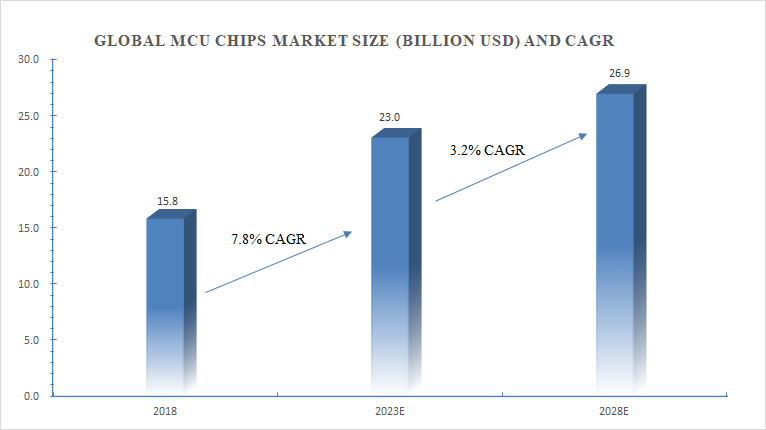
The global MCU chip market exhibited robust growth in recent years and is projected to maintain its upward trajectory. In 2018, the market was valued at $15.8 billion, and by 2023, it is expected to reach $23.0 billion, reflecting a compound annual growth rate (CAGR) of 7.8% during this period. Looking ahead to 2028, the market is predicted to expand further to $26.9 billion, with a CAGR of 3.2% from 2023 to 2028. This steady growth demonstrates the enduring demand for MCU chips in an increasingly interconnected world.
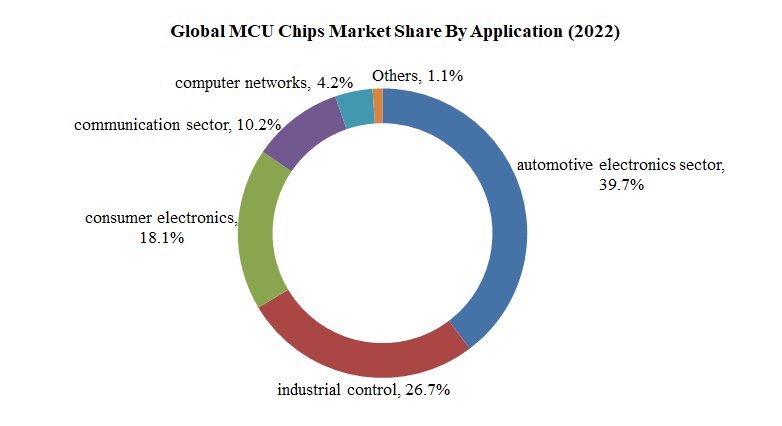
 Analyzing the downstream applications of MCU chips in 2022, the automotive electronics sector accounted for the largest market share at 39.7%. This highlights the critical role of MCU chips in modern automotive systems, including advanced driver-assistance systems (ADAS), infotainment systems, and engine control units (ECUs). The industrial control segment held a substantial share of 26.7%, underscoring the importance of MCU chips in ensuring efficient automation and control processes across various industries. Consumer electronics, including smartphones, tablets, and wearable devices, represented 18.1% of the market, emphasizing the pervasive integration of MCU chips in everyday consumer technology. The communication sector accounted for 10.2%, encompassing applications in wireless communication systems, IoT devices, and networking equipment. Lastly, computer networks accounted for 4.2%, reflecting the utilization of MCU chips in network infrastructure and server systems.
 The global demand for MCU chips extends across various regions, including North America, Europe, Asia Pacific, Latin America, and the Middle East and Africa. These regions serve as major consumption hubs, driven by technological advancements, industrial growth, and expanding consumer electronics markets. The Asia Pacific region holds a significant share owing to its thriving electronics manufacturing sector and the presence of key semiconductor manufacturers.
With continuous innovation and evolving applications, the MCU chip market is poised for sustained growth in the foreseeable future. The increasing reliance on advanced electronics, coupled with the integration of MCU chips in an expanding array of devices, further underscores their significance in driving technological progress and enhancing the performance of modern systems.