Molecular Imaging System Market: Growth Momentum and Policy Shifts Reshape Competitive Landscape
Global Molecular Imaging System Market: Growth Momentum and Policy Shifts Reshape Competitive Landscape
The global Molecular Imaging System market is estimated to reach between USD 3 billion and 6 billion in 2025, with a projected compound annual growth rate (CAGR) of 3.2%–5.2% through 2030. The market is dominated by PET/CT systems, followed by PET/MRI and SPECT systems.
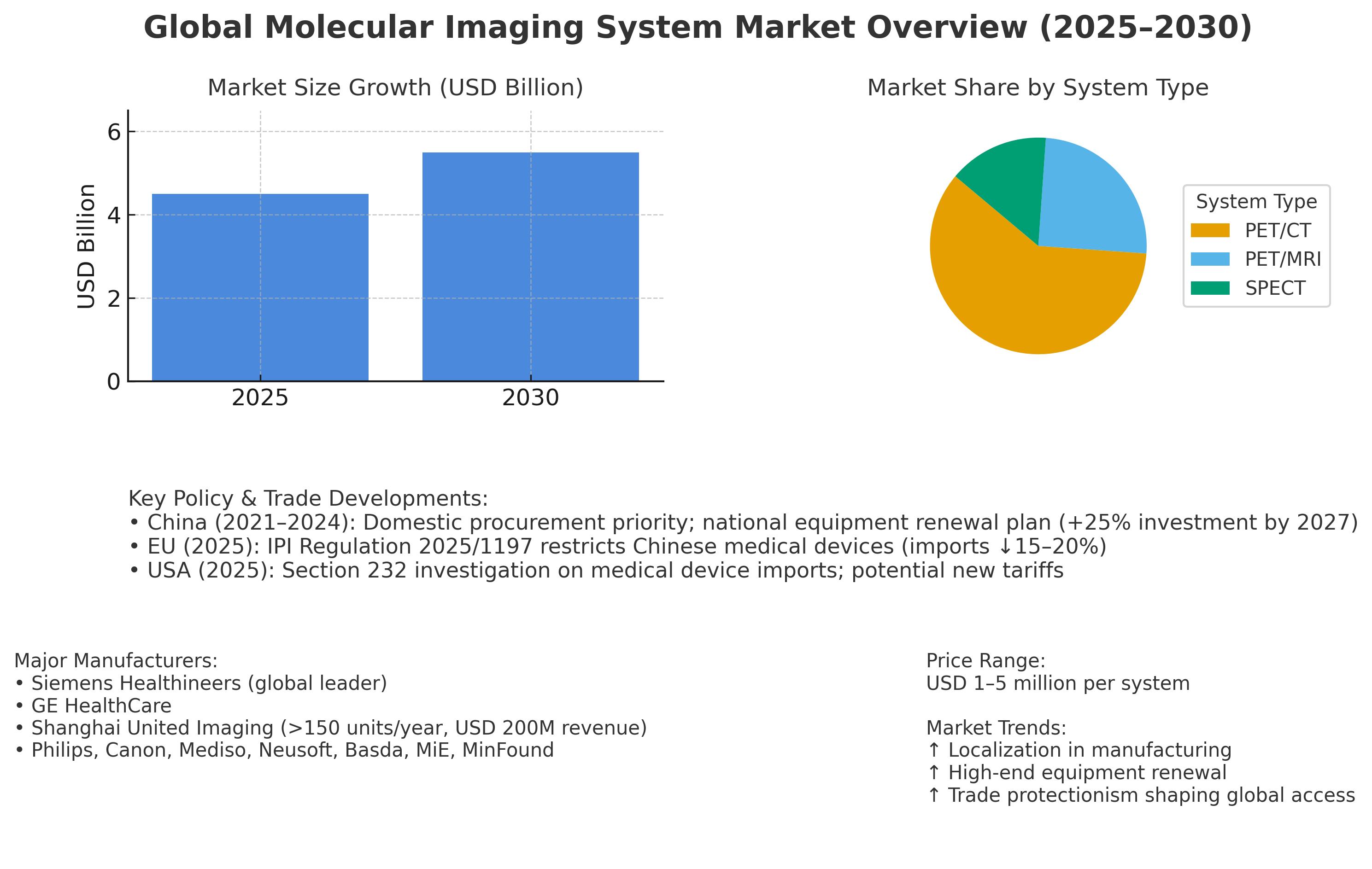
Key players include Siemens Healthineers, GE HealthCare, Philips, Canon Medical, Shanghai United Imaging Medical Technology Co. Ltd., Spectrum Dynamics Medical, Mediso Medical Imaging Systems, Neusoft Medical, and Shenzhen Basda Medical. Siemens Healthineers remains the largest manufacturer globally, while GE HealthCare holds the second-largest share. In China, Shanghai United Imaging leads production with an annual capacity exceeding 150 units and revenue around USD 200 million.
PET/CT systems are primarily used for cancer diagnosis, staging, and treatment planning, while PET/MRI integrates metabolic and structural imaging for neurological and cardiac diagnostics. SPECT systems (gamma cameras) enable functional and anatomical visualization across cardiac and oncologic applications. Product prices range from USD 1 million to 5 million depending on configuration and imaging capability.
Policy environments are increasingly shaping global competition. In China, government procurement policies since 2021 have prioritized domestic medical device manufacturing, while the 2024 “Equipment Renewal and Trade-In Action Plan” aims to accelerate upgrades in healthcare equipment nationwide. In May 2024, China’s National Development and Reform Commission announced that by 2027, investment in medical devices will grow over 25% from 2023, with notable expansion in high-end systems.
Conversely, in Europe, the EU Commission concluded its first International Procurement Instrument (IPI) investigation into China’s medical device market in January 2025, citing discriminatory procurement practices. As a result, the EU issued Implementing Regulation (EU) 2025/1197 in June 2025, restricting Chinese medical device access to EU public procurement markets—potentially reducing Chinese imports by 15%–20%.
In the United States, the Department of Commerce announced in September 2025 a Section 232 investigation into imports of robotics, industrial machinery, medical equipment, and personal protective products, assessing potential national security risks. The move signals possible tariff expansion on imported medical devices, continuing the protectionist trade policies seen in previous administrations.
Together, these regulatory shifts highlight increasing localization, trade protection, and geopolitical scrutiny within the global molecular imaging industry—factors expected to significantly influence manufacturing strategies and market access over the next decade.
----------------------------------------------------------------------------------------------------------------------------------------
About HDIN Research
HDIN Research is a professional market intelligence provider dedicated to delivering high-quality industry analysis and forward-looking insights across a wide range of sectors. Our reports and presentations are designed to help clients navigate complex markets and make informed business decisions.
Contact Us:
TEL: +86-010-82142830
Email: sales@hdinresearch.com