Printed Circuit Board (PCB) Market Poised for High-End Growth Amidst Supply Chain Re-Globalization
Global PCB Market Poised for High-End Growth Amidst Supply Chain Re-Globalization
November 20, 2025 – The global Printed Circuit Board (PCB) market is forecast to maintain steady to strong growth, driven by secular trends in advanced connectivity, data processing, and smart mobility. The market size is projected to be between 75 and 85 billion USD in 2025, with a projected Compound Annual Growth Rate (CAGR) of 4.5% to 7.5% through 2030.
PCBs are the essential electronic interconnect components, providing mechanical support and electrical connection for components across virtually all electronic devices.
Market Drivers and Technology Trends
The long-term growth of the PCB industry is anchored by several critical sectors:
-
Telecommunications: 5G infrastructure and related network/communication devices.
-
Computing & Storage: High-performance computing (HPC), AI, and data center servers.
-
Automotive: New Energy Vehicles (NEVs) and smart driving technologies.
To meet the demands of these advanced applications, the PCB industry is accelerating its transition toward high-end products, including High-Layer PCBs, High-Frequency/High-Speed boards, HDI PCBs, and IC Substrates. The trend is miniaturization and integration, focusing on lightweight, thin, low-loss, and multi-functional designs.
Geographic Shift: Asia Dominance and Re-Globalization
The global PCB manufacturing landscape has undergone a profound shift, consolidating production power in Asia:
-
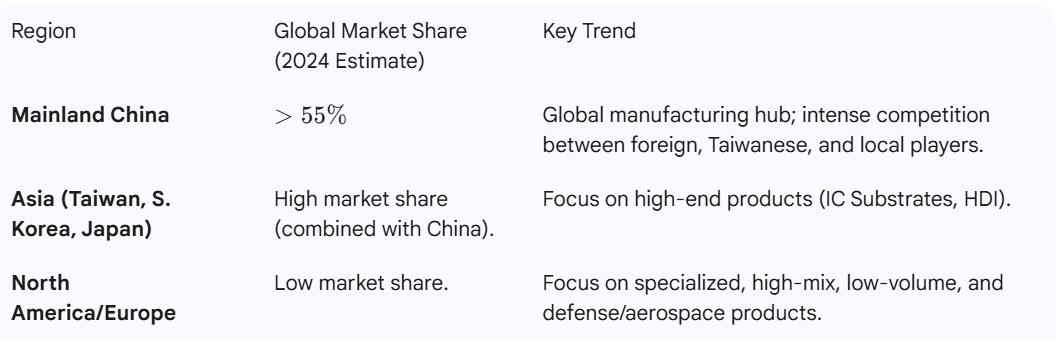
Asia Dominance: Before 2000, North America, Europe, and Japan held over 70% of global PCB value. Today, the center of manufacturing has decisively shifted to Asia, primarily Mainland China, Taiwan, and South Korea.
-
China's Position: Mainland China surpassed Japan in 2006 to become the world's largest PCB manufacturing base. Its share of global PCB output has grown from 8% in 2000 to over 55% in 2024.
Competitive Structure
The market is highly fragmented but led by large, vertically integrated Asian manufacturers:
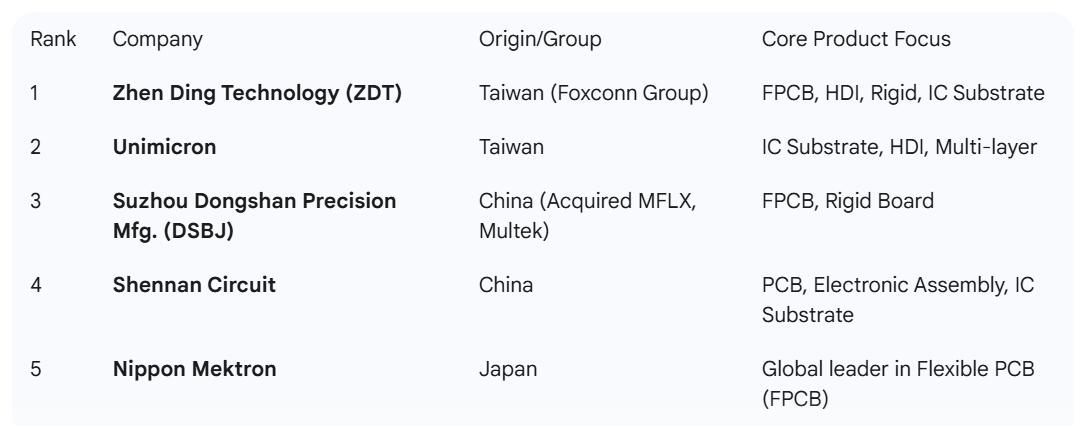
Other major players include: TTM Technologies, COMPEQ, Tripod Technology, WUS Group, and Kinwong.
Impact of Tariffs and Supply Chain Restructuring
Geopolitical tensions and trade tariffs are fundamentally reshaping the PCB supply chain:
-
Increased Costs: Tariffs directly increase the cost of imported PCBs and raw materials (like copper clad laminates), which are then passed downstream to electronic products.
-
Capacity Relocation: To mitigate tariff exposure and supply chain risks, manufacturers are actively relocating or expanding production capacity to duty-friendly regions such as Thailand, Vietnam, India, and Mexico.
-
Market Shift: Companies less exposed to U.S. exports are strengthening their focus on the growing domestic Chinese market and other regional markets (e.g., ASEAN). This is accelerating the development and adoption of domestic high-end PCB technology in China.
The current geopolitical climate simultaneously drives up operational costs and forces the industry to invest in flexible, multi-region manufacturing strategies to ensure supply continuity.