Sugar Alcohol Market Overview 2025: Growth, Segmentation, and Industry Dynamics
Date : 2025-12-23
Reading : 890
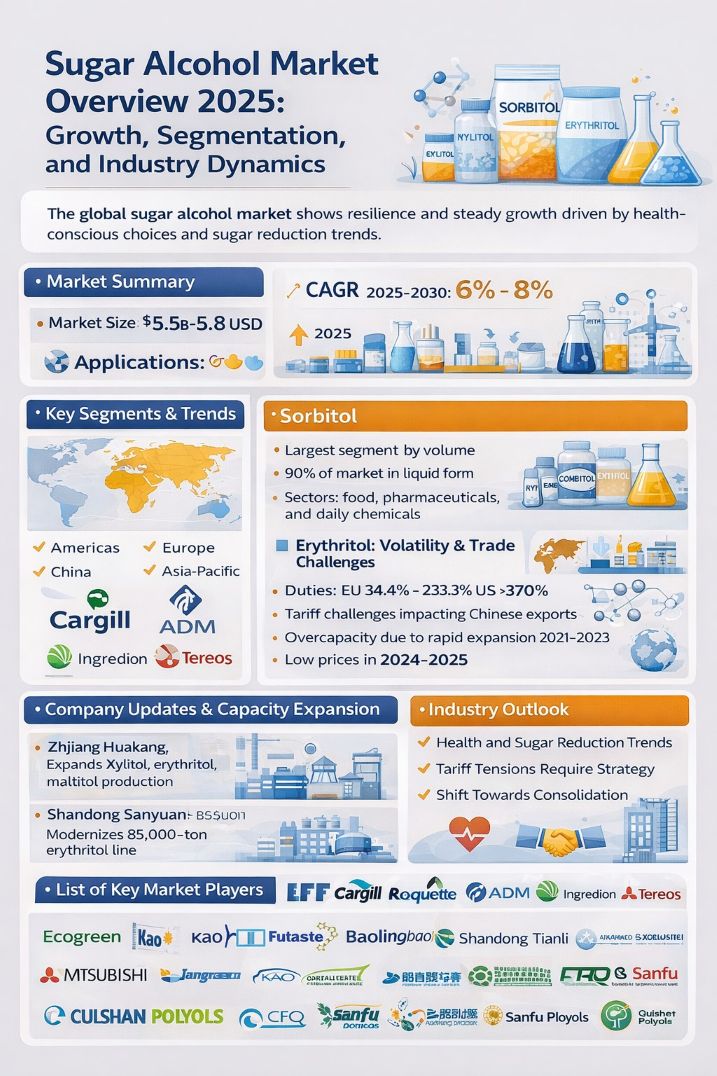
The global sugar alcohol market continues to demonstrate resilience and steady growth, driven by the increasing consumer demand for low-calorie, functional food ingredients and sugar substitutes. As of 2025, the market size is estimated between 5.5 billion USD and 5.8 billion USD. Projections indicate a Compound Annual Growth Rate (CAGR) of 6% to 8% through 2030. Sugar alcohols, also known as polyols, are widely utilized as sweeteners and thickeners across the food, pharmaceutical, personal care, and industrial sectors.
The market landscape is characterized by a diverse range of products, including Sorbitol, Maltitol, Xylitol, Erythritol, Mannitol, Isomalt, and Lactitol. While established players like Cargill, Roquette, and ADM maintain strong global footholds, significant capacity expansions and consolidations are occurring among major Asian manufacturers, particularly in China.
Market Data Overview
Segment Analysis and Product Trends
Sorbitol
Sorbitol remains the dominant category in terms of volume, accounting for the largest market share. It is widely used in food, pharmaceuticals, and daily chemical products. The production methods include hydrogenation, electrochemical, and fermentation processes, with hydrogenation being the most prevalent. Liquid sorbitol, favored for its simple processing and high yield, constitutes approximately 90% of the sorbitol market. Major consumption centers include China, the United States, Europe, and the Asia-Pacific region.
Erythritol: Volatility and Trade Challenges
Erythritol is unique among sugar alcohols as the only product prepared via biological fermentation. The segment has experienced significant volatility. Following a surge in demand and profitability around 2021, the industry saw an expansion wave, leading to overcapacity. Prices dropped from a high of 40,000 RMB/ton in 2021 to lows of 9,500 RMB/ton in the first half of 2023. While 2024 and 2025 have seen some capacity clearance, prices remain relatively low.
The year 2025 has been defined by regulatory headwinds for Chinese exporters. Following a complaint by Jungbunzlauer S.A., the European Commission issued a final anti-dumping ruling on January 16, 2025, imposing duties ranging from 34.4% to 233.3% on Chinese erythritol for five years. Furthermore, in the United States, following a petition by Cargill, the Department of Commerce announced preliminary anti-subsidy rates (3.29%-3.49%) in May 2025 and preliminary anti-dumping margins (over 370%) in July 2025 against Chinese producers.
Xylitol and Others
Xylitol is a staple in the confectionery industry, particularly for chewing gum and ice cream, serving as a direct sucrose substitute. The global xylitol market size was projected at 1.017 billion USD in 2024.
Maltitol consumption is dominated by liquid forms due to cost advantages, with major production bases in Japan, Europe, the US, and China.
Mannitol, an isomer of sorbitol often extracted from kelp or produced synthetically, sees a global annual consumption of approximately 150,000 tons.
Company Developments and Capacity Updates
The competitive landscape has seen aggressive expansion and strategic M&A activity, particularly among Chinese manufacturers aiming to secure market share and diversify product portfolios.
* **Zhejiang Huakang Pharmaceutical: The company has aggressively expanded its footprint. After bringing its phase II sorbitol project online in 2021 and a 30,000-ton high-purity crystalline erythritol line in 2022, Huakang acquired Yusweet Co. Ltd. in 2024. Yusweet brings additional capacities of 45,000 tons of xylitol, 30,000 tons of erythritol, and 30,000 tons of maltitol. In 2024, Huakang's total crystalline sugar alcohol output reached 172,200 tons.
* **Shandong Sanyuan Biotechnology: Recognized as a leading global erythritol supplier, Sanyuan is focusing on modernization. In 2025, the company initiated an upgrade on its 85,000-ton legacy production line to enable flexible manufacturing of a broader range of products.
* **Baolingbao Biology: The company completed a 13,000-ton erythritol expansion in mid-2021, bringing capacity to 30,000 tons. By early 2023, an additional 30,000-ton crystal project was completed, raising total erythritol capacity to 60,000 tons annually.
* **Shandong Tianli Pharmaceutical: A major player in the sorbitol sector, Tianli boasts a massive capacity of 700,000 tons per year for sorbitol and 20,000 tons for mannitol.
* **Other Key Capacities:**
* **Zhaoqing Huanfa Biotechnology: 150,000 tons/year of sorbitol and 20,000 tons/year of maltitol.
* **Qinhuangdao Lihua Starch: 100,000 tons/year of sorbitol.
Industry Outlook
The sugar alcohol industry is transitioning from a phase of rapid, uncoordinated expansion to one of consolidation and strategic refinement. While demand remains robust due to global health trends reducing sugar intake, manufacturers must navigate intense pricing pressures and increasingly complex international trade barriers. Success in the coming years will depend on production flexibility, cost optimization, and the ability to mitigate tariff risks in key Western markets.
For more information or to inquire about the full report, please visit the HDIN Research website.
Media Contact
Company Name: HDIN Research
Contact Person: Sales Department
Email: sales@hdinresearch.com
Website: www.hdinresearch.com
The market landscape is characterized by a diverse range of products, including Sorbitol, Maltitol, Xylitol, Erythritol, Mannitol, Isomalt, and Lactitol. While established players like Cargill, Roquette, and ADM maintain strong global footholds, significant capacity expansions and consolidations are occurring among major Asian manufacturers, particularly in China.
Market Data Overview
Segment Analysis and Product Trends
Sorbitol
Sorbitol remains the dominant category in terms of volume, accounting for the largest market share. It is widely used in food, pharmaceuticals, and daily chemical products. The production methods include hydrogenation, electrochemical, and fermentation processes, with hydrogenation being the most prevalent. Liquid sorbitol, favored for its simple processing and high yield, constitutes approximately 90% of the sorbitol market. Major consumption centers include China, the United States, Europe, and the Asia-Pacific region.
Erythritol: Volatility and Trade Challenges
Erythritol is unique among sugar alcohols as the only product prepared via biological fermentation. The segment has experienced significant volatility. Following a surge in demand and profitability around 2021, the industry saw an expansion wave, leading to overcapacity. Prices dropped from a high of 40,000 RMB/ton in 2021 to lows of 9,500 RMB/ton in the first half of 2023. While 2024 and 2025 have seen some capacity clearance, prices remain relatively low.
The year 2025 has been defined by regulatory headwinds for Chinese exporters. Following a complaint by Jungbunzlauer S.A., the European Commission issued a final anti-dumping ruling on January 16, 2025, imposing duties ranging from 34.4% to 233.3% on Chinese erythritol for five years. Furthermore, in the United States, following a petition by Cargill, the Department of Commerce announced preliminary anti-subsidy rates (3.29%-3.49%) in May 2025 and preliminary anti-dumping margins (over 370%) in July 2025 against Chinese producers.
Xylitol and Others
Xylitol is a staple in the confectionery industry, particularly for chewing gum and ice cream, serving as a direct sucrose substitute. The global xylitol market size was projected at 1.017 billion USD in 2024.
Maltitol consumption is dominated by liquid forms due to cost advantages, with major production bases in Japan, Europe, the US, and China.
Mannitol, an isomer of sorbitol often extracted from kelp or produced synthetically, sees a global annual consumption of approximately 150,000 tons.
Company Developments and Capacity Updates
The competitive landscape has seen aggressive expansion and strategic M&A activity, particularly among Chinese manufacturers aiming to secure market share and diversify product portfolios.
* **Zhejiang Huakang Pharmaceutical: The company has aggressively expanded its footprint. After bringing its phase II sorbitol project online in 2021 and a 30,000-ton high-purity crystalline erythritol line in 2022, Huakang acquired Yusweet Co. Ltd. in 2024. Yusweet brings additional capacities of 45,000 tons of xylitol, 30,000 tons of erythritol, and 30,000 tons of maltitol. In 2024, Huakang's total crystalline sugar alcohol output reached 172,200 tons.
* **Shandong Sanyuan Biotechnology: Recognized as a leading global erythritol supplier, Sanyuan is focusing on modernization. In 2025, the company initiated an upgrade on its 85,000-ton legacy production line to enable flexible manufacturing of a broader range of products.
* **Baolingbao Biology: The company completed a 13,000-ton erythritol expansion in mid-2021, bringing capacity to 30,000 tons. By early 2023, an additional 30,000-ton crystal project was completed, raising total erythritol capacity to 60,000 tons annually.
* **Shandong Tianli Pharmaceutical: A major player in the sorbitol sector, Tianli boasts a massive capacity of 700,000 tons per year for sorbitol and 20,000 tons for mannitol.
* **Other Key Capacities:**
* **Zhaoqing Huanfa Biotechnology: 150,000 tons/year of sorbitol and 20,000 tons/year of maltitol.
* **Qinhuangdao Lihua Starch: 100,000 tons/year of sorbitol.
Industry Outlook
The sugar alcohol industry is transitioning from a phase of rapid, uncoordinated expansion to one of consolidation and strategic refinement. While demand remains robust due to global health trends reducing sugar intake, manufacturers must navigate intense pricing pressures and increasingly complex international trade barriers. Success in the coming years will depend on production flexibility, cost optimization, and the ability to mitigate tariff risks in key Western markets.
For more information or to inquire about the full report, please visit the HDIN Research website.
Media Contact
Company Name: HDIN Research
Contact Person: Sales Department
Email: sales@hdinresearch.com
Website: www.hdinresearch.com