Synthetic Turf Market Hits 4.5 Billion USD in 2025 Driven by Sports and Landscaping Demand
Date : 2025-12-26
Reading : 1530
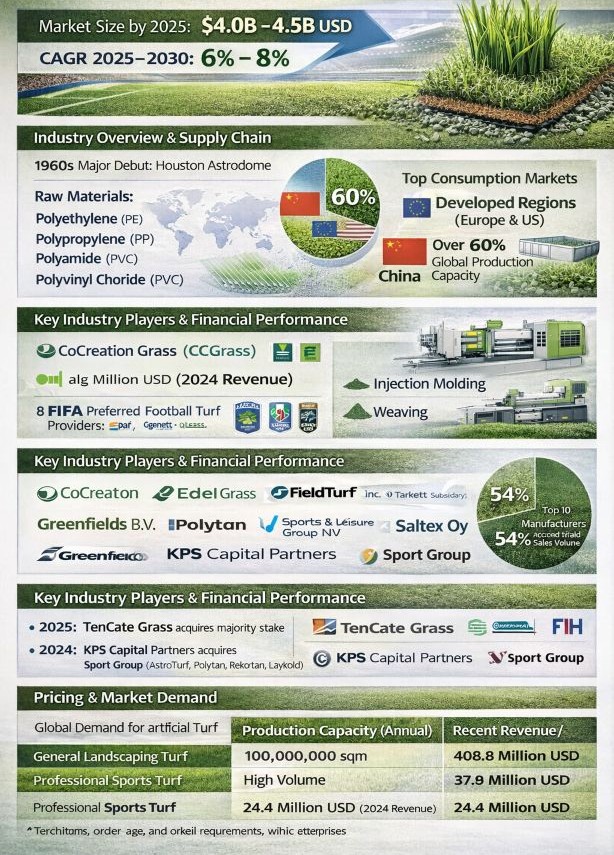
The global synthetic turf market has demonstrated robust growth resilience, reaching a valuation between 4.0 billion USD and 4.5 billion USD in 2025. Fueled by expanding applications in professional sports and residential landscaping, the industry is projected to maintain a Compound Annual Growth Rate (CAGR) of 6% to 8% through 2030.
Synthetic turf, a surface of synthetic fibers made to look like natural grass, has evolved significantly since its first major application in the Houston Astrodome in the 1960s. While originally designed for indoor stadiums, modern artificial grass is now widely utilized in residential lawns, commercial spaces, and outdoor sports fields. Manufacturing processes generally fall into injection molding and weaving, utilizing raw materials such as Polyethylene (PE), Polypropylene (PP), Polyvinyl Chloride (PVC), and Polyamide.
Global Supply and Consumption Patterns
The market displays a distinct geographical separation between production and consumption. Developed regions, particularly Europe and the United States, remain the primary consumption markets. Conversely, China has established itself as the global manufacturing hub, leveraging advantages in cost, capacity, and technology to control over 60% of the global production capacity.
The industry is characterized by high market concentration. In 2023, the top ten manufacturers accounted for 54% of global sales volume. This consolidation trend has continued into 2024 and 2025 with significant mergers and acquisitions reshaping the competitive landscape. Notable transactions include TenCate Grass acquiring a majority stake in Sports & Leisure Group in 2025, and KPS Capital Partners completing the acquisition of Sport Group (owners of AstroTurf, Polytan, Rekortan, and Laykold) in 2024.
Key Industry Players and Financial Performance
The market is led by major entities recognized for their compliance with international standards. There are currently 8 FIFA Preferred Football Turf Providers, including CoCreation Grass, Edel Grass B.V., FieldTurf Inc. (a Tarkett subsidiary), Greenfields B.V. (a TenCate Grass subsidiary), Limonta Sport S.P.A, Polytan GmbH (a Sport Group subsidiary), Sports & Leisure Group NV, and Saltex Oy.
CoCreation Grass (CCGrass) stands out as the global leader in both production and sales scale. As a preferred supplier for FIFA, World Rugby, and FIH, CCGrass also participated in drafting the Chinese National Standard for sports artificial grass.
Pricing and Market Demand
The global demand for artificial turf currently stands at approximately 400 million square meters per year. Pricing varies significantly based on raw materials, technical parameters, and order volume. While general landscaping turf is available at various price points, professional sports turf typically ranges from 160 to 600 RMB per square meter, reflecting the stringent quality requirements for athletic performance and safety.
Future Outlook
With the continued integration of artificial turf in residential sectors and the constant upgrade of sports facilities globally, the market is poised for steady expansion. The strategic consolidation of major players suggests a future focused on technological innovation and sustainability in material sourcing.
Summary
Media Contact
Company Name: HDIN Research
Website: www.hdinresearch.com
Email: sales@hdinresearch.com
Synthetic turf, a surface of synthetic fibers made to look like natural grass, has evolved significantly since its first major application in the Houston Astrodome in the 1960s. While originally designed for indoor stadiums, modern artificial grass is now widely utilized in residential lawns, commercial spaces, and outdoor sports fields. Manufacturing processes generally fall into injection molding and weaving, utilizing raw materials such as Polyethylene (PE), Polypropylene (PP), Polyvinyl Chloride (PVC), and Polyamide.
Global Supply and Consumption Patterns
The market displays a distinct geographical separation between production and consumption. Developed regions, particularly Europe and the United States, remain the primary consumption markets. Conversely, China has established itself as the global manufacturing hub, leveraging advantages in cost, capacity, and technology to control over 60% of the global production capacity.
The industry is characterized by high market concentration. In 2023, the top ten manufacturers accounted for 54% of global sales volume. This consolidation trend has continued into 2024 and 2025 with significant mergers and acquisitions reshaping the competitive landscape. Notable transactions include TenCate Grass acquiring a majority stake in Sports & Leisure Group in 2025, and KPS Capital Partners completing the acquisition of Sport Group (owners of AstroTurf, Polytan, Rekortan, and Laykold) in 2024.
Key Industry Players and Financial Performance
The market is led by major entities recognized for their compliance with international standards. There are currently 8 FIFA Preferred Football Turf Providers, including CoCreation Grass, Edel Grass B.V., FieldTurf Inc. (a Tarkett subsidiary), Greenfields B.V. (a TenCate Grass subsidiary), Limonta Sport S.P.A, Polytan GmbH (a Sport Group subsidiary), Sports & Leisure Group NV, and Saltex Oy.
CoCreation Grass (CCGrass) stands out as the global leader in both production and sales scale. As a preferred supplier for FIFA, World Rugby, and FIH, CCGrass also participated in drafting the Chinese National Standard for sports artificial grass.
Pricing and Market Demand
The global demand for artificial turf currently stands at approximately 400 million square meters per year. Pricing varies significantly based on raw materials, technical parameters, and order volume. While general landscaping turf is available at various price points, professional sports turf typically ranges from 160 to 600 RMB per square meter, reflecting the stringent quality requirements for athletic performance and safety.
Future Outlook
With the continued integration of artificial turf in residential sectors and the constant upgrade of sports facilities globally, the market is poised for steady expansion. The strategic consolidation of major players suggests a future focused on technological innovation and sustainability in material sourcing.
Summary
Media Contact
Company Name: HDIN Research
Website: www.hdinresearch.com
Email: sales@hdinresearch.com