Meta-Phenoxy Benzaldehyde Market Value Estimated at USD 130-230 Million in 2026
Date : 2026-01-06
Reading : 150
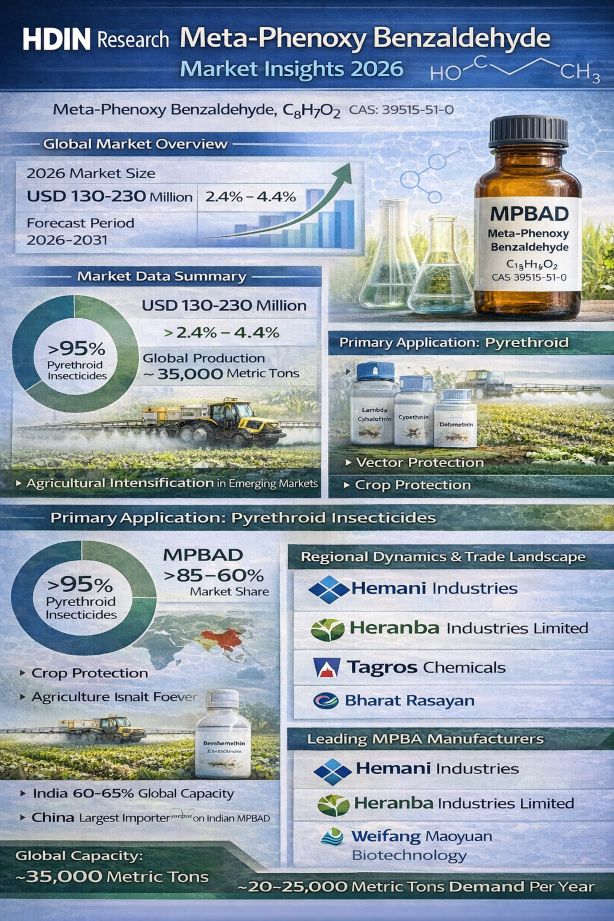
HDIN Research has announced the release of its latest industry analysis, "Meta-Phenoxy Benzyaldehyde Market Insights 2026." The report provides a detailed evaluation of the global market for Meta-Phenoxy Benzyaldehyde (MPBAD), a critical intermediate chemical used primarily in the synthesis of pyrethroid insecticides. As of 2026, the market size is valued between USD 130 million and USD 230 million, with a projected growth trajectory extending through 2031.
The study indicates that the market is expected to expand at a Compound Annual Growth Rate (CAGR) of 2.4% to 4.4% from 2026 to 2031. This growth is driven largely by the sustained demand for synthetic pyrethroids such as Lambda Cyhalothrin, Cypermethrin, and Deltamethrin, which remain essential for global agricultural productivity and public health vector control programs.
Figure Market Data Summary of Meta-Phenoxy Benzyaldehyde
Regional Dynamics and Trade Landscape
The report highlights the Asia-Pacific region as the dominant force in the MPBAD market, accounting for the vast majority of production and consumption. India has emerged as the global production hub, holding approximately 85% of global capacity with nearly 30,000 metric tons. China remains the second-largest producer and the world's largest importer.
Trade dynamics between these two nations significantly influence market pricing and flow. The report notes that anti-dumping duties implemented by China on Indian MPBAD imports in mid-2024 continue to impact trade structures, necessitating strategic adjustments for exporters. Despite these regulatory hurdles, the fundamental demand from downstream pyrethroid technical manufacturers ensures continued trade activity.
Competitive Landscape and Capacity
The industry is characterized by a moderately consolidated structure, where the top five manufacturers control approximately 78% of total production capacity. Major players identified in the report include Hemani Industries Limited, Heranba Industries Ltd., Tagros Chemicals, Bharat Rasayan Ltd., and Weifang Maoyuan Biotechnology.
A key finding in the report is the presence of manufacturing overcapacity. With global capacity standing at approximately 35,000 metric tons against an estimated annual demand of 20,000 to 25,000 metric tons, the market faces competitive pricing pressures. This environment favors integrated manufacturers who can optimize costs and maintain high quality standards for pharmaceutical and agricultural applications.
Drivers and Future Outlook
The primary driver for the MPBAD market remains global food security. As agricultural sectors in emerging markets modernize and adopt integrated pest management practices, the demand for effective and environmentally favorable insecticides like pyrethroids continues to rise. Additionally, public health initiatives aimed at malaria control in tropical regions support the consumption of pyrethroid-based mosquito nets and sprays.
While the market faces challenges regarding raw material price volatility and insecticide resistance, the shift away from more toxic organophosphate chemistries provides a stable long-term foundation for MPBAD demand.
About HDIN Research
HDIN Research is a market research and consulting firm providing detailed industry analysis and strategic insights. We help clients navigate complex markets with data-driven research and actionable intelligence.
Media Contact:
HDIN Research
Website: www.hdinresearch.com
Email: sales@hdinresearch.com
The study indicates that the market is expected to expand at a Compound Annual Growth Rate (CAGR) of 2.4% to 4.4% from 2026 to 2031. This growth is driven largely by the sustained demand for synthetic pyrethroids such as Lambda Cyhalothrin, Cypermethrin, and Deltamethrin, which remain essential for global agricultural productivity and public health vector control programs.
Figure Market Data Summary of Meta-Phenoxy Benzyaldehyde
Regional Dynamics and Trade Landscape
The report highlights the Asia-Pacific region as the dominant force in the MPBAD market, accounting for the vast majority of production and consumption. India has emerged as the global production hub, holding approximately 85% of global capacity with nearly 30,000 metric tons. China remains the second-largest producer and the world's largest importer.
Trade dynamics between these two nations significantly influence market pricing and flow. The report notes that anti-dumping duties implemented by China on Indian MPBAD imports in mid-2024 continue to impact trade structures, necessitating strategic adjustments for exporters. Despite these regulatory hurdles, the fundamental demand from downstream pyrethroid technical manufacturers ensures continued trade activity.
Competitive Landscape and Capacity
The industry is characterized by a moderately consolidated structure, where the top five manufacturers control approximately 78% of total production capacity. Major players identified in the report include Hemani Industries Limited, Heranba Industries Ltd., Tagros Chemicals, Bharat Rasayan Ltd., and Weifang Maoyuan Biotechnology.
A key finding in the report is the presence of manufacturing overcapacity. With global capacity standing at approximately 35,000 metric tons against an estimated annual demand of 20,000 to 25,000 metric tons, the market faces competitive pricing pressures. This environment favors integrated manufacturers who can optimize costs and maintain high quality standards for pharmaceutical and agricultural applications.
Drivers and Future Outlook
The primary driver for the MPBAD market remains global food security. As agricultural sectors in emerging markets modernize and adopt integrated pest management practices, the demand for effective and environmentally favorable insecticides like pyrethroids continues to rise. Additionally, public health initiatives aimed at malaria control in tropical regions support the consumption of pyrethroid-based mosquito nets and sprays.
While the market faces challenges regarding raw material price volatility and insecticide resistance, the shift away from more toxic organophosphate chemistries provides a stable long-term foundation for MPBAD demand.
About HDIN Research
HDIN Research is a market research and consulting firm providing detailed industry analysis and strategic insights. We help clients navigate complex markets with data-driven research and actionable intelligence.
Media Contact:
HDIN Research
Website: www.hdinresearch.com
Email: sales@hdinresearch.com