Global Space Race Shifts to “Airline-Style” Operations: SpaceX Dominates Reusable Launch Vehicles (RLV), While China Accelerates via Capital Reforms
Date : 2026-01-05
Reading : 1418
A newly released deep analysis report on the global state of Reusable Launch Vehicles (RLV) outlines a transforming aerospace landscape where the ability to reuse rockets has become the definitive metric of power. While the United States, led by SpaceX, maintains absolute market dominance, China is engineering a rapid "leapfrog" catch-up through unique policy innovations and supply chain advantages.
The report, analyzing national strategies and corporate technical routes, identifies the transition to reusable technology as the core driver for future space access and the construction of "New Quality Productive Forces."
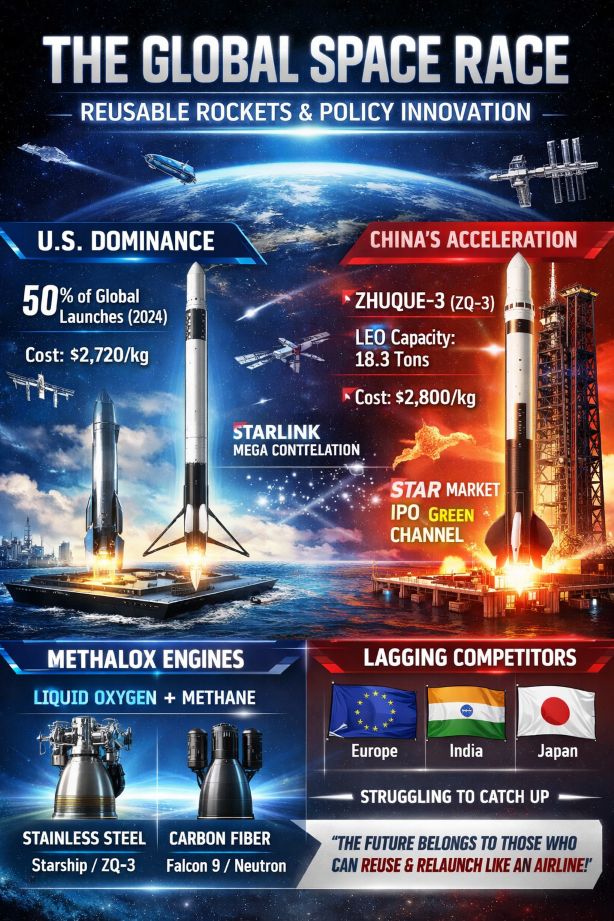
Figure Summary of Reusable Launch Vehicles (RLV) Market
US Hegemony and the SpaceX Standard
The United States remains the undisputed leader in the field, utilizing a procurement service model where NASA and the Space Force mitigate development risks for commercial entities. The report highlights SpaceX as the market hegemon, having completed over half of global launches in 2024. With the Falcon 9 achieving routine reusability, SpaceX has driven launch costs down to approximately $2,720 per kilogram, creating a cost barrier that traditional competitors find nearly impossible to breach.
However, the competition is evolving. Blue Origin is projected to break SpaceX’s monopoly on vertical landing recovery with its New Glenn rocket, aiming for a maritime landing of its first stage in November 2025.
China’s "Green Channel" and Methane Breakthroughs
The analysis draws specific attention to China’s strategic countermeasures. Unlike the U.S. market-driven approach, China is utilizing "milestone-driven capitalization."
New regulations on the Shanghai Stock Exchange’s STAR Market have waived traditional profitability requirements for commercial rocket enterprises. Instead, successful orbital entry with reusable technology is now a primary threshold for IPO eligibility. This policy has created a financing "green channel" for high-input enterprises like **LandSpace**, allowing them to accelerate R&D despite long return cycles.
Technologically, Chinese private firms are bypassing the kerosene route used by the Falcon 9, moving directly to Liquid Oxygen/Methane (Methalox) propulsion—the same technology chosen for SpaceX’s next-generation Starship.
LandSpace’s Zhuque-3 (ZQ-3) is highlighted as a key competitor. Using stainless steel architecture similar to Starship, it boasts a recoverable LEO capacity of **18.3 tons**, slightly edging out the Falcon 9’s 17 tons, with a target cost of roughly **$2,800/kg**.
The "Methalox" Convergence and Material Divergence
The report identifies a global technical convergence toward Methalox engines due to their clean burning properties, which simplify maintenance for reuse. However, a divergence in materials is emerging:
* Stainless Steel: Adopted by SpaceX (Starship) and LandSpace (ZQ-3) for durability and lower manufacturing costs, sacrificing some weight for easier reuse.
* Carbon Fiber/Aluminum: Retained by **Rocket Lab’s Neutron** and the Falcon 9 to maximize payload ratios.
Lagging Competitors
While the US and China sprint ahead, other regions face challenges:
* Europe: Focused on "rebuilding" capacity through ESA. The Ariane 6 remains expendable, with reusable operations not expected until the 2030s.
* India: Targeting ultra-low costs ($4,000/kg) through its RLV-TD winged space plane program.
*Japan: Currently prioritizing reliability with the H3, with reuse planned for the 2030s.
Analyst Insight
"The era of expendable rockets is ending." the report concludes. With the first-stage booster accounting for nearly 77.8% of total hardware costs, recovery is the only path to economic viability in the age of mega-constellations like Starlink and China’s GW Constellation. The future market share will belong not just to those who can launch, but to those who can achieve high-frequency, "airline-like" turnover.
The report, analyzing national strategies and corporate technical routes, identifies the transition to reusable technology as the core driver for future space access and the construction of "New Quality Productive Forces."
Figure Summary of Reusable Launch Vehicles (RLV) Market
US Hegemony and the SpaceX Standard
The United States remains the undisputed leader in the field, utilizing a procurement service model where NASA and the Space Force mitigate development risks for commercial entities. The report highlights SpaceX as the market hegemon, having completed over half of global launches in 2024. With the Falcon 9 achieving routine reusability, SpaceX has driven launch costs down to approximately $2,720 per kilogram, creating a cost barrier that traditional competitors find nearly impossible to breach.
However, the competition is evolving. Blue Origin is projected to break SpaceX’s monopoly on vertical landing recovery with its New Glenn rocket, aiming for a maritime landing of its first stage in November 2025.
China’s "Green Channel" and Methane Breakthroughs
The analysis draws specific attention to China’s strategic countermeasures. Unlike the U.S. market-driven approach, China is utilizing "milestone-driven capitalization."
New regulations on the Shanghai Stock Exchange’s STAR Market have waived traditional profitability requirements for commercial rocket enterprises. Instead, successful orbital entry with reusable technology is now a primary threshold for IPO eligibility. This policy has created a financing "green channel" for high-input enterprises like **LandSpace**, allowing them to accelerate R&D despite long return cycles.
Technologically, Chinese private firms are bypassing the kerosene route used by the Falcon 9, moving directly to Liquid Oxygen/Methane (Methalox) propulsion—the same technology chosen for SpaceX’s next-generation Starship.
LandSpace’s Zhuque-3 (ZQ-3) is highlighted as a key competitor. Using stainless steel architecture similar to Starship, it boasts a recoverable LEO capacity of **18.3 tons**, slightly edging out the Falcon 9’s 17 tons, with a target cost of roughly **$2,800/kg**.
The "Methalox" Convergence and Material Divergence
The report identifies a global technical convergence toward Methalox engines due to their clean burning properties, which simplify maintenance for reuse. However, a divergence in materials is emerging:
* Stainless Steel: Adopted by SpaceX (Starship) and LandSpace (ZQ-3) for durability and lower manufacturing costs, sacrificing some weight for easier reuse.
* Carbon Fiber/Aluminum: Retained by **Rocket Lab’s Neutron** and the Falcon 9 to maximize payload ratios.
Lagging Competitors
While the US and China sprint ahead, other regions face challenges:
* Europe: Focused on "rebuilding" capacity through ESA. The Ariane 6 remains expendable, with reusable operations not expected until the 2030s.
* India: Targeting ultra-low costs ($4,000/kg) through its RLV-TD winged space plane program.
*Japan: Currently prioritizing reliability with the H3, with reuse planned for the 2030s.
Analyst Insight
"The era of expendable rockets is ending." the report concludes. With the first-stage booster accounting for nearly 77.8% of total hardware costs, recovery is the only path to economic viability in the age of mega-constellations like Starlink and China’s GW Constellation. The future market share will belong not just to those who can launch, but to those who can achieve high-frequency, "airline-like" turnover.