AI-Native Hardware and the Post-Smartphone Era
HDIN Research Annual Flagship Thesis 2026:
-AI-Native Hardware and the Post-Smartphone Era
Executive Summary
As generative AI continues to evolve into a general-purpose cognitive infrastructure, the global intelligent hardware ecosystem is entering a structural inflection point. Traditional devices, dominated by screen-based interaction and local computation, are increasingly giving way to AI-native interfaces where intelligence is centralized in large models and distributed across execution endpoints.
OpenAI's upcoming AI pen, a screenless, voice-enabled device expected around 2026, exemplifies this paradigm shift. While modest in form, its significance lies in representing the transition from devices as computing platforms to devices as AI interaction interfaces, signaling a fundamental restructuring of human-computer interaction.
This thesis outlines the current landscape, strategic implications, and long-term trajectories for AI-native hardware and associated ecosystems, providing HDIN Research's authoritative perspective on the post-smartphone era.
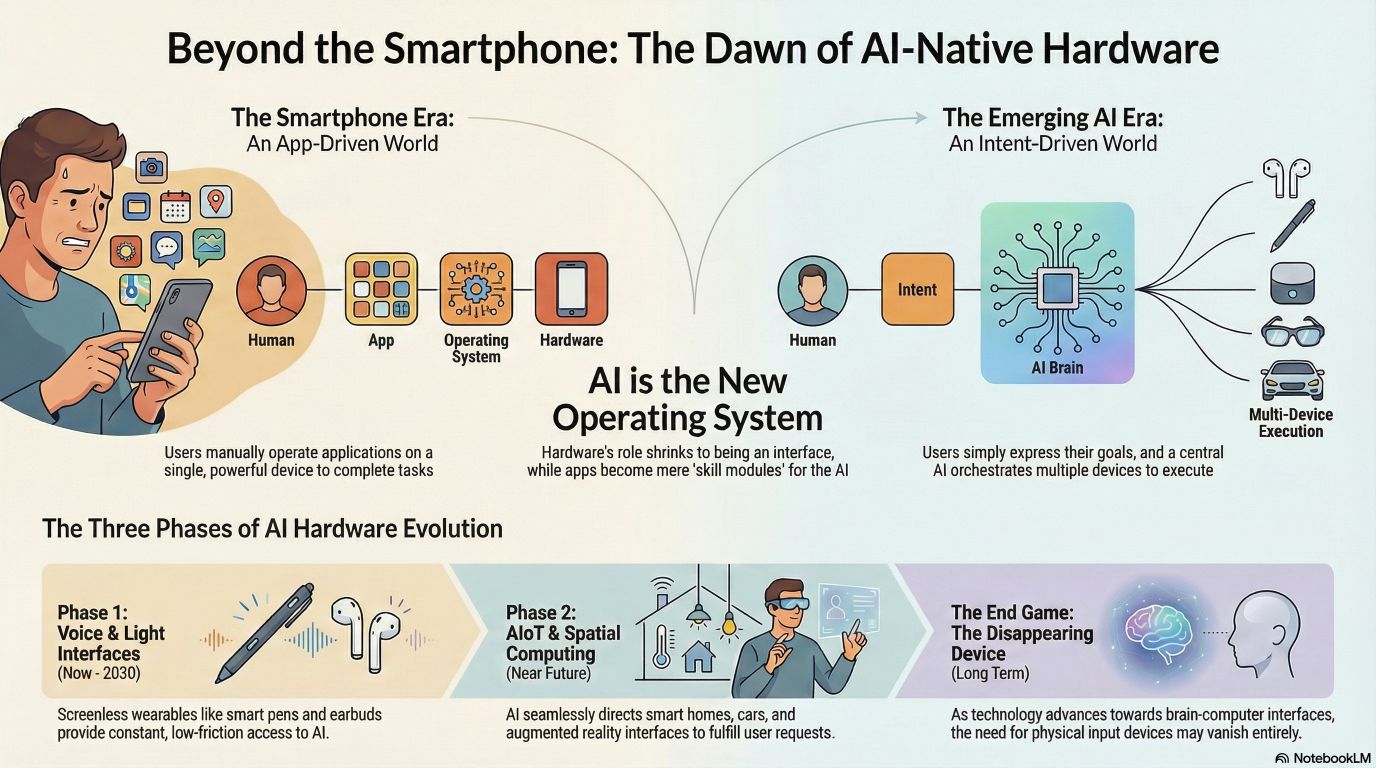
Figure Beyond the Smartphone The Dawn of Al-Native Hardware
Market Context and Technology Landscape
Historically, consumer electronics innovation has followed incremental enhancement cycles: faster processors, higher-resolution displays, and expanded application ecosystems. The mobile internet era was defined by the following paradigm:
User → Application → Operating System → Device
Generative AI is driving a shift to an AI-centric model:
User → Intent → AI Understanding & Decision-Making → Multi-Device Execution
In this emerging framework, AI serves as a persistent cognitive layer, orchestrating complex operations across heterogeneous devices. Hardware becomes a sensing and execution layer rather than the locus of intelligence.
Strategic Implications
-
Device Primacy Disruption: Smartphones will not disappear immediately, but their role as the dominant entry point is gradually eroded as AI-native interfaces proliferate.
-
AI as Cognitive Infrastructure: Organizations capable of integrating centralized AI with distributed endpoints will capture disproportionate strategic and economic value.
-
New Ecosystem Dynamics: The value chain will shift from hardware innovation alone toward orchestration, intent interpretation, and AI platform integration.
Future Trajectories
-
Near-Term: Lightweight AI interfaces, including voice pens, earbuds, and wearables, enabling low-friction AI access and contextual interaction.
-
Medium-Term: AIoT networks, orchestrating intelligent actions across smart homes, vehicles, industrial systems, and urban infrastructure.
-
Long-Term: Spatial computing and AR/mixed-reality devices embedding AI into physical space, shifting interaction from screens to ambient contexts.
-
Far-Term: Neural interfaces enabling direct intent-to-action pathways, reducing reliance on traditional input modalities.
Across all categories, hardware becomes more distributed, while intelligence becomes more centralized.
HDIN Research Strategic Insight
The defining strategic question of the next decade is not which device is most advanced, but rather:
Who controls the pathway from human intent to real-world execution?
Firms that establish centralized AI platforms capable of persistent learning, multi-device coordination, and seamless contextual interaction will define leadership in the post-smartphone era.
Conclusion
AI-native hardware represents a structural evolution of technology ecosystems, moving intelligence from devices into centralized models and distributed execution layers. As explicit interfaces diminish, the next wave of value creation will reside in platforms and systems that convert intent directly into action, reshaping the landscape of intelligent devices for decades to come.
Disclaimer
This thesis has been prepared by HDIN Research based on publicly available information, industry research, and independent analysis. It is intended for informational purposes only and does not constitute investment advice, financial recommendations, or any form of decision guidance.
HDIN Research makes no representations or warranties regarding the completeness or accuracy of the information contained herein and assumes no liability for any direct or indirect losses arising from the use of this content. Forward-looking statements are based on current assumptions and market conditions and are subject to risks and uncertainties that may cause actual outcomes to differ materially.