Epsilon-Polylysine Market Poised for Strong Growth as Clean Label Demand Accelerates
Date : 2026-01-16
Reading : 337
HDIN Research, a leading provider of market intelligence and strategic analysis, has announced the release of its latest comprehensive report titled Epsilon-Polylysine Global Market Insights 2026. The report details a robust growth trajectory for the natural preservative industry, driven by increasing consumer demand for clean label food products and tightening regulations on synthetic additives.
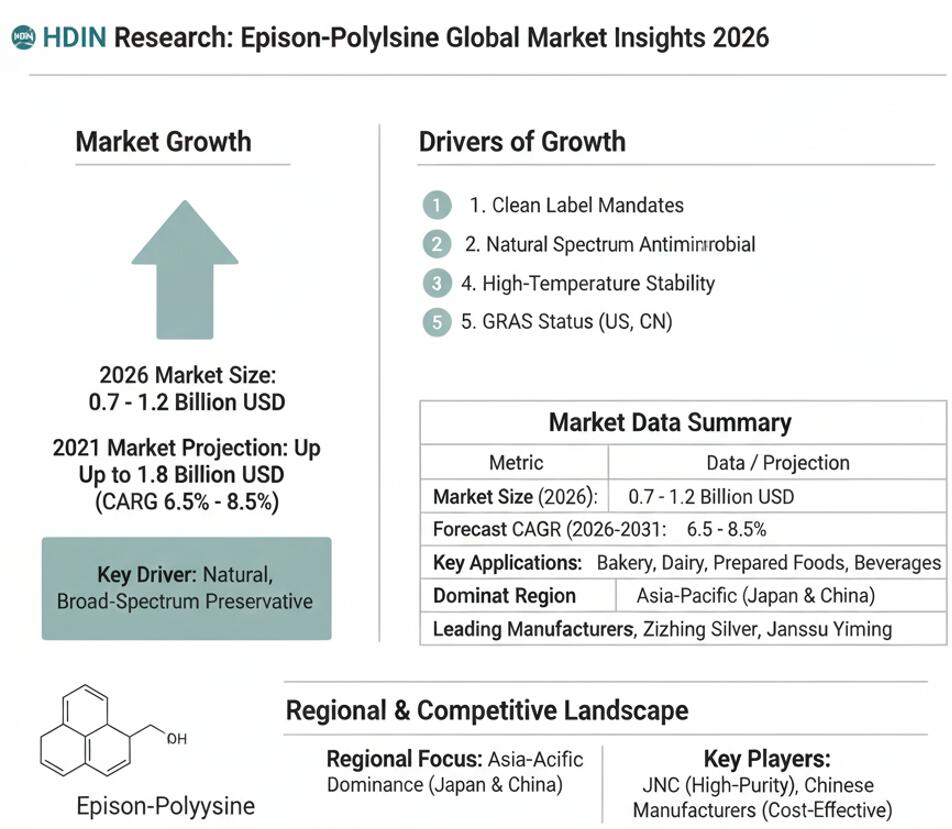
According to the new research, the global Epsilon-Polylysine market is valued between 0.7 billion and 1.2 billion USD in 2026. The market is projected to expand at a Compound Annual Growth Rate (CAGR) of 6.5% to 8.5% through 2031, potentially reaching a market size of up to 1.8 billion USD by the end of the forecast period.
Drivers of Growth
The report identifies the global shift toward natural food preservation as the primary catalyst for market expansion. Epsilon-Polylysine, a naturally occurring homopolymer produced through fermentation, offers broad-spectrum antimicrobial efficacy against bacteria, yeasts, and molds. Unlike many traditional natural preservatives, it maintains stability under high-temperature processing, making it highly suitable for bakery, dairy, and prepared food applications.
Analysts at HDIN Research highlight that the "clean label" movement is no longer a niche trend but a market standard. With consumers increasingly scrutinizing ingredient lists, manufacturers are reformulating products to replace synthetic preservatives like sodium benzoate and potassium sorbate with natural alternatives. Epsilon-Polylysine is well-positioned to capitalize on this shift due to its GRAS (Generally Recognized As Safe) status in major markets including the United States, Japan, and China.
Figure Market Data Summary of Epsilon-Polylysine
Regional and Competitive Landscape
The report notes that the Asia-Pacific region currently dominates the global market. Japan, as the pioneer of commercial adoption, represents the largest single-country market, accounting for approximately 35-40% of global consumption. However, China is rapidly emerging as a dual hub for both consumption and production, benefiting from integrated supply chains for raw materials like glucose and lysine.
The competitive landscape is characterized by a mix of established technology leaders and growing regional producers. JNC Corporation (Japan) remains the global leader in technology and quality, focusing on high-purity grades for premium applications. Meanwhile, manufacturers in China are expanding capacity and improving fermentation efficiency to serve the growing demand for cost-effective natural preservatives in the mid-tier market.
Future Outlook
HDIN Research projects that the market will continue to evolve through technological advancements in strain optimization and fermentation processes. These improvements are expected to enhance production efficiency, potentially narrowing the cost gap between natural and synthetic preservatives. Furthermore, pending regulatory evaluations in the European Union could unlock significant new market opportunities in the coming years.
About HDIN Research
HDIN Research is a global market research and consulting firm providing strategic insights to the chemical, food, and biotechnology industries. We help clients navigate complex market landscapes with granular data and actionable intelligence.
Media Contact
For more information regarding this report, please contact:
HDIN Research
Website: www.hdinresearch.com
Email: sales@hdinresearch.com
According to the new research, the global Epsilon-Polylysine market is valued between 0.7 billion and 1.2 billion USD in 2026. The market is projected to expand at a Compound Annual Growth Rate (CAGR) of 6.5% to 8.5% through 2031, potentially reaching a market size of up to 1.8 billion USD by the end of the forecast period.
Drivers of Growth
The report identifies the global shift toward natural food preservation as the primary catalyst for market expansion. Epsilon-Polylysine, a naturally occurring homopolymer produced through fermentation, offers broad-spectrum antimicrobial efficacy against bacteria, yeasts, and molds. Unlike many traditional natural preservatives, it maintains stability under high-temperature processing, making it highly suitable for bakery, dairy, and prepared food applications.
Analysts at HDIN Research highlight that the "clean label" movement is no longer a niche trend but a market standard. With consumers increasingly scrutinizing ingredient lists, manufacturers are reformulating products to replace synthetic preservatives like sodium benzoate and potassium sorbate with natural alternatives. Epsilon-Polylysine is well-positioned to capitalize on this shift due to its GRAS (Generally Recognized As Safe) status in major markets including the United States, Japan, and China.
Figure Market Data Summary of Epsilon-Polylysine
Regional and Competitive Landscape
The report notes that the Asia-Pacific region currently dominates the global market. Japan, as the pioneer of commercial adoption, represents the largest single-country market, accounting for approximately 35-40% of global consumption. However, China is rapidly emerging as a dual hub for both consumption and production, benefiting from integrated supply chains for raw materials like glucose and lysine.
The competitive landscape is characterized by a mix of established technology leaders and growing regional producers. JNC Corporation (Japan) remains the global leader in technology and quality, focusing on high-purity grades for premium applications. Meanwhile, manufacturers in China are expanding capacity and improving fermentation efficiency to serve the growing demand for cost-effective natural preservatives in the mid-tier market.
Future Outlook
HDIN Research projects that the market will continue to evolve through technological advancements in strain optimization and fermentation processes. These improvements are expected to enhance production efficiency, potentially narrowing the cost gap between natural and synthetic preservatives. Furthermore, pending regulatory evaluations in the European Union could unlock significant new market opportunities in the coming years.
About HDIN Research
HDIN Research is a global market research and consulting firm providing strategic insights to the chemical, food, and biotechnology industries. We help clients navigate complex market landscapes with granular data and actionable intelligence.
Media Contact
For more information regarding this report, please contact:
HDIN Research
Website: www.hdinresearch.com
Email: sales@hdinresearch.com