Spirits Market to Reach New Heights, Projecting USD 810-850 Billion Value by 2031
Date : 2026-01-23
Reading : 402
HDIN Research has announced the release of its latest comprehensive industry report, "Spirits Global Market Insights 2026," offering a detailed analysis of the global alcoholic beverage landscape. The report indicates that the global spirits market is entering a phase of resilient growth, characterized by a structural shift toward premiumization and expanding consumption in emerging economies.
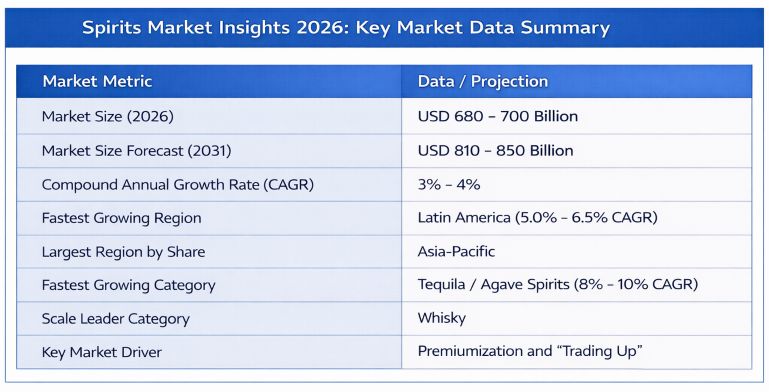
According to the findings, the global spirits market is valued between USD 680 billion and USD 700 billion as of 2026. Despite near-term macroeconomic headwinds and inventory adjustments following the post-pandemic boom, the market is projected to expand at a compound annual growth rate (CAGR) of 3% to 4% through 2031. By the end of the forecast period, total market value is expected to reach between USD 810 billion and USD 850 billion.
A primary driver of this financial expansion is the "trading up" phenomenon. While volume growth is expected to remain modest at 1-2%, revenue growth will outpace it due to consumers preferring higher-quality, premium, and super-premium products. This trend transcends all geographies, with whisky premiumization notably strong in Asia-Pacific and a continued surge in ultra-premium tequila in North America.
Regional dynamics highlight a diverse growth picture. Asia-Pacific remains the world's largest market by volume and value, anchored by China's massive consumption of Baijiu and the rapid development of the Indian market. Meanwhile, Latin America is identified as a high-growth frontier, with consumption expanding in both volume and value as the middle class grows. North America and Europe, representing mature markets, are seeing growth driven largely by category rotation—such as the shift from beer and wine to spirits—and the expansion of the cocktail culture.
The report also analyzes the competitive landscape across seven major categories. Whisky retains its position as the scale leader globally. However, Tequila and agave spirits are highlighted as the fastest-growing major category, projected to grow at a CAGR of 8-10%, driven by authenticity narratives and celebrity brand investments. The Ready-to-Drink (RTD) cocktail segment is also noted as a significant growth engine, bridging the gap between convenience and premium spirit quality.
Figure Spirits Market Summary
The competitive landscape remains fragmented yet stable. The top three corporate players account for approximately 20% of the global market share. Major multinational groups like Diageo, Pernod Ricard, and Suntory Global Spirits continue to consolidate the market through strategic acquisitions of craft brands and regional specialists. The report emphasizes that future competitive advantages will likely stem from digital transformation, sustainability credentials, and the ability to execute premiumization strategies effectively.
Challenges remain, including global economic uncertainty, potential trade tariffs, and complex regulatory environments. However, the report concludes that the fundamental drivers—demographic shifts, increasing affluence in emerging markets, and product innovation—provide a strong foundation for the industry's medium-to-long-term success.
About HDIN Research
HDIN Research focuses on providing market consulting services. As an independent third-party consulting firm, it is committed to providing in-depth market research and analysis reports.
Media Contact:
HDIN Research
Website: www.hdinresearch.com
Email: sales@hdinresearch.com
According to the findings, the global spirits market is valued between USD 680 billion and USD 700 billion as of 2026. Despite near-term macroeconomic headwinds and inventory adjustments following the post-pandemic boom, the market is projected to expand at a compound annual growth rate (CAGR) of 3% to 4% through 2031. By the end of the forecast period, total market value is expected to reach between USD 810 billion and USD 850 billion.
A primary driver of this financial expansion is the "trading up" phenomenon. While volume growth is expected to remain modest at 1-2%, revenue growth will outpace it due to consumers preferring higher-quality, premium, and super-premium products. This trend transcends all geographies, with whisky premiumization notably strong in Asia-Pacific and a continued surge in ultra-premium tequila in North America.
Regional dynamics highlight a diverse growth picture. Asia-Pacific remains the world's largest market by volume and value, anchored by China's massive consumption of Baijiu and the rapid development of the Indian market. Meanwhile, Latin America is identified as a high-growth frontier, with consumption expanding in both volume and value as the middle class grows. North America and Europe, representing mature markets, are seeing growth driven largely by category rotation—such as the shift from beer and wine to spirits—and the expansion of the cocktail culture.
The report also analyzes the competitive landscape across seven major categories. Whisky retains its position as the scale leader globally. However, Tequila and agave spirits are highlighted as the fastest-growing major category, projected to grow at a CAGR of 8-10%, driven by authenticity narratives and celebrity brand investments. The Ready-to-Drink (RTD) cocktail segment is also noted as a significant growth engine, bridging the gap between convenience and premium spirit quality.
Figure Spirits Market Summary
The competitive landscape remains fragmented yet stable. The top three corporate players account for approximately 20% of the global market share. Major multinational groups like Diageo, Pernod Ricard, and Suntory Global Spirits continue to consolidate the market through strategic acquisitions of craft brands and regional specialists. The report emphasizes that future competitive advantages will likely stem from digital transformation, sustainability credentials, and the ability to execute premiumization strategies effectively.
Challenges remain, including global economic uncertainty, potential trade tariffs, and complex regulatory environments. However, the report concludes that the fundamental drivers—demographic shifts, increasing affluence in emerging markets, and product innovation—provide a strong foundation for the industry's medium-to-long-term success.
About HDIN Research
HDIN Research focuses on providing market consulting services. As an independent third-party consulting firm, it is committed to providing in-depth market research and analysis reports.
Media Contact:
HDIN Research
Website: www.hdinresearch.com
Email: sales@hdinresearch.com