Sponge Iron (DRI) Market Value Estimated at 80-85 Billion USD in 2026, Driven by Steel Decarbonization
Date : 2026-01-30
Reading : 523
HDIN Research, an independent market consulting firm, has released its latest analysis titled "Sponge Iron Global Market Insights 2026." The report values the global Sponge Iron (Direct Reduced Iron) market at 80-85 billion USD for the current year, projecting a robust Compound Annual Growth Rate (CAGR) of 7-10% through 2031. This surge is primarily underpinned by the global steel industry's aggressive shift toward decarbonization and the expansion of Electric Arc Furnace (EAF) capacity.
Market Overview
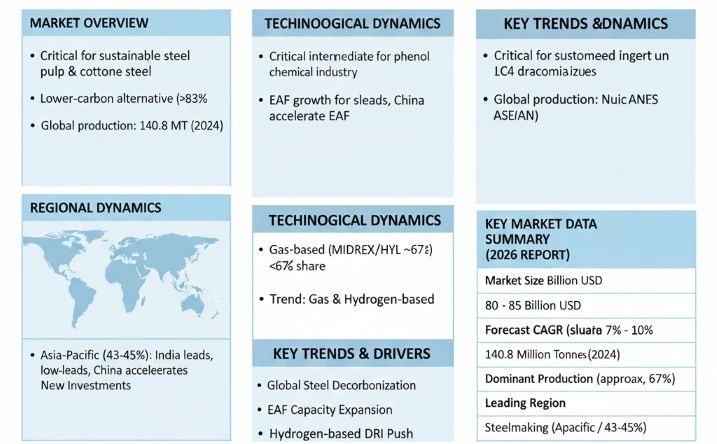
Direct Reduced Iron (DRI), commonly known as sponge iron, has emerged as a critical feedstock for sustainable steel production. According to the HDIN Research report, global production volumes reached 140.8 million tonnes in 2024, marking a 3.8% increase from the previous year. The market trajectory is being reshaped by the "Green Steel" revolution, where DRI serves as a lower-carbon alternative to traditional blast furnace inputs.
The analysis highlights that the decarbonization imperative is the single largest driver of market growth. With the DRI-EAF route capable of reducing carbon emissions by 50-70% compared to traditional methods, steelmakers globally are rapidly integrating this material into their supply chains. In 2024 alone, electric arc furnaces accounted for 93% of all new steelmaking capacity announcements, signaling a structural shift in raw material demand.
Regional and Technological Dynamics
The Asia-Pacific region continues to dominate the global landscape, holding a projected 43-45% market share in 2026. India remains the world's largest producer, accounting for nearly 39% of global output, largely driven by coal-based production. However, the report notes significant momentum in China, where government mandates on blast furnace limitations are accelerating EAF adoption.
The Middle East and Africa region maintains its position as a low-cost production hub, leveraging abundant natural gas reserves. Iran and Saudi Arabia remain key players, with the region increasingly focusing on export-oriented Hot Briquetted Iron (HBI). Meanwhile, Europe is identified as the pioneer for Hydrogen-based DRI (H2-DRI), with aggressive carbon pricing mechanisms driving the transition from natural gas to renewable hydrogen reductants.
In terms of technology, Gas-based reduction processes (primarily MIDREX and HYL/Energiron) continue to lead the market, accounting for approximately 67% of global production. While coal-based rotary kiln processes remain significant in India, the long-term trend favors gas and hydrogen-based routes due to their superior environmental profiles.
Figure Key Market Data Summary of Direct Reduced Iron (DRI)
Future Outlook
HDIN Research forecasts that the market will reach a valuation of 120-134 billion USD by 2031. The industry is entering a transitional phase where Hydrogen-based DRI will move from pilot demonstration to commercial scalability, projected to capture 12-18% of the market share by 2031. This evolution is supported by substantial global investments in green hydrogen infrastructure and renewable energy.
About HDIN Research
HDIN Research focuses on providing market consulting services. As an independent third-party consulting firm, it is committed to providing in-depth market research and analysis reports. We assist clients in navigating complex industrial landscapes through rigorous data analysis and strategic insights.
Media Contact:
HDIN Research
Website: www.hdinresearch.com
Email: sales@hdinresearch.com
Market Overview
Direct Reduced Iron (DRI), commonly known as sponge iron, has emerged as a critical feedstock for sustainable steel production. According to the HDIN Research report, global production volumes reached 140.8 million tonnes in 2024, marking a 3.8% increase from the previous year. The market trajectory is being reshaped by the "Green Steel" revolution, where DRI serves as a lower-carbon alternative to traditional blast furnace inputs.
The analysis highlights that the decarbonization imperative is the single largest driver of market growth. With the DRI-EAF route capable of reducing carbon emissions by 50-70% compared to traditional methods, steelmakers globally are rapidly integrating this material into their supply chains. In 2024 alone, electric arc furnaces accounted for 93% of all new steelmaking capacity announcements, signaling a structural shift in raw material demand.
Regional and Technological Dynamics
The Asia-Pacific region continues to dominate the global landscape, holding a projected 43-45% market share in 2026. India remains the world's largest producer, accounting for nearly 39% of global output, largely driven by coal-based production. However, the report notes significant momentum in China, where government mandates on blast furnace limitations are accelerating EAF adoption.
The Middle East and Africa region maintains its position as a low-cost production hub, leveraging abundant natural gas reserves. Iran and Saudi Arabia remain key players, with the region increasingly focusing on export-oriented Hot Briquetted Iron (HBI). Meanwhile, Europe is identified as the pioneer for Hydrogen-based DRI (H2-DRI), with aggressive carbon pricing mechanisms driving the transition from natural gas to renewable hydrogen reductants.
In terms of technology, Gas-based reduction processes (primarily MIDREX and HYL/Energiron) continue to lead the market, accounting for approximately 67% of global production. While coal-based rotary kiln processes remain significant in India, the long-term trend favors gas and hydrogen-based routes due to their superior environmental profiles.
Figure Key Market Data Summary of Direct Reduced Iron (DRI)
Future Outlook
HDIN Research forecasts that the market will reach a valuation of 120-134 billion USD by 2031. The industry is entering a transitional phase where Hydrogen-based DRI will move from pilot demonstration to commercial scalability, projected to capture 12-18% of the market share by 2031. This evolution is supported by substantial global investments in green hydrogen infrastructure and renewable energy.
About HDIN Research
HDIN Research focuses on providing market consulting services. As an independent third-party consulting firm, it is committed to providing in-depth market research and analysis reports. We assist clients in navigating complex industrial landscapes through rigorous data analysis and strategic insights.
Media Contact:
HDIN Research
Website: www.hdinresearch.com
Email: sales@hdinresearch.com