Toray Industries Strategizes for 2025: Weaving Sustainability with Aggressive Structural Reforms
Date : 2026-01-13
Reading : 339
Toray Industries is entering the final phase of its AP-G 2025 medium-term management program, executing a dual strategy that balances aggressive growth in green energy with rigorous structural reforms in underperforming sectors. According to recent market analysis by HDIN Research, the Japanese materials giant is leveraging a unique corporate philosophy known as the Fabric Model to navigate global geopolitical risks and inflationary pressures while transitioning towards high-yield business structures.
The Fabric Model: Integrating Philosophy with Innovation
Toray President Mitsuo Ohya has articulated the company's growth strategy through the metaphor of a woven fabric. In this model, the warp threads represent the immutable corporate philosophy of contributing to society through new value creation—a principle held since 1926. The weft threads represent flexible technical innovation and business model adaptation.
This strategic alignment is not merely conceptual but financial. By intertwining these elements, Toray aims to convert environmental value into economic revenue. A key component of this strategy is the Technology Brand approach, which combines intellectual property protection with B2B2C marketing. Through patent networks and strategic branding of technologies like NANODESIGN and NANOALLOY, the company has successfully implemented strategic pricing, moving away from cost-plus models to value-based pricing. This shift alone contributed approximately 30 billion JPY to business profit improvements over the 2024-2025 period.
Divergent Paths: Hydrogen Expansion and Battery Separator Reform
HDIN Research analysis highlights a sharp contrast in Toray's portfolio management, particularly within the energy sector.
Hydrogen Business (Next Generation Growth): Toray is aggressively positioning itself across the entire hydrogen supply chain. Capitalizing on its global market share leadership in carbon fiber, the company is expanding production of high-pressure hydrogen tanks for fuel cell vehicles and logistics. Furthermore, through its German subsidiary Greenerity, Toray is ramping up production of catalyst coated membranes (CCM) and membrane electrode assemblies (MEA) for water electrolysis, anticipating a surge in green hydrogen demand.
Battery Separator Films (Structural Reform): Conversely, the battery separator film (BSF) business faces significant restructuring under the company's Darwin Project. Due to slowing electric vehicle (EV) market growth and intense commoditization, Toray is reducing its exposure. The company plans to downsize its stake in its Hungarian joint venture with LG Chem to 30 percent, effectively shifting to a vertical integration model led by LG. Domestically, Toray has ceased operations on older, low-efficiency production lines in Japan and Korea. Management has signaled that if the business cannot meet Return on Invested Capital (ROIC) targets, a complete exit remains a possible option under the Best Owner principle.
The Darwin Project and ROIC Management
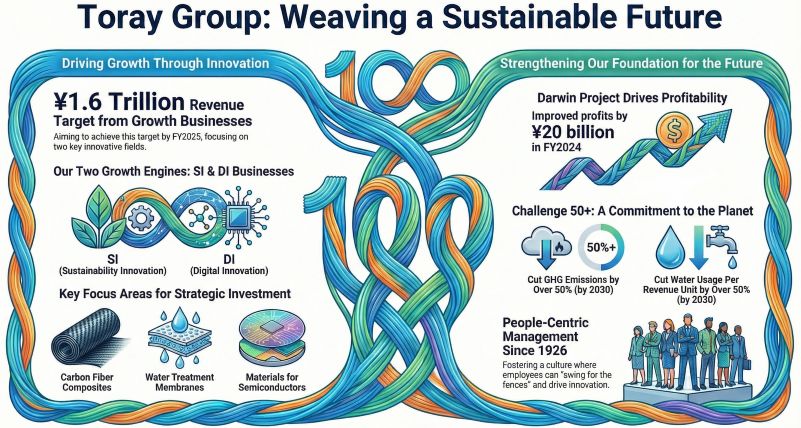
To ensure resilience, Toray is executing the Darwin Project, a structural reform initiative targeting businesses with high capital employed but low profitability. Beyond the battery separator restructuring, this project includes optimizing global production for polyester staple fibers and PET films. The initiative aims to improve asset efficiency and restore profitability by shifting product mixes toward high-value-added applications, such as MLCC release films and aerospace materials.
Figure Market Data Summary of Toray
Future Outlook
Toray projects a Core Operating Income of 150 billion JPY for the fiscal year ending March 2025. The company's resilience strategy focuses on local production for local consumption to mitigate trade barrier risks. Moving forward, the expansion of Sustainable Innovation (SI) and Digital Innovation (DI) businesses is expected to account for 60 percent of total revenue by 2025.
About HDIN Research
HDIN Research focuses on providing market consulting services. As an independent third-party consulting firm, it is committed to providing in-depth market research and analysis reports.
Media Contact
HDIN Research
Email: sales@hdinresearch.com
Website: www.hdinresearch.com
The Fabric Model: Integrating Philosophy with Innovation
Toray President Mitsuo Ohya has articulated the company's growth strategy through the metaphor of a woven fabric. In this model, the warp threads represent the immutable corporate philosophy of contributing to society through new value creation—a principle held since 1926. The weft threads represent flexible technical innovation and business model adaptation.
This strategic alignment is not merely conceptual but financial. By intertwining these elements, Toray aims to convert environmental value into economic revenue. A key component of this strategy is the Technology Brand approach, which combines intellectual property protection with B2B2C marketing. Through patent networks and strategic branding of technologies like NANODESIGN and NANOALLOY, the company has successfully implemented strategic pricing, moving away from cost-plus models to value-based pricing. This shift alone contributed approximately 30 billion JPY to business profit improvements over the 2024-2025 period.
Divergent Paths: Hydrogen Expansion and Battery Separator Reform
HDIN Research analysis highlights a sharp contrast in Toray's portfolio management, particularly within the energy sector.
Hydrogen Business (Next Generation Growth): Toray is aggressively positioning itself across the entire hydrogen supply chain. Capitalizing on its global market share leadership in carbon fiber, the company is expanding production of high-pressure hydrogen tanks for fuel cell vehicles and logistics. Furthermore, through its German subsidiary Greenerity, Toray is ramping up production of catalyst coated membranes (CCM) and membrane electrode assemblies (MEA) for water electrolysis, anticipating a surge in green hydrogen demand.
Battery Separator Films (Structural Reform): Conversely, the battery separator film (BSF) business faces significant restructuring under the company's Darwin Project. Due to slowing electric vehicle (EV) market growth and intense commoditization, Toray is reducing its exposure. The company plans to downsize its stake in its Hungarian joint venture with LG Chem to 30 percent, effectively shifting to a vertical integration model led by LG. Domestically, Toray has ceased operations on older, low-efficiency production lines in Japan and Korea. Management has signaled that if the business cannot meet Return on Invested Capital (ROIC) targets, a complete exit remains a possible option under the Best Owner principle.
The Darwin Project and ROIC Management
To ensure resilience, Toray is executing the Darwin Project, a structural reform initiative targeting businesses with high capital employed but low profitability. Beyond the battery separator restructuring, this project includes optimizing global production for polyester staple fibers and PET films. The initiative aims to improve asset efficiency and restore profitability by shifting product mixes toward high-value-added applications, such as MLCC release films and aerospace materials.
Figure Market Data Summary of Toray
Future Outlook
Toray projects a Core Operating Income of 150 billion JPY for the fiscal year ending March 2025. The company's resilience strategy focuses on local production for local consumption to mitigate trade barrier risks. Moving forward, the expansion of Sustainable Innovation (SI) and Digital Innovation (DI) businesses is expected to account for 60 percent of total revenue by 2025.
About HDIN Research
HDIN Research focuses on providing market consulting services. As an independent third-party consulting firm, it is committed to providing in-depth market research and analysis reports.
Media Contact
HDIN Research
Email: sales@hdinresearch.com
Website: www.hdinresearch.com