Quantum Computing Market Analysis: Navigating Physical Limits, Geopolitical Divides, and the Hybrid Future
Date : 2026-01-14
Reading : 633
The race for quantum supremacy has entered a complex new phase defined by a stark contrast between patent volume and practical application, alongside a deepening convergence of artificial intelligence and quantum hardware. According to the latest industry analysis by HDIN Research, while global investment surges, the sector faces significant physical bottlenecks and uneven regional maturity, prompting a shift toward hybrid computing models and long-term state-sponsored roadmaps.
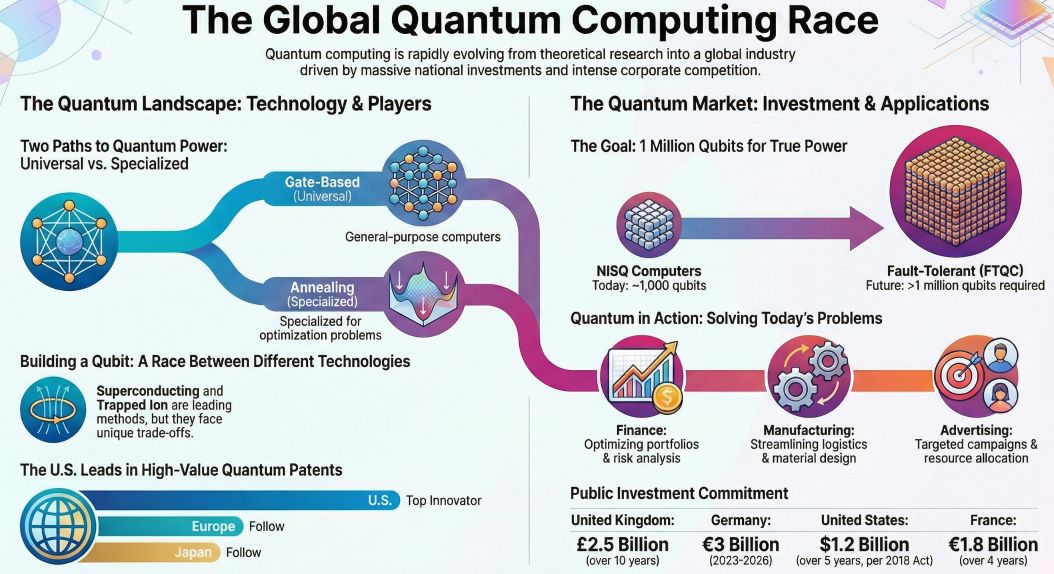
Figure Global Quantum Computing Race
The Quantity-Quality Paradox in China
A dominant theme in the current landscape is the structural contradiction within China's quantum sector. HDIN Research data indicates that while China commands a staggering 60 percent of global quantum patent applications, it faces a challenge in international influence. Despite an estimated government investment exceeding 15 billion USD, China's International Patent Family (IPF) rate stands at only 5.8 percent, significantly lower than the global average of 31.2 percent and the United States rate of 51.8 percent.
This disparity suggests a focus on domestic protection over global commercialization. Furthermore, while China leads in quantum communications, particularly Quantum Key Distribution (QKD), it lags in the more commercially lucrative quantum computing field, where the United States maintains a lead in high-impact citations and academic influence. China remains a net absorber of knowledge, citing more foreign innovations than it exports in influential technical impact.
Physical Limits and Supply Chain Fragility
The industry is also grappling with the physical realities of scaling. HDIN Research highlights a "scaling paradox" where constructing a single logical qubit capable of fault-tolerant calculation may require between 1,000 and 100,000 physical qubits to manage noise and decoherence. Current hardware, hovering in the hundreds of qubits, remains far from the million-qubit threshold required for commercial utility in sectors like cryptography or chemical simulation.
A critical choke point in this supply chain is the dilution refrigerator, the infrastructure necessary to maintain operational temperatures near absolute zero (10-20mK). The market is heavily dependent on Helium-3, a scarce isotope, and is dominated by European and American manufacturers. Export controls on these cooling systems have intensified pressure on nations like China to accelerate indigenous development, though the engineering barriers remain high.
The Rise of Hybrid Computing and AI Synergy
To bridge the gap between current Noisy Intermediate-Scale Quantum (NISQ) devices and future fault-tolerant machines, the market is rapidly pivoting toward hybrid quantum-classical computing. This approach utilizes classical high-performance computing (HPC) for data processing while offloading specific complex problems to quantum processors.
Simultaneously, a symbiotic relationship between AI and quantum technology is emerging. Artificial intelligence is proving essential in designing quantum chips and optimizing error correction codes, effectively accelerating hardware development. Conversely, quantum algorithms are beginning to reduce training times for large language models from weeks to hours, creating a high-value feedback loop particularly beneficial for the pharmaceutical and financial sectors.
Investment Divergence and Japan's Long Game
Financial maturity varies drastically by region. The United States currently attracts over 50 percent of global private quantum investment, characterized by large deal sizes and a robust ecosystem for late-stage growth. In contrast, Europe suffers from a funding gap; despite having a comparable number of startups, it captures only about 5 percent of private capital, with most ventures struggling to secure growth-stage financing.
Japan has adopted a distinct long-term strategy through its Moonshot Goal 6 program. Unlike the venture-driven US model, Japan is pursuing a state-coordinated roadmap targeting a fully fault-tolerant universal quantum computer by 2050. This plan involves deep industry-academia collaboration among giants like Fujitsu, NEC, and RIKEN, focusing on gradual milestones in 2030 and 2040 to ensure sustainable technological sovereignty.
Global Quantum Strategic Overview
The following table summarizes the strategic positioning and challenges of key global regions as analyzed by HDIN Research.
Region: China
Key Strength: Patent Volume & Communications
Strategic Focus: Quantum Key Distribution (QKD) Networks
Primary Challenge: Low international patent influence (IPF 5.8%) and hardware export restrictions.
Region: United States
Key Strength: Quality & Private Capital
Strategic Focus: Universal Quantum Computing & Commercialization
Primary Challenge: High competition and the physical scaling of qubit stability.
Region: Europe
Key Strength: Basic Research & Startup Volume
Strategic Focus: Supply Chain (Cooling/Lasers) & Simulation
Primary Challenge: Fragmentation of private capital and lack of late-stage funding.
Region: Japan
Key Strength: Long-term Planning (Moonshot)
Strategic Focus: Fault-Tolerant Quantum Computing (FTQC) by 2050
Primary Challenge: immense time horizon requiring sustained public-private commitment.
Please click to watch the TikTok video of the report presentation.
About HDIN Research
HDIN Research focuses on providing market consulting services. As an independent third-party consulting firm, it is committed to providing in-depth market research and analysis reports.
Media Contact
HDIN Research
Email: sales@hdinresearch.com
Website: www.hdinresearch.com
Figure Global Quantum Computing Race
The Quantity-Quality Paradox in China
A dominant theme in the current landscape is the structural contradiction within China's quantum sector. HDIN Research data indicates that while China commands a staggering 60 percent of global quantum patent applications, it faces a challenge in international influence. Despite an estimated government investment exceeding 15 billion USD, China's International Patent Family (IPF) rate stands at only 5.8 percent, significantly lower than the global average of 31.2 percent and the United States rate of 51.8 percent.
This disparity suggests a focus on domestic protection over global commercialization. Furthermore, while China leads in quantum communications, particularly Quantum Key Distribution (QKD), it lags in the more commercially lucrative quantum computing field, where the United States maintains a lead in high-impact citations and academic influence. China remains a net absorber of knowledge, citing more foreign innovations than it exports in influential technical impact.
Physical Limits and Supply Chain Fragility
The industry is also grappling with the physical realities of scaling. HDIN Research highlights a "scaling paradox" where constructing a single logical qubit capable of fault-tolerant calculation may require between 1,000 and 100,000 physical qubits to manage noise and decoherence. Current hardware, hovering in the hundreds of qubits, remains far from the million-qubit threshold required for commercial utility in sectors like cryptography or chemical simulation.
A critical choke point in this supply chain is the dilution refrigerator, the infrastructure necessary to maintain operational temperatures near absolute zero (10-20mK). The market is heavily dependent on Helium-3, a scarce isotope, and is dominated by European and American manufacturers. Export controls on these cooling systems have intensified pressure on nations like China to accelerate indigenous development, though the engineering barriers remain high.
The Rise of Hybrid Computing and AI Synergy
To bridge the gap between current Noisy Intermediate-Scale Quantum (NISQ) devices and future fault-tolerant machines, the market is rapidly pivoting toward hybrid quantum-classical computing. This approach utilizes classical high-performance computing (HPC) for data processing while offloading specific complex problems to quantum processors.
Simultaneously, a symbiotic relationship between AI and quantum technology is emerging. Artificial intelligence is proving essential in designing quantum chips and optimizing error correction codes, effectively accelerating hardware development. Conversely, quantum algorithms are beginning to reduce training times for large language models from weeks to hours, creating a high-value feedback loop particularly beneficial for the pharmaceutical and financial sectors.
Investment Divergence and Japan's Long Game
Financial maturity varies drastically by region. The United States currently attracts over 50 percent of global private quantum investment, characterized by large deal sizes and a robust ecosystem for late-stage growth. In contrast, Europe suffers from a funding gap; despite having a comparable number of startups, it captures only about 5 percent of private capital, with most ventures struggling to secure growth-stage financing.
Japan has adopted a distinct long-term strategy through its Moonshot Goal 6 program. Unlike the venture-driven US model, Japan is pursuing a state-coordinated roadmap targeting a fully fault-tolerant universal quantum computer by 2050. This plan involves deep industry-academia collaboration among giants like Fujitsu, NEC, and RIKEN, focusing on gradual milestones in 2030 and 2040 to ensure sustainable technological sovereignty.
Global Quantum Strategic Overview
The following table summarizes the strategic positioning and challenges of key global regions as analyzed by HDIN Research.
Region: China
Key Strength: Patent Volume & Communications
Strategic Focus: Quantum Key Distribution (QKD) Networks
Primary Challenge: Low international patent influence (IPF 5.8%) and hardware export restrictions.
Region: United States
Key Strength: Quality & Private Capital
Strategic Focus: Universal Quantum Computing & Commercialization
Primary Challenge: High competition and the physical scaling of qubit stability.
Region: Europe
Key Strength: Basic Research & Startup Volume
Strategic Focus: Supply Chain (Cooling/Lasers) & Simulation
Primary Challenge: Fragmentation of private capital and lack of late-stage funding.
Region: Japan
Key Strength: Long-term Planning (Moonshot)
Strategic Focus: Fault-Tolerant Quantum Computing (FTQC) by 2050
Primary Challenge: immense time horizon requiring sustained public-private commitment.
Please click to watch the TikTok video of the report presentation.
About HDIN Research
HDIN Research focuses on providing market consulting services. As an independent third-party consulting firm, it is committed to providing in-depth market research and analysis reports.
Media Contact
HDIN Research
Email: sales@hdinresearch.com
Website: www.hdinresearch.com