Photoresist Market: AI Acceleration and Localization Reshape the Semiconductor Material Landscape
Date : 2026-01-20
Reading : 1786
The global semiconductor photoresist industry is currently navigating a profound transformation driven by the dual forces of artificial intelligence (AI) integration and geopolitical restructuring. According to the latest insights from HDIN Research, the market, long dominated by Japanese and American heavyweights, is witnessing a paradigm shift where digital innovation and supply chain resilience have become the new benchmarks for competitiveness.
Figure The Global Semiconductor Materials Race

The intersection of digitalization and material science is redefining research and development cycles. Leading global suppliers, including JSR, Tokyo Ohka Kogyo (TOK), Shin-Etsu Chemical, and Fujifilm, are aggressively adopting Materials Informatics (MI). This data-driven approach allows companies to simulate experiments in virtual environments, significantly reducing the time and cost associated with traditional trial-and-error methods. For instance, Fujifilm has implemented AI models to predict toxicity and optimize chemical compositions, slashing safety evaluation timelines from months to mere weeks. Similarly, JSR is leveraging AI to accelerate the development of metal oxide resists, a critical material for next-generation extreme ultraviolet (EUV) lithography.
Beyond technological tools, the industry is witnessing a talent revolution. The traditional reliance on specialized chemical expertise is evolving into a demand for "hybrid talent"—professionals capable of bridging material science with data analytics. Companies like Shin-Etsu are cultivating "T-shaped" personnel who possess deep domain knowledge in organic synthesis alongside broad digital competencies. This shift aims to create a decision-making architecture that combines data-driven insights with "on-site sense," ensuring that algorithmic predictions align with the complex realities of semiconductor manufacturing.
The competitive landscape remains stratified but dynamic. Japanese giants continue to hold a near-monopoly on high-end technologies, particularly in the EUV and High-NA (High Numerical Aperture) segments essential for 2nm processes and beyond. JSR and TOK lead the transition toward metal oxide inorganic photoresists, which offer superior resolution and etch resistance compared to traditional polymer-based solutions. Meanwhile, geopolitical friction and the drive for supply chain security are forcing a "local-for-local" production strategy. Global majors are establishing regional production hubs in the US, South Korea, and other key markets to mitigate export control risks and ensure business continuity.
In parallel, the Chinese market is accelerating its localization efforts. While Japanese firms dominate the absolute high-end, Chinese companies like Nanda Optoelectronics, Shanghai Sinyang, and Tongcheng New Material are making significant headwinds in the KrF and ArF segments. Advancements in domestic supply chains have seen these companies successfully validate products with major local foundries, moving from laboratory research to small-batch mass production. However, the gap remains distinct: while mature process materials are achieving self-sufficiency, domestic EUV solutions remain largely in the early R&D phase, constrained by the lack of advanced exposure equipment and ultra-high-purity raw materials.
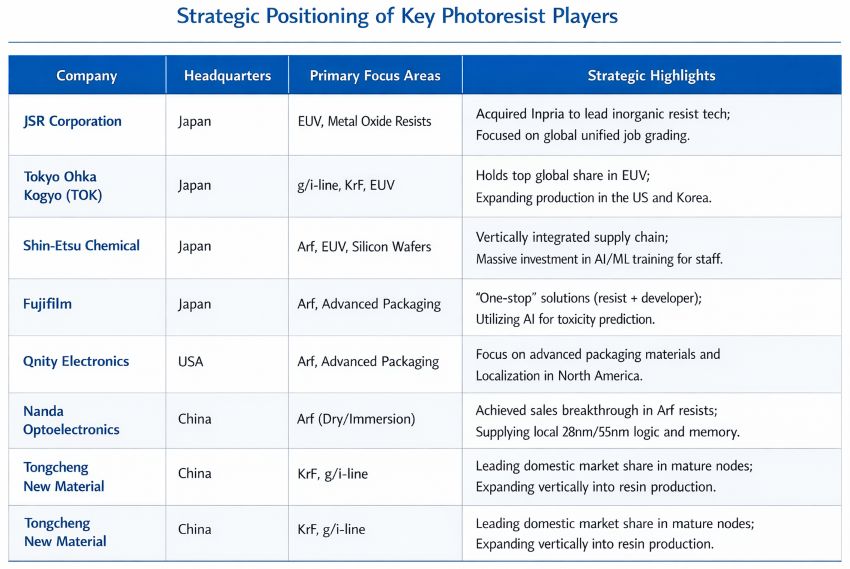
The following table summarizes the strategic positioning of key global and regional players in the current market environment:
Looking ahead, the industry is also grappling with sustainability mandates. As environmental regulations regarding PFAS (per- and polyfluoroalkyl substances) tighten globally, manufacturers are prioritizing the development of eco-friendly, PFAS-free photoresists. This "green transformation" is no longer optional but a critical requirement for maintaining long-term partnerships with top-tier foundries.
HDIN Research concludes that while the hierarchy at the cutting edge of 2nm nodes remains stable under Japanese leadership, the mid-range market is becoming increasingly contested. The winners in the coming decade will be those who can successfully integrate AI to accelerate material discovery while navigating the complex web of global trade restrictions and sustainability requirements.
Please click to watch the YouTube video of the report presentation.
About HDIN Research
HDIN Research focuses on providing market consulting services. As an independent third-party consulting firm, it is committed to providing in-depth market research and analysis reports.
Media Contact
Company Name: HDIN Research
Email: sales@hdinresearch.com
Website: www.hdinresearch.com
Figure The Global Semiconductor Materials Race
The intersection of digitalization and material science is redefining research and development cycles. Leading global suppliers, including JSR, Tokyo Ohka Kogyo (TOK), Shin-Etsu Chemical, and Fujifilm, are aggressively adopting Materials Informatics (MI). This data-driven approach allows companies to simulate experiments in virtual environments, significantly reducing the time and cost associated with traditional trial-and-error methods. For instance, Fujifilm has implemented AI models to predict toxicity and optimize chemical compositions, slashing safety evaluation timelines from months to mere weeks. Similarly, JSR is leveraging AI to accelerate the development of metal oxide resists, a critical material for next-generation extreme ultraviolet (EUV) lithography.
Beyond technological tools, the industry is witnessing a talent revolution. The traditional reliance on specialized chemical expertise is evolving into a demand for "hybrid talent"—professionals capable of bridging material science with data analytics. Companies like Shin-Etsu are cultivating "T-shaped" personnel who possess deep domain knowledge in organic synthesis alongside broad digital competencies. This shift aims to create a decision-making architecture that combines data-driven insights with "on-site sense," ensuring that algorithmic predictions align with the complex realities of semiconductor manufacturing.
The competitive landscape remains stratified but dynamic. Japanese giants continue to hold a near-monopoly on high-end technologies, particularly in the EUV and High-NA (High Numerical Aperture) segments essential for 2nm processes and beyond. JSR and TOK lead the transition toward metal oxide inorganic photoresists, which offer superior resolution and etch resistance compared to traditional polymer-based solutions. Meanwhile, geopolitical friction and the drive for supply chain security are forcing a "local-for-local" production strategy. Global majors are establishing regional production hubs in the US, South Korea, and other key markets to mitigate export control risks and ensure business continuity.
In parallel, the Chinese market is accelerating its localization efforts. While Japanese firms dominate the absolute high-end, Chinese companies like Nanda Optoelectronics, Shanghai Sinyang, and Tongcheng New Material are making significant headwinds in the KrF and ArF segments. Advancements in domestic supply chains have seen these companies successfully validate products with major local foundries, moving from laboratory research to small-batch mass production. However, the gap remains distinct: while mature process materials are achieving self-sufficiency, domestic EUV solutions remain largely in the early R&D phase, constrained by the lack of advanced exposure equipment and ultra-high-purity raw materials.
The following table summarizes the strategic positioning of key global and regional players in the current market environment:
Looking ahead, the industry is also grappling with sustainability mandates. As environmental regulations regarding PFAS (per- and polyfluoroalkyl substances) tighten globally, manufacturers are prioritizing the development of eco-friendly, PFAS-free photoresists. This "green transformation" is no longer optional but a critical requirement for maintaining long-term partnerships with top-tier foundries.
HDIN Research concludes that while the hierarchy at the cutting edge of 2nm nodes remains stable under Japanese leadership, the mid-range market is becoming increasingly contested. The winners in the coming decade will be those who can successfully integrate AI to accelerate material discovery while navigating the complex web of global trade restrictions and sustainability requirements.
Please click to watch the YouTube video of the report presentation.
About HDIN Research
HDIN Research focuses on providing market consulting services. As an independent third-party consulting firm, it is committed to providing in-depth market research and analysis reports.
Media Contact
Company Name: HDIN Research
Email: sales@hdinresearch.com
Website: www.hdinresearch.com